
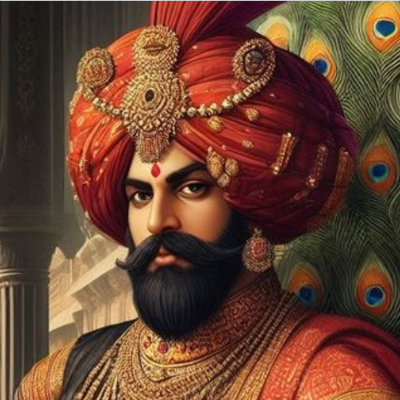
About
Daksha — Son of the Ten Prachetasas and Marisha, Great Prajapati, Father of the Mothers of All Living Beings
Daksha · Daksha Prajapati · Daksha Prachetasa · Dakshesha
Daksha is one of the most consequential figures in the entire Puranic tradition — a Prajapati of supreme creative power whose daughters became the mothers of the gods, the demons, the Nagas, the birds, the celestials, and all other classes of living beings in the cosmos. In the tradition represented by this genealogical series — descending from Svayambhuva Manu through Uttanapada, Dhruva, the lineage of the Chakshusa Manvantara, Anga, Vena, Prithu, Vijitashva, Havirdhana, Prachinabarhisat, and the ten Prachetasas — Daksha is the son of the ten Prachetasas and their shared wife Marisha, born from the combined potency of all ten brothers together with the creative power of Soma who had nourished Marisha from his fingertips. This profile treats Daksha specifically in the context of this birth from the Prachetasas, which is the birth relevant to the present genealogical tree. However, the tradition surrounding Daksha is extraordinarily complex: across the Rig Veda, the Brahmanas, the Mahabharata, and the eighteen Mahapuranas, Daksha appears in multiple contradictory roles and with multiple irreconcilable genealogies — as a mind-born son of Brahma, as a figure born from Brahma's right thumb, as a son of Aditi who is also her father, and as the son of the Prachetasas. All these traditions are addressed in the textual variants section of this profile. He is the father of an enormous number of daughters — the precise number varying widely between sources — who became the wives of Dharma, the moon-god Chandra, the sage Kashyapa, and other divine figures, from whose unions the entire populated Puranic universe descended.
✦ The Name
The name Daksha derives from the Sanskrit root daks meaning to be able, to excel, to be competent or skillful. The principal meanings are able, expert, skillful, fit, energetic, and fire. The Bhagavata Purana offers its own internal etymology: Daksha received this name because he was uniquely skilled and prolific in the begetting of children — an appropriate etymology given that his defining cosmic role is the creation of the lineages that populate the three worlds. The Vedic tradition adds the additional meaning of the right side or the south, connecting the name to the sacrificer's right hand and the correct performance of ritual. In the Rig Veda, the name Daksha is applied both as a proper noun and as an abstract quality meaning creative power or skillful action, indicating that the figure of Daksha is in origin a personification of the generative and sacrificial competence of the cosmos.
✦ Lineage — The Prachetasa Birth
- Fathers: The ten Prachetasas — sons of Prachinabarhisat and Shatadruti, who had performed ten thousand years of tapas in the ocean and received from Vishnu the capacity to fulfill the creative mandate assigned by Brahma. Daksha was begotten by the combined potency of all ten brothers acting jointly.
- Mother: Marisha — a woman of supernatural origin, born from the moisture shed by the apsara Pramloca as she flew through the forest after her liaison with the sage Kandu. She was raised by the trees and nourished by Soma the moon-god with nectar from his fingertips. Soma brought her to the Prachetasas and offered her as their joint wife, promising that from the union of the brothers' accumulated vigour with his own nourishing power and Marisha's substance, a son of great patriarchal capacity would be born.
- Wife (Prachetasa birth): Asikni — also called Panchajani and Virani; identified as the daughter of the Prajapati Virana or Panchajana. In this second birth, Daksha married Asikni and through her begot sixty daughters who became the progenitors of all species.
✦ Daksha's Cosmogonic Creative Activity
After his birth from the Prachetasas and Marisha, Daksha undertook the task of filling the earth and the three worlds with living beings. The Vishnu Purana records that he first attempted to create beings through the power of his will — projecting them by mental force — and produced gods, sages, demons, yakshas, and rakshasas. But these mind-born beings did not multiply through sexual reproduction, and Daksha became concerned that his creative project would not fill the world sufficiently. He therefore performed austerities at the mountain Aghamarshana near the Vindhyas, directing his tapas toward Vishnu, who appeared before him and granted him Asikni as his wife, urging him to engage in sexual creation.
Daksha and Asikni first begot sons — named the Haryashvas in one tradition and Shavalashvas in another — whom Daksha instructed to multiply living beings. In both cases, the sage Narada intervened and directed these sons toward renunciation, persuading them to seek liberation rather than worldly propagation, so that they never fathered progeny. Daksha, furious at Narada's repeated intervention, cursed the sage. He then turned to begetting daughters, which proved the more enduring creative strategy.
✦ The Daughters — Principal Genealogical Significance
The daughters of Daksha by Asikni — sixty in number in the Mahabharata (Harivamsha), the Vishnu Purana, the Devi Bhagavata Purana, and the Brahma Vaivarta Purana — are the most cosmogonically consequential single generation of women in the entire Puranic tradition, as their marriages and offspring account for the origin of virtually every class of divine, demonic, and natural being in the Puranic universe. Their distribution across husbands as recorded in the Vishnu Purana and allied sources is as follows. Ten daughters — Maruvati, Vasu, Jami, Lamba, Bhanu, Urja, Sankalpa, Muhurta, Sadhya, and Vishva — were given to Dharma the god of righteousness, and through them were born the Vishvedevas, Sadhyas, Marutas, Vasus, and other divine categories. Twenty-seven daughters — the lunar constellations beginning with Ashvini and ending with Revati — were given to Chandra the moon-god; their husbands' neglect of some in favour of others led to Daksha's curse on Chandra. Thirteen daughters — Aditi, Diti, Danu, Arishta, Surasa, Surabhi, Vinata, Tamra, Krodhavasha, Ira, Kadru, Vishva, and Muni — were given to the sage Kashyapa, and through them were born the entirety of the divine and demonic and natural cosmic population: Aditi bore the twelve Adityas including Indra and Vishnu in his solar manifestation; Diti bore the Daityas including Hiranyakashipu and Hiranyaksha; Danu bore the Danavas; Kadru bore the Nagas including Shesha and Vasuki; Vinata bore Garuda and Aruna; and so on through all the other daughters. Remaining daughters were given to Arishtanemi, Angiras, Shukra, Krishashva, and other sages.
In the first birth of Daksha — as the mind-born son of Brahma — his wife is Prasuti, daughter of Svayambhuva Manu, and with her he had between sixteen and sixty daughters depending on the source. These daughters, who are personifications of the virtues and qualities of mind and body — Shraddha, Lakshmi, Dhriti, Tushti, Pushti, Medha, Kriya, Buddhi, Lajja, Vapu, Shanti, Siddhi, Kirti, and others — were given in marriage to the god Dharma and to various sages. Among them was Sati — the youngest and most beloved — who married Shiva against Daksha's wishes. This marriage and its tragic consequences are the subject of the Daksha Yajna episode.
✦ The Daksha Yajna — The Sacrifice, Sati's Death, and the Destruction of the Sacrifice
The most narratively elaborated episode in all of Daksha's mythology is the story of his great yajna — a sacrifice from which he deliberately excluded Shiva — and its catastrophic consequences. This episode is narrated in the Bhagavata Purana, the Shiva Purana, the Linga Purana, the Kurma Purana, the Brahmanda Purana, the Matsya Purana, the Vishnu Purana, the Mahabharata, and others, with significant variations in detail. The core narrative runs as follows. Daksha, who harboured deep resentment of Shiva — whether arising from a prior insult at a Brahma yajna where Shiva allegedly failed to show proper respect, or from Daksha's fundamental disapproval of Shiva's nature as an ascetic outsider to the established cosmic social order — organised a grand sacrifice and deliberately did not invite Shiva or his wife Sati. Sati, learning of the sacrifice, insisted on attending despite Shiva's discouragement. She went, was publicly humiliated by her father's contemptuous words against Shiva, and — unable to bear the dishonour done to her husband and unable to continue in a body born of such a father — immolated herself in the sacrificial fire.
When news of Sati's death reached Shiva, his grief and fury were boundless. He tore a lock from his matted hair and from it created Virabhadra — a terrifying form — together with Bhadrakali. Virabhadra and his attendants descended on the sacrifice, drove away or wounded all the assembled gods, cut off the heads of the sages, tore out Bhrigu's beard, put out the eyes of Bhaga, broke the teeth of Pushan, and beheaded Daksha himself. The sacrifice was destroyed in its entirety. The gods then appealed to Brahma and ultimately to Vishnu, who mediated a resolution. Shiva was pacified, and in the reconciliation that followed, Daksha was revived — but since his own head could not be found or was not available, he was given the head of a goat, the Vishnu Purana and Linga Purana agreeing on this detail though differing on which goat. The sacrifice was then completed with Vishnu as the presiding deity and Shiva receiving a share of the oblations.
✦ Sati's Death and the Shakti Pithas
After Sati's self-immolation, Shiva took up her corpse and wandered through the cosmos in inconsolable grief, carrying her body and performing his fierce dance of lamentation. The universe was disturbed by Shiva's roaming. Vishnu intervened to restore cosmic stability, using his Sudarshana Chakra to sever Sati's body into pieces as Shiva carried it. In the most widely cited version of this tradition, the body fell in fifty-one or one hundred and eight pieces across the Indian subcontinent and surrounding regions, and each place where a piece fell became consecrated as a Shakti Pitha — a seat of the goddess, a site of sacred power where Sati's presence is permanently enshrined. This geographical mapping of Sati's dismembered body onto the sacred landscape of the subcontinent is one of the most influential consequences of the Daksha Yajna narrative in the lived religious tradition.
✦ The Two Births of Daksha — Manvantaric Reconciliation
The tradition of Daksha having two births is acknowledged explicitly in the Bhagavata Purana and the Mahabharata and is treated as one of the major textual complexities surrounding this figure. In his first birth he is a Manasaputra — a mind-born son — of Brahma, born in the Svayambhuva Manvantara, married to Prasuti daughter of Svayambhuva Manu, and the father of the daughters who gave rise to the divine and moral categories of existence. In his second birth — which is the one directly relevant to the present genealogical series — he is the son of the ten Prachetasas and Marisha, placed in the Chakshusa Manvantara or the transition between Manvantaras, married to Asikni daughter of Prajapati Virana, and the father of sixty daughters who became the mothers of all species.
The Vishnu Purana commentary by H. H. Wilson notes that the Mahabharata explicitly acknowledges the existence of two Dakshas and remarks on the perplexity this causes — including the logical problem that if Daksha son of the Prachetasas is also the grandson of Soma through Marisha, how can he simultaneously be the father-in-law of Soma through his twenty-seven lunar-nakshatra daughters? The Vishnu Purana attempts to resolve this by assigning the two Dakshas to different Manvantaras, a reconciliation that while structurally elegant is noted by commentators as cosmologically somewhat strained given that descendants of Uttanapada — the genealogical root of this lineage — would ordinarily be placed in the Svayambhuva Manvantara rather than the Chakshusa. The Garuda Purana treats Daksha's second birth from the Prachetasas as a consequence of Shiva's curse upon him at the Daksha Yajna, explicitly stating that Daksha was born of the Prachetas by the imprecation of Bhava — Shiva — rather than through the natural Puranic genealogical sequence.
✦ Daksha in the Vedic Tradition
The Rig Veda presents a mythological statement about Daksha and Aditi that profoundly complicates any linear genealogical treatment: the Rig Veda says that Daksha sprang from Aditi and Aditi from Daksha, making them simultaneously parent and child of one another. This cyclical co-origination — which Theosophical interpreters understood as a reference to the eternal recycling of the divine principle — is irreconcilable with any single linear genealogical tree. The Brahmanas develop Daksha's identification with Prajapati, the abstract generative power of the cosmos, treating him not merely as a historical figure in a genealogical sequence but as the personification of creative competence itself. This Vedic dimension means that Daksha, more than any other figure in this genealogical series, is simultaneously a historical-mythological individual in a specific lineage and a cosmic abstraction that transcends and precedes any particular lineage.
✦ Textual Variants and Inconsistencies — Summary
Daksha's textual situation is the most complex of any figure in this genealogical series. The principal irreconcilable inconsistencies are as follows. His parentage is given as: born from Brahma's right thumb with his wife from the left thumb, per the Mahabharata and Matsya Purana; born as a mind-born son of Brahma, per the Vishnu Purana and Bhagavata Purana's first-birth tradition; born as the son of the ten Prachetasas and Marisha, per the Vishnu Purana's second-birth tradition and the Bhagavata Purana Canto 4 genealogy; and born from Aditi while also being Aditi's father, per the Rig Veda. His first wife is Prasuti daughter of Svayambhuva Manu in one tradition, and Asikni daughter of Prajapati Virana in another. The number of his daughters from each wife varies between sixteen, twenty-four, and sixty depending on source and wife. The names of the daughters given to Kashyapa vary between thirteen and fifteen across different Purana lists. The question of whether the two Dakshas are the same individual in different births or two entirely distinct figures is never definitively resolved within the primary sources themselves.
✦ Connection to the Wider Genealogy
In the present genealogical series, Daksha is the point at which the lineage descending from Svayambhuva Manu through Uttanapada and Dhruva connects to the enormous cosmogonic branching of all divine and natural lineages that are described throughout the remaining Skandhas of the Bhagavata Purana and across all the principal Mahapuranas. Through his daughter Aditi and her sons by Kashyapa come the twelve Adityas — the great gods of the Vaivasvata Manvantara including Vivasvat the sun-god, whose son Vaivasvata Manu is the seventh and current Manu. Through his daughter Diti come the Daityas. Through his daughter Danu come the Danavas. Through his daughter Kadru come the Nagas. Through his daughter Vinata come Garuda and Aruna. Through his twenty-seven lunar-nakshatra daughters and their husband Chandra come the asterism tradition. Through his daughter Sati and her husband Shiva — and through Sati's subsequent rebirth as Parvati — comes one of the central threads of the Shaiva tradition. Through his daughter Prasuti's daughters in the first-birth tradition come the abstract divine qualities personified as female beings married to Dharma. Daksha thus stands at the absolute convergence point of the Puranic genealogical tradition — the figure through whom the linear ancestral chain from the first Manu fans out into the entirety of the divine, demonic, and natural world.
✦ References
- Bhagavata Purana, Canto 4, Chapter 30: Records the birth of Daksha from the ten Prachetasas and Marisha as the direct continuation of the Prachetasas' narrative.
- Bhagavata Purana, Canto 6, Chapter 4: Cross-reference confirming Daksha's role as Prajapati in the genealogy of Kashyapa's wives and their offspring.
- Vishnu Purana, Book I, Chapters 7, 14–15: Both births of Daksha — as mind-born son of Brahma (Chapter 7) and as son of the Prachetasas and Marisha (Chapter 15); Chapter 15 contains the Vishnu Purana's most detailed treatment of Daksha's daughters by Asikni and their marriages and progeny.
- Mahabharata, Adi Parva, Chapter 65; Shanti Parva, Mokshadharma: The Adi Parva lists Daksha's sixty daughters by Virini (Asikni) and their progeny. The Mokshadharma section acknowledges the two-Daksha problem explicitly and notes the perplexity of commentators.
- Shiva Purana, Linga Purana, Kurma Purana: Principal sources for the Daksha Yajna narrative — the sacrifice, Sati's death, Virabhadra's destruction of the sacrifice, Daksha's decapitation, and his revival with a goat's head.
- Rig Veda: The earliest textual attestation of Daksha, where he and Aditi emerge from one another in a statement of cyclical co-origination that transcends linear genealogy.
- Garuda Purana: Attributes Daksha's second birth from the Prachetasas directly to Shiva's curse upon him at the Daksha Yajna.
- Vettam Mani, Puranic Encyclopaedia (1975), Daksha entry: The most comprehensive modern consolidation of Daksha's multiple parentage traditions, both births, both wives, daughters and their progeny, and the Daksha Yajna episode across primary sources.