
About
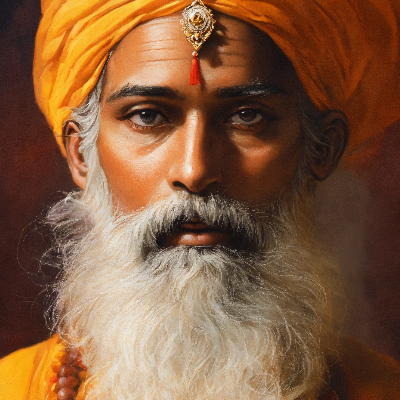
Kandu — Vedic and Puranic Sage
Kandu · Kandurishi
Kandu is a Brahmin sage of notable ascetic power whose story is preserved primarily in the Vishnu Purana and echoed in the Brahma Purana and Brahma Vaivarta Purana. He is remembered above all for an episode in which the celestial nymph Pramlocha, sent by the god Indra to break his austerities, succeeded in diverting him from his penances for a period that, though it felt brief to the sage, amounted by divine reckoning to several hundred or thousand years depending on the textual recension. When Pramlocha eventually departed his hermitage, she shed perspiration from her body as she flew through the sky, and from that perspiration the sage's daughter Marisha was born among the trees of the forest. Kandu's story is a classical Puranic demonstration of how accumulated ascetic merit can be undermined by distraction, and of the cosmic disproportion between human and divine time.
✦ The Name
The name Kandu does not receive explicit etymological commentary within the primary Puranic passages that narrate his story. It functions as a proper name throughout the Vishnu Purana account. No widely accepted Vedic derivation is established in the texts themselves. Later compilers, including Vettam Mani in the Puranic Encyclopaedia, record the name without offering a root analysis, treating it as a received proper noun.
✦ Lineage
- Father: The Vishnu Purana does not name Kandu's father. He is introduced directly as an established sage without recorded parentage in the primary narrative.
- Consort: Pramlocha — an Apsara, a celestial nymph of the heavenly realms, sent by Indra to interrupt Kandu's austerities. She lived with Kandu at his hermitage on the mountain Mandara for the duration described in the episode below.
- Daughter: Marisha — born not through conventional birth but from the drops of perspiration that fell from Pramlocha's body as she departed Kandu's hermitage. Marisha was raised among the trees of the forest and later became the wife of the ten Prachetas, a group of royal brothers, and through them the mother of Daksha in certain Puranic lineages.
✦ The Episode of Pramlocha
The central narrative of Kandu's life as recorded in the Vishnu Purana runs as follows. Kandu was engaged in deep and sustained austerities at the hermitage of Mandara when Indra, the king of the gods, grew alarmed at the power the sage was accumulating through his penances. Indra dispatched the Apsara Pramlocha to break Kandu's concentration. Pramlocha employed her beauty and companionship, and Kandu became wholly absorbed in her company. When at last Pramlocha sought to depart, Kandu initially entreated her to remain. She eventually prepared to leave, and Kandu, believing she had been with him for only a few days, gave her leave to go.
Pramlocha reminded him that she had in fact been at his side for a duration vastly exceeding what he supposed — the Vishnu Purana gives the figure as eight hundred and seven years, six months, and three days, though the Brahma Purana and related texts give varying figures. The sage, confronted with this revelation, recognised that the distortion of his sense of time was itself a consequence of the power of illusion under which he had fallen. He was overcome with rage — directed not entirely at Pramlocha, whose role was assigned to her, but at the situation itself. Some recensions record that he cursed Pramlocha in his anger, causing her body to dissolve into perspiration and mist as she flew upward through the air.
As Pramlocha moved through the forest canopy, the drops of perspiration that fell or were wiped from her limbs by the branches and leaves of the trees gave rise to a child — the girl who would be named Marisha. Marisha was thus born of the forest and of the nymph's body without a conventional maternal birth, and she was nurtured among the trees. Kandu, having witnessed or learned of this birth, resumed his austerities.
✦ Textual Variants
The Vishnu Purana, in the translation and commentary of H. H. Wilson, is the fullest source for this episode and gives the duration of the liaison as over eight hundred years. The Brahma Purana treats the same episode but varies in the specific figure of years elapsed. The Brahma Vaivarta Purana also refers to Kandu in related genealogical contexts. These variants concern the arithmetic of the time-distortion but do not alter the structure of the episode: the seduction, the departure, the revelation of lost time, the rage, and the miraculous birth of Marisha are consistent across all major recensions.
✦ Theological Significance
Kandu's episode functions in Puranic literature as a paradigmatic account of the hazards attending extreme asceticism. The narrative encodes several theological concerns: the power of Indra to perceive ascetic accumulation as a political threat to the sovereignty of the gods; the role of the Apsaras as instruments of divine policy rather than merely decorative figures; the Puranic understanding that intense spiritual absorption warps the practitioner's experience of time; and the recurrent theme that anger, even when spiritually understandable, is itself a force that generates consequences — in this case the unusual birth of Marisha. Kandu is not condemned in these narratives as a fallen sage in any absolute sense; rather his story illustrates the specific vulnerability of austerity-based spiritual power to the assault of sensory attachment.
✦ Connection to the Wider Genealogy
Kandu's genealogical significance lies entirely in his fatherhood of Marisha. Marisha, born from Pramlocha's perspiration and raised in the forest, became the wife of the ten Prachetas — ancient royal sages who are described in the Vishnu Purana as sons of King Prachinabarhis and who undertook prolonged penances beneath the ocean. From the union of Marisha with the Prachetas, the progenitor Daksha was born in certain Puranic lineages, making Kandu an indirect ancestor in one strand of the creation genealogy that traces back through Daksha to the origins of living beings.
✦ References
- Vishnu Purana, Book I, Chapter 15: Primary source for the full narrative of Kandu's austerities, his liaison with Pramlocha, the revelation of elapsed time, and the birth of Marisha from the nymph's perspiration.
- Brahma Purana: Contains a parallel account of the same episode with minor variation in the duration stated for the liaison.
- Brahma Vaivarta Purana: References Kandu in genealogical passages connected to the lineage of the Prachetas.
- Vettam Mani, Puranic Encyclopaedia (Motilal Banarsidass, 1975): Provides a concise secondary summary of the Kandu episode and identifies the relevant Puranic sources.
- H. H. Wilson, The Vishnu Purana: A System of Hindu Mythology and Tradition (1840): English translation with notes, used for cross-referencing chapter and verse locations within the Vishnu Purana narrative.