
About
Haryashvas — The Ten Thousand Sons of Daksha
Haryashvas · Haryasvas · the Ten Thousand Sons of Daksha
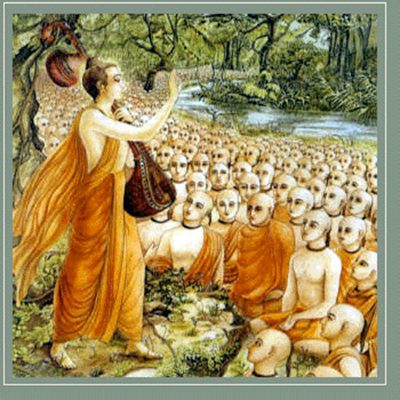
The Haryashvas are a group of ten thousand sons born to the progenitor Daksha — one of the foremost Prajapatis, or lord-creators, in the Puranic cosmogony — from his wife Asikni, daughter of the sage Panchajana. They appear in the Vishnu Purana, the Bhagavata Purana, the Brahma Purana, and other Puranic texts as the first group of sons produced by Daksha for the purpose of populating the universe. They were sent by their father to undertake this task but were intercepted by the divine sage Narada — a wandering celestial sage and son of Brahma, the creator deity — who instructed them in the futility of worldly engagement and the superior merit of spiritual renunciation. Persuaded by Narada's counsel, all ten thousand Haryashvas dispersed to pursue liberation and never returned to fulfil their father's command. Their dispersal prompted Daksha to produce a second group of sons, the Sabalashvas, who met a similar fate. The Haryashvas thus stand as a collective figure embodying the Puranic tension between the householder's duty to perpetuate creation and the renunciant's aspiration toward liberation.
✦ The Name
The name Haryashvas is a compound of two Sanskrit elements. The first, harya, is generally understood as meaning tawny, bay, or golden-coloured, and is associated with horses of that hue. The second, ashva, means horse. The compound thus denotes those who possess bay horses or those of the tawny steeds — a name of the type common among royal and semi-divine lineages in Vedic and Puranic literature where horses connote strength, nobility, and vitality. The name is also recorded as Haryasvas in some recensions, reflecting standard orthographic variation in the transcription of the Sanskrit.
✦ Lineage
- Father: Daksha — one of the principal Prajapatis, lords of created beings, in the Puranic cosmogonic scheme. In the lineage given by the Vishnu Purana, Daksha is the son of the ten Prachetas and their wife Marisha, who was herself born from the perspiration of the Apsara Pramlocha. In the Bhagavata Purana, Daksha is identified instead as a mind-born son of Brahma, reflecting a divergent genealogical tradition. Daksha is charged with the propagation of living beings and undertakes this task through multiple waves of procreation.
- Mother: Asikni — daughter of the sage Panchajana. She is the principal wife of Daksha named in connection with his procreative programme in the Vishnu Purana and Bhagavata Purana. Through Asikni, Daksha fathers the Haryashvas, the Sabalashvas, and his many daughters.
- Brothers (subsequent group): The Sabalashvas — one thousand sons subsequently born to Daksha and Asikni after the dispersal of the Haryashvas, sent with the same mandate to populate the world, and similarly diverted by Narada from that purpose.
✦ The Episode of Narada's Intervention
The Vishnu Purana and the Bhagavata Purana both narrate the following sequence. Daksha, having been charged with the task of filling the universe with living beings, fathered the ten thousand Haryashvas upon his wife Asikni and dispatched them with instructions to go forth and multiply. The sons gathered and prepared to carry out their father's command. Before they could do so, however, the divine sage Narada — a wandering ascetic and celestial musician who is a son of Brahma and moves freely between all the realms of existence — appeared among them.
Narada addressed the Haryashvas with a series of enigmatic questions or statements, the precise form of which varies between the Vishnu Purana and the Bhagavata Purana. In the Bhagavata Purana's account, which is the more elaborate, Narada posed a sequence of seven riddles or allegorical statements — each pointing toward the nature of the world, the self, time, and liberation. The purport of these riddling teachings was to direct the sons' attention away from the task of worldly procreation and toward the recognition that the created world is bounded, transient, and ultimately unsatisfying, while the path of spiritual inquiry and liberation is the only pursuit worthy of a being possessed of intelligence.
The Haryashvas, understanding Narada's import, were persuaded. They renounced their father's mandate, dispersed in all directions — the texts say they went the way of no return, signifying that they took to the path of liberation and did not come back into the cycle of worldly engagement. None returned to Daksha. Their dispersal left the universe as unpopulated as before, and Daksha's mission unfulfilled.
✦ Daksha's Response
Upon learning that the Haryashvas had been diverted by Narada and had departed without populating the world, Daksha was overcome with grief and rage. The texts record that he lamented the loss of ten thousand sons and directed his anger squarely at Narada, whom he regarded as having wilfully sabotaged the work of creation by misleading his sons. Despite this anger, Daksha — recognising the continuing necessity of his mandate — composed himself sufficiently to father a second group of sons upon Asikni. These were the Sabalashvas, one thousand in number, who were sent with the same instructions as the Haryashvas.
✦ Textual Variants
The Vishnu Purana and the Bhagavata Purana agree on the essential structure of the episode — Daksha's sons, Narada's intervention, the sons' dispersal, and Daksha's grief — but differ substantially in the form of Narada's teachings. The Vishnu Purana gives a relatively brief account of Narada's address. The Bhagavata Purana expands it considerably, presenting the seven allegorical riddles in detail and providing an extended philosophical basis for the sons' decision to renounce. The number of sons is given as ten thousand in both texts, though some recensions of the Brahma Purana and related texts vary slightly. The Mahabharata refers to Daksha's sons in genealogical passages but does not elaborate the Narada episode at the same length as the major Puranas.
✦ Theological Significance
The Haryashvas episode encodes one of the central tensions in Puranic religious thought: the conflict between pravritti, the path of engagement with the world and the fulfilment of social and cosmic duties, and nivritti, the path of withdrawal, renunciation, and the pursuit of liberation. Daksha represents the principle of pravritti in its cosmic form — the duty to generate, sustain, and multiply life. Narada, in this episode, is the instrument of nivritti, directing beings capable of higher understanding away from the proliferation of the transient toward the pursuit of the permanent.
The Haryashvas are notable because they are not portrayed as having erred in following Narada's counsel. The texts present their choice as spiritually valid, even praiseworthy. The tragedy, from Daksha's perspective, is practical rather than moral: the work of creation is left undone, and Daksha must grieve ten thousand sons who have, in the Puranic understanding, achieved the highest outcome available to embodied beings. This ambivalence — in which the renunciation of the world is spiritually superior but cosmically inconvenient — is a characteristic Puranic complexity that the Haryashvas episode illustrates with particular clarity.
Narada's role here is also theologically significant. In Puranic literature Narada is a figure of deliberate disruption: a being who moves between worlds and whose interventions consistently unsettle settled orders and redirect beings toward spiritual rather than worldly ends. His conflict with Daksha over the Haryashvas and the Sabalashvas is one of the most extended illustrations of this function in the Puranic corpus, and it results eventually in a formal curse from Daksha directed at Narada.
✦ Daksha's Curse upon Narada
After the Sabalashvas similarly failed to return — having also been diverted by Narada — Daksha's grief intensified into formal imprecation. The Bhagavata Purana records that Daksha pronounced a curse upon Narada: that Narada, who had made it his business to prevent settled dwelling and the fulfilment of domestic duties, would himself never be able to remain in any single place, but would be condemned to wander perpetually without rest, unable to take root or remain anywhere in creation. This curse is presented in the Puranic tradition as the explanation for Narada's characteristic mode of existence as an eternal wanderer moving ceaselessly between the three worlds.
✦ References
- Vishnu Purana, Book I, Chapter 15: Narrates the birth of the Haryashvas from Daksha and Asikni, Narada's intervention, their dispersal, and Daksha's subsequent fathering of the Sabalashvas.
- Bhagavata Purana, Book VI, Chapter 5: Provides the fullest account of the episode, including the seven allegorical riddles addressed by Narada to the Haryashvas, and records Daksha's curse upon Narada following the dispersal of both groups of sons.
- Brahma Purana: Contains a parallel genealogical account of Daksha's sons in the context of the Prajapati's procreative programme.
- Mahabharata, Adi Parva: References Daksha's sons in genealogical passages without elaborating the Narada episode to the same extent as the major Puranas.
- Vettam Mani, Puranic Encyclopaedia (Motilal Banarsidass, 1975): Secondary summary of the Haryashvas episode identifying relevant chapters across the principal Puranic sources.
- H. H. Wilson, The Vishnu Purana: A System of Hindu Mythology and Tradition (1840): English translation with notes; used for locating and cross-referencing the Vishnu Purana passages relating to the Haryashvas.
- Cornelia Dimmitt and J. A. B. van Buitenen, Classical Hindu Mythology: A Reader in the Sanskrit Puranas (Temple University Press, 1978): Provides translated extracts and contextual commentary on the Daksha–Narada conflict and its cosmogonic significance.