
About
Sabalashvas — The One Thousand Sons of Daksha
Sabalashvas · Sabalasvas · Shabalashvas · the One Thousand Sons of Daksha
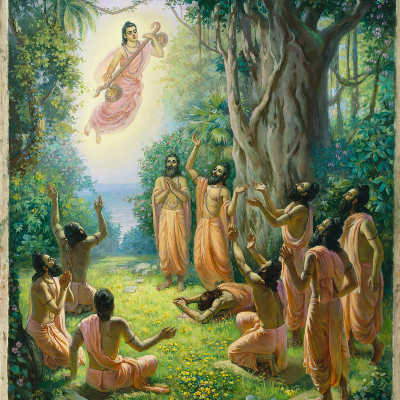
The Sabalashvas are a group of one thousand sons born to the progenitor Daksha — one of the foremost Prajapatis, or lord-creators, in the Puranic cosmogony — from his wife Asikni, daughter of the sage Panchajana. They appear in the Vishnu Purana, the Bhagavata Purana, the Brahma Purana, and related Puranic texts as the second group of sons produced by Daksha for the purpose of populating the universe, fathered after the first group — the ten thousand Haryashvas — had been diverted from that purpose by the wandering divine sage Narada. The Sabalashvas met the same fate as their elder brothers: Narada again appeared among them, delivered teachings pointing toward renunciation and liberation, and the entire group dispersed in all directions without returning to fulfil Daksha's mandate. Their dispersal completed Daksha's loss of both waves of sons and precipitated his formal curse upon Narada. The Sabalashvas, like the Haryashvas, are treated in the Puranic texts less as individuals than as a collective embodying the Puranic theme of the spiritual call to renunciation taking precedence over the worldly duty of procreation.
✦ The Name
The name Sabalashvas is a compound of sabala — meaning variegated, spotted, or multicoloured — and ashva, meaning horse. The compound thus denotes those who possess spotted or dappled horses, again a name in the tradition of horse-related epithets common among royal and semi-divine lineages in Sanskrit literature. The variant spelling Shabalashvas appears in some recensions, reflecting phonetic transcription differences. The contrast between the name Haryashvas — denoting bay or tawny horses — and Sabalashvas — denoting spotted or dappled horses — may suggest a deliberate pairing in the text, though the Puranas do not explicitly comment on any symbolic significance of this contrast.
✦ Lineage
- Father: Daksha — one of the principal Prajapatis in the Puranic cosmogonic scheme, charged with the propagation of living beings. In the Vishnu Purana, Daksha is the son of the ten Prachetas and their wife Marisha, who was herself born from the perspiration of the Apsara Pramlocha. In the Bhagavata Purana, Daksha is instead identified as a mind-born son of Brahma, the creator deity, reflecting a divergent genealogical tradition. Daksha fathered the Sabalashvas upon Asikni after the dispersal of the ten thousand Haryashvas left his procreative mission unfulfilled.
- Mother: Asikni — daughter of the sage Panchajana, principal wife of Daksha in the Vishnu Purana and Bhagavata Purana accounts of his procreative programme. She is the mother of both the Haryashvas and the Sabalashvas, as well as of Daksha's many daughters including Sati, Aditi, Diti, Danu, and others.
- Elder brothers (previous group): The Haryashvas — ten thousand sons previously born to Daksha and Asikni, sent with the same mandate to populate the world, and similarly diverted by Narada before the Sabalashvas were born.
✦ Context: The Prior Dispersal of the Haryashvas
To understand the Sabalashvas' episode it is necessary to know the circumstances that preceded their birth. Daksha had fathered ten thousand sons — the Haryashvas — upon his wife Asikni and had sent them forth to people the universe. Before they could do so, Narada — a wandering divine sage, son of Brahma, who moves freely between all the realms of creation — appeared among them and delivered teachings that persuaded them to renounce the world in favour of the pursuit of liberation. All ten thousand Haryashvas dispersed and did not return. Daksha, stricken with grief at the loss of ten thousand sons, nonetheless resolved to continue his task and fathered the Sabalashvas upon Asikni as a second attempt to fulfil his cosmic mandate.
✦ The Episode of Narada's Second Intervention
The Vishnu Purana and the Bhagavata Purana record that Narada, having previously diverted the Haryashvas, appeared once again among the Sabalashvas as they assembled to carry out Daksha's instruction. Narada addressed them with counsel directed toward the same end: the recognition that the path of renunciation and spiritual inquiry is of greater ultimate value than the fulfilment of worldly procreative duties.
The Bhagavata Purana specifies that Narada reminded the Sabalashvas of their brothers the Haryashvas, asking why they would choose to follow the path their elder brothers had wisely abandoned. He pointed out that the Haryashvas, having understood the true nature of the world, had taken the superior course. This appeal to the example of the elder brothers served to reinforce the teaching with a concrete and familial precedent rather than abstract philosophical argument alone.
The Sabalashvas, persuaded by Narada's words and the example of the Haryashvas, likewise renounced their father's mandate. They dispersed in all directions and did not return — described, as with the Haryashvas, as having gone the way of no return, signifying departure toward liberation rather than continued worldly existence.
✦ Daksha's Grief and Curse upon Narada
The loss of the Sabalashvas following immediately upon the loss of the Haryashvas brought Daksha's grief to a culmination. The Bhagavata Purana records that Daksha, now having lost a total of eleven thousand sons to Narada's influence, confronted Narada directly. His grief had hardened into wrath, and he pronounced a formal curse upon the sage. The terms of the curse, as given in the Bhagavata Purana, condemned Narada to wander perpetually and without rest through all the worlds, unable to remain in any single place or establish any settled dwelling. This curse is presented in the Puranic tradition as the cosmological explanation for Narada's ceaseless wandering as an eternal itinerant between the three worlds — a defining characteristic of his figure across all Puranic and epic literature.
The Vishnu Purana's account of this curse is briefer than the Bhagavata Purana's, but both texts agree that it was the double loss of the Haryashvas and the Sabalashvas that provoked it, and that the curse was Daksha's direct response to Narada's repeated interference with the work of creation.
✦ Textual Variants
The Vishnu Purana and the Bhagavata Purana agree on the fundamental structure of the episode but differ in elaboration. The Bhagavata Purana provides the more philosophically developed account, including Narada's specific appeal to the example of the Haryashvas as a precedent for the Sabalashvas' own renunciation. The Vishnu Purana treats the episode more briefly. The Brahma Purana contains parallel genealogical material. The number of the Sabalashvas is given as one thousand in the principal recensions, contrasting with the ten thousand of the Haryashvas; some minor variant readings exist but one thousand is the dominant figure across the major Puranas. The Mahabharata references Daksha's sons in genealogical contexts but does not develop the Narada episodes at comparable length.
✦ Theological Significance
The Sabalashvas episode deepens the theological statement already made by the Haryashvas narrative. Where the Haryashvas demonstrate that a single encounter with a spiritually powerful teacher can redirect even those assigned a cosmically important duty, the Sabalashvas demonstrate that this redirection is not a singular anomaly but a pattern — that the pull toward liberation is so strong that a second entire generation, knowing what happened to the first, chooses the same course. The repetition is not accidental in the Puranic telling: it reinforces that the outcome is not a misfortune or an error but the inevitable result when beings of sufficient intelligence encounter genuine spiritual wisdom.
The Sabalashvas episode also clarifies the nature of Narada's role in the Puranic cosmos. By repeating his intervention with a second group of sons after Daksha's explicit grief over the first, Narada is shown to act not out of personal animosity toward Daksha but out of an unwavering commitment to the spiritual welfare of any beings he encounters. From Daksha's perspective, Narada is a saboteur of the created order; from the Puranic tradition's broader perspective, Narada is a servant of liberation who cannot in good conscience allow beings capable of spiritual understanding to be consumed by the work of worldly proliferation when a higher path is available to them. The tension between these two legitimate perspectives — and Daksha's entirely understandable rage — gives the narrative its moral complexity.
Daksha's curse upon Narada, which results from the combined loss of both groups of sons, is itself theologically significant: it does not destroy or diminish Narada but simply formalises in cosmic terms what was already Narada's nature — that of an eternal wanderer who belongs everywhere and nowhere. The curse, in Puranic convention, thus has the character of naming rather than punishing.
✦ References
- Vishnu Purana, Book I, Chapter 15: Narrates the birth of the Sabalashvas following the dispersal of the Haryashvas, Narada's second intervention, the sons' dispersal, and Daksha's curse upon Narada.
- Bhagavata Purana, Book VI, Chapter 5: Provides the most elaborated account of the episode, including Narada's specific appeal to the Haryashvas as a precedent, and gives the fullest version of Daksha's curse upon Narada.
- Brahma Purana: Contains parallel genealogical material on Daksha's sons in the context of his procreative mandate.
- Mahabharata, Adi Parva: References Daksha's sons in genealogical passages without elaborating the Narada episodes at comparable length.
- Vettam Mani, Puranic Encyclopaedia (Motilal Banarsidass, 1975): Secondary summary of the Sabalashvas episode and its relationship to the Haryashvas narrative, with identification of the relevant Puranic sources.
- H. H. Wilson, The Vishnu Purana: A System of Hindu Mythology and Tradition (1840): English translation with notes; used for locating and cross-referencing the Vishnu Purana passages relating to the Sabalashvas and the curse upon Narada.
- Cornelia Dimmitt and J. A. B. van Buitenen, Classical Hindu Mythology: A Reader in the Sanskrit Puranas (Temple University Press, 1978): Provides translated extracts and commentary contextualising the Daksha–Narada conflict across both episodes and its place within the broader Puranic cosmogonic narrative.