
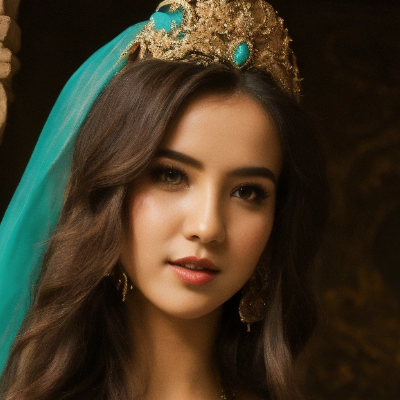
About
Bhadra — Daughter of Anuhlada, Wife of the Yaksha Rajatanabha
Bhadra · Bhadrā
Bhadra is a Daitya princess recorded in the Brahmanda Purana and the Vayu Purana as a daughter of Anuhlada — the second son of the Daitya king Hiranyakashipu — who was given in marriage to Rajatanabha, a Yaksha. Through this marriage she became the mother of Manivara and Manibhadra, two prominent Yakshas whose names appear in several Puranic contexts. Bhadra is significant as the sole recorded daughter of Anuhlada and as the genealogical bridge between the Daitya lineage of Hiranyakashipu and the Yaksha race of Kubera's retinue. Her textual record is sparse, and no narrative episodes are attached to her personally. This profile is kept brief in honest reflection of that limited base. The name Bhadra is shared by a large number of entirely distinct figures in the tradition; the necessary disambiguations are noted below.
✦ The Name
The Sanskrit word bhadra means "fortunate," "auspicious," "good," or "excellent." It is among the most common auspicious terms in Sanskrit literature and serves frequently as a personal name for both divine and human figures across the Puranic, epic, and classical traditions. The use of an auspicious name for a daughter of a Daitya family follows the same pattern seen elsewhere in the Hiranyakashipu lineage, where Sanskritic names of positive connotation are regularly assigned to figures belonging to the demonic race.
✦ Lineage
- Paternal great-grandfather: Kashyapa — primordial sage, son of Marichi who was a mind-born son of Brahma; the progenitor of the Daitya race through his wife Diti.
- Paternal great-grandmother: Diti — daughter of the Prajapati Daksha; ancestral mother of the Daityas; mother of Hiranyakashipu and Hiranyaksha.
- Paternal grandfather: Hiranyakashipu — the great Daitya king who obtained near-invulnerability through austerities and a boon from Brahma, conquered the three worlds, and was slain by the Narasimha avatar of Vishnu.
- Paternal grandmother: Kayadhu — wife of Hiranyakashipu, daughter of the Danava Jambha.
- Father: Anuhlada — the second son of Hiranyakashipu and Kayadhu; a Daitya of the second generation whose partial incarnation in the Dvapara Yuga, per the Mahabharata's Adi Parva (Chapter 67, verse 7), became Dhrishtaketu, king of Chedi. The Bhagavata Purana records Anuhlada's wife as Surya (or Surmya in the Brahmanda Purana variant), through whom he fathered his sons Bashkala and Mahisha. The primary texts do not name Bhadra's mother specifically.
- Brothers: Bashkala and Mahisha — sons of Anuhlada recorded in the Bhagavata Purana (6.18.16); Bhadra's relationship to them as a sister rests on the Brahmanda Purana's record of Anuhlada having a daughter who was given to Rajatanabha, combined with the Vayu Purana's Yaksha genealogy naming her as Bhadra.
- Paternal great-uncle: Hiranyaksha — younger son of Kashyapa and Diti; slain by Vishnu in the Varaha avatar.
- Paternal uncles: Samhlada — eldest son of Hiranyakashipu; Hlada — third son, father of Vatapi and Ilvala; Prahlada — the youngest, the supreme devotee of Vishnu in the Puranic tradition.
- Husband: Rajatanabha — a Yaksha; identified in the Vayu Purana's Yaksha genealogy as the son of Vasuruci and Kratusthali, making him a figure of the Yaksha race, the class of semi-divine beings associated with wealth and natural abundance who form part of the retinue of Kubera, the lord of wealth and the northern quarter.
- Sons: Manivara and Manibhadra — two Yakshas born of Bhadra and Rajatanabha, recorded in the Vayu Purana and Brahmanda Purana. Manibhadra in particular is a figure of considerable importance in the Yaksha tradition: the Brahmanda Purana (III.7.120) names him as a son of Rajatanabha through Bhadra, records him as a commander of the Yaksha army of Chandraprabha (Brahmanda Purana II.18.7–8), and describes him as a general (senapati) of the entire Yaksha host in the Vayu Purana (69.152, 69.157). He also appears in the Bhagavata Purana in connection with the Nalakuvara episode, and in the Mahabharata as a chief of the Yakshas alongside Kubera.
✦ Genealogical Significance
Bhadra's marriage to Rajatanabha represents one of the relatively rare recorded alliances between the Daitya lineage of Hiranyakashipu and the Yaksha race in the Puranic tradition. The Daityas and Yakshas are distinct categories of supernatural beings — the former arising from Kashyapa and Diti, the latter typically associated with Kubera and often traced to Brahma or Pulastya in different textual traditions — and intermarriage between them is not frequently attested. Through her sons Manivara and Manibhadra, Bhadra's descendants achieved prominence within the Yaksha hierarchy, Manibhadra in particular rising to a position of military leadership among the Yakshas across several Puranas.
✦ Disambiguation
The name Bhadra is borne by a large number of unrelated figures in the tradition and this Daitya princess must not be confused with any of them. Among the most prominent bearers of the same name are: Bhadra, the queen of the Yakshas and wife of Kubera (also called Riddhi); Bhadra, one of the eight principal wives of Krishna (a princess of the Kaikeya kingdom, daughter of King Dhrishtaketu); Bhadra, a daughter of the moon god Chandra; Bhadra, a daughter of King Kakshivan who married the Puru king Vyushitashva; and Bhadra, a princess of Vishala. None of these figures has any connection to the Daitya Bhadra who is the subject of this profile.
✦ References
- Primary Sources
- Brahmanda Purana, II.20.26 and III.7.119–120: Cited in the Wisdomlib Purana Index as the source recording that a daughter of Anuhlada was given in marriage to the Yaksha Rajatanabha, and that their son Manibhadra was a commander among the Yakshas.
- Vayu Purana, 50.25 and 69.152, 69.157: Cited in the Wisdomlib Purana Index as a parallel source for the same marriage, giving the daughter's name explicitly as Bhadra in the Yaksha genealogical section, and recording Manibhadra's role as Yaksha senapati.
- Bhagavata Purana, Canto 6, Chapter 18 (verse 16): Names Anuhlada's sons Bashkala and Mahisha; does not name Bhadra, but establishes Anuhlada's family context within which the Brahmanda and Vayu Purana references are placed.
- Secondary Sources
- Wisdomlib.org, "Anuhlada" entry: Records that Anuhlada's daughter was married by the Yaksha Rajatanabha, citing Brahmanda Purana II.20.26, III.7.119, and Vayu Purana 50.25.
- Wisdomlib.org, "Manibhadra" entry: Records Manibhadra as a son of Rajatanabha through Bhadra (Vayu Purana), establishing the daughter's name and her sons' identities.
- Culturalheritageofbharat.blogspot.com, "Yaksha and Yakshini" (drawing on Vayu Purana): Provides the genealogical sequence Vasuruci–Kratusthali–Rajatanabha–Bhadra–Manivara and Manibhadra, corroborating the Puranic Index entries.
- Wikipedia, "Manibhadra" article: Summarises Manibhadra's Puranic roles and his parentage as son of Rajatanabha, providing context for the significance of Bhadra's descendants in the Yaksha tradition.