
About
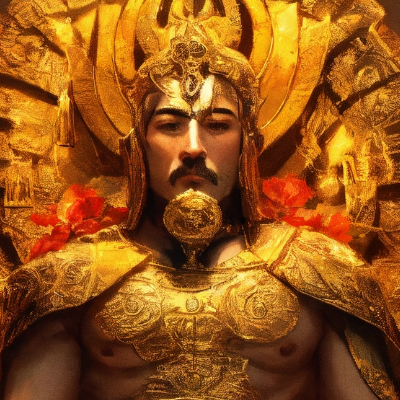
Rajatanabha — Yaksha Prince, Son of Vasuruci and Kratusthala, Father of the Mani-lineage
Rajatanabha · Rajatanābha · Rajatanatha · Rajatanābha
Rajatanabha is a Yaksha whose parentage, birth narrative, marriage, and descendants are recorded primarily in the Brahmanda Purana and the Vayu Purana. He is the son of a Yaksha known as Vasuruci and the Apsara Kratusthala, born in the Nandana forest through an unconventional union described in the Brahmanda Purana, and raised in the Himalayas. His significance in the genealogical tradition rests on two distinct and important sets of relationships: first, he is the Yaksha who received Bhadra — the Daitya princess who was a daughter of Anuhlada, himself a son of the Daitya king Hiranyakashipu — in marriage, thereby creating a rare genealogical bridge between the Daitya lineage of Hiranyakashipu and the Yaksha race; and second, he is the father of Manivara, Manibhadra, Manidhara, and at least one other son, through whom he became the progenitor of a significant branch of the Yaksha lineage. An older tradition preserved in commentarial literature on the Atharvaveda additionally associates Rajatanabha with the role of the Yaksha milcher in a cosmological episode concerning the milking of the earth. The Wisdomlib Purana Index records him under citations from the Brahmanda Purana at several verse locations and the Vayu Purana, making him one of the more fully documented Yakshas in the Puranic genealogical corpus below the level of Kubera himself.
✦ The Name
The Sanskrit compound rajatanabha is formed from rajata (silver) and nabha (navel, nave, or centre). The name therefore means "silver-navelled" or "he whose navel is like silver" — a description conveying a luminous or silver-bright centre of the body, a type of auspicious physical epithet common in Sanskrit naming traditions for divine and semi-divine beings. The word rajata also appears in the Puranic earth-milking traditions where the Yaksha race uses a silver vessel in their cosmic act of milking, and the secondary association between the name and that cosmological role may be intentional within the tradition.
✦ Lineage
- Father: Vasuruci — a Yaksha, the founding figure of this genealogical line in the Vayu Purana's Yaksha genealogy. The Brahmanda Purana (III.7.60, 100–117), as cited in the Wisdomlib entry on Yaksha, gives a more detailed account: Vasuruci was a Yaksha who assumed the form of a Rakshasa and lived with the Apsara Kratusthala in the Nandana forest (Indra's celestial garden). When Kratusthala learned of Vasuruci's true nature as a Rakshasa, she left him; their son Rajatanabha was then taken by Vasuruci to the Himalayas. The Wisdomlib "Yaksha concept" entry further notes a tradition, traceable to the Atharvaveda and its later commentarial literature, in which Rajatanabha is identified as "Kubera's son" and as the Yaksha who milched the earth on behalf of the Yaksha race using the Yakshas' preferred vessel, with Kubera as their calf in the cosmic milking episode. This identification of Rajatanabha as Kubera's son in the Atharvaveda tradition stands in tension with the Brahmanda Purana's identification of him as a son of Vasuruci — a genuine inconsistency across sources, discussed below.
- Mother: Kratusthala (also rendered Kratusthali or Pancachuda) — an Apsara; wife of Vasuruci; named in the Brahmanda Purana's Yaksha genealogy (III.7.100) as the mother of Rajatanabha. The same Kratusthala later appears as the mother of Devajani, who became the wife of Rajatanabha's own son Manivara — making Kratusthala both paternal grandmother and maternal grandmother-in-law within this genealogical line.
- Wife: Bhadra — a Daitya princess, daughter of Anuhlada (the second son of Hiranyakashipu and Kayadhu), given in marriage to Rajatanabha; recorded in the Vayu Purana's genealogical section and confirmed by the Brahmanda Purana (II.20.26, III.7.119) as cited in the Wisdomlib Purana Index entry on Anuhlada. Through Bhadra, Rajatanabha's children carry the Daitya blood of the lineage of Hiranyakashipu, of Kashyapa the primordial sage, and of Diti, daughter of Daksha Prajapati.
- Sons:
- Manivara — first son of Rajatanabha, named in the Brahmanda Purana (III.7.127–131) and the Vayu Purana; married Devajani (daughter of Kratusthala the Apsara) and fathered the class of Yakshas called Guhyakas and a named son Purnabhadra; associated with Kailasa and the Lohita hill.
- Manibhadra — second son of Rajatanabha, named in the Brahmanda Purana (III.7.120) and the Vayu Purana (69.152, 69.157); became commander-in-chief of the Yaksha host; married Punyajani and fathered a numerous lineage of Yakshas; widely attested across the Mahabharata, the Valmiki Ramayana, the Bhagavata Purana, the Shiva Purana, and in ancient sculptural tradition as a major tutelary deity of travellers and merchants.
- Manidhara — a son of Rajatanabha named in the Brahmanda Purana (II.18.12 and II.36.216) and the Matsya Purana (121.13); placed on the Lohita hill; no further narrative or descendants recorded in the sources consulted.
✦ The Birth Narrative
The Brahmanda Purana (III.7.60 and 100–117), as summarised in the Wisdomlib "Yaksha" definition entry, preserves an account of Rajatanabha's birth that is unusual within the Yaksha genealogical tradition. His father Vasuruci was a Yaksha who disguised himself as a Rakshasa and took up residence with the Apsara Kratusthala in the Nandana garden — the celestial grove of Indra. Kratusthala, believing him to be a Rakshasa, lived with him and conceived Rajatanabha. When the truth of Vasuruci's origin as a Yaksha became known to her, Kratusthala separated from him; Vasuruci then took the newborn Rajatanabha to the Himalayas, which became the Yaksha's home. This narrative frames Rajatanabha's birth as emerging from deception and cross-species union between the Yaksha and Apsara classes, a motif that the Brahmanda Purana uses to explain the distinctive character of this particular Yaksha lineage.
✦ The Atharvaveda Connection and the Milking of the Earth
The Wisdomlib "Yaksha concept" entry records a tradition, preserved in commentarial literature on the Atharvaveda and also referenced in discussions of the Dharmasutra period, in which Rajatanabha is credited with milching the earth on behalf of the Yakshas, using Kubera (Vaishravana) as their calf. This episode belongs to the cosmological "milking of the earth" tradition present across several Puranas, in which different classes of beings are said to have milked the earth-cow in primordial times, each using their own characteristic vessel and calf to obtain their desired boon. The Yaksha tradition assigns this act of milching to Rajatanabha, with the Yaksha prize being the power to disappear into another's body — an ability associated with the Yaksha and Guhyaka races. In this tradition, the commentarial literature refers to Rajatanabha as "Kubera's son," which is the genealogical alternative that stands in tension with the Brahmanda Purana's account of his parentage through Vasuruci and Kratusthala.
✦ Marriage into the Daitya Lineage
Rajatanabha's marriage to Bhadra, the daughter of Anuhlada, is recorded in the Brahmanda Purana (II.20.26 and III.7.119) and the Vayu Purana (50.25). This union represents one of the relatively uncommon instances in the Puranic genealogical tradition of a formal marriage between the Yaksha race and the Daitya lineage of Hiranyakashipu. Bhadra, as a daughter of Anuhlada, was a granddaughter of Hiranyakashipu and a great-granddaughter of Kashyapa and Diti — placing the Daitya blood of the oldest anti-divine lineage directly into the Yaksha line through their children. The significance of this alliance for the Yaksha genealogical tradition lies in the remarkable offspring it produced: Manibhadra in particular became one of the most attested and widely worshipped Yakshas in both the Puranic and the Jain traditions.
✦ Textual Variants and Inconsistencies
The principal inconsistency in Rajatanabha's textual record is his parentage. The Brahmanda Purana (III.7.100) and the Vayu Purana genealogical tradition make him a son of the Yaksha Vasuruci and the Apsara Kratusthala. The Atharvaveda commentarial tradition, as reported in the Wisdomlib "Yaksha concept" entry, instead calls him the son of Kubera — placing him in an entirely different genealogical position as a member of the senior Yaksha nobility descended directly from the lord of wealth. These two accounts cannot be harmonized within the primary sources themselves; they most likely reflect the absorption of Rajatanabha from an earlier independent Yaksha tradition (in which he was associated with Kubera's immediate lineage) into the more elaborated genealogical framework of the Brahmanda Purana and Vayu Purana (in which he becomes a descendant of the Yaksha Vasuruci through a dramatic birth narrative). No primary text consulted attempts to reconcile these two accounts.
A subsidiary variant concerns the name of Rajatanabha's wife and the mother of his sons. The Vayu Purana consistently gives her name as Bhadra (the Daitya princess). The Wisdomlib Purana Index entry on Manivara records one formulation in which the mother is called Manivarā — a name that appears to conflate the mother with one of her sons or represent a manuscript variant — while elsewhere in the same entry and in the Manibhadra entry the mother is consistently identified as Bhadra. The Vayu Purana reading of Bhadra as mother is treated as primary here for consistency with the broader genealogical record.
✦ References
- Primary Sources
- Brahmanda Purana, III.7.60 and III.7.100–117: Gives the birth narrative of Rajatanabha as the son of Vasuruci (a Yaksha in Rakshasa form) and the Apsara Kratusthala in Nandana, and his upbringing in the Himalayas.
- Brahmanda Purana, II.20.26 and III.7.119: Records Rajatanabha's marriage to Bhadra, the daughter of Anuhlada, and the sons born of this union.
- Brahmanda Purana, III.7.120 and III.7.127–131: Names Manibhadra and Manivara as sons of Rajatanabha, giving their wives and descendants.
- Brahmanda Purana, II.18.12 and II.36.216: Names Manidhara as a son of Rajatanabha, located on the Lohita hill.
- Vayu Purana, 50.25: Records the marriage of Rajatanabha to the daughter of Anuhlada (Bhadra); confirms the parentage of Manivara and Manibhadra.
- Vayu Purana, 69.152 and 69.157: Records Manibhadra as a son of Rajatanabha through Bhadra, and his role as Yaksha senapati.
- Matsya Purana, 121.13: Names Manidhara as a son of Rajatanabha on the Lohita (Hemashtinga) hill.
- Atharvaveda commentarial tradition: Refers to Rajatanabha as Kubera's son and the Yaksha who milched the earth; cited indirectly through the Wisdomlib "Yaksha concept" entry.
- Secondary Sources
- Wisdomlib.org, "Yaksha" definition entry (Purana and Shiva Purana glossary): Provides the Brahmanda Purana narrative (III.7.60, 100–117) of Rajatanabha's birth through Vasuruci and Kratusthala, and the Atharvaveda tradition of Rajatanabha as the Yaksha milcher and son of Kubera.
- Wisdomlib.org, "Anuhlada" entry: Records Rajatanabha as the Yaksha who married Anuhlada's daughter, citing Brahmanda Purana II.20.26 and Vayu Purana 50.25.
- Wisdomlib.org, "Manibhadra" entry: Identifies Rajatanabha as father of Manibhadra through Bhadra (Vayu Purana), citing Brahmanda Purana III.7.120.
- Wisdomlib.org, "Manivara" entry: Identifies Rajatanabha as father of Manivara, citing Brahmanda Purana III.7.127–131.
- Wisdomlib.org, "Manidhara" entry: Identifies Rajatanabha as father of Manidhara, citing Brahmanda Purana II.18.12 and Matsya Purana 121.13.
- Culturalheritageofbharat.blogspot.com, "Yaksha and Yakshini" (drawing on Vayu Purana): Provides the genealogical sequence Vasuruci–Kratusthala–Rajatanabha–Bhadra–Manivara and Manibhadra, noting also the Atharvaveda tradition of Rajatanabha as "Kubera's son" and the Yaksha milcher.