
About
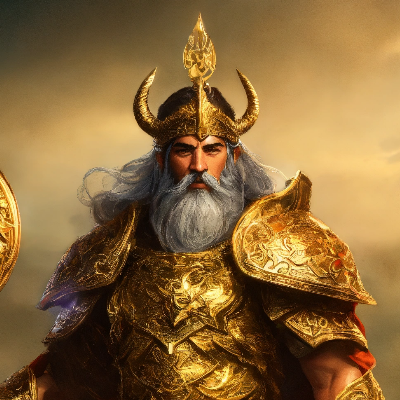
Manibhadra — Yaksha Commander, Son of Rajatanabha and Bhadra, Tutelary Deity of Travellers
Manibhadra · Maṇibhadra · Manibhadda · Parshvamauli
Manibhadra is one of the most prominent Yakshas in the Hindu, and later Jain, traditions — a commander-in-chief of the Yaksha host, a tutelary deity of travellers and merchants, and a figure who appears across several major Puranas, both Sanskrit epics, and a rich tradition of ancient sculptural art. The Brahmanda Purana and the Vayu Purana record him as the second of two sons born to the Yaksha Rajatanabha and his wife Bhadra, the Daitya princess who was herself a daughter of Anuhlada, the second son of Hiranyakashipu. Through this maternal line Manibhadra carries the blood of the Daitya race descended from the primordial sage Kashyapa and his wife Diti. He is also identified in certain texts — most prominently those giving Kubera's genealogy — as a son of Kubera and a different Bhadra (who is the queen of the Yakshas and wife of Kubera), and as a brother of Nalakuvara; this represents a genuine and important genealogical divergence across the textual tradition that must be stated clearly. His wife in the Puranic tradition is Punyajani, through whom he fathered a lineage of Yakshas. He appears in the Valmiki Ramayana as a Yaksha commander defeated by Ravana's general Prahasta on Kailasa, in the Mahabharata as a senior Yaksha chief at Kubera's court, and in the Bhagavata Purana in connection with the curse of Narada. He was a widely worshipped deity in ancient India and remains venerated among the Jains of Gujarat and Rajasthan today.
✦ The Name
The Sanskrit compound manibhadra is formed from mani (jewel, gem) and bhadra (auspicious, fortunate, excellent). The name therefore means "as excellent as a jewel," "auspicious jewel," or "jewel of good fortune." The Wikipedia article on the figure cites this etymology explicitly. The epithet Parshvamauli — meaning "he of the sideways diadem" — is attested in the Open Magazine's scholarly essay on Manibhadra, derived from an episode in which Ravana's general struck the Yaksha's crown askew during combat; it is an epithetic name given after that incident rather than a birth name.
✦ Lineage
- Paternal great-grandfather: Vasuruci — a Yaksha, the progenitor of Rajatanabha's line in the Vayu Purana's Yaksha genealogy.
- Paternal great-grandmother: Kratusthala (Kratusthali, Pancachuda) — an Apsara, wife of Vasuruci; the Brahmanda Purana identifies her as mother of Rajatanabha and as the mother of Devajani (Manibhadra's sister-in-law through his brother Manivara), making her a figure who connects two generations of the Yaksha genealogy.
- Father: Rajatanabha — a Yaksha; son of Vasuruci and Kratusthala; the Yaksha who received Bhadra the Daitya princess in marriage, creating the genealogical link between the Daitya lineage of Hiranyakashipu and this branch of the Yaksha race.
- Mother (Brahmanda Purana / Vayu Purana tradition): Bhadra — a Daitya princess, daughter of Anuhlada (second son of Hiranyakashipu and Kayadhu), given in marriage to the Yaksha Rajatanabha. Through Bhadra, Manibhadra's Daitya ancestry descends from Hiranyakashipu, from Kashyapa and Diti, and ultimately from Brahma through Marichi.
- Mother (alternative tradition): Bhadra — the queen of the Yakshas and wife of Kubera. Several secondary sources, including the Wikipedia article on Manibhadra, identify him as a son of Kubera and a Bhadra who is the Yaksha queen — a wholly different figure from the Daitya princess Bhadra. In this tradition, Manibhadra's brother is not Manivara but Nalakuvara, another son of Kubera. The Shiva Purana also describes Manibhadra as the brother of Kubera. These two genealogical traditions — son of Rajatanabha through the Daitya princess Bhadra, and son of Kubera through the Yaksha queen Bhadra — coexist in the texts without explicit reconciliation. They represent the most significant textual inconsistency in this profile and are recorded here without resolution, as the primary texts themselves do not harmonize them.
- Brother (Brahmanda Purana / Vayu Purana tradition): Manivara — the first son of Rajatanabha and Bhadra; husband of Devajani and father of the Guhyakas and of Purnabhadra.
- Brother (alternative tradition): Nalakuvara — son of Kubera; the figure who appears alongside Manibhadra in the Bhagavata Purana episode of Narada's curse and in traditions identifying both as sons of Kubera.
- Wife: Punyajani — named in the Brahmanda Purana (III.7.120) and the Vayu Purana (69.152, 69.157) as Manibhadra's wife; described as the mother of a numerous lineage of Yakshas. Her name means "she of sacred birth" or "one born of merit."
- Sons: A numerous lineage of Yakshas born of Punyajani, described collectively in the Vayu Purana tradition; the specific names of individual sons beyond this general description are not given in the sources consulted.
✦ Role as Yaksha Commander
Manibhadra's most consistently attested function across the Puranic tradition is his military and administrative role within the Yaksha hierarchy. The Vayu Purana (47.7) designates him as the senapati — general or commander-in-chief — of the entire Yaksha host. The Brahmanda Purana (II.18.7–8) places him more specifically as the commander of the Yakshas of Chandraprabha, a celestial locality; the same text (III.7.120) situates him on the hill adjoining Caitraratha, the garden of Kubera. The Matsya Purana (121.8–9) corroborates his residence in the same vicinity. Across these texts Manibhadra functions consistently as one of the senior officers of Kubera's supernatural retinue, whether framed as son, brother, or subordinate of the lord of wealth, depending on the specific text.
✦ In the Valmiki Ramayana
The Valmiki Ramayana's Yuddha Kanda (Chapter 19, verse 11) contains a significant episode involving Manibhadra. When Ravana's minister Vibhishana addresses Rama at Lanka, he identifies Prahasta — Ravana's chief of army — as the Rakshasa general who had defeated Manibhadra in a battle on the mountain of Kailasa. The verse explicitly names Manibhadra as the Yaksha figure who was overcome by Prahasta in that engagement. The Open Magazine's scholarly essay on Manibhadra, drawing on a related passage in the Uttara Kanda tradition, additionally records that during the battle for Lanka, Manibhadra fought and laid low the Rakshasa minister Dhumraksha but was himself forced to withdraw when a blow from Ravana's mace knocked his diadem sideways — an episode that gave rise to his epithet Parshvamauli, "He of the Sideways Crown." The Ramayana thus preserves Manibhadra as an active Yaksha military commander who engaged directly with the Rakshasa forces of Lanka.
✦ In the Mahabharata
The Mahabharata refers to Manibhadra at several points. He is mentioned in the Sabha Parva (2.10.15) as a prominent Yaksha at the court of Kubera, worshipped by traders and travellers for their protection and the success of their journeys. The Vana Parva (3.63.130) contains a further reference establishing his role as a recipient of worship by those seeking safe passage. The Anushasana Parva (Chapter 19, verse 33) records that the sage Ashtavakra once received Manibhadra hospitably. In the Ashvamedha Parva (14.65.7), Arjuna propitiates Manibhadra when seeking to recover the wealth of king Marutta for Yudhishthira's horse sacrifice. These Mahabharata references collectively establish Manibhadra as a significant Yaksha deity within the ritual and devotional life recorded in the epic — one whose favour warriors, merchants, and sages sought through worship.
✦ In the Bhagavata Purana
The Bhagavata Purana narrates an episode involving Manibhadra and his brother Nalakuvara — identifying them here as sons of Kubera — in which the two Yakshas were disporting themselves with their wives or with Apsaras in the river Ganges in a state of intoxication and without garments. When the divine sage Narada passed by on his way to Vishnu, the women covered themselves but the two brothers, too drunk to perceive the sage properly, continued boasting and behaving without restraint. Narada, wishing to correct their arrogance, cursed both brothers to be transformed into trees — the famous twin Arjuna trees near Vrindavana — with the condition that they would be liberated only by an avatar of Vishnu. In the Dvapara Yuga, the infant Krishna, tied to a wooden mortar by his mother Yashoda as a punishment for mischief, crawled with the mortar between the twin trees and uprooted them, thereby liberating the Yakshas from their arboreal existence. This episode is one of the most widely narrated stories of the Krishna Janma section of the Bhagavata Purana's tenth canto.
✦ As a Tutelary Deity and in Other Traditions
The Brahmanda Purana (IV.33.78) describes Manibhadra as a devotee of the goddess Lalita, placing him within the Shakta devotional tradition as well as the Vaishnava and Shaiva contexts in which he appears elsewhere. The Shiva Purana identifies him explicitly as the brother of Kubera and chief of the Yakshas, and as the tutelary deity of travellers and merchants. The historian Upinder Singh, cited in the Open Magazine essay, identifies Manibhadra as a deity worshipped at important ancient trading centres of northwest South Asia from approximately the third to the first centuries BCE, supported by epigraphic evidence. The Parkham Yaksha sculpture near Mathura — a monumental sandstone figure over two and a half metres tall, dated on paleographical grounds to the second century BCE — bears an inscription associating it with the Manibhadra devotional congregation, and is among the oldest identified images of any Yaksha deity. In the Jain tradition, Manibhadra Yaksha (also called Manibhadra Vira) is a widely venerated protective deity, particularly among Jain communities in Gujarat affiliated with the Tapa Gaccha, with major temples at Ujjain, Aglod (Mehsana district), and Magarwada (Banaskantha district).
✦ Textual Variants and Inconsistencies
The fundamental inconsistency in Manibhadra's textual record is his parentage. The Brahmanda Purana (III.7.120) and the Vayu Purana (69.152, 69.157) make him a son of the Yaksha Rajatanabha through Bhadra the Daitya princess, and his brother in this tradition is Manivara. Multiple other sources — including the Wikipedia article on Manibhadra drawing on traditions that identify Kubera as his father and a different Bhadra (the Yaksha queen, wife of Kubera) as his mother — make him a son of Kubera with Nalakuvara as his brother. The Shiva Purana refers to him as the brother of Kubera rather than his son. These three genealogical relationships — son of Rajatanabha, son of Kubera, and brother of Kubera — are irreconcilable across the texts and almost certainly reflect the absorption into Brahmanical and Puranic literature of a pre-existing popular deity whose diverse regional origins left different genealogical traces in different texts. No primary text consulted attempts to reconcile these divergent accounts.
✦ References
- Primary Sources
- Brahmanda Purana, III.7.120: Names Manibhadra as a son of Rajatanabha through Bhadra; records his wife as Punyajani and his role as a commander of the Yakshas of Chandraprabha.
- Brahmanda Purana, II.18.7–8: Places Manibhadra as commander of the Yakshas of Chandraprabha and situates him on the hill adjoining Caitraratha.
- Brahmanda Purana, IV.33.78: Describes Manibhadra as a devotee of the goddess Lalita.
- Vayu Purana, 47.7: Designates Manibhadra as senapati (commander-in-chief) of the entire Yaksha host.
- Vayu Purana, 69.152 and 69.157: Records Manibhadra as a son of Rajatanabha and Bhadra; names Punyajani as his wife and the progenitor of a lineage of Yakshas.
- Matsya Purana, 121.8–9: Corroborates Manibhadra's residence on the hill adjoining Caitraratha.
- Valmiki Ramayana, Yuddha Kanda, Chapter 19 (verse 11): Records that Ravana's general Prahasta defeated Manibhadra in battle on Kailasa.
- Mahabharata, Sabha Parva, 2.10.15: Names Manibhadra as a chief Yaksha at Kubera's court, worshipped by traders and travellers.
- Mahabharata, Vana Parva, 3.63.130: Further reference to Manibhadra as recipient of worship by those seeking safe travel.
- Mahabharata, Anushasana Parva, Chapter 19 (verse 33): Records the sage Ashtavakra honouring Manibhadra.
- Mahabharata, Ashvamedha Parva, 14.65.7: Records Arjuna propitiating Manibhadra before recovering king Marutta's wealth.
- Shiva Purana, 2.2.37: Identifies Manibhadra as the brother of Kubera and chief of the Yakshas, and as the tutelary deity of travellers and merchants; an episode describes Manibhadra at Daksha's sacrifice striking Bhrigu during the conflict.
- Bhagavata Purana, Canto 10 (Damodara episode): Narrates the curse of Manibhadra and Nalakuvara by Narada and their liberation by the infant Krishna.
- Secondary Sources
- Wisdomlib.org, "Manibhadra" entry: Compiles the Purana Index references across Brahmanda, Vayu, Matsya, and Shiva Puranas, and the Mahabharata; identifies his roles as Yaksha senapati, commander at Chandraprabha, devotee of Lalita, and tutelary deity of travellers.
- Wikipedia, "Manibhadra" article: Summarises his Puranic roles, the Parkham Yaksha inscription, his Jain veneration, and his identification in some traditions as a son of Kubera and brother of Nalakuvara.
- Aritra Ghosh, "The Yaksha Who Deserves More Attention," Open Magazine (June 2023): Provides the scholarly synthesis of Manibhadra's appearances across the Mahabharata, the Ramayana, and the Puranas, the epithet Parshvamauli, and the archaeological and epigraphic evidence for his worship in ancient India, citing Upinder Singh's historical research.
- Vettam Mani, Puranic Encyclopaedia (Motilal Banarsidass): Referenced via Wisdomlib for the entries on Manibhadra and Rajatanabha confirming the genealogical details used in this profile.