
About
The Upakichakas — Brothers of Kichaka, Slain by Bhima at the Cremation Ground
Upakichakas · Brothers of Kichaka · Sons of Kekaya · Sons of Malavi · Sutaputras
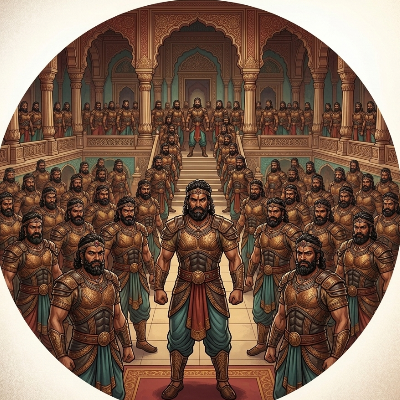
The Upakichakas were the brothers of Kichaka, the commander-in-chief of the armies of King Virata, ruler of the Matsya kingdom, and collectively the sons of Kekaya, a Suta chieftain associated with the Kekaya country of northwestern Bharatavarsha, and of Malavi, a woman associated with the Malava country of central Bharatavarsha. They appear in the Virata Parva of the Mahabharata as a group rather than as named individuals, serving alongside their elder brother Kichaka in the Matsya kingdom. Their sole narrative episode concerns the events immediately following Kichaka's death at the hands of Bhima, the second of the five Pandava brothers: upon discovering Kichaka's disfigured corpse, the Upakichakas seized Draupadi — the wife of the five Pandavas, who was living at Virata's court in disguise — and attempted to cremate her alive with their dead brother. Bhima intervened and killed them all. Their deaths extinguished the entire male line of Kekaya and Malavi as recorded in the Mahabharata. The Upakichakas are not named individually in any surviving primary source, and no personal histories, distinguishing characteristics, or individual episodes are attributed to any of them.
✦ The Name
The designation Upakichakas is a compound Sanskrit term in which the prefix upa carries the sense of subordinate to, lesser than, or associated with, combined with the name Kichaka. The name thus identifies this group collectively as those who stand in relation to Kichaka — his subordinates, associates, and brothers defined by their connection to him rather than by individual identities of their own. This naming convention reflects a pattern in the Mahabharata whereby groups of brothers or followers of a dominant figure are named collectively through their relationship to that figure, without the preservation of individual names. The patronymic Sutaputra, meaning sons of a Suta, is applicable to them as it is to Kichaka, identifying their community as the hereditary charioteer-herald class of ancient Bharatavarsha. The Mahabharata does not record the number of the Upakichakas with precision, referring to them as a large group.
✦ Lineage
- Father: Kekaya — a Suta chieftain associated with the Kekaya country of northwestern Bharatavarsha; the Suta community was a hereditary class traditionally associated with chariot-driving, bardic recitation, and royal service at the courts of ancient India
- Mother: Malavi — a woman associated with the Malava country of central Bharatavarsha; named in the Virata Parva alongside Kekaya as the mother of Kichaka, and by extension the mother of the Upakichakas
- Elder brother: Kichaka — commander-in-chief of the armies of King Virata of the Matsya kingdom; the most powerful military figure in the Matsya court and the dominant presence in Virata's kingdom by virtue of both his military reputation and his fraternal connection to Queen Sudeshna; killed by Bhima in the dance hall after his assault upon Draupadi
- Sister (through Kichaka's lineage): Sudeshna — chief queen of King Virata of the Matsya kingdom; sister of Kichaka and by extension of the Upakichakas; her position at Virata's court provided the basis for Kichaka's authority and for the entire family's presence in the Matsya establishment
✦ Role at the Matsya Court
The Upakichakas served in the military and administrative establishment of the Matsya kingdom under the command of their brother Kichaka. The Mahabharata does not describe their individual roles, ranks, or responsibilities with any specificity. They appear as a collective body defined by their loyalty to and association with Kichaka, and their presence at court is implied by their ability to act as a group in the immediate aftermath of his death. The text presents them as sharing in the power and prestige that Kichaka's position afforded, though none of them is distinguished by any personal deed or office that the narrative records.
✦ The Attempt to Cremate Draupadi and the Death of the Upakichakas
When Kichaka's body was discovered in the dance hall the morning after his secret meeting with Bhima, the corpse had been so thoroughly destroyed — Bhima having crushed and contorted it until the limbs were driven into the torso — that it was unrecognisable as the product of a human combatant. The Upakichakas, confronting the remains of their powerful elder brother, concluded that the killing had been carried out by the gandharva husbands whom Draupadi had claimed as her protectors during her time at Virata's court. This conclusion was precisely the interpretation that Bhima had intended the manner of killing to produce.
Rather than being deterred by the evidence of supernatural force, the Upakichakas resolved upon revenge against Draupadi. They seized her by force and bound her, then dragged her toward the cremation ground with the declared intention of burning her alive upon Kichaka's funeral pyre. Draupadi cried out loudly as she was taken, appealing for help. Bhima, who had anticipated that some retaliatory action against Draupadi was possible and had positioned himself nearby in the disguise of a forest-dweller, heard her cries and followed.
At the cremation ground, Bhima attacked the Upakichakas and killed them all. The Mahabharata describes the killing as swift and total, with Bhima uprooting a large tree and using it as a weapon against the group. The deaths of the Upakichakas, coming immediately upon Kichaka's own death, removed every male member of the family from the Matsya court at once. The scale and manner of the killing — an unknown man of apparently superhuman strength destroying an entire armed group — further reinforced the impression among the Matsya populace that a powerful non-human force was operating in connection with Draupadi, and the narrative records that people in the kingdom were deeply unsettled by the sequence of events.
✦ Consequences of Their Deaths
The simultaneous destruction of Kichaka and all the Upakichakas left the Matsya kingdom stripped of its most formidable military leadership at a critical moment. The Mahabharata explicitly connects this sudden vulnerability to the subsequent invasion of Matsya by the Trigarta king Susharma, who had long been deterred from aggression against Virata by fear of Kichaka alone, and to the near-simultaneous incursion by the Kaurava forces under Duryodhana, eldest son of the blind king Dhritarashtra. These twin invasions, coming hard upon the deaths of Kichaka and the Upakichakas, created the circumstances in which the Pandavas were compelled to reveal themselves in battle, effectively ending their year of incognito concealment. The deaths of the Upakichakas are thus narratively instrumental not merely as an episode of justice for Draupadi but as a structural hinge in the Virata Parva that brings the Pandavas' period of disguise to its close and accelerates the movement toward the Kurukshetra war.
✦ Textual Variants and Limitations
No Mahapurana, Upapurana, regional Itihasa, or Vedic text supplements the Mahabharata's account of the Upakichakas with additional material. They are not named individually in any known Sanskrit source, and no tradition of individual characterisation or independent narrative has attached to any member of the group. Regional retellings and vernacular adaptations of the Mahabharata that treat the Kichaka episode in detail — including the Tamil Mahabharata of Villiputhur Alvaar and the Telugu rendering — follow the same broad narrative structure as the Sanskrit original with respect to the Upakichakas, presenting them as a collective body rather than as individuals, though the specific manner of their killing and the details of Bhima's disguise may vary between versions.
✦ Connection to the Wider Genealogy
The Upakichakas represent the final generation of the Suta lineage of Kekaya and Malavi as recorded in the Mahabharata. Their father Kekaya was a Suta chieftain of the Kekaya country, and their mother Malavi was associated with the Malava country. Their sister Sudeshna's marriage to King Virata of the Matsya kingdom placed the family within the orbit of one of the major royal courts of the late Kuru period. Virata's daughter Uttaraa became the wife of Abhimanyu — the son of the Pandava Arjuna and his wife Subhadra, who was herself the sister of Krishna, the Yadava prince and avatar of the god Vishnu — and Uttaraa's son Parikshit inherited the Kuru throne after the Kurukshetra war, making the Matsya royal family genealogically significant in the continuation of the Kuru line. The Upakichakas themselves, however, left no descendants and no continuing lineage within the tradition as it is recorded in any surviving primary source.
✦ References
- Mahabharata, Virata Parva (Book 4), chapters 20–23: Primary and sole Sanskrit source for the Upakichakas; narrates their discovery of Kichaka's body, their seizure of Draupadi and attempt to cremate her alive, and their killing by Bhima at the cremation ground.
- Mahabharata, Virata Parva (Book 4), chapters 24–72: Narrates the consequences of the deaths of Kichaka and the Upakichakas, including the vulnerability of the Matsya kingdom, the Trigarta and Kaurava invasions, and the revelation of the Pandavas' identities.
- Vettam Mani, Puranic Encyclopaedia (1975): Entry on Kichaka and associated entries reference the Upakichakas as a group; synthesises the Virata Parva account without adding independent primary source material.
- Alf Hiltebeitel, The Cult of Draupadi, Vol. 1 (1988): Analyses the Kichaka episode including the role of the Upakichakas in the narrative structure of the Virata Parva; contributes scholarly perspective on the episode's function within the broader Mahabharata and within regional performance traditions.