
About
Ilvala and Vatapi — The Asura Brothers of Manimati, Slain by Agastya
Ilvala · Ilwala · Vatapi · Vatapin · Sainhikeya (by one genealogy) · Daitya of Manimati
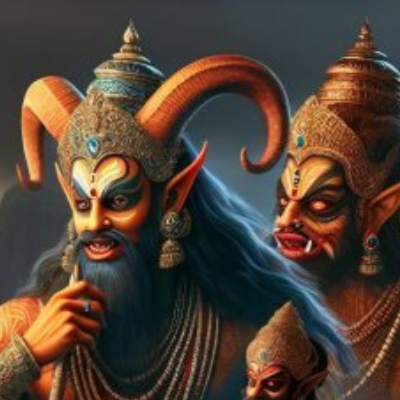
Ilvala and Vatapi are two asura brothers in the Hindu epic and Puranic tradition, renowned for a sustained murderous scheme in which they deceived and killed a vast number of brahmin sages by means of Vatapi's power of shape-transformation and Ilvala's power to recall the dead by voice. Their story is narrated at length in the Mahabharata's Vana Parva at Chapters 96 through 99, within the Tirtha-yatra Parva, and is also told in the Valmiki Ramayana's Aranya Kanda. They are finally destroyed by the sage Agastya — among the most celebrated of the Vedic seers — in an episode that is also the occasion of Agastya's marriage to Lopamudra and the fulfilment of his ancestral duty. Their parentage is given differently across the primary sources and is addressed in the textual variants section below. The Vishnu Purana at Chapter 21 lists them among the sons of Viprachitti and Simhika, which is the genealogical position that places them in the present series. The ancient city of Vatapi, known today as Badami in the Bagalkot district of Karnataka, perpetuates the name of the elder brother in geographical tradition.
✦ The Names
The name Ilvala has no firmly established Sanskrit etymology in the classical lexicons beyond its status as a proper noun; the Monier-Williams dictionary records it simply as the name of a daitya, the elder brother of Vatapi. The name Vatapi derives from a Sanskrit root associated with wind, air, or the quality of spreading through the air, though some analyses connect it to vata meaning wind and apa meaning water, giving a sense of pervasiveness or diffusion. The Grokipedia analysis notes that Vatapi's name connects symbolically to the sage Agastya's incantation Vatapi jirnah bhava — Vatapi, be digested — which is the verbal formula by which Agastya destroyed him, and that the name therefore carries the narrative of its own undoing embedded within it.
✦ Lineage
- Father (per Vishnu Purana, Chapter 21): Viprachitti — eldest of the Danava race, son of Kashyapa and Danu; king of the Danavas; identified in the Mahabharata as the previous birth of Jarasandha of Magadha.
- Mother (per Vishnu Purana, Chapter 21): Simhika — daughter of Kashyapa and Diti; sister of Hiranyakashipu and Hiranyaksha; mother of the Sainhikeya class of demons, of whom Svarbhanu-Rahu is the eldest.
- Father (per Mahabharata Vana Parva, Chapter 96): The Mahabharata text at Chapter 96 explicitly calls Ilvala a son of Diti — daitya — without naming Viprachitti as an intermediate. This is a direct statement in the primary epic source and places the brothers as Daityas in the line of Kashyapa and Diti, one generation closer to the source than the Vishnu Purana's account would place them.
- Father (per Bhagavata Purana, footnote to Vishnu Purana Chapter 21 in Wilson's translation): The Bhagavata Purana is cited in Wilson's footnote as inserting Ilvala and Vatapi as sons of Hlada — a son of Hiranyakashipu — which would make them grandsons of Hiranyakashipu through the Daitya line, a third and distinct genealogical placement.
- Parents (per Skanda Purana, Asura Kanda): The Skanda Purana gives a completely different account in which Ilvala and Vatapi were born to a giantess named Ajamukhi through the sage Durvasa, the irascible son of the sage Atri, after Ajamukhi had propitiated Durvasa for love. In this account Durvasa, angered that his sons demanded all his ascetic merit, cursed them to meet death at Agastya's hands — a version that both explains their origin and pre-establishes the manner of their end.
- Brothers (per Vishnu Purana genealogical position): Svarbhanu-Rahu, Namuchi, Shalya, Nabha, Vyamsha, Khasrima, Anjaka, Naraka, Kalanabha, and Vaktrayodhi — the other sons of Viprachitti and Simhika as listed in Vishnu Purana Chapter 21.
- Son of Ilvala: Balavala — named in the Bhagavata Purana; described as a demon who used to come to the forest of Naimisha and disturb the assembled sages as they listened to the narration of the Puranas from the suta Ugrashravas; he is the continuing demonic presence of the Ilvala lineage in the tradition following his father's death.
✦ The Powers of the Two Brothers
The two brothers are distinguished by complementary and mutually enabling supernatural powers. Ilvala possessed the extraordinary ability to summon any being — including the dead — back to life and to embodied form simply by calling that being's name aloud. The Mahabharata states that whomsoever Ilvala summoned with his voice, that being would return to him even from the abode of Yama, taking on a re-embodied and living form. This power of vocal resurrection had no apparent limit in the tradition, and gave Ilvala a means of indefinitely recycling his brother as a weapon. Vatapi possessed the complementary power of voluntary shape-transformation, being able to assume any form he desired at will, including the form of a goat, a ram, or any other animal, and to survive that form's apparent death and dissolution within a consumed body until recalled. Together these two powers formed a lethal trap: Vatapi could be killed, cooked, eaten, and then reconstituted within the living body of whoever had consumed him, tearing his way out upon Ilvala's summons.
✦ The Origin of Their Brahmin-Killing Campaign
The Mahabharata's Vana Parva at Chapter 96 narrates the origin of the brothers' campaign against brahmins. Ilvala, the elder, once approached a brahmin ascetic of great austerity and requested that the sage grant him a son of power equal to Indra, the king of the gods. The sage refused, considering Ilvala unworthy of such a boon due to his accumulated sins and demonic nature. This refusal enraged Ilvala profoundly, and from that moment he vowed vengeance against the brahmin class as a whole. His scheme was to entice brahmins with generous hospitality, feed them the flesh of Vatapi transformed into a ram, and then recall Vatapi by name, causing the younger brother to tear his way out through the brahmin's body. Ilvala carried out this scheme repeatedly and with great success, killing a great number of sages and brahmins in the region of his city Manimati. The narrative in the Mahabharata conveys the scale of the destruction by noting that the brothers killed brahmins on many occasions without any ability of the victims to perceive or resist the trap until it was too late.
✦ The Encounter with Agastya
The full account of the encounter is given in the Mahabharata's Vana Parva, Chapters 96 through 99, as a narrative embedded within the story of Agastya's marriage to Lopamudra. Agastya had encountered his ancestors hanging upside down in a pit, tormented because the sage was childless and no one performed the requisite rites for them. Determined to fulfil his filial duty, Agastya required wealth to support a wife and household. Unable to find a king with sufficient surplus, he was directed to Ilvala, who was renowned for his great wealth, however ill-gotten. Agastya accordingly came to Ilvala's city of Manimati, accompanied by three kings — Shrutarva, Bradhnashva, and Trasadasyu. Ilvala, hearing of the arrival of Agastya and the kings, came out to receive them with due hospitality and set about preparing the feast in his customary manner, transforming Vatapi into a ram, cooking his flesh, and serving it to his guests. The three kings, knowing the brothers' reputation, were overcome with dread and sorrow at the meal set before them. Agastya, however, spoke calmly to reassure them, declaring that he would eat the great asura himself.
Agastya consumed the entire portion of flesh prepared from Vatapi. After the meal was concluded, Ilvala called his brother's name in the customary manner: Come out, Vatapi. But from within Agastya's body came only a quantity of air — the sound of the sage's burp — and nothing more. Agastya, breaking into laughter, told Ilvala plainly that Vatapi had already been digested and could not come out. The Mahabharata preserves the sage's words in direct form: How can he come out? I have already digested that great asura. Ilvala, confronted with the complete failure of his scheme against the sage's ascetic power, was overcome with grief and fear. He joined his hands in submission, turned to his guests, and asked what service he could render them. Agastya, in the Mahabharata account, demanded wealth — ten thousand cows, an equivalent weight in gold for each of his royal companions, twice the amount for himself, and a golden chariot yoked to two swift horses named Virava and Surava. Ilvala, with a heavy heart, provided all of this from his accumulated riches.
✦ The Death of Ilvala
The two primary sources differ on whether Ilvala survived the encounter or was also destroyed by Agastya. The Mahabharata's Vana Parva account concludes with Ilvala subdued and rendered harmless — he provides the wealth, the guests depart, and no killing of Ilvala is explicitly narrated in this passage. The Valmiki Ramayana's Aranya Kanda, however, gives a different resolution: in that account, after Vatapi's destruction within Agastya's stomach, Ilvala in his rage attacked Agastya directly, whereupon the sage burned him to ashes with a fiery glance. This version, in which both brothers are destroyed in the same encounter, is also preserved in the regional tradition that places the site of the event at a location in Tamil Nadu known today as Villivakkam in Chennai, where according to local tradition Agastya subsequently built a temple to Shiva as atonement. The difference between the two primary epic accounts is not trivial: in the Mahabharata's telling, Ilvala survives as a subdued and impoverished asura; in the Ramayana's telling, he does not survive at all.
✦ The Narrative Context — Lopamudra and the Pilgrimage Frame
The Ilvala-Vatapi episode in the Mahabharata is embedded within the larger account of Agastya's marriage to Lopamudra and the sage's quest for wealth to establish his household. The sage Lomasha narrates the episode to Yudhishthira during the Pandavas' forest exile, as they undertake a pilgrimage to sacred tirthas or river fords. The occasion for the narrative is Yudhishthira's curiosity about why Agastya had slain Vatapi at the tirtha of Durjaya — the episode is thus framed as a local sacred history explaining the spiritual significance of the pilgrimage site. This positioning within the Vana Parva gives the Ilvala-Vatapi episode its distinctive character in the Mahabharata tradition: it is told not primarily as a cosmological or dynastic narrative but as the foundational act that established a sacred tirtha through the sage's victory over demonic forces, and simultaneously as the economic episode that made Agastya's marriage and lineage possible.
✦ Textual Variants and Inconsistencies
The parentage of Ilvala and Vatapi is the most significant point of inconsistency across the primary sources. The Mahabharata Vana Parva Chapter 96 calls Ilvala a son of Diti — placing him as a direct Daitya — without mentioning Viprachitti. The Vishnu Purana Chapter 21 lists them as sons of Viprachitti by Simhika, making them Sainhikeyas — children of Simhika — and brothers of Svarbhanu-Rahu. The Bhagavata Purana in the relevant genealogical context is noted in Wilson's translation footnote as placing Ilvala and Vatapi as sons of Hlada, a son of Hiranyakashipu — two generations further down the Daitya line from the Mahabharata's placement. The Skanda Purana's Asura Kanda gives the completely different account of their birth from the giantess Ajamukhi through Durvasa. These four genealogies cannot be reconciled. The Vishnu Purana placement is adopted in this series because it is the one that connects Ilvala and Vatapi most directly to the Viprachitti-Simhika lineage being documented here, but the Mahabharata's primary epic testimony calling Ilvala a son of Diti carries equal or greater textual weight as the foundational epic source for their narrative.
The two accounts of Ilvala's death — survived in the Mahabharata, slain in the Ramayana — are a further textual inconsistency noted above. The Mahabharata account does not narrate Ilvala's death, while the Ramayana account does. These represent genuinely different versions of the same event as told in the two great epics, and neither suppresses the other.
The Valmiki Ramayana identifies Vatapi as the ram and Ilvala as the host in the scheme, while some secondary and later regional sources reverse the brothers' roles or adjust the details of the food preparation. The controlling primary source in both epics is consistent in making Ilvala the elder and the one with the power of vocal resurrection, and Vatapi the younger with the shape-transformation power.
✦ Geographical Legacy
The ancient city of Vatapi — Ilvala's city is called Manimati in the Mahabharata but Vatapi in other sources — is identified with Badami, a town in the Bagalkot district of the modern state of Karnataka. Badami was the capital of the Chalukya dynasty of Vatapi, which ruled a significant portion of the Deccan from approximately the sixth to eighth centuries CE and deliberately adopted the name of the mythological asura city as their dynastic seat. The name Vatapi as the Chalukya capital appears in their inscriptions and in historical accounts, making this one of the clearest cases in Indian history where an epic asura's name was directly absorbed into the political geography and royal identity of a historical ruling house.
✦ Connection to the Wider Genealogy
In the genealogical framework of the present series, Ilvala and Vatapi are brothers of Svarbhanu-Rahu and Namuchi through their shared parents Viprachitti and Simhika, and are therefore grandsons of Kashyapa through both the Danava line of Danu (through Viprachitti) and the Daitya line of Diti (through Simhika). Through Ilvala's son Balavala, the lineage continues into the Puranic period as a continuing demonic presence at the Naimisha forest, the site of the Mahabharata's own framing narrative. Ilvala's encounter with Agastya indirectly enables one of the most significant genealogical events in the Puranic tradition: Agastya's marriage to Lopamudra and the birth of his son, since it is from Ilvala's wealth that Agastya is able to establish his household and fulfil his ancestral duties. The asura who killed brahmins with his wealth thus becomes the inadvertent instrument of the sage's most essential dharmic obligation.
✦ References
- Mahabharata, Vana Parva, Chapters 96–99 (Tirtha-yatra Parva): Primary and most extensive source for the full episode; narrates the origin of Ilvala's brahmin-killing campaign, the scheme using Vatapi, the arrival of Agastya and the three kings at Manimati, the digestion of Vatapi, Ilvala's submission, and the extraction of wealth; identifies Ilvala as a son of Diti.
- Valmiki Ramayana, Aranya Kanda: Narrates the Ilvala-Vatapi episode as background during Rama's passage through Agastya's forest domain; gives the version in which Ilvala attacks Agastya after his brother's death and is burned to ashes by the sage's glance; the primary source for Ilvala's death at Agastya's hands.
- Vishnu Purana, Book I, Chapter 21: Lists Vatapi and Ilvala among the sons of Viprachitti by Simhika, placing them in the Sainhikeya genealogy as brothers of Svarbhanu-Rahu; the genealogical source adopted in this series.
- Bhagavata Purana (referenced in Wilson's footnote to Vishnu Purana Chapter 21): Places Ilvala and Vatapi as sons of Hlada, a son of Hiranyakashipu; a third genealogical tradition irreconcilable with the Vishnu Purana and Mahabharata accounts.
- Bhagavata Purana (narrative sections): Names Balavala as the son of Ilvala, who disturbs the sages at Naimisha forest during the narration of the Puranas; the primary source for the continuation of Ilvala's lineage after the Agastya episode.
- Skanda Purana, Asura Kanda: Gives the variant genealogy making Ilvala and Vatapi sons of Ajamukhi the giantess by Durvasa, with Durvasa cursing them to die at Agastya's hands; a fourth and entirely separate genealogical tradition.
- Dharmawiki, Agastya article: Modern reference drawing on the Mahabharata Vana Parva text with Sanskrit passages; confirms the chapter references (96–99) and provides the Sanskrit of the key verses including Ilvala's summons and Agastya's response.
- Wikipedia, Ilvala and Vatapi article: Modern secondary reference; summarises the Mahabharata and Ramayana accounts and notes Balavala as Ilvala's son from the Bhagavata Purana.
- Vettam Mani, Puranic Encyclopaedia (1975): Modern reference; consolidates the multiple genealogical traditions and episode variants for both brothers.
- Monier-Williams Sanskrit-English Dictionary: Modern reference; records Ilvala as the name of the daitya elder brother of Vatapi, and Vatapi with its associated semantic range.