
About
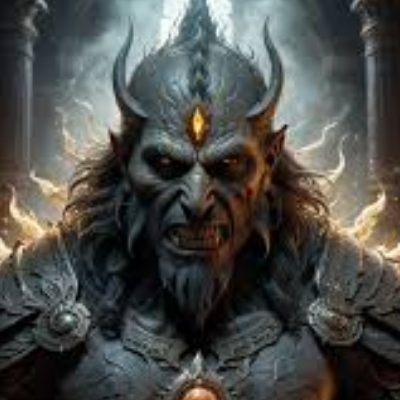
Namuchi — The Asura of the Foam-Weapon, Son-in-Law of Svarbhanu
Namuchi · Namuci · Namuki · Makhashyu · Sainhikeya (by one genealogy) · Svarbhanujamai
Namuchi is one of the most celebrated asura adversaries of Indra in the Hindu textual tradition, distinguished by his appearance in the Rigveda, the Yajurveda, multiple Brahmanas, the Mahabharata, the Bhagavata Purana, and the Matsya Purana. He is the asura who extracted a treaty of non-aggression from Indra that appeared to make him invulnerable to any weapon and at any time, and who then turned that treaty's terms against Indra by stealing the king of the gods' strength through intoxicating liquor. He was ultimately slain by Indra using the foam of water — a substance neither wet nor dry — at the hour of twilight, a time neither day nor night, thereby exploiting the precise loopholes of the covenant's language. His severed head pursued Indra as a manifestation of the sin of Brahmahatya and led to a notable episode of purification at the sacred confluence of the rivers Aruna and Sarasvati. His parentage, like that of several of his brothers, is given differently across the primary sources; in the context of this series he is placed as a son of Viprachitti and Simhika, per the Vishnu Purana's Chapter 21. He is additionally connected to this series by a marriage recorded in the Bhagavata Purana: he took as his wife Suprabha — identified with Prabha, daughter of Svarbhanu — who in that source's genealogy becomes his wife, though in the Vayu Purana and Harivamsha tradition the same Prabha is the wife of Ayus and mother of Nahusha, a direct contradiction addressed below.
✦ The Name
The name Namuchi is derived from the Sanskrit roots na meaning not and much or muc meaning to release, to let go, or to free. The compound therefore means one who does not release or one who does not let go — a name the tradition reads as deeply emblematic of Namuchi's character and role. He is the asura who does not release Indra's strength once he has taken it, who does not release himself from the gods' pursuit even when cornered, and whose very nature is the obstruction and retention of cosmic power against the divine order. The Monier-Williams dictionary records this etymology and notes the name as characteristic of asura appellations that embody the quality of their bearer's principal action. In Buddhist literature, Namuchi is identified with Mara, the personification of spiritual obstruction and death — an identification that demonstrates the name's symbolic breadth across traditions. In the Shukla Yajurveda at verses 10.33 and 10.34 he is called Namuchi of asura birth, confirming the designation across the Vedic textual stratum.
✦ Lineage
- Father (per Vishnu Purana, Chapter 21): Viprachitti — eldest of the Danava race, son of Kashyapa and Danu; king of the Danavas; the previous birth of Jarasandha of Magadha according to the Mahabharata's Adi Parva.
- Mother (per Vishnu Purana, Chapter 21): Simhika — daughter of Kashyapa and Diti; sister of Hiranyakashipu and Hiranyaksha; mother of the Sainhikeya class of asuras, of whom Svarbhanu-Rahu is the eldest.
- Father (per Mahabharata, Adi Parva, Chapter 65, verse 22): The Mahabharata's Adi Parva explicitly states that Namuchi was the son of Prajapati Kashyapa by his wife Danu — making him a Danava in the direct line of Kashyapa and Danu without the intermediate generation of Viprachitti. This is the primary epic genealogy and differs from the Vishnu Purana's placement of him as a son of Viprachitti.
- Paternal grandparents (in both accounts): Kashyapa — one of the seven primordial sages, son of Marichi and grandson of Brahma; and Danu — a daughter of Daksha and one of Kashyapa's principal wives, mother of the Danava race.
- Uncle (per Vishnu Purana genealogy through Simhika): Hiranyakashipu — the great Daitya tyrant slain by Vishnu in the Narasimha avatar. The Wisdomlib Namuci definition confirms Namuchi is described as a nephew of Hiranyakashipu in Puranic passages.
- Brothers (per Vishnu Purana): Svarbhanu-Rahu, Vatapi, Ilvala, Shalya, Nabha, Vyamsha, Khasrima, Anjaka, Naraka, Kalanabha, and Vaktrayodhi — the other sons of Viprachitti and Simhika.
- Wife (per Bhagavata Purana): Suprabha — identified with Prabha, daughter of Svarbhanu; her name means radiant or of auspicious lustre; as Svarbhanu's daughter she is Namuchi's niece in the Vishnu Purana genealogy that makes both Svarbhanu and Namuchi sons of Viprachitti by Simhika, an intra-lineage union the tradition records without comment. This identification from the Bhagavata Purana is in direct contradiction with the Vayu Purana and Harivamsha tradition that makes Prabha the wife of Ayus and mother of Nahusha — see the textual variants section below.
- Residence: The first talam or Atala, the first of the underground realms, as specified in the Wisdomlib Namuci definition drawing on Puranic geography; a fitting location for a lord of asuras who retreated to the rays of the sun when pressed and was finally killed at the shore of the cosmic ocean.
✦ Namuchi in the Rigveda and Vedic Brahmanas
The Rigveda at hymn 10.73 contains one of the earliest direct references to Indra's defeat of Namuchi, recording that Indra slew him. Rigveda 10.131 places Namuchi in association with Vritra, the great dragon-like asura who blocked the cosmic waters and was Indra's most famous adversary; Namuchi is described there as an ally of Vritra who continued to cause trouble for Indra after Vritra's defeat. The Shukla Yajurveda at verses 10.33 and 10.34 mentions the Ashvins aiding Indra in his deeds against Namuchi of asura birth, and thanks the twin physicians for their assistance in the episode. The fullest Vedic account is in the Shatapatha Brahmana, embedded in the Yajurveda, which preserves the essential narrative: through the power of sura liquor, Namuchi stole from Indra his strength, the essence of food, and the Soma drink, then the Ashvins and Sarasvati provided Indra with the means of circumventing his covenant, and Indra used foam as his weapon. The Pancavimsa Brahmana and Maitrayani Samhita also contain references to this episode, establishing that the Namuchi-Indra conflict belongs to the oldest stratum of narratable episodes preserved across multiple Vedic textual traditions.
✦ The Retreat into the Sun's Rays and the Pact
The Mahabharata's Shalya Parva narrates the pact between Indra and Namuchi in direct speech preserved in the epic's text. During a great battle between the gods and the asuras in which Namuchi led the asura forces, Indra struck down vast numbers of asura warriors but found himself unable to kill Namuchi, who remained impervious to all his attacks. Namuchi, finding himself cornered and unable to escape Indra's pressure, retreated into a ray of the Sun and concealed himself there. Indra pursued him and discovered his hiding place. From within the sun's protective radiance, Namuchi negotiated the terms of a non-aggression compact with Indra in exchange for leaving his refuge. The conditions, as stated by Namuchi and accepted by Indra, were comprehensive: I will not kill you with anything wet or dry; I will not kill you in the night or in the day; I will not kill you with my fist or with my palm; I will not kill you with staff or bow. These conditions, taken together, appeared to rule out every available weapon and every viable moment of attack.
Assured by this covenant, Namuchi emerged from the sun's ray. He then turned his advantage against Indra with calculated malice: by means of the sura liquor — the intoxicating drink not consumed by the gods — he stripped Indra of his strength, the essence of food, and the Soma drink itself. Indra was suddenly rendered weak and powerless, his divine energy drained by Namuchi's use of sura against him. Unable to act against Namuchi under the terms of his own oath, Indra sought the aid of the twin Ashvins, the divine physicians, and of the goddess Sarasvati, lamenting that his sworn enemy had taken his power from him and demanding their help in reclaiming it.
✦ The Foam Weapon and the Death of Namuchi
The Ashvins and Sarasvati devised the solution to Indra's dilemma. They provided him with a weapon made from the foam of the ocean — phena in Sanskrit — which was neither wet nor dry in the strict sense, being neither fully a liquid nor a solid. Indra then waited for the twilight hour, a liminal moment that is neither fully day nor fully night. At that transitional juncture, on the shore of the ocean where waves were breaking neither entirely on land nor entirely on water, Indra struck Namuchi with the foam-covered weapon and severed his head. The letter of every condition of the covenant had been technically observed while its spirit had been entirely violated.
The Shatapatha Brahmana and the Mahabharata agree on the essential sequence. The Mahabharata's Shalya Parva records that in another account, Mahavishnu taking the form of Indra killed Namuchi — a variant also noted in the Mahabharata — but the principal and most widely attested account is Indra acting with the foam weapon and the Ashvins' assistance. The Bhagavata Purana and Matsya Purana, cited in the Wisdomlib definition, confirm Namuchi's defeat and death at Indra's hands in the Deva-Asura war between Bali and Indra, placing the episode within the broader Puranic framework of that cosmic conflict.
✦ The Severed Head, Brahmahatya, and Purification
The consequences of the killing did not end with Namuchi's death. His severed head rose from the ground and pursued Indra relentlessly, calling him a slayer of a friend and a wretch — the charge of having violated a solemn covenant. The Mahabharata's Shalya Parva at Section 43 records this episode: Namuchi's head haunted Indra across the worlds. Namuchi, as a son of Kashyapa, was held to have brahminical ancestry — the Mahabharata passage notes this interpretation — and his killing therefore incurred for Indra the terrible sin of Brahmahatya, the slaughter of a brahmin, regardless of the asura's demonic nature.
Unable to bear the torment of the pursuing head and the burden of the sin, Indra sought counsel from Brahma the creator. Brahma directed him to bathe at the sacred confluence of the rivers Sarasvati and Aruna, a tirtha known as Arunasangama. Indra obeyed, performed sacrifices and gifts there, immersed himself in the holy waters, and was cleansed of the sin of Brahmahatya. The severed head of Namuchi also fell into the river at that moment, and through this contact the asura was granted access to eternal regions in recognition of his having undergone what the tradition treats as a form of sacrifice. From that episode onward, Arunasangama was consecrated as a place of pilgrimage with particular power for the purification of sins. The Mahabharata's Shalya Parva records that Baladeva bathed at this tirtha during his pilgrimage and obtained great merit.
✦ The Episode in the Bhagavata Purana — Devashura War of Bali and Indra
The Bhagavata Purana's Skandha VIII contains the most extended Puranic account of Namuchi's role, placing his combat with Indra within the great Deva-Asura war in which the asura king Bali fought Indra for dominion of the three worlds. In this account Namuchi is explicitly identified as a son of Viprachitti and a lord of asuras hostile to Indra. He is described as a resident of Atala, the first of the underground realms. He participated in the battle at Bali's side, and when the asura forces experienced reverses, Namuchi confronted Indra directly. The Bhagavata Purana's account confirms that he could not be killed by either a dry or a wet weapon, and that Indra ultimately learned through a voice in the air to use foam and thereby overcame him. The Matsya Purana at Chapter 22 verse 61 confirms the same episode. The Wisdomlib compilation notes additionally that in the Bhagavata Purana's account Namuchi was eventually taken to Patala by Vamana — the dwarf avatar of Vishnu who measured the three worlds and dispossessed Bali — in the aftermath of the war, suggesting that in some Puranic recensions he survived the encounter with Indra and was subsequently subjugated rather than killed outright, a variant that further complicates the death accounts.
✦ The Padma Purana Account
The Padma Purana gives a distinct narrative in which Namuchi serves as a captain in the army of the asura king Hiranyaksha. In this account he fights Indra directly, briefly renders him unconscious, and causes Indra's elephant Airavata to thrust its tusks into the ground. He then uses his magical powers to summon an army of monstrous creatures. Vishnu intervenes and destroys Namuchi's created army with the Sudarshana Chakra. Ultimately Indra delivers the killing blow. This Padma Purana version places the episode differently in terms of which asura king Namuchi serves, and in terms of Vishnu's direct role — here Vishnu intervenes with the Chakra, which is not found in the Mahabharata and Shatapatha Brahmana accounts. The core outcome — Indra kills Namuchi — is consistent across all versions.
✦ Textual Variants and Inconsistencies
The parentage of Namuchi presents the same divergence found across the Sainhikeya group. The Mahabharata's Adi Parva at Chapter 65 verse 22 gives him as a son of Kashyapa by Danu directly — a full Danava. The Vishnu Purana Chapter 21 places him as a son of Viprachitti and Simhika — one generation further down through the combined Danava-Daitya line. Both placements ultimately derive from Kashyapa, but through different wives and different intermediate generations. These two genealogical positions are irreconcilable within the primary sources, and this profile adopts the Vishnu Purana placement for consistency with the series while acknowledging the Mahabharata's primary testimony.
The marriage of Namuchi to Suprabha or Prabha, daughter of Svarbhanu, is attested in the Bhagavata Purana and in the Wisdomlib Namuci definition drawing on that source. However, the Wilson footnote to Vishnu Purana Chapter 21 notes explicitly: the Bhagavata makes Prabha the wife of Namuchi; according to the Vayu, she is the mother of Nahusha. The Harivamsha at Chapter 28 verses 1 and 9 states unambiguously that Prabha, Svarbhanu's daughter, was the wife of Ayus the son of Pururavas and mother of Nahusha and his four brothers. These two primary-source assignments — Prabha as wife of Namuchi per the Bhagavata Purana, and Prabha as wife of Ayus per the Vayu Purana and Harivamsha — cannot be reconciled. The genealogical series has previously established Prabha's marriage to Ayus and role as Nahusha's mother through the Harivamsha, which is the more explicit and detailed account. The Bhagavata Purana's identification of Prabha as Namuchi's wife represents a separate tradition that is recorded here as a textual variant without suppressing either claim.
The question of whether Namuchi was killed at the Namuchi-Indra battle, or survived to be taken to Patala by Vamana in the later Bali-Indra war, is also unresolved across the Puranic corpus. The Mahabharata, Shatapatha Brahmana, and Rigveda accounts uniformly treat his decapitation as fatal. The Bhagavata Purana's reference to him being taken to Patala by Vamana implies a later presence that the Mahabharata account does not provide for.
✦ Namuchi in Buddhist Literature
The name Namuchi passed from the Hindu tradition into Buddhist canonical literature as a standard name for Mara, the figure of spiritual obstruction, temptation, and death who sought to prevent Siddhartha Gautama from attaining enlightenment. The etymology — one who does not let go — translates naturally into the Buddhist context, where Mara is the force that does not release beings from the cycle of rebirth and suffering. The identification is attested in the Pali canon and in Sanskrit Buddhist texts including the Lalitavistara and the Mahavastu. This cross-traditional adoption confirms that Namuchi's name carried a weight of symbolic significance reaching well beyond his specific Puranic and Vedic narrative role.
✦ Theological and Cosmological Significance
The Namuchi episode in its Shatapatha Brahmana and Mahabharata forms occupies a distinctive theological position in the tradition. It is one of the clearest cases in the Vedic and epic record of a god — Indra, no less, the king of the devas — incurring the sin of Brahmahatya and requiring purification. Unlike many episodes in which Indra's power and righteousness are affirmed without qualification, the Namuchi story presents Indra as bound by his own oath, weakened by the asura he bound himself to, forced to find a legal loophole to escape his own commitment, and burdened with sin by the manner of his victory. The tradition does not suppress this moral complexity: Indra's guilt is stated plainly, the severed head's curse is validated, and the purification is required. The episode thus functions as one of the tradition's demonstrations that even divine power operates within a framework of cosmic obligation, and that victory gained through the exploitation of a technicality rather than through straightforward righteousness leaves a residue of spiritual debt that must be addressed.
✦ Connection to the Wider Genealogy
In the genealogical context of this series, Namuchi sits at the junction of two of its most significant threads. Through his parents Viprachitti and Simhika he is a brother of Svarbhanu, whose daughter Prabha is the ancestress of Nahusha, Yayati, the Pandavas, and the Kauravas through the Chandravamsha. If the Bhagavata Purana's account of his marriage to Suprabha-Prabha is accepted as a parallel tradition, he is simultaneously both a brother of Svarbhanu and a son-in-law of Svarbhanu through two different generations of the same lineage — an entanglement of relationship that the primary texts do not address and that the contradictory assignments of Prabha's marriage across different Puranas leave unresolved. His defeat by Indra using foam and his posthumous contribution to the sacred geography of the Arunasangama tirtha add a further dimension: the asura's demise, like those of Vatapi and Namuchi's own brother Svarbhanu, becomes the occasion and the instrument of a permanent cosmic institution — in this case a place of pilgrimage where Brahmahatya can be purified.
✦ References
- Rigveda, Hymn 10.73: Records Indra's slaying of Namuchi in passing; one of the earliest textual references to the episode.
- Rigveda, Hymn 10.131: Places Namuchi in association with Vritra as an asura adversary of Indra.
- Shukla Yajurveda, verses 10.33–34: Names Namuchi of asura birth and records the Ashvins' role in aiding Indra against him.
- Shatapatha Brahmana (embedded in the Yajurveda): Contains the fullest Vedic narrative of the episode; records Namuchi's theft of Indra's strength through sura liquor, Indra's appeal to the Ashvins and Sarasvati, the provision of the foam-vajra, and the killing at twilight on the ocean shore; the primary Vedic prose source for the story.
- Pancavimsa Brahmana, Chapter 12.6.8; Maitrayani Samhita, IV.34; Taittiriya Brahmana, 1.7.1.6: Additional Brahmana references confirming the spread of the Namuchi episode across the Vedic literary corpus.
- Mahabharata, Adi Parva, Chapter 65, verse 22: States that Namuchi was the son of Prajapati Kashyapa by his wife Danu; the primary epic genealogical source placing him as a direct Danava.
- Mahabharata, Shalya Parva, Section 43: Narrates the full episode in the context of Baladeva's pilgrimage; records the covenant between Indra and Namuchi, the theft of Indra's strength, the foam weapon, the killing at twilight, the pursuit by the severed head, and Indra's purification at Arunasangama; the most extensive epic treatment.
- Vishnu Purana, Book I, Chapter 21: Lists Namuchi among the sons of Viprachitti by Simhika; the genealogical source adopted in this series.
- Bhagavata Purana, Skandha VII, Chapter 2, verse 4; Skandha VIII, Chapters 10–11: Places Namuchi in the Deva-Asura war between Bali and Indra; confirms his parentage from Viprachitti; names Suprabha-Prabha as his wife; describes his being taken to Patala by Vamana as a variant of his end.
- Matsya Purana, Chapter 22, verse 61: Confirms Namuchi's death at Indra's hands using foam; one of the Puranic sources cited in the Wisdomlib definition.
- Padma Purana: Gives the variant account in which Namuchi is a captain in Hiranyaksha's army, fights Indra, briefly renders him unconscious, and is killed after Vishnu destroys his created army with the Sudarshana Chakra.
- Vishnu Purana, Chapter 21, Wilson translation footnote: Modern scholarly apparatus; explicitly records the contradictory assignment of Prabha as wife of Namuchi per the Bhagavata versus wife of Ayus and mother of Nahusha per the Vayu Purana; the key source for identifying this textual inconsistency.
- Harivamsha, Adi Parva, Chapter 28, verses 1 and 9: Names Prabha, daughter of Svarbhanu, as the wife of Ayus and mother of Nahusha and his brothers; the controlling primary statement for Prabha's marriage in this genealogical series.
- Vettam Mani, Puranic Encyclopaedia (1975): Modern reference; consolidates all primary source references for Namuchi including the killing episode, the Brahmahatya, and the purification at Arunasangama.
- Wisdomlib.org, Namuci definition entry: Modern reference; compiles the Bhagavata Purana, Matsya Purana, and other sources confirming Namuchi's son-of-Viprachitti genealogy, his residence in Atala, his marriage to Suprabha, and his defeat in the Bali-Indra war; notes the identification with Mara in Buddhist literature.
- Wikipedia, Namuchi article: Modern secondary reference; provides the Rigvedic, Brahmana, and Puranic attestation survey and notes the Brahmahatya episode and purification at Arunasangama.
- Monier-Williams Sanskrit-English Dictionary: Modern reference; establishes the etymology of Namuchi from na and much as one who does not release; confirms the application of the name to Mara in Buddhist usage.