
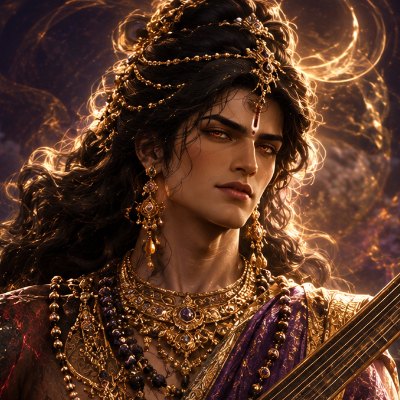
About
Vasuruci — Yaksha Progenitor, Father of Rajatanabha
Vasuruci · Vasuruci the Yaksha
Vasuruci is a figure recorded in the Vayu Purana and the Brahmanda Purana as the patriarch of a Yaksha genealogical line that extends through his son Rajatanabha to the prominent Yaksha figures Manivara, Manibhadra, and Manidhara. He is identified in the Vayu Purana's genealogy of Yaksha lineages simply as the Yaksha husband of the Apsara Kratusthala and father of Rajatanabha. The Brahmanda Purana (III.7.60, 100–117) provides a considerably more complex account in which a being described as a Rakshasa — a son of Khasha who bears the appellation "Yaksha" — takes the form of Vasuruci to live with Kratusthala in the Nandana garden. These two accounts present genuinely different pictures of Vasuruci's identity and must be stated separately. Beyond his role as the starting point of this particular genealogical chain, Vasuruci does not appear in narrative episodes in the primary sources consulted, and no details of his own lineage beyond the broad category of his kind are recorded in the texts. This profile is accordingly kept brief in honest reflection of that limited base.
✦ The Name
The Sanskrit compound vasuruci is formed from vasu (wealth, brilliance, a class of benevolent divine beings, or simply "good") and ruci (brightness, radiance, desire, or taste). The name therefore carries meanings such as "having the radiance of wealth," "delighting in the good," or "of brilliant splendour." The Vasus as a class of deities — the eight Ashtavasus — and their qualities of luminosity and beneficence are well attested in Vedic literature, and the name Vasuruci draws on this register of brightness and auspicious abundance.
✦ Lineage and Identity: Two Accounts
The primary sources present two distinct and irreconcilable accounts of Vasuruci's nature and origin, and both must be stated clearly.
The Vayu Purana tradition treats Vasuruci straightforwardly as a named Yaksha, the founding male figure of the Vasuruci–Kratusthala genealogical line from which Rajatanabha and his sons descend. In this account, summarised in the Vayu Purana's detailed Yaksha genealogy, Vasuruci is a Yaksha who entered into a union with the Apsara Kratusthala and fathered Rajatanabha. No parentage for Vasuruci himself is given in this tradition. He functions as the starting point of the lineage, unnamed as to his own origin.
The Brahmanda Purana tradition (III.7.60 and 100–117), as recorded in the Wisdomlib "Yaksha" definition entry, presents a substantially different narrative. In this account, a being called "Yaksha" — described as a Rakshasa and a son of Khasha — assumed the form of Vasuruci and lived with the Apsara Kratusthala in the Nandana garden, the celestial grove of Indra. Kratusthala bore this being a son named Rajatanabha. When Kratusthala eventually learned that her partner was in reality a Rakshasa and not the Yaksha Vasuruci whose form he had assumed, she separated from him; the Rakshasa then took the newborn Rajatanabha to the Himalayas. In this version, "Vasuruci" is not the true identity of the father but a disguise adopted by a Rakshasa figure. The Rakshasa's parentage is given as a son of Khasha — Khasha being one of the wives of the primordial sage Kashyapa, whose children are identified in the Puranic genealogical tradition as the Yakshas and Rakshasas born of Kashyapa's union with that wife.
These two accounts cannot be reconciled within the primary sources themselves. The Vayu Purana treats Vasuruci as a genuine Yaksha patriarch; the Brahmanda Purana treats "Vasuruci" as a disguise adopted by a Rakshasa. Most likely the two texts preserve different stages of a tradition that was not fully harmonized when the Brahmanda Purana elaborated a more detailed mythological framing around what was originally a simpler genealogical entry.
✦ Lineage
- Father (Brahmanda Purana account only): Kashyapa — the primordial sage, son of Marichi who was a mind-born son of Brahma; the great cosmic progenitor through whose many wives the gods, demons, Nagas, Gandharvas, Yakshas, and all other classes of beings were born. In this tradition, the Rakshasa who assumes the form of Vasuruci is a son of Kashyapa through his wife Khasha.
- Mother (Brahmanda Purana account only): Khasha — one of the wives of Kashyapa, a daughter of the Prajapati Daksha; the Harivamsha and the Vishnu Purana identify Khasha as the mother of the Yaksha and Rakshasa races through Kashyapa — a tradition that frames both classes as siblings of a single parentage.
- Consort: Kratusthala (also Kratusthali, Pancachuda) — an Apsara; named in both the Vayu Purana and the Brahmanda Purana as the mother of Rajatanabha through her union with Vasuruci (or the being who assumed his form). The same Kratusthala later appears in the genealogy as the mother of Devajani, who became the wife of Rajatanabha's own son Manivara — making Kratusthala both the consort of Vasuruci and the maternal grandmother of Manivara's wife within this lineage.
- Son: Rajatanabha — a Yaksha; the only recorded child of Vasuruci and Kratusthala; father of Manivara, Manibhadra, and Manidhara through his wife Bhadra, the Daitya princess daughter of Anuhlada, and progenitor of the Guhyaka class of supernatural beings through his son Manivara. Rajatanabha is also the figure credited in Atharvaveda commentarial tradition with milching the earth on behalf of the Yaksha race, with Kubera as their calf.
✦ The Brahmanda Purana Narrative: Yaksha as Son of Khasha
The Brahmanda Purana passage cited in the Wisdomlib "Yaksha" definition entry provides a distinctive origin for the Rakshasa who assumes the form of Vasuruci. This being is described as a son of Khasha — a wife of Kashyapa whose children are the Yakshas and Rakshasas in the Puranic genealogical scheme. The passage describes him as having four hands and four feet and a fearful appearance, wandering at night; he bore the appellation "Yaksha" itself, used here as a proper name or class designation. He took the form of the Yaksha Vasuruci specifically to gain access to the celestial Nandana garden and to the Apsara Kratusthala who dwelt there. This narrative is unusual in the Puranic tradition in that it makes the founding figure of a Yaksha genealogical line a disguised Rakshasa rather than a genuine Yaksha — a feature that may reflect an older mythological layer in which the Yaksha and Rakshasa categories were less sharply distinguished, or a deliberate compositional choice in the Brahmanda Purana to explain the partially monstrous character attributed to this particular lineage in contrast to the more benevolent Yaksha families.
✦ The Yaksha Race and Its Origins in the Puranic Tradition
Vasuruci's placement within the broader Yaksha genealogical tradition requires a brief note on how the Puranas account for the origin of the Yaksha race as a class. Several different origin accounts coexist in the texts without reconciliation. The Harivamsha (drawing on the tradition attributed to the sage Kashyapa through his wife Khasha) states that Khasha gave birth to the Yakshas and Rakshasas jointly — making both classes siblings descending from Kashyapa and Khasha. The Vishnu Purana's genealogical lists confirm Khasha among Kashyapa's wives with the same offspring. The Vayu Purana's individual Yaksha family genealogies present named founders of specific lineages — of whom Vasuruci is one — without always tying them explicitly to the Khasha–Kashyapa descent. The Brahmanda Purana's more elaborate narrative of the Rakshasa assuming Vasuruci's form attempts, in its own way, to bridge the Rakshasa origin (from Khasha) and the Yaksha lineage that follows, without fully harmonizing the two frameworks. Vasuruci sits precisely at this junction in the tradition.
✦ References
- Primary Sources
- Brahmanda Purana, III.7.60 and III.7.100–117: The most detailed primary source for Vasuruci; gives the narrative of a Rakshasa son of Khasha taking the form of Vasuruci, living with the Apsara Kratusthala in Nandana, fathering Rajatanabha, and then departing to the Himalayas with the son when his true nature was discovered.
- Brahmanda Purana, III.22.14, III.41.30, III.71.111: Further citations of the same narrative cluster in the Wisdomlib Purana Index entry on Yaksha, confirming the Brahmanda Purana's consistent treatment of this tradition across multiple chapters.
- Vayu Purana, chapter 69 (verse context cited in Wisdomlib): Provides the parallel genealogical account treating Vasuruci as a named Yaksha founder of the Rajatanabha line, paired with the Apsara Kratusthala.
- Harivamsha, I.3 (Kashyapa's lineage section): States that Khasha, wife of Kashyapa, gave rise to the Yaksha and Rakshasa races jointly — establishing the cosmological frame within which the Brahmanda Purana's account of the Rakshasa son of Khasha assuming Vasuruci's form is set.
- Vishnu Purana, Amsha 1 (Kashyapa's wives section): Lists Khasha among Kashyapa's wives as mother of Yakshas and Rakshasas, corroborating the cosmological parentage framework.
- Secondary Sources
- Wisdomlib.org, "Yaksha" definition entry (Purana glossary, citing Shiva Purana translation): Provides the compact summary of the Brahmanda Purana narrative (III.7.60, 100–117) describing the Rakshasa who assumed the form of Vasuruci, his union with Kratusthala, and the birth and relocation of Rajatanabha — the sole secondary source found to address Vasuruci's identity directly.
- Culturalheritageofbharat.blogspot.com, "Yaksha and Yakshini" (drawing on Vayu Purana): Identifies Vasuruci as the Yaksha founder paired with Kratusthali at the head of the Vasuruci–Kratusthali genealogical family, the first of the notable Yaksha family lineages listed in the Vayu Purana's Yaksha genealogical section.
- Vettam Mani, Puranic Encyclopaedia (Motilal Banarsidass): Referenced indirectly through the Wisdomlib secondary apparatus for cross-referencing the Khasha–Kashyapa tradition and the genealogy of Yaksha lineages.