
About
The Timis — Aquatic Progeny of Timi and Kashyapa, Great Beings of the Waters
Timi · Timayah (plural) · the whale-beings · eldest order of the aquatic creation · born of Timi and Kashyapa
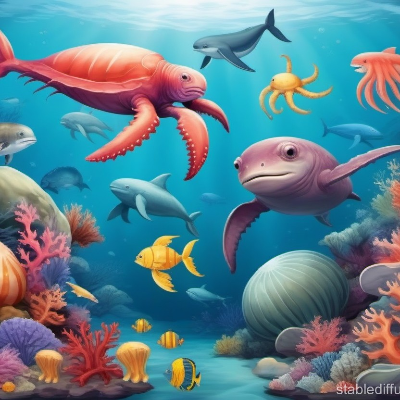
The Timis are the primordial aquatic beings born of the union of Timi — daughter of Daksha and wife of Kashyapa — and the Prajapati sage Kashyapa himself. They stand at the foundation of the entire order of aquatic creatures in the Sanskrit cosmogonic tradition, as Timi's womb is declared in the Bhagavata Purana to be the source of all the yadogana — all beings of the waters. Within this vast class, the Timis are the foremost: the great whale-beings, colossal marine creatures of fabulous scale, whose name gives the mother-figure her identity and whose existence defines the aquatic hierarchy that culminates in the even more fearsome Timingila and Timitimingila. In classical Sanskrit, timi (तिमि) simultaneously designates both Kashyapa's wife and the creature type she produces — a transparency of naming that follows the pattern seen in the Krodhavasha lineage, where Mrigi (deer-mother) produces mrigas, Matangi (elephant-mother) produces matangas, and Sharduli (tiger-mother) produces shardulas. Here, Timi the whale-mother produces the timis.
✦ The Name
Timi is both a proper noun — the name of the wife of Kashyapa — and a common noun denoting a class of enormous aquatic beings. The Monier-Williams Sanskrit-English Dictionary records timi as "a fabulous fish of great size; a whale; the ocean" and gives specific attestations in the Mahabharata, Harivamsha, Ramayana, and Bhagavata Purana. The Yates Sanskrit-English Dictionary gives the same: "a fabulous fish of great size; a whale; the ocean." Tamil and Nepali cognate usages confirm the same root meaning — an aquatic animal of enormous size. As the plural timayah (or Timis), the beings born of this mother-figure are the entirety of the whale-like, colossal-fish class — the progenitors not merely of ordinary fish but of the greatest and most fearsome creatures of the deep. The Amarakosha (5th century CE), the authoritative Sanskrit lexicographical text, lists timi and timingila together as the two premier categories of marine megafauna in its classification of aquatic creatures.
✦ Lineage
- Maternal grandmother: Daksha Prajapati — father of Timi, one of the sixty daughters he gave in marriage to various cosmic progenitors.
- Mother: Timi — a daughter of Daksha and one of Kashyapa's wives, named in the Bhagavata Purana VI.6.25–26 as the thirteenth in the list of Kashyapa's thirteen wives by Daksha's daughters, and identified as the mother of all aquatic beings. The Mahabharata's Adi Parva also lists Timi among Kashyapa's wives (Daksha Wikipedia, citing the Mahabharata).
- Father: Kashyapa — the foremost Prajapati, son of Marichi and grandson of Brahma, through whom all orders of cosmic beings came into existence.
- Maternal aunts (co-wives of Kashyapa): Aditi, Diti, Danu, Krodhavasha, Sarama, Tamra, Surabhi, Muni, and others — each the progenitrix of a different cosmic order.
- Nature and scope: The Timis are the entire yadogana — the aquatic race. The Bhagavata Purana VI.6.26 states: timeryadadgana asan — "from Timi were the aquatics." Within this broad class, the primary beings are the great whale-like creatures (the Timis proper), whose offspring include the even larger Timingilas and then the Timitimingilas. The Sushruta Samhita lists the timi at the head of the family of marine creatures, followed immediately by the timingila.
✦ The Timis in the Primary Texts
The Timis appear throughout the epic and Puranic literature as a byword for incomprehensible oceanic scale. The Mahabharata's Vana Parva (168.3) names them in conjunction with Timingilas and Timitimingilas in a description of what lies beneath the great waters: timingilah kacchapascha tatha timi timingilah / makarscha atra drishyante jale magna ivadrayah — "there were seen Timingilas, tortoises, Timi-Timingilas and Makaras, like great rocks submerged in the water." Here Timi (singular or as a class) is listed alongside the Timingila and the Timitimingila. The Ramayana's Yuddha-kanda (4.114) describes the ocean between India and Lanka as "abounding with whales and Timingila." The Bhagavata Purana (XII.9.16) uses Timingila alongside Makara as the creatures that assault the sage Markandeya during his visionary journey through the waters of cosmic dissolution. The Sushruta Samhita (Chapter 45) opens its classification of marine creatures: "The Timi, Timingila, Kulisha, Pakamatsya, Nirularu, Nandi-Varalaka, Makara..." — listing timi and timingila as the two foremost categories of sea life. In the Vishnu-Sahasranama of the Skanda Purana, Timiṅgila appears as one of the thousand epithets of Vishnu (Skanda Purana, Avantikshetra-mahatmya, verse 81), in the sequence Maharnava (great ocean) — Mahamatsya (great fish) — Timingila (whale-swallower), indicating that the Timingila's enormity was used to evoke the supreme presence of the divine in the depths of the universe.
✦ The Aquatic Hierarchy: Timi, Timingila, Timitimingila
The Sanskrit tradition establishes a three-tier hierarchy of aquatic scale with the Timi, Timingila, and Timitimingila. The Timi is the whale-being — immense by any ordinary standard, a creature whose very name stands for "the ocean" in some lexical usages. Above it in scale is the Timingila: the whale-swallower, a being large enough to consume a Timi whole. Above even that is the Timitimingila: the swallower of the whale-swallower. The Pali Text Society dictionary notes this compound hierarchy explicitly: "timitimingala — a fisheater, reduplicated as intensified; meaning greedy or monstrous fisheater." In Sanskrit the same structure generates timi → timingila → timitimingila, each level swallowing the one below. The Mahabharata Vana Parva verse lists all three in a single passage, confirming that this was a recognised tripartite cosmological schema, not merely a literary figure. In Buddhist Pali texts (Vinaya II.238, Anguttara IV.200), timingila appears as the largest fish in existence, further confirming that this being was understood cross-traditionally as the apex predator of the aquatic realm.
✦ The Timitimingila Nyaya
The three-tier hierarchy of Timi, Timingila, and Timitimingila gave rise to a philosophical maxim in Sanskrit literature: the Timimgila-nyaya or Timitimingila-nyaya, the "maxim of the whale-swallower." It is used in various Sanskrit texts to express the principle of larger powers consuming smaller ones, hierarchical absorption, or the idea that what seems itself immense is nonetheless susceptible to an even greater force. The Wisdomlib full-text index for timi includes the entry "Timimgilanyaya" and "Timimgilarashi," confirming that the logic of the three-tier aquatic hierarchy became a recognised technical device in Sanskrit philosophical and literary reasoning. This nyaya is one of the notable secondary contributions of the Timi cosmogony to the broader Sanskrit intellectual tradition — illustrating how a cosmogonic genealogical scheme became a tool of philosophical argumentation.
✦ The Timis and the Cosmic Ocean
The Timis and their offspring are not merely zoological types in the Sanskrit imagination but are intimately connected to the conception of the cosmic ocean — the waters of dissolution and of creation that frame the Puranic world-view. The Bhagavata Purana's vision of Markandeya adrift in the waters of universal dissolution, assailed by Makaras and Timingilas, is one of the most dramatic passages in Puranic literature, using these great sea creatures to convey the terror and immensity of the primal waters. In the Skanda Purana's Vishnu-Sahasranama, the Timingila appears alongside the Makara and the ocean itself as an epithet of Vishnu — the supreme being who contains and transcends even the greatest powers of the deep. Timi as the mother of all aquatics thus occupies a cosmologically fundamental role: she is the origin of the life that inhabits the primordial waters from which creation emerges and into which it dissolves.
✦ References
- Primary Sources
- Bhagavata Purana VI.6.25–26: The genealogical chapter listing Timi among Kashyapa's thirteen wives by Daksha's daughters, and stating timeryadadgana asan — "from Timi were the aquatics."
- Mahabharata, Vana Parva 168.3: The passage listing Timingilas, tortoises, Timi-Timingilas, and Makaras together in the ocean, establishing the three-tier hierarchy.
- Valmiki Ramayana, Yuddhakanda 4.114: Describes the ocean as abounding with whales (timi) and Timingila.
- Bhagavata Purana XII.9.16: Markandeya attacked by Makaras and Timingila in the cosmic dissolution waters.
- Sushruta Samhita, Chapter 45: Lists timi and timingila at the head of the family of marine fish.
- Skanda Purana, Vishnu-Sahasranama (Avantikshetra-mahatmya, verse 81): Timingila as one of Vishnu's thousand epithets, placed in the cosmic ocean sequence.
- Amarakosha I.10.19: Timi and timingila listed together as premier marine creatures.
- Secondary Sources
- Wisdomlib.org, "Timi: 24 definitions": The Puranic Index entry (Bhagavata Purana) and the Monier-Williams/Yates lexicographical definitions; the full-text index including Timingila, Timitimingila, Timimgilanyaya, and related compounds.
- Wisdomlib.org, "Timingila: 19 definitions": Cross-references across Buddhism (Mahayana, Pali), Jyotisha, Puranic, and Hinduism glossaries; Tibetan translation "swallower of tinmi"; Amarakosha I.10.19 citation.
- Wisdomlib.org, "Timingala: 7 definitions": Pali Text Society dictionary: "timitimingala — a monstrous fisheater, the largest fish in existence; a fisheater reduplicated as intensified."
- Gosai.com / Swami Narasingha, "Timingila — Myth or Fact?": Comprehensive compilation of all primary text citations (Bhagavatam 12.9.16, Ramayana Yuddhakanda 4.114, Mahabharata Vana Parva 168.3, Sushruta Samhita Ch.45) with Sanskrit verses and translation.