
About
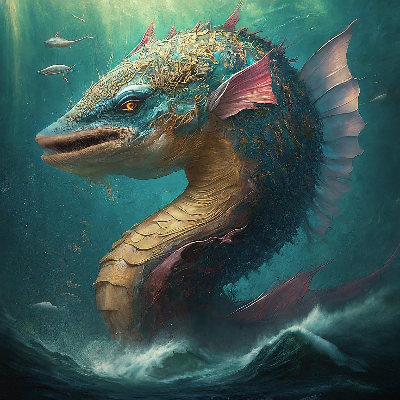
Timingila — Daughter of Timi and Kashyapa, Progenitrix of the Timitingilas, the Whale-Swallower
Timingila · Timimgila · daughter of Timi · progenitrix of the Timitimingilas · the swallower of whales
Timingila occupies the middle position of the three-tier aquatic hierarchy that descends from Timi and Kashyapa. As the second generation — a daughter of Timi rather than Timi herself — she follows the two-generation genealogical structure seen elsewhere in the Kashyapa lineage (notably in the avian line of Tamra, where Tamra bears daughters who in turn bear the birds), by which the most extreme or specialised members of a zoological order are assigned to the second generation rather than the first. Timingila's progeny, the Timitimingilas, are the apex predators of the Sanskrit cosmogonic ocean — beings of such scale that they devour the Timingilas whole, just as the Timingilas themselves devour the Timis. The name is transparent: timi (whale) + gila (swallower) = the being that swallows whales. In the Sanskrit tradition, this name is simultaneously a zoological designation, a cosmological symbol, a philosophical maxim, and — in the Skanda Purana's Vishnu-Sahasranama — one of the thousand names of Vishnu himself.
A textual clarification is required. The genealogical framing of Timingila as a named daughter of Timi who then bears the Timitingila class follows a two-generation Tamra-type structure recorded in the prior profile. The Bhagavata Purana VI.6.26 ascribes the whole yadogana to Timi without subdivision into named daughters. The Vishnu Purana Chapter XXI (H.H. Wilson translation) omits Timi entirely from its list of Kashyapa's wives. The two-generation structure — Timi → Timingila (daughter) → Timitimingilas — is consistent with the Puranic genealogical method applied to the avian lineage (Tamra → Shuki/Shyeni etc. → parrots/eagles etc.) but is not directly attested as such in a single surviving verse of a primary text in the sources consulted. The Timingila is attested copiously as a creature class across the epics and Puranas; its status as a named genealogical daughter of Timi rests on the secondary systematisation of the Puranic tradition. This profile covers what is known of the Timingila from primary sources and notes the genealogical framing honestly.
✦ The Name
Timingila is a Sanskrit compound: timi (whale, great fish) + gila (swallowing, from the verbal root gilati — to swallow). The compound thus means "swallower of the timi" or "the one that swallows whales." The derivation is confirmed across all sources without variation: the Gosai.com Timingila article states the etymology as settled; the Wisdomlib Timingala definition confirms "timi + gila = fisheater, monstrous fisheater"; the Tibetan translation na-mid (via the Mahaprajnaparamita Shastra) gives "swallower of tinmi" (tinmi being the Tibetan for timi). In Sanskrit this kind of compound names a creature by its prey — as Garuda (the eagle) is the serpent-eater, so the Timingila is the whale-eater. The name thus implies a cosmological inversion: that which seemed the greatest of fish — the timi — is itself only prey in the eyes of a still-greater being. The Kannada gloss on Wisdomlib confirms: "a large aquatic mammal that is believed to feed on whales."
✦ Lineage
- Grandfather: Daksha Prajapati — through whose daughter Timi the aquatic race descended from Kashyapa.
- Father: Kashyapa — the foremost Prajapati, progenitor of all cosmic orders.
- Mother: Timi — the great whale-mother, daughter of Daksha and wife of Kashyapa, from whose womb all aquatics were born (Bhagavata Purana VI.6.26).
- Siblings: The Timis — the primary aquatic beings, the great whale-like creatures. Timingila is the second-generation specialist: where the Timis are the great whale race, Timingila is the progenitrix of a being even larger that preys on them.
- Progeny: The Timitimingilas — the beings that swallow the Timingilas whole, as the Timingilas swallow the Timis. These are the apex beings of the Sanskrit cosmogonic ocean, standing at the extreme limit of conceivable aquatic scale.
✦ The Timingila in the Primary Texts
The Timingila's textual record in the Sanskrit epics and Puranas is among the richest of any non-anthropomorphic creature in the tradition. The four primary citations, already given in the Timis profile above, are worth restating in the context of Timingila's specific identity. The Mahabharata Vana Parva (168.3) is the most comprehensive single verse: it lists timingilas, tortoises, timi-timingilas (Timitimingilas), and Makaras all together as creatures of colossal oceanic scale, distinguishing the Timingila from the yet-larger Timitimingila. The Ramayana Yuddhakanda (4.114) pairs timi and timingila as the fearsome inhabitants of the ocean between India and Lanka, their presence marking the waters as belonging to a different order of danger than anything on land. The Bhagavata Purana XII.9.16 is the most vivid narrative encounter: the sage Markandeya, cast adrift in the waters of cosmic dissolution, is attacked by Makaras and Timingilas amid total darkness — the creatures here function as the most extreme manifestation of the primal, pre-ordered chaos that the cosmic ocean represents. The Sushruta Samhita places timi and timingila at the head of the marine creature family in its classification of animal-based medicinal substances — giving them a zoological-medical reality distinct from pure mythology.
✦ Timingila as a Name of Vishnu
The Skanda Purana's Vishnu-Sahasranama (Avantikshetra-mahatmya, verse 81) lists Timingila as one of the thousand names of Vishnu, in the sequence: Maharnava (great ocean) — Mahamegha (great cloud) — Mahamatsya (great fish) — Timingila (whale-swallower). This sequence moves from the cosmic ocean to the most fearsome of its inhabitants, and identifies the Timingila with Vishnu in his aspect as the being who encompasses and transcends the very greatest forces of the physical world. The placement of Timingila between Mahamatsya and Ananta (the cosmic serpent) in this sahasranama sequence connects the whale-swallower to the entire archetype of the divine as the ocean's depth — expressed also in the Matsya avatar of Vishnu, the great fish of the cosmic dissolution. The identification of the Timingila as an epithet of Vishnu elevates the cosmogonic creature from the genealogical lineage of Timi and Kashyapa to a theological-symbolical function: the being that swallows the greatest is itself an image of the supreme.
✦ Timingila in Buddhist Literature
The Timingila appears in Buddhist canonical literature as early as the Pali Vinaya (II.238) and Anguttara Nikaya (IV.200), where timitimingala — the Pali form of the Sanskrit compound — is described as "the largest fish in existence." The 5th century CE Buddhist agricultural manual Vajratunda Samaya Kalparaja lists Timingilas among the creatures of a sacred lotus lake. The 2nd century CE Mahaprajnaparamita Shastra (Chapter 13) identifies Timingila in Tibetan as na-mid, "the swallower of tinmi." This cross-traditional attestation in early Buddhist texts — geographically and compositionally independent of the Hindu Puranic tradition — suggests that the Timingila was not a late theological invention but had roots in the shared aquatic natural history and cosmological imagination of the ancient Indian world. The creature's presence in multiple independent traditions reinforces its status as one of the most consistently attested fabulous beings in classical South Asian literature.
✦ The Timitimingila: Progeny of Timingila
Timingila's own progeny — the Timitimingilas — represent the ultimate extension of the scale logic that runs through the aquatic hierarchy. The compound timi + timingila produces timitimingila: the being that swallows the whale-swallower. The Mahabharata Vana Parva lists this creature as a distinct being alongside the Timingila, confirming that the three tiers (timi, timingila, timitimingila) were already distinguished at the epic level, not merely in later Puranic elaboration. The Pali tradition gives the same three tiers: timi, timingila, timitimingila (or in Pali, timitimingala). The Sushruta Samhita tradition includes a further compound, timingilagila, that takes the recursion one step further — a being that swallows even the timitimingila — but this fourth level is not widely attested. The three-tier system timi → timingila → timitimingila is the standard articulation across texts and became the basis of the Timimgila-nyaya, the philosophical maxim of hierarchical absorption discussed in the Timis profile above.
✦ References
- Primary Sources
- Mahabharata, Vana Parva 168.3: Sanskrit verse naming timingilas, timi-timingilas, and Makaras as distinct oceanic beings of colossal scale, confirming the three-tier hierarchy.
- Valmiki Ramayana, Yuddhakanda 4.114: Timi and Timingila together in the description of the ocean between India and Lanka.
- Bhagavata Purana XII.9.16: Markandeya attacked by Timingilas and Makaras in the waters of cosmic dissolution.
- Sushruta Samhita, Chapter 45: Timi and Timingila at the head of the marine creature family; timingilagila as a further extension.
- Skanda Purana, Avantikshetra-mahatmya, verse 81: Timingila as one of the thousand names of Vishnu.
- Vinaya II.238; Anguttara Nikaya IV.200 (Pali Canon): Timingala as the largest fish in existence.
- Mahaprajnaparamita Shastra, Chapter 13 (2nd century CE): Tibetan identification of Timingila as na-mid, "swallower of tinmi."
- Amarakosha I.10.19: Timi and Timingila as the two premier categories of marine life.
- Secondary Sources
- Wisdomlib.org, "Timingila: 19 definitions": The comprehensive cross-traditional entry covering Purana, Mahayana Buddhism, Jyotisha, and Hinduism glossaries; confirms "huge aquatic monster" definition and Tibetan translation; notes the Jatland Mahabharata reference to a southern king named Timingila (Sabha Parva II.28.46).
- Wisdomlib.org, "Timingala: 7 definitions": Pali Text Society dictionary: the three-tier hierarchy timi / timingala / timitimingala; the reduplicated compound as "greedy or monstrous fisheater."
- Wisdomlib.org, "Timingila: Significance and symbolism": Records Timingila in Mahayana as "a larger fish that swallows the smaller timi, further establishing the hierarchy among aquatic life forms."
- Gosai.com / Swami Narasingha, "Timingila — Myth or Fact?": The most thorough secondary compilation of primary text citations with Sanskrit verses and translations; etymology confirmed as timi + gila.