
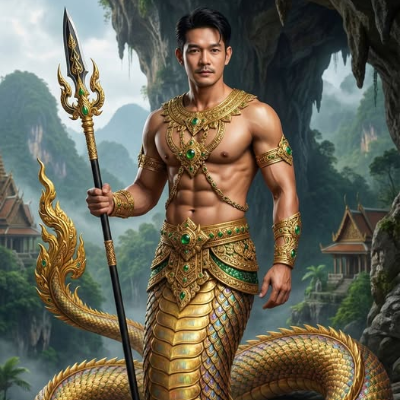
About
Maninaga — Serpent of the Kadru Line, Associated with Girivraja
Maninaga · Mani-naga · Kadraveya · son of Kashyapa and Kadru
Maninaga is a divine serpent, a Naga of the Kadru lineage, born of the primordial sage Kashyapa and his wife Kadru, the mother of the entire serpent race. He is counted among the prominent sons named in the Adi Parva of the Mahabharata during the enumeration of the chief Nagas at the serpent sacrifice of King Janamejaya. His name also attaches to a sacred bathing site mentioned in the Vana Parva of the Mahabharata and to a Shiva shrine — Maninageshvara — whose greatness is celebrated in the Skanda Purana. He is further noted in the Harivansha, the appendix to the Mahabharata. The Sabha Parva places him in a geographical connection to the ancient city of Girivraja. His name additionally appears in the Tibetan Buddhist text Manjushrimulakalpa, which attests to his resonance beyond strictly Hindu contexts.
✦ The Name
The name Maninaga is a compound of two Sanskrit elements: mani, meaning a jewel, gem, or precious stone — in Naga contexts frequently referring to the luminous crest-jewel worn on or within the hood of a great serpent — and naga, the generic word for a divine serpent. The name therefore carries the meaning of "the jewelled serpent" or "the gem-serpent," consistent with the broader Puranic imagery of Nagas as beings whose hoods blaze with precious gems that illuminate the dark regions of the underworld. The Monier-Williams Sanskrit-English Dictionary identifies him as a serpent-demon, and the compound mani-naga appears in both the Mahabharata and the Harivansha as the proper name of this specific figure. As a patronymic he is a Kadraveya — a son born of Kadru — which is the standard classification term for Nagas of her lineage in Sanskrit grammatical and Puranic literature.
✦ Lineage
- Father: Kashyapa — the foremost of the Prajapatis, a progenitor-sage of the tradition, son of Marichi who was himself a mind-born son of Brahma. Kashyapa fathered an enormous range of beings through his many wives, and is regarded as the progenitor of gods, demons, humans, birds, Nagas, and other orders of living beings.
- Mother: Kadru — a daughter of Daksha Prajapati and one of Kashyapa's wives, celebrated throughout the Mahabharata and the Puranas as the mother of the thousand-strong serpent race. She is the figure whose curse upon her disobedient sons formed the mythological cause of the great serpent sacrifice performed by King Janamejaya.
- Siblings: The full fraternity of Kadru's sons numbers in the thousands; among the principal named brothers are Shesha (also called Ananta, the cosmic serpent and eternal bed of Vishnu), Vasuki (king of the Nagas and lord of Patala), Takshaka, Airavata, Karkotaka, Kaliya, Elapatra, Nila, Anila, Dhananjaya, Nahusha, Kambala, and Ashvatara, along with many hundreds more whose names are recorded across the Adi Parva lists.
✦ Enumeration Among the Chief Nagas
Maninaga is named in the recitation of the principal serpents that occurs in two related passages of the Adi Parva of the Mahabharata. In Section XXXI (I.31.6), the narrator Sauti gives a first list of the prominent Nagas born of Kadru, and Maninaga appears in this enumeration. In Section XXXV (I.35), the same list is repeated in fuller form during the narrative of the Sarpa Satra — the great serpent sacrifice of Janamejaya — as Sauti responds to the sage Shaunaka's request to hear the names of the foremost serpents. On this occasion the narrator explicitly acknowledges that the total number of Nagas defies complete enumeration and names only those of greatest significance; Maninaga's inclusion in this selected list marks him as among the more distinguished members of the Kadru lineage. In the Ganguli translation of the Adi Parva, the text of Section XXXV renders his name as "the serpent Mani," a shortened form of the compound that refers to this same figure.
✦ Association with Girivraja
The Sabha Parva of the Mahabharata places Maninaga in a geographical context. At Chapter 21, verse 50, in the section describing Girivraja — the ancient capital of the Magadha kingdom in the eastern part of the Indian subcontinent — Maninaga is stated to reside in the vicinity of that city. Girivraja, also known as Rajagriha, was one of the most significant urban centres of ancient India. This reference gives Maninaga a rare degree of specificity among the lesser-named Nagas: rather than being situated purely in the cosmological underworld, he is here associated with a real and historically attested location. The nature of his residence there — whether as a tutelary deity of the region, a guardian of a particular site, or simply a local serpent presence — is not elaborated in the Sabha Parva passage itself. The reference is a brief one, but its particularity is noteworthy.
✦ The Maninaga Tirtha
In the Vana Parva of the Mahabharata, at Chapter 84, verse 106, a sacred bathing site bearing the name Maninaga is mentioned in the context of a pilgrimage itinerary. The text states that a person who spends a night at this tirtha earns the spiritual merit equivalent to the gift of a thousand cows, and that one who partakes of food offered to the deity at that place becomes free from the effects of serpent poison. This second benefit is particularly significant: the connection between the Naga figure Maninaga and the protection from snake venom reflects the broader Puranic understanding that veneration of a powerful Naga deity at his associated sacred site confers immunity from the very danger he represents. The Monier-Williams dictionary corroborates the dual usage of Maninaga — as both a serpent being and a sacred bathing-place — explicitly citing the Mahabharata at this verse. The Skanda Purana, in the Reva-khanda section of the Avantya-khanda, devotes Chapter 72 to the greatness of Maninageshvara tirtha (maninaga-ishvara-tirtha), a site associated with the divine serpent that extends his cultic presence into the Puranic pilgrimage literature of the Narmada river region.
✦ Appearance in the Harivansha
Maninaga is also mentioned in the Harivansha, the major appendix to the Mahabharata that elaborates on the legends of the Vrishni lineage and the life of Krishna. The precise Harivansha passage is referenced in the Monier-Williams Sanskrit-English Dictionary, which cites both the Mahabharata and the Harivansha as sources for the proper name. The Harivansha context does not appear to add substantially different information about Maninaga's narrative role beyond confirming his continued recognition within the post-epic Puranic literature associated with the Mahabharata tradition. Böhtlingk and Roth's Grosses Petersburger Wörterbuch also cites the Harivansha alongside the Mahabharata for this name, providing an independent scholarly corroboration of his attestation in that text.
✦ Connection to the Wider Genealogy
Maninaga belongs to the great Kashyapa lineage. His paternal grandfather is Marichi, one of the seven mind-born Prajapatis of Brahma. Through Kashyapa's other wives, Maninaga is a half-sibling in the cosmic-genealogical sense to Garuda and Aruna, who were born of Vinata — and thus the Naga race and the eagle race of Garuda share a half-fraternal origin. The famous enmity between Garuda and the Nagas, a central theme in the Adi Parva of the Mahabharata, thus forms part of the cosmic background of Maninaga's lineage. His full brothers include the great serpent kings Vasuki, Shesha, and Takshaka, the last of whom killed King Parikshit and thereby triggered the Janamejaya sacrifice in which the Nagas collectively faced destruction. The association of Maninaga's name with the Girivraja region also places him in proximity to Magadha, one of the most important political and spiritual zones of ancient India, a region intimately connected with events of both epic and Puranic significance.
✦ References
- Primary Sources
- Mahabharata, Adi Parva, Section XXXI (I.31.6): First occurrence of Maninaga's name in the initial list of Kadru's chief serpent sons.
- Mahabharata, Adi Parva, Section XXXV (I.35): The fuller enumeration of foremost Nagas at the Sarpa Satra, where Maninaga is named among the principal serpents.
- Mahabharata, Sabha Parva, Chapter 21 (II.21.50): Places Maninaga in the region of Girivraja, the ancient Magadha capital.
- Mahabharata, Vana Parva, Chapter 84 (III.84.106): Describes a tirtha named Maninaga with specific ritual benefits including freedom from serpent poison and the merit of a thousand cow-gifts.
- Harivansha: Corroborates the name Maninaga as a serpent-demon figure in post-epic Puranic literature associated with the Mahabharata tradition.
- Skanda Purana, Avantya-khanda, Reva-khanda, Chapter 72: Dedicated chapter on the greatness of Maninageshvara tirtha, the sacred site associated with this Naga in the Narmada river region.
- Manjushrimulakalpa (6th century CE, Tibetan Buddhist text): Names Maninaga among the Nagas attending a teaching, providing a cross-traditional attestation of the figure beyond Hindu texts.
- Secondary Sources
- Wisdomlib.org, "Maninaga: 8 definitions": Compiles references from the Mahabharata, the Harivansha, the Shodhganga Kasyapa Samhita source, and Sanskrit dictionaries, providing the comprehensive cross-reference base for this profile.
- Cologne Digital Sanskrit Dictionaries (Monier-Williams; Böhtlingk and Roth; Cappeller): Cite the Mahabharata and Harivansha for the name Maninaga as both a serpent-demon and a sacred bathing-place.
- Wikipedia, "Naga": Includes a photograph of a Kushan-period (2nd century CE) stone sculpture from Rajgir, Bihar, depicting Maninaga and Svastika — the earliest known artistic representation associated with this Naga.