
About
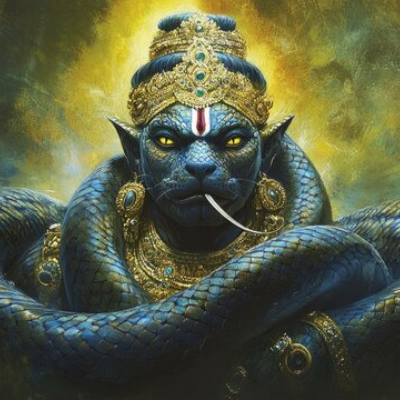
Kauravya — Naga Prince, Son of Airavata, Father of Aryaka
Kauravya · Kauravya Naga
Kauravya is a Naga — a serpent being of the divine order — who appears in the Mahabharata as a member of the great lineage of Nagas dwelling in the subterranean realm of Patala and in the sacred waters of the earth. He is the son of Airavata, one of the foremost of all Nagas, and the father of Aryaka, a Naga whose significance in the Mahabharata arises through his relationship with the Pandava hero Nakula. Kauravya himself is not the protagonist of any extended narrative episode in the surviving text; he functions principally as a genealogical link within the Naga lineage, connecting the illustrious ancestral line of Airavata to the later figure of Aryaka, who plays a role in the story of the Pandavas' exile.
✦ The Name
The name Kauravya is a patronymic formation, derived from the name Kurava or from an association with the Kaurava lineage-name, though in the context of Naga genealogy it functions as a clan or descent identifier rather than as a connection to the Kuru royal dynasty of the epic. The suffix follows the standard Sanskrit pattern of forming a descendant's name from the ancestor's root name. The name carries no recorded independent etymological gloss in the primary sources beyond its function as a lineage marker within the Naga world.
✦ Lineage
- Father: Airavata — one of the greatest and most celebrated of all Nagas, counted among the foremost serpent beings in the Mahabharata's enumeration of the Naga clans. Airavata is a figure of high standing in the Naga world, distinct from but related in name to Airavata the divine elephant who emerged from the churning of the cosmic ocean and became the mount of Indra, king of the gods.
- Son: Aryaka — a Naga who is identified in the Mahabharata as the maternal great-grandfather of Nakula, one of the five Pandava brothers. Nakula is the son of Madri, the second wife of the Pandava patriarch Pandu, and was born through the grace of the Ashvins, the divine twin physicians. Aryaka's connection to Nakula establishes a bond between the Naga world and the Pandava lineage that becomes narratively significant during the period of the Pandavas' forest exile.
✦ Role in the Mahabharata Narrative
Kauravya's appearance in the Mahabharata is confined to genealogical enumeration rather than active narrative participation. The text records him as a named member of the Naga lineage descending from Airavata, and his significance is established almost entirely through his position as the father of Aryaka. It is through Aryaka that the lineage acquires its connection to the Pandava story. When Bhima, the second and mightiest of the five Pandava brothers, falls into the Naga realm after being poisoned and thrown into the Ganga river by the Kauravas during the brothers' childhood, it is Aryaka who recognises Bhima as the great-grandson of his own great-grandson Nakula — establishing a familial bond across the boundary between the human and the serpent worlds. Kauravya, as Aryaka's father, is the generational link that places Aryaka within the distinguished lineage of Airavata and thereby lends weight to Aryaka's standing when he acts on behalf of Bhima.
✦ Connection to the Wider Genealogy
Kauravya belongs to the Airavata branch of the Naga lineages as enumerated in the Mahabharata. The Nagas of the Mahabharata are generally held to descend from Kashyapa, one of the seven great primordial sages, and his wife Kadru, herself a daughter of the progenitor Daksha. Kadru is regarded as the mother of all Nagas, and the various Naga clans — of which Airavata's line is among the most honoured — trace their origin to this primordial pair. Kauravya thus sits within this larger cosmological genealogy as a member of the Airavata sub-lineage descended ultimately from Kashyapa and Kadru. His son Aryaka extends this lineage into a relationship with the human world through the Pandava connection, making Kauravya the pivot point between the purely divine-serpent ancestry above him and the human-Naga interrelationship below him.
✦ Textual Variants and Inconsistencies
The primary sources do not record significant variant accounts of Kauravya's identity or lineage across different recensions of the Mahabharata. His mention is brief and genealogical in character, and the consistency of his identification as son of Airavata and father of Aryaka is maintained in the principal references. The Airavata Naga of the Naga genealogies should be carefully distinguished from Airavata the divine elephant, who is a separate being in the tradition; some secondary sources have noted potential for confusion given the shared name, but the primary text treats these as distinct figures without ambiguity in the relevant passages.
✦ References
- Primary Sources:
- Mahabharata, Adi Parva — Contains the enumeration of Naga lineages including the Airavata clan, within which Kauravya is named as a descendant of Airavata and ancestor of Aryaka.
- Mahabharata, Adi Parva, Astika sub-parva — Provides the broader cosmological account of the Naga lineages descending from Kashyapa and Kadru, situating all major Naga clans including Airavata's line within the primordial genealogy.
- Mahabharata, Sabha Parva and Aranyaka Parva — Contains the episode in which Aryaka, son of Kauravya, encounters Bhima in the Naga realm and recognises the familial connection between his lineage and the Pandavas.
- Secondary Sources:
- Puranic Encyclopaedia by Vettam Mani — Provides an identifying entry for Kauravya within the Naga genealogies and notes his position as son of Airavata and father of Aryaka.
- The Mahabharata, critical edition published by the Bhandarkar Oriental Research Institute — The authoritative critical text against which Naga genealogical references have been verified.