
About
Alambusha — Rakshasa Warrior of the Kurukshetra War, Slayer of Iravat
Alambusha · Alambhusha · Shalakatanka · Alambus
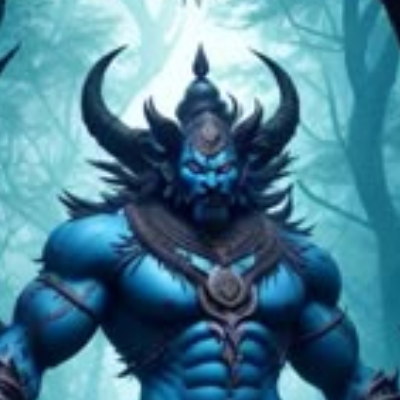
Alambusha is a Rakshasa warrior of considerable power who appears in the Mahabharata as one of the notable supernatural fighters on the Kaurava side during the Kurukshetra war. He is the son of a Rakshasa named Rishyashringa — a figure distinct from the celebrated brahmin sage of the same name — and bears the additional epithet Shalakatanka. Alambusha is known primarily for two deeds: the killing of Iravat, the son of the Pandava hero Arjuna by the Naga princess Ulupi, on the first day of the great battle; and his own death at the hands of the Pandava Rakshasa warrior Ghatotkacha, the son of Bhima by the Rakshasi Hidimba, in the course of the war. He appears in the Udyoga Parva, the Bhishma Parva, and the Drona Parva of the Mahabharata. He must be distinguished from a second figure of the same name, Alambusha son of Jatasura, who is a separate Rakshasa mentioned in the Drona Parva and who is not the same individual as the son of Rishyashringa.
✦ The Name
The name Alambusha does not have a universally agreed Sanskrit etymology in the primary sources or classical commentaries. It may be related to the Sanskrit root alamba, meaning support or hanging, or may be a proper name without a transparent derivation, as is the case with many names of Rakshasa figures in the epics. The epithet Shalakatanka, by which Alambusha is also known in certain passages, is likewise not etymologically explained in the primary texts. The name Alambusha is shared by at least two distinct Rakshasa figures in the Mahabharata — the son of Rishyashringa, who is the subject of this profile, and a son of Jatasura mentioned in the Drona Parva — and this coincidence of names has been a source of conflation in some later retellings and secondary accounts.
✦ Lineage
- Father: Rishyashringa — a Rakshasa leader named in the Mahabharata's Udyoga Parva; distinct from the brahmin sage Rishyashringa of the Ramayana tradition
- Class of being: Rakshasa — a class of supernatural beings of great martial power capable of assuming multiple forms in battle
- Epithet: Shalakatanka — an additional name by which Alambusha is identified in certain passages of the Mahabharata
✦ Alliance with the Kauravas
In the Udyoga Parva, the fifth book of the Mahabharata, the text enumerates the warriors and allies assembled on both sides before the commencement of the Kurukshetra war. In this enumeration, found in Book 5, Chapter 167, verse 33, Alambusha son of Rishyashringa is listed among the Rakshasa warriors committed to the Kaurava cause under Duryodhana, the eldest of the hundred Kaurava princes and the principal antagonist of the epic. The reasons for Alambusha's alliance with the Kauravas are not elaborated in the text; the Mahabharata frequently includes supernatural warriors among the Kaurava forces without providing detailed motivation for each, and Alambusha's alignment is presented as a fact of the pre-war muster rather than as the outcome of a narrated decision.
✦ The Killing of Iravat
The most celebrated deed attributed to Alambusha in the Mahabharata is the killing of Iravat on the first day of the Kurukshetra war. Iravat is the son of the Pandava hero Arjuna — the third of the five Pandava brothers and one of the greatest warriors of the epic — by the Naga princess Ulupi, a daughter of the Naga king Kauravya. Iravat is thus a being of both human heroic and divine serpentine lineage, and he joined the Pandava forces at Kurukshetra. In the Bhishma Parva, Book 6, Chapter 45, verses 43 through 44, the encounter between Alambusha and Iravat is described. Alambusha, drawing upon the shape-shifting powers characteristic of the Rakshasa class, assumed a great serpentine form in battle — a deliberate counter to Iravat's Naga heritage and fighting style. Through this stratagem Alambusha overcame and slew Iravat, a deed that caused great grief among the Pandava forces, as Arjuna witnessed the death of his son. The killing of Iravat is one of the significant early losses suffered by the Pandavas in the war and marks Alambusha as a warrior of consequence on the Kaurava side.
✦ Death at the Hands of Ghatotkacha
Alambusha's death is narrated in the Drona Parva, Book 7, Chapter 109, verses 22 through 31. His slayer is Ghatotkacha, the Rakshasa son of the Pandava Bhima — the second of the five Pandava brothers, a man of immense physical strength — by the Rakshasi Hidimba. Ghatotkacha, being himself half-Rakshasa, was a formidable supernatural warrior capable of employing the full range of maya, the illusory and shape-shifting powers of the Rakshasa class. The battle between Alambusha and Ghatotkacha is thus a contest between two Rakshasa warriors of great power, one fighting for the Kauravas and one for the Pandavas. In the encounter described in the Drona Parva, Ghatotkacha overcame Alambusha and killed him, thereby avenging the death of Iravat — his own half-brother through their shared Pandava father Arjuna and Bhima respectively — and eliminating one of the more dangerous supernatural opponents on the Kaurava side.
✦ Textual Variants and the Question of Two Alambushas
A significant textual issue surrounding Alambusha is the existence of a second figure of the same name within the Mahabharata itself. The Drona Parva, Chapter 174, mentions a Rakshasa named Alambusha who is identified as the son of Jatasura. Jatasura is a Rakshasa who appears in the Aranyaka Parva of the Mahabharata as an enemy of the Pandavas during their forest exile; he was slain by Bhima. A son of this Jatasura bearing the name Alambusha is thus a distinct individual from the Alambusha son of Rishyashringa who is the subject of this profile. The two figures share a name, both belong to the Rakshasa class, and both appear in the context of the Kurukshetra war, which has led to conflation in some secondary accounts and retellings. The primary textual basis for distinguishing them is the explicit paternal identification: the son of Rishyashringa is introduced as such in Udyoga Parva Chapter 167, verse 33, and is the Alambusha associated with the killing of Iravat and the death at Ghatotkacha's hands in the passages cited above. The relationship between these two figures, whether the Mahabharata intends them as distinct individuals or whether scribal or compositional variation has produced a duplication, is not resolved within the text itself.
✦ Connection to the Wider Genealogy
Alambusha stands within the Mahabharata's network of supernatural warriors as a Rakshasa of sufficient power and prominence to be named in the pre-war muster, to kill a warrior of Iravat's lineage and distinction, and to require the full strength of Ghatotkacha to overcome. Through his father Rishyashringa Rakshasa he belongs to a named Rakshasa lineage, though that lineage is not further elaborated in the surviving text. His opponent in death, Ghatotkacha, is the son of Bhima and Hidimba — Bhima being the second Pandava prince, son of Pandu and Kunti, and Hidimba being a Rakshasi of the forest encountered during the Pandavas' early exile. His victim Iravat is the son of Arjuna, the third Pandava, by the Naga princess Ulupi, making Iravat a figure of both the heroic Pandava lineage and the divine Naga lineage. Alambusha's career in the war thus intersects with several of the most significant genealogical lines of the Mahabharata, even though his own lineage remains only partially recorded.
✦ References
- Primary Sources
- Mahabharata, Udyoga Parva, Book 5, Chapter 167, verse 33: Introduces Alambusha as the son of Rishyashringa and lists him among the Kaurava allies assembled before the Kurukshetra war.
- Mahabharata, Bhishma Parva, Book 6, Chapter 45, verses 43–44: Describes Alambusha's entry into the war and his battle with and killing of Iravat, son of Arjuna, through the use of Rakshasa shape-shifting powers.
- Mahabharata, Drona Parva, Book 7, Chapter 109, verses 22–31: Narrates Alambusha's final battle and his death at the hands of the Rakshasa warrior Ghatotkacha, son of Bhima.
- Mahabharata, Drona Parva, Chapter 174: References a second Rakshasa named Alambusha identified as the son of Jatasura, relevant for establishing the textual distinction between the two figures.
- Secondary Sources
- Mani, Vettam. Puranic Encyclopaedia. Motilal Banarsidass, 1975: Entry on Alambusha covering his identity as son of Rishyashringa, his killing of Iravat, and his death at Ghatotkacha's hands, with notes on the second Alambusha.
- Manuscrypts.com, Alambusha entry (2010): Secondary source consolidating the Mahabharata verse references for Alambusha's narrative arc and his paternal identification.
- Manuscrypts.com, Jatasura entry (2012): Secondary source relevant for establishing the identity and lineage of the separate Alambusha son of Jatasura mentioned in the Drona Parva.