
About
Shrutadevi — Daughter of Shurasena, Wife of Vriddhasharma, Mother of Dantavakra
Shrutadevi · Srutadeva · Shrutadevа · Shurakanya · daughter of Shurasena · queen of Karusha
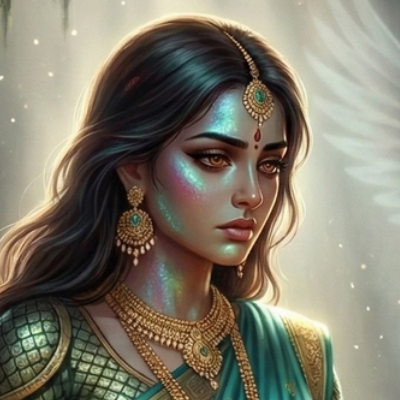
Shrutadevi is a figure in the Hindu epic and Puranic tradition, identified in the Bhagavata Purana's ninth canto and in the Vishnu Purana as one of the five celebrated daughters of Shurasena — the Yadava king of the Vrishni lineage and a descendant of the Chandravamsha lunar dynasty — and his queen Marisha. She is named explicitly in the Bhagavata Purana Canto 9, Chapter 24, verse 31 alongside her four sisters in the enumeration of the Shurakanyas — the celebrated daughters of Shura. Through her marriage to Vriddhasharma, king of the Karusha kingdom, she became the mother of Dantavakra — a powerful warrior and fierce antagonist of Krishna who is identified in the Bhagavata Purana and Vishnu Purana as the mortal incarnation of Vijaya, one of the two celestial gatekeepers of Vishnu's abode Vaikuntha, fulfilling the third and final birth of his curse before attaining liberation at Krishna's hands. Shrutadevi is thus the mortal mother of a figure whose story belongs to the cosmic cycle of Vishnu's gatekeepers — the same cycle in which her sister Shrutashrava's son Shishupala also participates as the incarnation of Vijaya's companion gatekeeper Jaya. Her significance in the tradition is both genealogical and theological, anchoring the Karusha kingdom's royal line to the Vrishni-Yadava complex while simultaneously placing her within the Puranic narrative of divine liberation through ordained conflict with Vishnu's avatar.
✦ The Name
The name Shrutadevi is a Sanskrit compound of shruta — meaning heard, celebrated, renowned, or that which has been learned through sacred oral transmission — and devi, the Sanskrit word for goddess, divine woman, or queen. The name therefore carries the sense of "she who is celebrated" or "the renowned goddess," a name of distinction and sacred resonance consistent with Kshatriya royal naming conventions. The prefix shruta — from the root shru meaning to hear — connects the name to the Vedic tradition of shruti, the category of sacred knowledge received through hearing, giving the name an additional register of learning and sacred transmission. The variant spellings Srutadeva and Shrutadeva found in different recensions and transliteration systems refer to the same figure; the feminine suffix devi or deva in these contexts is interchangeable across manuscript traditions.
✦ Lineage
- Father: Shurasena — the Yadava king of the Vrishni lineage, descendant of Vrishni I and Madri through the line of Devamidhusha and Shurasena's own father; patriarch of the Shurasena branch of the Vrishni clan; father of Vasudeva and the five Shurakanyas; his kingdom centred on Mathura.
- Mother: Marisha — queen of Shurasena, named in the primary sources as the mother of his children including the five celebrated daughters.
- Brother: Vasudeva — the most celebrated of Shurasena's sons; husband of Devaki and father of Krishna, the eighth avatar of Vishnu, and of Balarama; making Shrutadevi the paternal aunt of Krishna and Balarama.
- Sister: Pritha — the eldest and most celebrated of the five sisters; given in adoption by Shurasena to his childless cousin Kuntibhoja, after which she became known as Kunti; wife of the Kuru king Pandu and mother of the three elder Pandavas — Yudhishthira, Bhima, and Arjuna — born through divine boons from the deities Dharma, Vayu, and Indra respectively.
- Sister: Shrutakirtti — one of the five Shurakanyas, named in the Bhagavata Purana Canto 9 Chapter 24 verse 31 alongside Shrutadevi; already profiled in this genealogical database.
- Sister: Shrutashrava — one of the five Shurakanyas; wife of King Damaghosha of the Chedi kingdom and mother of Shishupala — the powerful king who is identified in the Bhagavata Purana as the mortal incarnation of Jaya, companion gatekeeper of Vijaya at Vishnu's abode Vaikuntha, fulfilling his own third and final cursed birth before attaining liberation when slain by Krishna at the Rajasuya sacrifice of Yudhishthira; already profiled in this genealogical database.
- Sister: Rajadhidevi — one of the five Shurakanyas, named in the Bhagavata Purana Canto 9 Chapter 24 verse 31; already profiled in this genealogical database.
- Husband: Vriddhasharma — king of the Karusha kingdom, a realm situated in the central Indian subcontinent; named in the primary sources as the husband to whom Shurasena gave Shrutadevi in a marriage alliance cementing the Vrishni-Yadava connection with the Karusha royal house.
- Son: Dantavakra — king of Karusha after his father Vriddhasharma; a warrior of great physical power; identified in the Bhagavata Purana and Vishnu Purana as the mortal incarnation of Vijaya, one of the two celestial gatekeepers of Vaikuntha — Vishnu's eternal abode — in his third and final cursed birth; a fierce ally of Jarasandha, the powerful king of Magadha, and of Shishupala, the king of Chedi; he stood in direct opposition to his maternal cousin Krishna throughout his life and was eventually slain by Krishna with a mace following the Rajasuya sacrifice of Yudhishthira, at which moment the Bhagavata Purana records that his soul was liberated and merged into Vishnu, completing the cycle of the gatekeeper's curse.
- Son: Viduratha — younger son of Vriddhasharma and Shrutadevi; attested in the Bhagavata Purana Canto 10 Chapter 78 verse 11 as Dantavakra's younger brother; upon witnessing Dantavakra's death at Krishna's hands on the banks of the Yamuna river, Viduratha rushed forward with sword and shield in a state of overwhelming fraternal grief intending to attack Krishna, and was decapitated by Krishna's Sudarshana Chakra — the razor-edged spinning discus weapon of Vishnu — the blow removing his head complete with helmet and earrings; his death in the same confrontation as his elder brother marks the extinction of the direct Karusha royal line in the primary sources.
✦ The Marriage Alliance with Karusha
Shurasena's marriage of his five daughters into prominent Yadava and Kshatriya families across the Indian subcontinent reflects the standard Puranic pattern of royal alliance-building through matrimonial diplomacy. Shrutadevi's marriage to Vriddhasharma of Karusha extended the Vrishni-Yadava network into the Karusha kingdom — a realm sufficiently significant to appear in the Mahabharata's political geography as an independent power with its own royal tradition. The Bhagavata Purana records the marriage explicitly in the context of Shurasena's daughters, identifying Vriddhasharma as the husband from whose union with Shrutadevi Dantavakra was born. The Karusha kingdom's subsequent identification as the home base of Dantavakra — one of Krishna's principal adversaries — gives the marriage alliance a narrative consequence that extends well beyond its immediate political significance.
✦ The Jaya-Vijaya Cycle and Shrutadevi's Theological Role
The most theologically significant dimension of Shrutadevi's place in the tradition arises from her son Dantavakra's identity as the incarnation of Vijaya. The Bhagavata Purana narrates that Jaya and Vijaya — the two principal gatekeepers of Vaikuntha, Vishnu's eternal celestial abode — were cursed by the four Kumaras, the celibate mind-born sons of Brahma, after the gatekeepers prevented the sages from entering Vishnu's presence. Given the choice between seven births as devotees of Vishnu or three births as his adversaries, Jaya and Vijaya chose the shorter path of three births as enemies, accepting that through their ordained conflict with Vishnu's avatars they would attain liberation more swiftly. Their three pairs of births were as Hiranyaksha and Hiranyakashipu in the first birth — slain by the Varaha and Narasimha avatars of Vishnu respectively — as Ravana and Kumbhakarna in the second birth — slain by Rama, the seventh avatar — and as Shishupala and Dantavakra in the third and final birth, slain by Krishna, the eighth avatar.
Within this framework Shrutadevi is the mortal mother chosen for Vijaya's third and final incarnation as Dantavakra, while her sister Shrutashrava is the mortal mother chosen for Jaya's third and final incarnation as Shishupala. That both final incarnations of the cursed gatekeepers should be born of sisters — daughters of the same father Shurasena and therefore maternal cousins of Krishna himself — is one of the Bhagavata Purana's most pointed illustrations of the cosmic plan operating through apparently ordinary familial relationships. The two sisters' sons, bound to oppose their cousin Krishna until he liberates them, enact the final resolution of a celestial drama that began at the gates of Vaikuntha. Shrutadevi's role as Dantavakra's mother is thus not merely genealogical but cosmologically ordained within the Bhagavata Purana's theological framework.
✦ Textual Variants and Inconsistencies
The Bhagavata Purana Canto 9 Chapter 24 verse 31 and the Vishnu Purana Book 4 Chapter 14 are consistent in naming Shrutadevi among Shurasena's five daughters. The variant spellings Srutadeva, Shrutadeva, and Shrutadevi across different recensions and transliteration systems reflect orthographic variation rather than substantive textual disagreement. The identification of Dantavakra as Shrutadevi's son by Vriddhasharma of Karusha is confirmed in the Bhagavata Purana's genealogical passages. The Jaya-Vijaya identification of Dantavakra is consistent across the Bhagavata Purana and the Vishnu Purana, though the Mahabharata's treatment of Dantavakra — where he appears as a warrior allied with Shishupala and Jarasandha — does not engage explicitly with the gatekeeper theology, treating him as a political and military figure rather than a cosmic one. The two registers — the epic's political register and the Puranic theological register — are complementary rather than contradictory.
✦ Connection to the Wider Genealogy
Shrutadevi stands at a remarkable convergence of genealogical threads. Through her father Shurasena and her brother Vasudeva she belongs to the Vrishni-Yadava lineage that produces Krishna — Vishnu's eighth avatar and the central figure of the Bhagavata Purana's tenth skandha. Through her sister Kunti she is the paternal aunt of the five Pandava brothers — Yudhishthira, Bhima, Arjuna, Nakula, and Sahadeva — whose conflict with the Kauravas forms the subject of the Mahabharata's central narrative. Through her sister Shrutashrava she is connected to the Chedi royal house and to Shishupala, whose liberation at Krishna's hands at the Rajasuya sacrifice immediately precedes Dantavakra's own final confrontation with Krishna. Through her son Dantavakra she is the mortal vessel of the last incarnation of Vijaya, completing a cosmic cycle that began at the gates of Vaikuntha. The symmetry of her position — sister of Krishna's father, aunt of Krishna, and mother of one of Krishna's ordained adversaries — makes Shrutadevi one of the more structurally significant of the Shurasena daughters in the Puranic theological architecture, even though her own personal narrative is not elaborated beyond her parentage, marriage, and maternity.
✦ References
- Bhagavata Purana, Canto 9, Chapter 24, verse 31: The principal primary source explicitly naming Shrutadevi alongside her four sisters as daughters of Shurasena; the Sanskrit verse enumerates the five Shurakanyas — Pritha, Shrutadeva, Shrutakirti, Shrutashrava, and Rajadhidevi — as the celebrated daughters of Shura.
- Bhagavata Purana, genealogical and narrative sections on Dantavakra: Identifies Vriddhasharma as Shrutadevi's husband and Dantavakra as the son born from their union; establishes Dantavakra's identity as the incarnation of Vijaya the gatekeeper in his third and final cursed birth; records his liberation at Krishna's hands following the Rajasuya sacrifice.
- Bhagavata Purana, Jaya-Vijaya narrative sections: The foundational account of the gatekeeper curse, the three paired births, and the theological framework within which Shrutadevi's son Dantavakra is situated as Vijaya's final mortal incarnation.
- Vishnu Purana, Book 4, Chapter 14: Parallel primary source confirming Shrutadevi as a daughter of Shurasena and as an aunt of Krishna; provides supporting genealogical data on the Shurasena lineage within which the five daughters are enumerated.
- Mahabharata, political and warrior references to Dantavakra: Records Dantavakra as a warrior allied with Jarasandha and Shishupala in opposition to Krishna; treats him as a political and military figure without engaging the gatekeeper theology; complementary to rather than contradicting the Puranic account.
- Vettam Mani, Puranic Encyclopaedia (1975): Secondary reference consolidating the Puranic data on Shrutadevi, her marriage to Vriddhasharma of Karusha, her son Dantavakra, and the Jaya-Vijaya theological framework within which Dantavakra's life and death are situated.