
About
Nahusha — King of the Lunar Dynasty, Ruler of Heaven, Cursed into Serpent Form
Nahusha · Nahusa · son of Ayu · grandson of Pururavas · father of Yayati
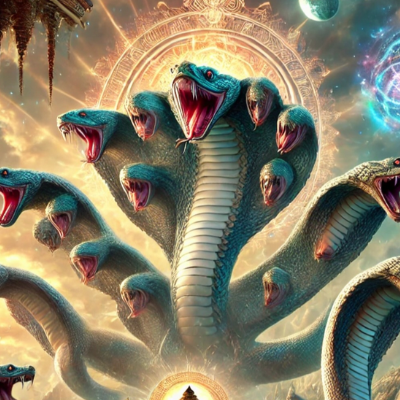
Nahusha is one of the celebrated kings of the Chandravamsha — the Lunar dynasty of the Puranic and epic tradition — and an ancestor of both the Pandavas and the Kauravas. He is the son of Ayu, grandson of Pururavas, fifth in descent from the Moon, and father of Yayati, from whom the great branches of the Lunar dynasty including the Yadavas and the Paurava-Kuru line descend. In his career as a mortal king, Nahusha performed great sacrifices and accumulated tremendous spiritual merit, and through this merit he was elevated to rule Svarga — the realm of the gods — during the temporary absence of Indra. His rule of heaven devolved into arrogance and moral transgression: he lusted after Indra's wife Shachi and demanded that the seven Vedic sages carry his palanquin, whereupon the sage Agastya (in some accounts Bhrigu) cursed him to fall from heaven as a serpent. In this serpent form — enormous, powerful, and endowed with a boon that deprived even mighty beings of their strength when he coiled them — Nahusha remained for many centuries until he was encountered by the Pandavas during their forest exile. He captured Bhima and was only persuaded to release him when Yudhishthira answered his philosophical questions about the nature of a Brahmin and the qualities of the Supreme Being. This discourse freed Nahusha from the curse and he ascended again to his celestial form. He is mentioned in the Rigveda, in multiple books of the Mahabharata, in the Bhagavata Purana, the Vishnu Purana, the Vayu Purana, the Matsya Purana, the Brahmanda Purana, and the Harivamsha. He is also listed in the Adi Parva's Naga enumeration at I.35, though this is a distinct and separate figure sharing his name — a serpent son of Kadru — who should not be confused with the cursed king.
✦ A Note on the Two Figures Named Nahusha
The Mahabharata's Adi Parva lists a Naga named Nahusha among the sons of Kadru at Section XXXV (I.35). This serpent Nahusha — a son of Kashyapa and Kadru — is a genealogically distinct figure from the king Nahusha of the Lunar dynasty. The former belongs to the Naga lineage through Kadru; the latter is a descendant of Pururavas through the Lunar line, a human king cursed temporarily into serpent form. The Wisdomlib Purana glossary entry for Nahusha explicitly distinguishes them: one is a Naga born to Kashyapa and Kadru; the other is the famous king and ancestor of the Pandavas. The king Nahusha's serpent form is a punishment for arrogance, not a permanent identity. This profile concerns the king, whose story is the richer and primary tradition; the Kadru-born Naga of the same name has no surviving episode or Puranic role of its own beyond its position in the Adi Parva list.
✦ The Name
The name Nahusha appears in the Rigveda from Mandala 1 onward, indicating great antiquity. The Padma Purana tradition states that Nahusha was named "the fearless one" by the sage Vasishtha, who found and raised the infant after he had been spirited away from his father Ayu's household. The name carries no transparent Sanskrit etymology requiring comment beyond this narrative derivation; it is regarded as a proper name of the royal-dynastic tradition rather than a descriptive epithet in the way that many other Puranic names function.
✦ Lineage
- Grandfather, twice-removed: Brahma — the creator, through the line Brahma–Atri–Chandra (the moon god).
- Great-grandfather: Chandra — the moon god, who gives his name to the Chandravamsha or Lunar dynasty.
- Grandfather: Pururavas — the first great king of the Lunar dynasty, celebrated for his love affair with the Apsara Urvashi.
- Father: Ayu — eldest son of Pururavas, who completed his education under the sage Chyavana and married the Asura princess Prabha, daughter of Svarbhanu.
- Mother: Prabha, daughter of Svarbhanu (per the Harivamsha and Vayu Purana). In the Padma Purana tradition, Nahusha married Ashokasundari, a daughter of Shiva and Parvati.
- Principal wife: Viraja, mind-born daughter of the Pitrs — the ancestors — according to the Harivamsha and Vayu Purana. Another tradition names Ashokasundari as his wife and the mother of Yayati.
- Sons: Six sons are most commonly listed: Yati (who became an ascetic and renounced the throne), Yayati (who succeeded to the kingdom and became the ancestor of many dynasties), Samyati, Ayati, Viyati, and Kriti. The Matsya Purana lists seven sons.
- Principal son: Yayati — who married Devayani, daughter of the Asura preceptor Shukracharya, and also took Sharmishtha, daughter of the Asura king Vrishaparvan, as his second consort; father of Yadu (ancestor of the Yadavas and ultimately of Krishna), Turvasu, Druhyu, Anu, and Puru (ancestor of the Paurava-Kuru dynasty from which the Pandavas descend).
✦ Reign as Mortal King
Nahusha reigned from Pratishthana — identified with the region of modern Prayagraj — and is described across the Mahabharata and the Puranas as a king of tremendous accomplishment. He performed numerous great sacrifices, practised severe austerities, studied the Vedas, exercised self-restraint, and maintained dominion over his kingdom with justice. These accumulated spiritual merits raised him to a status equal to the gods. The Manusmriti references Nahusha as a king who came into conflict with the Brahmins, and the story of his rise and fall is repeated multiple times across different books of the Mahabharata as well as in the Puranas, each version with slight variations in detail.
✦ Elevation to Sovereignty of Heaven
When the god Indra killed the Brahmin Vritra — or Vishvarupa in some accounts — he was afflicted by the sin of Brahmin-slaughter (Brahmahatya) and went into hiding in a remote lake, leaving the realm of the gods without a ruler. The gods, unable to function without a sovereign, approached the great mortal kings to find a worthy substitute. Nahusha, owing to the immensity of his spiritual merit, was chosen to occupy Indra's throne. He assumed sovereignty over Svarga and ruled the gods, the Asuras, and the three worlds. For a period he governed well, dispensing justice and maintaining the cosmic order. This phase of his story is presented in the Anushasana Parva's account of his history as related by Bhishma to Yudhishthira.
✦ The Fall: Arrogance, Lust, and the Curse
Power intoxicated Nahusha. He grew arrogant and began to covet Shachi, the wife of Indra. Instructed by Brihaspati on behalf of Indra, Shachi contrived to delay Nahusha by requesting that he arrive carried by the seven great sages — the Saptarishis — in a palanquin, which she declared would be a fitting mode of transport for the sovereign of the gods. Nahusha complied and compelled the revered sages to carry him. As they bore him towards Shachi's mansion, Nahusha grew impatient and kept calling out to them to hurry, using the word sarpa, sarpa — meaning "move on, move on," but homophonous with the word for "serpent." In this commotion, the sage Agastya, hidden inside the matted locks of Agastya by Bhrigu in one version of the account, was kicked by Nahusha's foot. This insult proved fatal to Nahusha's divine career. The curse was pronounced — in some accounts by Agastya, in others by Bhrigu speaking from concealment — and Nahusha was hurled from heaven transformed into a great serpent, condemned to roam the earth. At the moment of falling, the enraged but compassionate sage granted a condition for the curse's release: a man whose knowledge was equal to the deepest questions Nahusha might pose would eventually free him. Agastya is also described as then appealing to Bhrigu on Nahusha's behalf to obtain that compassionate provision.
✦ The Encounter with the Pandavas
The resolution of Nahusha's curse occurs in the Vana Parva (Sections CLXXVIII–CLXXIX), during the twelve-year forest exile of the Pandavas. While roaming the forest, Bhima — the second Pandava, celebrated as the mightiest of the five brothers — encountered an enormous serpent in the form of a constrictor and touched its tail. Despite his superhuman strength, which normally allowed him to vanquish gods, demons, and Rakshasas, Bhima found himself immediately overpowered by the serpent's coils. This was the result of the boon the serpent had received: any being of superior strength would instantly lose its power when seized by it. Bhima was immobilised and helplessly held. When Yudhishthira, the eldest Pandava, came searching for his brother and found him coiled in the serpent's grip, the serpent revealed itself: it was King Nahusha of the Lunar dynasty, fifth in descent from the Moon, an ancestor of the Pandava brothers themselves. The serpent declared that it would eat Bhima unless Yudhishthira could answer its questions. Yudhishthira agreed to the discourse that followed. Nahusha posed searching philosophical questions about the nature of a Brahmin — whether caste is determined by birth or by conduct — and about the nature of the Supreme Being. Yudhishthira answered that a Brahmin is defined not by birth but by the virtues of truth, charity, forgiveness, good conduct, benevolence, observance of Dharma, and mercy; and that one in whom these qualities are absent, though born in a Brahmin family, is in conduct a Sudra. Nahusha, satisfied, praised these answers, acknowledged that his excessive pride had destroyed him, released Bhima, and — his curse fulfilled — ascended to heaven in his celestial form, blessing both Pandavas as he departed.
✦ Textual Variants
The accounts of Nahusha's fall differ in small but notable respects across texts. In the Vana Parva account, the curse is attributed to Agastya. In the Anushasana Parva, Bhishma's retelling ascribes the key curse to Bhrigu, who was hidden inside Agastya's matted hair and delivered his curse at the moment of the kick; Agastya is presented as subsequently interceding with Bhrigu for compassion on Nahusha's behalf. Some accounts mention the condition for release as Shachi acknowledging Indra rather than as Yudhishthira's philosophical discourse. The number of sons varies — six or seven — across the Puranas. These variations are consistent with the tradition of multiple tellings of a major story across different parvas and Puranas, each emphasising different aspects.
✦ Connection to the Wider Genealogy
Nahusha is the critical generational link between the early Lunar dynasty (Brahma–Atri–Chandra–Budha–Pururavas–Ayu) and the later epoch in which the great dynastic branches proliferate. His son Yayati's five sons — Yadu, Turvasu, Druhyu, Anu, and Puru — are the progenitors of respectively the Yadavas (through Yadu, whose line eventually yields Krishna), and the Paurava-Kuru dynasty (through Puru), which in turn produces Dushyanta, Bharata, Kuru, Pratipa, Shantanu, Dhritarashtra, Pandu, and ultimately the Pandavas and Kauravas. Nahusha is thus an ancestor of virtually all the principal human characters of the Mahabharata. The serpent in the Vana Parva identifies himself to Yudhishthira explicitly as "your ancestor" — a claim confirmed by the dynastic genealogies of the Adi Parva.
✦ References
- Primary Sources
- Mahabharata, Adi Parva, Section XXXV (I.35): The Naga named Nahusha listed among Kadru's sons — a distinct figure from the king, sharing only the name.
- Mahabharata, Vana Parva, Sections CLXXVIII–CLXXIX (III.178–179): The primary account of Bhima's capture and Yudhishthira's philosophical dialogue with the serpent Nahusha and the lifting of the curse.
- Mahabharata, Anushasana Parva, Section C (XIII.100): Bhishma's retelling to Yudhishthira of how Nahusha fell from heaven through the curse of Bhrigu and Agastya.
- Bhagavata Purana IX.17.1–3, IX.18.1–2, VI.13.16: Genealogical placement of Nahusha as son of Ayu, his children including Yayati, and his role as a temporary Indra.
- Vishnu Purana IV.8.3, IV.9.28, IV.10.1: Genealogy of Nahusha and the main outline of his story.
- Vayu Purana 68.24, 73.46: Nahusha's marriage to Viraja, his sons, and succession by Yayati.
- Brahmanda Purana II.27.24, III.6.24: Nahusha's genealogical position and his sons.
- Harivamsha: Nahusha's marriage to Viraja, daughter of the Pitrs.
- Rigveda (Mandala I and others): Nahusha is referenced as an ancient king, marking the Vedic antiquity of the name and the figure.
- Secondary Sources
- Wikipedia, "Nahusha": Summarises the main narrative across the Mahabharata and Puranas with reference to the relevant passages.
- Wisdomlib.org, "Nahusa: 18 definitions": Purana glossary entry distinguishing the Kadru-born Naga Nahusha from the king Nahusha of the Lunar dynasty, and citing the relevant Puranic references for each.
- Sacred Texts Archive, Mahabharata Book 3, Section CLXXIX (trans. Ganguli): The English translation of the dialogue between Yudhishthira and the serpent Nahusha.
- Sacred Texts Archive, Mahabharata Book 13, Section C (trans. Ganguli): The Anushasana Parva retelling of Nahusha's fall.