
About
Kambala — Naga Lord of Patala, Bearer of the Solar Chariot
Kambala · Kambalasva · Kadraveya · son of Kashyapa and Kadru
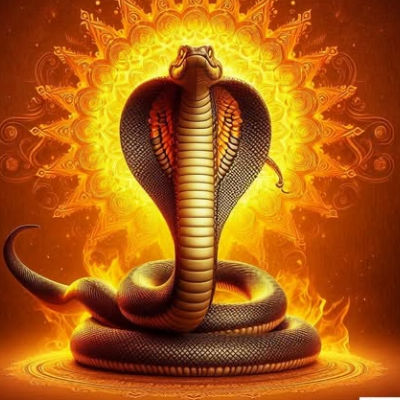
Kambala is a divine serpent of the Kadru lineage, born to the primordial sage Kashyapa and his wife Kadru, the mother of the serpent race. He is named among the chief Nagas in the Adi Parva of the Mahabharata and is recognised across multiple Mahapuranas and a Shaiva Agama as a lord of Patala, a participant in the cosmic solar calendar, and a figure of sufficient stature to be employed in Shiva's chariot for the destruction of the Tripuras. He consistently appears paired with his brother Ashvatara in Puranic cosmological literature, the two of them named together as the Naga pair who ride in the solar chariot during the winter months. He is also attested in the Tibetan Buddhist text Manjushrimulakalpa.
✦ The Name
The primary meaning of kambala in Sanskrit is a woollen blanket or woollen garment. Applied as a Naga name it may reflect the thick, enveloping coils of a great serpent, but no textual source provides an explicit etymology for the Naga's name. The variant form Kambalasva appears in the Bhagavata Purana's solar chariot lists, compounding kambala with ashva (horse) — likely a scribal or manuscript variant rather than a distinct figure, since Kambala and Ashvatara appear throughout Puranic literature as a fixed pair and Kambalasva is simply a conflation of the two names. As a patronymic he is a Kadraveya, a son of Kadru.
✦ Lineage
- Father: Kashyapa — the foremost Prajapati, son of Marichi, grandson of Brahma, progenitor of all cosmic orders of beings.
- Mother: Kadru — daughter of Daksha, mother of the thousand Nagas, whose curse underlies the great serpent sacrifice of Janamejaya.
- Siblings: The principal named brothers include Shesha, Vasuki, Takshaka, Airavata, Karkotaka, Kaliya, Elapatra, Dhananjaya, Nila, Anila, Nahusha, and Ashvatara, together with the full thousand-strong progeny of Kadru.
✦ Lord of Patala
The Bhagavata Purana, in its fifth book (V.24.31), lists Kambala among the sovereign lords of Patala — the seven-layered underworld realm inhabited by the Nagas — alongside Vasuki, Shankha, Kulika, Mahashankha, Shveta, Dhananjaya, Dhritarashtra, Shankhachuda, Ashvatara, and Devadatta. The Bhagavata Purana characterises these Naga lords collectively as beings of great power and fierce temper, each possessing multiple jewelled hoods whose radiance illuminates the darkness of the underworld caverns. The Brahmanda Purana and the Vayu Purana corroborate Kambala's status as a Kadraveya lord of Patala, placing him specifically in the underworld level known as Sutala. The Matsya Purana also records his presence in the Prajapati-kshetra on the banks of the Yamuna at Prayaga, where he is described as a thousand-hooded serpent associated with that region's sacred geography.
✦ In the Solar Cosmology
Kambala is identified in the Puranic solar-calendar cosmology as the Naga who rides in the chariot of the sun god Surya during specific months of the year, serving along with five or six other divine beings — a sage, a Gandharva, an Apsara, a Yaksha, and a Rakshasa — as part of the sun's monthly retinue. In this cosmological system, the Nagas in the solar chariot are described as arranging the chariot ropes and yoking the horses, performing a specific functional role in the sun's daily and seasonal journey. Across the Vishnu Purana, the Matsya Purana, the Brahmanda Purana, and the Linga Purana, Kambala and Ashvatara are placed together as the pair of Nagas serving during the winter months of Tapas and Tapasya (Magha and Phalguna, approximately January to March). The Linga Purana is explicit that these two "sons of Kadru" preside over the chariot of the sun in the months of the late winter season. One variant in the Bhagavata Purana lists the form Kambalasva for the month of Isha (Ashvina), indicating slight variation in the calendar assignments across manuscripts.
✦ Service in the Tripura Destruction
The Karna Parva of the Mahabharata records that Kambala was among the Nagas employed in the construction of Shiva's cosmic chariot for the destruction of the three fortified cities of the Asuras known as the Tripuras. In that episode, Shiva assembled a chariot of cosmic dimensions — the earth as its body, the sun and moon as its wheels, Brahma as its charioteer — and Nagas served as the ropes binding the chariot's components. Kambala's presence in this list places him alongside several of his brothers in the same ceremonial role.
✦ In the Parakhya Tantra and Buddhist Literature
The Parakhya Tantra, a Shaiva Agamic text, names Kambala as the Naga chief presiding over Nitala — one of the seven levels of the Puranic underworld in Shaiva cosmological scheme. This mention extends his attestation into the Agamic literature beyond the Puranic and epic mainstream. The Tibetan Buddhist text Manjushrimulakalpa, a major 6th-century Kriya Tantra, also lists Kambala among the Nagas present at the teachings of Manjushri, indicating that the figure's name carried currency across the broader religious cultures of the Indian subcontinent.
✦ Connection to the Wider Genealogy
Kambala belongs to the Kashyapa lineage — his paternal grandfather is Marichi, a mind-born son of Brahma. His half-brother Garuda (son of Kashyapa through Vinata) is the hereditary enemy of the serpent race. His brother Vasuki served as the churning rope at the Samudra Manthana. His consistently paired association with Ashvatara in the Puranas suggests a special cosmological coupling between these two brothers, distinguishing them as a unit within the broader Naga family in the context of solar service.
✦ References
- Primary Sources
- Mahabharata, Adi Parva, Section XXXV (I.35): The principal enumeration naming Kambala among the foremost Nagas of Kadru.
- Mahabharata, Karna Parva: The Tripura destruction episode placing Kambala in Shiva's cosmic chariot.
- Bhagavata Purana V.24.31: Names Kambala among the Naga lords of Patala.
- Vishnu Purana II.10 (solar chariot section): Lists Kambala and Ashvatara as the winter-month Nagas in the solar retinue.
- Matsya Purana 6.29, 104.5, 126.15: Corroborates the solar chariot role and Patala association; mentions the Prajapati-kshetra at Prayaga.
- Brahmanda Purana II.23 (solar chariot chapter): Explicitly names Kambala and Ashvatara as sons of Kadru serving in the sun's chariot for the winter months of Tapas and Tapasya.
- Linga Purana, Chapter 55 (solar chariot): Lists Kambala and Ashvatara together as the winter serpents in the solar chariot cosmology.
- Parakhya Tantra 5.44–45 (Shaiva Agama): Names Kambala as the Naga chief presiding over the underworld level Nitala.
- Manjushrimulakalpa (6th century CE, Tibetan Buddhist): Lists Kambala among the Nagas attending Manjushri's teachings.
- Secondary Sources
- Wisdomlib.org, "Kambala: 39 definitions": Cross-references the Mahabharata, Bhagavata, Brahmanda, Vayu, and Matsya Puranas, the Parakhya Tantra, and the Manjushrimulakalpa for this figure.
- Wisdomlib.org, Linga Purana Chapter 55 (English translation): Provides the solar chariot passage explicitly naming Kambala and Ashvatara as sons of Kadru.
- Isvara.org, "Surya the Sun God" (compiled Puranic Encyclopaedia): Details the monthly associations of specific Nagas with the solar chariot, confirming Kambala in the winter months.