
About
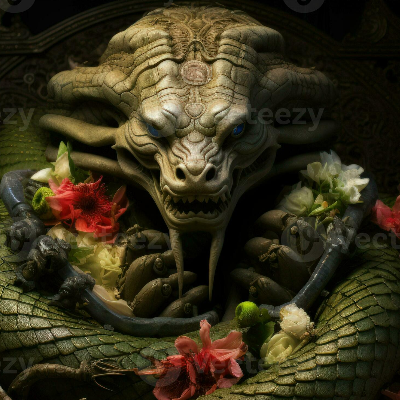
Ashvatara — Naga Lord of Patala, Bearer of the Solar Chariot, Guardian of Prayaga
Ashvatara · Asvatara · Kadraveya · son of Kashyapa and Kadru
Ashvatara is a divine serpent of the Kadru lineage, born to the sage Kashyapa and his wife Kadru, and counted among the foremost Nagas in the Mahabharata's Adi Parva enumeration. He is among the better-attested of the named Nagas across the Mahapuranas, appearing in the Bhagavata Purana as a lord of Patala, in the solar-chariot cosmology of the Vishnu Purana, the Matsya Purana, the Brahmanda Purana, and the Linga Purana as the Naga governing a specific month of the year, in the Karna Parva's account of the Tripura destruction as a component of Shiva's cosmic chariot, and in the Vana Parva's pilgrimage itinerary through a sacred pond at Prayaga that bears his name. He is consistently paired with his brother Kambala in the Puranic solar cosmology, and his attestation extends into the Tibetan Buddhist Manjushrimulakalpa.
✦ The Name
Ashvatara is a Sanskrit compound formed from ashva (horse) and the suffix tara, conveying the sense of "more swift than a horse," "swifter," or "excelling the horse." The Shabda-Sagara Sanskrit-English Dictionary identifies it as an adjectival form meaning swift or speedy before its use as a proper name. As applied to this Naga, it may reflect the speed or vigour attributed to a great serpent, or it may be purely a proper name without active semantic intent. The word also designates a class of Gandharvas in some Sanskrit sources, and the Sanskrit lexical tradition includes it among words for a mule — indicating the word's range of usage beyond this specific Naga. As a patronymic he is a Kadraveya.
✦ Lineage
- Father: Kashyapa — the primordial Prajapati, son of Marichi and grandson of Brahma, progenitor of gods, demons, Nagas, and birds.
- Mother: Kadru — daughter of Daksha Prajapati, mother of the thousand-strong serpent race, whose curse provides the mythological cause of the Sarpa Satra.
- Siblings: Among the principal named brothers are Shesha, Vasuki, Takshaka, Airavata, Karkotaka, Kaliya, Elapatra, Dhananjaya, Nila, Nahusha, Kambala, and the full thousand-strong lineage of Kadru's sons.
✦ Lord of Patala
The Bhagavata Purana (V.24.31) names Ashvatara among the chief lords of Patala, alongside Vasuki, Shankha, Kulika, Mahashankha, Shveta, Dhananjaya, Dhritarashtra, Shankhachuda, Kambala, and Devadatta. The passage describes these Naga sovereigns as beings of formidable power, each possessing multiple hoods — ranging from five to seven to hundreds to thousands — adorned with precious gems whose light illuminates the dark caverns of the underworld. The Brahmanda Purana and the Vayu Purana also place Ashvatara among the Kadraveya Nagas of Patala. The Bhagavata Purana's fifth book describes him as residing in the underworld level of Sutala, and the Matsya Purana (6.29, 104.5, 106.27, 110.8) records him in multiple underworld contexts.
✦ In the Solar Cosmology
Like his brother Kambala, Ashvatara is assigned a specific place in the Puranic solar-chariot cosmology, in which the sun's entourage is composed of six or seven divine beings cycling through a monthly succession throughout the year. Ashvatara and Kambala are paired together in the Brahmanda Purana's chapter on heavenly bodies as the two sons of Kadru who serve in the sun's chariot during the winter months of Tapas and Tapasya (Magha and Phalguna). The Vishnu Purana specifies Ashvatara as the Naga of the month of Urja (Kartika, approximately October–November), in the retinue of the Aditya Vishnu. The Bhagavata Purana's twelfth book further confirms Ashvatara's presence in the solar retinue, placing him in the month of Phalguna (February–March). The Linga Purana lists the twelve solar Nagas as a group — Vasuki, Kankanikarana, Takshaka, Naga, Elapatra, Shankhapala, Airavata, Dhananjaya, Mahapadma, Karkotaka, Kambala, and Ashvatara — with Ashvatara closing the list. The Nagas in this cosmology are described as yoking the horses to the chariot and arranging the ropes, a functional and liturgically significant role.
✦ The Sacred Pond at Prayaga
The Vana Parva of the Mahabharata (III.55.76) records that a sacred pond named after Ashvatara exists at Prayaga — the ancient sacred confluence of the Ganges, Yamuna, and the subterranean Sarasvati at what is today Prayagraj. A bathing site (tirtha) bearing a Naga's name at the most sacred pilgrimage confluence in the Hindu tradition represents a meaningful degree of cultic recognition. This reference is corroborated by the Matsya Purana's description of Ashvatara as a thousand-hooded Naga in the Prajapati-kshetra at Prayaga on the banks of the Yamuna — a description that places him as the resident serpent deity of that specific stretch of the sacred geography. The combination of a Puranic sacred site and an epic tirtha reference gives Ashvatara a concrete geographical presence unusual among the less-prominent Nagas.
✦ Service in the Tripura Destruction
The Karna Parva of the Mahabharata records Ashvatara among the Nagas employed in the construction of Shiva's cosmic chariot for the destruction of the Tripuras. This episodic reference, shared with several of his brothers, connects Ashvatara to one of the most celebrated events in Shaiva mythology. The Wisdomlib Puranic Encyclopaedia entry compiled from the Matsya Purana (126.15) and Brahmanda Purana corroborates this connection.
✦ In Buddhist Literature
Ashvatara is named in the Tibetan Buddhist Manjushrimulakalpa among the Nagas attending the transmission of Manjushri's teachings — an attestation he shares with his brother Kambala. His presence in that text, alongside figures drawn from the Hindu Naga tradition, is consistent with the general pattern by which prominent Naga names were incorporated into Buddhist cosmological literature across traditions.
✦ Textual Variants
The solar-calendar Purana passages assign Ashvatara to slightly different months across texts: the Vishnu Purana places him in Urja (Kartika), the Bhagavata Purana in Phalguna, and the Brahmanda Purana places both Kambala and Ashvatara jointly in the winter months of Tapas and Tapasya. These minor discrepancies reflect the known variation in calendrical reckoning across Puranic redactions rather than any substantive disagreement about the figure's nature or identity.
✦ Connection to the Wider Genealogy
Ashvatara belongs to the Kashyapa lineage, sharing in the cosmic genealogy that extends from Brahma through Marichi and Kashyapa. His half-brother Garuda — son of Kashyapa through Vinata — is the serpents' natural enemy. His brother Vasuki served as the churning rope at the Samudra Manthana and is the sovereign of all Nagas. Ashvatara's consistent pairing with Kambala in the solar cosmology suggests these two brothers occupy a specific and complementary position in the Puranic ordering of the Naga race relative to the cosmic rhythms of time.
✦ References
- Primary Sources
- Mahabharata, Adi Parva, Section XXXV (I.35): Principal enumeration of Ashvatara among the chief Nagas of Kadru.
- Mahabharata, Vana Parva (III.55.76): Reference to the sacred pond at Prayaga bearing Ashvatara's name.
- Mahabharata, Karna Parva: Ashvatara among the Nagas in Shiva's Tripura chariot.
- Bhagavata Purana V.24.31: Names Ashvatara among the Naga lords of Patala.
- Bhagavata Purana XII.11 (solar chariot section): Assigns Ashvatara to the month of Phalguna in the solar retinue.
- Vishnu Purana II.10: Places Ashvatara in the retinue of the solar chariot for the month of Urja.
- Matsya Purana 6.29, 104.5, 106.27, 110.8, 126.15: Multiple references to Ashvatara in Patala, the Prajapati-kshetra at Prayaga, and the Tripura destruction.
- Brahmanda Purana, Chapter 23 (solar chariot): Explicitly names Kambala and Ashvatara as sons of Kadru serving in the winter months of the solar chariot.
- Linga Purana, Chapter 55: Lists Ashvatara among the twelve solar Nagas.
- Vayu Purana: Corroborates Ashvatara's Kadraveya identity and Patala role.
- Manjushrimulakalpa (6th century CE, Tibetan Buddhist): Names Ashvatara among the Nagas at Manjushri's teachings.
- Secondary Sources
- Wisdomlib.org, "Ashvatara: 18 definitions": Comprehensive cross-reference of all Puranic, epic, and Buddhist citations, including the Puranic Encyclopaedia summary of the figure's key attributes.
- Wisdomlib.org, Linga Purana Chapter 55 (English translation): The solar chariot passage listing Ashvatara among the twelve Naga bearers of the sun.
- Wisdomlib.org, Brahmanda Purana Chapter 23 (English translation): The passage explicitly identifying Kambala and Ashvatara as the sons of Kadru in the solar chariot for the winter months.
- Isvara.org, "Surya the Sun God" (compiled Puranic Encyclopaedia): Confirms the monthly assignments for Ashvatara and Kambala in the solar cosmology.