
About
Airavata — The Divine Elephant, Mount of Indra and King of the Ashtadiggajas
Airavata · Airavana · Abhra-Matanga · Arkasodara · Gajendra · Naga-Raja · Indra-Hastin · Shvetahasti
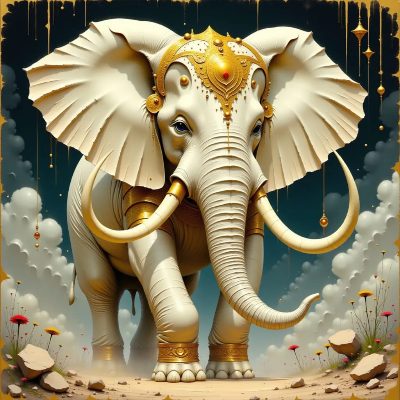
Airavata is the foremost of the eight celestial elephants known as the Ashtadiggajas, the divine guardians of the eight cardinal and intercardinal directions, and is celebrated throughout Hindu scripture as the mount of Indra, the king of the gods and lord of Svarga. He is described across multiple primary texts as white as the moon or as freshly risen clouds, of immense supernatural stature, and of unsurpassed majesty among all elephant-kind. He appears prominently in the Mahabharata, the Ramayana, the Vishnu Purana, the Bhagavata Purana, the Agni Purana, and the Matanga-Lila, among others. Within the genealogical framework of the Puranic tradition, Airavata is the son of Iravati, who is herself the daughter of Bhadramada, one of the ten daughters of Krodhavarsha. Krodhavarsha is a daughter of Daksha, the progenitor lord, and is one of the wives of Kashyapa, the great progenitor sage regarded as the common ancestor of gods, demons, serpents, and all classes of being. Airavata's consort is Abhramu, herself one of the eight female dik-gaja elephants born of the same mother Iravati, making the two siblings as well as consorts in accordance with the convention applied to this group in the Puranic genealogical tradition.
✦ The Name
The name Airavata derives from the Sanskrit iravat, meaning possessing water or produced from water, with the nominal suffix indicating nobility of origin. The water-connection is thematically apt given his emergence from the cosmic ocean in one origin tradition and his association with rain-bearing clouds. Abhra-Matanga means elephant of the clouds. Shvetahasti means the white-tusked one. Indra-Hastin designates him as the elephant of Indra. Gajendra means lord of elephants. Arkasodara, meaning brother of the sun, appears in certain texts though its precise scriptural basis varies.
✦ Lineage
- Paternal great-grandfather: Kashyapa — the foremost of the progenitor sages, son of Marichi who is himself a mind-born son of Brahma the creator; regarded as the father of all classes of beings through his many wives
- Paternal great-grandmother: Krodhavarsha — a daughter of Daksha, the progenitor lord, and one of the thirteen or more wives of Kashyapa; mother of ten daughters whose descendants include the elephant lineages
- Grandmother: Bhadramada — one of the ten daughters born of Krodhavarsha; the specific narrative of her life is not elaborated in the primary sources beyond her place in this lineage
- Mother: Iravati — daughter of Bhadramada; named in the Matanga-Lila and related texts as the mother of the eight male Ashtadiggajas and the eight female dik-gaja elephants
- Siblings (male — the Ashtadiggajas): Pundarika (guardian of the south-east), Vamana (guardian of the south), Kumuda (guardian of the south-west), Anjana (guardian of the west), Pushpadanta (guardian of the north-west), Sarvabhauma (guardian of the north), and Supratika (guardian of the north-east)
- Siblings (female): Abhramu, Kapila, Pingala, Anupama, Tamrakarni, Shubhradanti, Angana, and Anjanavati — the eight female dik-gaja elephants born of Iravati
- Consort: Abhramu — the eldest of the eight female dik-gaja elephants, herself a daughter of Iravati and thus a sibling of Airavata; the pairing of corresponding male and female elephants as consorts is the convention of this lineage
- Directional station: Guardian of the East, the most auspicious of the eight directions
✦ Origin Traditions
Two distinct origin traditions exist for Airavata in the primary sources. The first and most widely attested places his emergence at the Samudra Manthan, the churning of the cosmic ocean of milk by the gods and demons together, as described in the Mahabharata's Adi Parva and in the Vishnu Purana and Bhagavata Purana. In this account, Airavata arose in brilliant white splendour as one of the great treasures of the churning and was immediately claimed by Indra as his mount. The second tradition, preserved in the Agni Purana and elaborated in the Matanga-Lila, holds that Brahma the creator sang sacred hymns over the two halves of a cosmic egg at the beginning of creation, producing eight male elephants from the right half — the Ashtadiggajas — and eight female elephants from the left. In this account Airavata is the foremost of the males and a primordial being predating the churning episode. The genealogical lineage tracing Airavata through Iravati, Bhadramada, Krodhavarsha, and Kashyapa represents a third strand of tradition that situates him within the standard Puranic framework of descent from the great progenitor sage, and is the framework adopted in the present genealogical record.
✦ The Curse of Durvasa and Its Consequences
A significant episode connecting Airavata to the events of the Samudra Manthan concerns the sage Durvasa, a figure of terrible power and volatile temper who appears throughout the Puranic tradition. Durvasa presented Indra with a sacred garland of divine flowers while the god was riding upon Airavata. Indra received the garland carelessly and placed it upon Airavata's head. The elephant took the garland with his trunk and cast it to the ground. Durvasa, enraged by this treatment of his gift — whether by Airavata's action or Indra's indifference — pronounced a curse stripping the three worlds of their prosperity and the gods of their divine vigour. This weakening of the gods before the demons created the crisis that necessitated the churning of the ocean, making Airavata's action in this episode the proximate cause of one of the most consequential events in Puranic cosmology.
✦ Role as Guardian of the Eastern Quarter and Cosmic Significance
As the senior of the eight dik-gajas, Airavata guards the eastern direction, the quarter of the rising sun, of auspicious beginnings, and of Indra's own regency among the Ashtadikpalas, the eight divine guardians of the directions. In the Puranic cosmological system the dik-gajas are understood not merely as symbolic animals but as structural supporters of the cosmos, bearing the weight of the world's quarters upon their bodies. Airavata's white colour associates him with purity, the moon, and rain-bearing clouds, reflecting his master Indra's ancient identity as the god of rain and thunder. His epithet Abhra-Matanga, the elephant of the clouds, makes this connection explicit.
✦ Textual Variants and Inconsistencies
The principal inconsistency is the existence of two irreconcilable origin accounts — emergence at the Samudra Manthan versus primordial creation from Brahma's cosmic egg — which the texts themselves do not harmonise. A further variant concerns the number of Airavata's tusks and trunks: some texts describe him with four tusks and multiple trunks while others present a more conventional elephantine form distinguished by white colour and great size. The Gajendra Moksha episode of the Bhagavata Purana features an elephant king whose identity with Airavata is asserted in some commentarial traditions but is not confirmed unambiguously by the text itself. Airavata also appears in certain Puranic lists of great Nagas, reflecting the Sanskrit term's capacity to denote both serpents and great elephantine beings.
✦ Iconography
Airavata is depicted in sculpture and painting as a large white elephant, sometimes with four tusks, bearing Indra upon his back. In temple iconography he appears most commonly on the eastern face or gateway, consistent with his guardianship of that direction. His image is considered highly auspicious and features in the decorative programmes of temples dedicated to Indra, Vishnu, and Shiva alike.
✦ References
- Primary Sources
- Mahabharata, Adi Parva: Narrates the Samudra Manthan including Airavata's emergence and his being taken by Indra; contains enumerations of the great Nagas and elephants.
- Mahabharata, Udyoga Parva and Vana Parva: Describes Indra's divine court and battles in which Airavata serves as the god's mount.
- Valmiki Ramayana, Bala Kanda and Yuddha Kanda: References Airavata in cosmological passages and in similes comparing warriors to the celestial elephant.
- Vishnu Purana, Book I: Narrates the Samudra Manthan and includes Airavata in genealogical and cosmological lists.
- Bhagavata Purana, Book VIII: Contains both the Samudra Manthan narrative and the Gajendra Moksha episode relevant to Airavata's identity.
- Agni Purana: Preserves the alternative origin tradition of Airavata's birth from Brahma's cosmic egg with the other seven dik-gajas.
- Matanga-Lila (attributed to Nilakantha): Elaborates the mythology of Airavata and the dik-gajas in detail, including the genealogical lineage through Iravati and the cosmic-egg origin account.
- Amarakosha of Amarasimha: Lists and explains Airavata's names and epithets.
- Secondary Sources
- Mani, Vettam. Puranic Encyclopaedia. Motilal Banarsidass, 1975: Comprehensive entry consolidating Puranic and epic references to Airavata including variant origin accounts.
- Dowson, John. A Classical Dictionary of Hindu Mythology and Religion. Trubner and Co., 1879: Summary entry with references to principal textual appearances.