
About
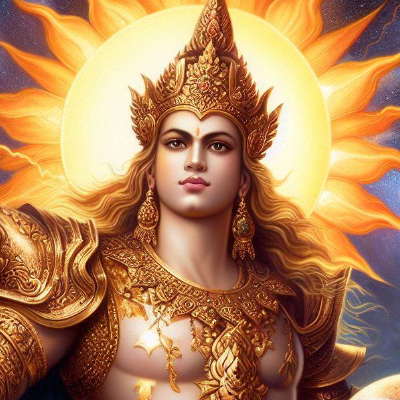
Dhata — Aditya of Creation and Ordainment
Dhata · Dhatri · Dhata Aditya · Vidhata
Dhata is one of the twelve Adityas, the solar deities who form a group of divine sons born to the sage Kashyapa and his wife Aditi, herself the daughter of the patriarch Daksha. As one of the Adityas, Dhata is a sovereign cosmic power associated with the ordaining of life, the regulation of natural order, and the bestowal of offspring and prosperity. He appears across a wide range of Puranic literature, including the Vishnu Purana, the Bhagavata Purana, the Mahabharata, and the Matsya Purana, though the details of his narratives and the enumeration of the Adityas vary among these texts.
✦ The Name
The name Dhata derives from the Sanskrit root dha, meaning to place, establish, or ordain. Dhata therefore carries the sense of one who places or establishes — a creator, a sustainer, or more specifically a dispenser of fates and outcomes. In many contexts the name is rendered as Dhatri, which carries the parallel sense of one who supports or maintains. The epithet connects Dhata closely to the function of cosmic regulation, particularly the ordaining of the births and destinies of living beings. In certain texts the name Vidhata is used alongside Dhata or Dhatri, with Vidhata sometimes treated as a separate deity and sometimes as an alternate name for the same figure. Where the two names are distinguished, Dhata is associated with the creation or bestowal of good fortune, while Vidhata is associated with the opposite or the prescribing of fate more broadly.
✦ Lineage
- Father: Kashyapa — one of the seven great primordial sages (Saptarshis), regarded as a progenitor of gods, demons, humans, and creatures; son of Marichi, who was himself one of the mind-born sons of Brahma.
- Mother: Aditi — daughter of the patriarch Daksha and wife of Kashyapa; regarded as the mother of the gods (Devas) and the divine source from whom all the Adityas are born.
- Brothers (the Adityas): Mitra, Varuna, Aryaman, Bhaga, Indra (Shakra), Vivasvat (Surya), Pushan, Parjanya, Amsha, Tvashtr, and Vishnu — the precise enumeration and the names included in the group of twelve vary among different Puranic texts. In the Rigveda the Adityas are enumerated as six or seven, while later Puranic tradition standardises the group at twelve.
- Spouse: The Vishnu Purana records that Dhata married two daughters of Meru — the cosmic mountain regarded as the axis of the universe. The names of these two wives are given as Kuhu and Sinivali in some accounts, though variant readings exist across manuscripts.
- Children: The Vishnu Purana states that Dhata fathered sons named Syama, Atreya, and others through his wives, though these sons are not developed as significant narrative figures in the primary sources.
✦ Dhata Among the Twelve Adityas
The twelve Adityas are understood in Puranic cosmology as twelve distinct aspects or forms of the sun, each presiding over one month of the year. Dhata is conventionally assigned to the month of Chaitra — the first month of the Hindu calendar, corresponding broadly to March and April — in texts such as the Vishnu Purana and the Mahabharata's Udyoga Parva and Anushasana Parva. During his presiding month, Dhata is described as drawing up the waters from the earth and distributing them, as generating heat and life, and as performing functions related to the orderly continuance of the cosmos. The Mahabharata, in its section dealing with the solar months and their presiding deities, names Dhata among the principal solar manifestations and associates him with the sustaining of creatures.
✦ Textual Variants and Inconsistencies
The relationship between Dhata, Dhatri, and Vidhata is handled inconsistently across primary sources, and this inconsistency is worth noting carefully. In some Puranic passages, Dhata and Vidhata appear as twin deities, both sons of Aditi and Kashyapa, and both equally associated with the ordaining of fate and the creation of progeny. The Vishnu Purana at certain points treats Dhata and Vidhata as a distinct pair within the broader Aditya group rather than as a single figure with two names. The Bhagavata Purana likewise refers to both names in ways that suggest two entities on some occasions. In other Puranic contexts, however, Vidhata is identified not as an Aditya at all, but as a son of Brahma or as a cosmic principle entirely distinct from the solar lineage. This ambiguity is present in the source texts themselves and has not been resolved by the tradition into a single consistent account.
Additionally, the assignment of specific months to specific Adityas is not uniform across all Puranic texts. While many texts give Dhata the month of Chaitra, others vary the assignment. The Mahabharata and the Vishnu Purana broadly agree, but the Matsya Purana and the Padma Purana show variant assignments in certain recensions.
✦ Theological and Cosmic Significance
Within the Aditya framework, Dhata represents the solar function of creation and bestowal. The Adityas collectively are understood as the luminous, sovereign powers that govern different domains of cosmic and natural life. Dhata's particular domain — the ordaining of offspring, the dispensing of fortune, and the establishment of order — places him at the intersection of solar energy and the metaphysical function of dharmic regulation. In the Vedic and early post-Vedic period, the Adityas were sovereign gods in their own right; by the time of the major Puranas they had been largely incorporated into a solar theology in which each Aditya is a manifestation of the one sun across the twelve months.
Dhata's function as a dispenser of progeny and a regulator of destiny also connects him to the broader Puranic understanding of cosmic law operating through divine personalities. The bestowal of children and the ordaining of births were understood not as random occurrences but as acts of divine governance, and Dhata's name — rooted in the concept of placing or establishing — encapsulates this function precisely.
✦ Connection to the Wider Genealogy
Dhata belongs to one of the most significant divine lineages in Hindu cosmology. His father Kashyapa is considered the progenitor of nearly all living beings — through different wives he is said to have fathered the Devas, the Asuras, the Nagas, the birds, and many other orders of being. His mother Aditi, as the mother of the Adityas, holds the status of a primordial goddess and is one of the most frequently mentioned divine mothers in the Rigveda. Dhata's brothers among the Adityas include some of the most significant sovereign deities of the Vedic tradition: Varuna, the lord of cosmic law and the waters; Mitra, the deity of covenant and friendship; Indra, the king of the gods and the wielder of the thunderbolt; and Vishnu, who in Puranic theology becomes the preeminent deity of the Vaishnava tradition. Through his marriage into the lineage of Meru, the cosmic mountain, Dhata is also connected to the geography of the Puranic universe.
✦ References
- Primary Sources
- Vishnu Purana, Book I, Chapter 15; Book II: Lists the twelve Adityas as sons of Aditi and Kashyapa, names Dhata among them, describes his wives as daughters of Meru, and assigns him a role in the monthly solar cycle.
- Bhagavata Purana, Skandha VI, Chapters 6 and 18: Enumerates the children of Aditi and Kashyapa, includes Dhata in the Aditya list, and at points distinguishes Dhata and Vidhata as a pair.
- Mahabharata, Anushasana Parva (Book XIII) and Udyoga Parva (Book V): Lists the Adityas and their presiding months; names Dhata as the Aditya of the month of Chaitra and associates him with life-sustaining solar functions.
- Matsya Purana, Chapters 6 and 171: Provides genealogical information on the Adityas and includes variant enumerations and monthly assignments relevant to Dhata.
- Rigveda, Book II and Book VIII (various hymns to the Adityas): Provides the foundational Vedic basis for the Aditya group, though at this stage the group is smaller and Dhata is not individually prominent; establishes the theological framework that Puranic texts later develop.
- Padma Purana, Srishti Khanda: Contains material on the Adityas and their cosmic functions with some variant assignments compared to the Vishnu Purana.
- Secondary Sources
- Mani, Vettam. Puranic Encyclopaedia (1975): Entry on Dhata and related entries on the Adityas and Aditi; useful for cross-referencing variant names and textual references across Puranic sources.
- Macdonell, A. A. Vedic Mythology (1897): Provides detailed analysis of the Adityas in the Vedic tradition and charts the development of the group from the Rigveda onward.
- Wisdomlib (wisdomlib.org), entries on Dhata, Adityas, and Aditi: Aggregates verse references from digitised Puranic texts and provides cross-textual comparisons useful for identifying variant readings.