
About
Vishnu Aditya — The Pervader, Son of Aditi, and the Dwarf Incarnation
Vishnu · Vamana · Upendra · Trivikrama · Urukrama · Damodara · Shatakratu · Aditi-nandana · Aditeya · Aditi-ja · Urugaya
Vishnu is one of the twelve Adityas, the solar deities born to the sage Kashyapa and his wife Aditi, daughter of the patriarch Daksha. In the Rigveda he appears as a relatively minor but theologically distinctive solar deity, celebrated above all for his three strides that measure the entire cosmos — an act that already in the Vedic period marks him as a deity of extraordinary spatial and cosmic significance. In the Puranic tradition, Vishnu as an Aditya becomes identified with the Vamana avatar — the dwarf incarnation — in which Vishnu, born as the son of Kashyapa and Aditi in response to their prayers, recovers the three worlds from the demon king Bali through his cosmic three-stride expansion. This identification between Vishnu the Aditya and Vishnu the Vamana avatar is one of the most explicit connections in the Puranic literature between the Vedic Aditya tradition and the Puranic theology of divine descent, and it gives Vishnu's membership of the Aditya group a narrative weight and theological elaboration that most of his brothers do not possess. Beyond the Vamana episode, however, Vishnu in the Puranas is of course far more than simply one of the twelve solar deities: he is in the Vaishnava tradition the supreme deity, the lord of all creation, the preserver of the cosmos, and the source from whom all beings and all other gods ultimately derive. The present profile addresses Vishnu specifically in his identity as an Aditya — as the son of Kashyapa and Aditi — and as Vamana, while acknowledging that his full theological identity in the Vaishnava tradition vastly exceeds the scope of the Aditya classification. His universal Puranic identity is touched upon where directly relevant to his Aditya nature but is not comprehensively treated here, as such treatment would require a separate and considerably more extensive profile.
✦ The Name
The name Vishnu is derived from the Sanskrit root vish, meaning to pervade, to enter into, or to spread throughout. Vishnu is therefore the pervader — the one who pervades or permeates the entire cosmos. This etymology is explicitly stated in several Puranic texts and is central to the theology of Vishnu's universal identity: as the pervader, he is present throughout all of existence, sustaining it from within rather than governing it from without. The name thus encodes a specifically immanent understanding of the divine — Vishnu is not merely the lord of creation but its pervasive inner reality.
The name Vamana means the dwarf or the small one, derived from the root vam or from a related form meaning stunted in growth or short in stature. As the name of the fifth avatar of Vishnu, it designates the deliberately diminutive form that the supreme deity assumed in order to approach the demon king Bali as an apparently harmless brahmin student and secure from him the gift of three paces of land. The contrast between the dwarfish form and the cosmic expansion that followed — in which those three paces covered all of creation — is central to the episode's theological meaning.
The epithet Upendra means the younger Indra or the one below Indra, applied to Vishnu specifically in his identity as the Aditya born to Aditi — making him a younger brother of Indra among the Aditya group — and as the Vamana avatar who initially presents himself as smaller and less powerful than the king of the gods. The Bhagavata Purana uses this epithet explicitly in the context of Vishnu's birth as an Aditya. Trivikrama means the one of three strides, commemorating the cosmic expansion in which Vamana covered the three worlds in three steps. Urukrama means the wide-striding one, with the same reference. Urugaya means the widely praised one or the one who goes far, again with resonance of the cosmic strides. Aditi-nandana, Aditeya, and Aditi-ja all mean son of Aditi — epithets applied to Vishnu specifically to emphasise his Aditya identity as born from the cosmic mother.
✦ Lineage
- Father: Kashyapa — one of the seven great primordial sages and the supreme progenitor of all orders of beings; son of Marichi, who was one of the mind-born sons of Brahma the creator. Kashyapa is the father of the gods through Aditi, of the demons through Diti and Danu, of the Nagas through Kadru, of the birds through Vinata, and of all remaining categories of beings through his other wives.
- Mother: Aditi — daughter of the patriarch Daksha and wife of Kashyapa; the boundless, inexhaustible mother of all the Adityas. In the Vamana narrative, Aditi performs specific austerities — the Payovrata, a twelve-day observance of ritual purity and devotion — specifically to obtain Vishnu as her son, and Vishnu appears to her and agrees to be born from her womb for the purpose of defeating Bali and recovering the three worlds for the gods.
- Brothers (the Adityas): Dhata, Mitra, Varuna, Aryaman, Bhaga, Indra (Shakra), Vivasvat (Surya), Pushan, Parjanya, Amsha, and Tvashtr. As Upendra — the younger Indra — Vishnu in his Aditya birth is specifically positioned as the younger brother of Indra within the group, a relationship that the Vamana narrative makes structurally important: Vishnu as Vamana acts on behalf of Indra and the gods to recover what Indra has lost.
- Half-brothers (the Daityas): Through Kashyapa's wife Diti, the Daityas including Hiranyakashipu and Hiranyaksha are Vishnu's half-brothers — a genealogical irony that the Puranic tradition acknowledges, since Vishnu's avatars repeatedly kill these Daitya half-brothers. Bali, the demon king against whom the Vamana episode is directed, is the grandson of Hiranyakashipu's son Prahlada — himself one of Vishnu's greatest devotees — making Bali also part of this extended half-fraternal network.
- Consort (in Puranic identity beyond the Aditya birth): Lakshmi — the goddess of fortune and prosperity, who emerged from the churning of the cosmic ocean and chose Vishnu as her eternal consort. In his Vamana form, Vishnu is accompanied by Lakshmi implicitly as his eternal partner, though the Vamana narrative focuses on his relationship with Aditi and Kashyapa as parents and with Bali as his interlocutor.
- In the Vamana episode specifically: Vishnu as Vamana is described as approaching the sage Kashyapa to be invested with the sacred thread — the upanayana ceremony marking his initiation as a brahmin student — before going to Bali's sacrifice. The preceptor Shukracharya, guru of the demons, is present at Bali's sacrifice and recognises Vamana's true identity, warning Bali not to grant his request. Bali nevertheless proceeds.
✦ Vishnu in the Rigveda
In the Rigveda, Vishnu is not among the most prominent deities — he receives fewer individual hymns than Indra, Agni, Varuna, or Soma — but the hymns addressed to him establish a character of remarkable theological significance that would prove, in the long development of the tradition, to be the seed from which an entire supreme theology grew. The Rigvedic Vishnu is above all the deity of the three strides. In a series of celebrated hymns, Vishnu is described as striding across the cosmos in three steps, measuring the entire extent of the universe — earth, atmosphere, and heaven — with these three paces. The highest of his three steps is described as a place of supreme radiance where the gods dwell and where those who have performed good deeds go after death, a celestial realm of light that Vishnu surveys from his exalted position.
The Rigvedic Vishnu is also described as a close ally and companion of Indra — the two are sometimes addressed together, and Vishnu is invoked alongside Indra in hymns celebrating the defeat of Vritra and other cosmic victories. This alignment with Indra in the Vedic period anticipates the structural relationship in the Vamana narrative, where Vishnu acts on behalf of Indra and the gods to recover what the demon Bali has taken from them. The association between Vishnu's three strides and Indra's cosmic victories is present already in the Rigveda, where the two deities appear as complementary powers — Indra providing the martial force and Vishnu providing the spatial or cosmic dimension of the divine victory.
The Rigvedic Vishnu is also consistently associated with goodwill toward humanity. Several hymns describe him as a friendly deity who assists humans, who is easy to approach, and whose highest step — though beyond ordinary human reach — is always open to those who are devoted to him. This accessible, benevolent character of the Vedic Vishnu is notably different from the more awe-inspiring and punitive character of Varuna, and it establishes the temperamental quality that would become characteristic of Vishnu in all subsequent theology: approachable, protective, and fundamentally inclined toward the welfare of those who seek his help.
✦ Aditi's Austerities and the Birth of Vamana
The Bhagavata Purana's eighth book provides the most detailed and theologically developed account of the circumstances of Vishnu's birth as Vamana, the son of Aditi and Kashyapa. The narrative begins with the defeat of the gods by the demon king Bali. Bali, grandson of the great Vishnu-devotee Prahlada and son of Virochana, had performed the Vishvajit sacrifice under the direction of his preceptor Shukracharya — the divine guru of the demons — and had received from it irresistible power, a divine chariot, celestial armour, and inexhaustible resources. With this empowerment he had attacked Svarga, defeated Indra and the assembled gods in battle, and taken possession of all three worlds. Indra and the defeated gods, stripped of their heavenly realms and their divine privileges, wandered the earth in distress.
Aditi, the mother of the gods and of Indra, was overcome with grief at the condition of her sons. At the counsel of her husband Kashyapa, she undertook the Payovrata — a twelve-day observance of strict ritual purity, restraint, and devotion directed toward Vishnu — with the purpose of obtaining from him the protection and restoration of her sons. The Payovrata involved specific dietary restrictions, specific recitations, and a sustained focus of devotion upon Vishnu as the supreme protector. At the conclusion of the twelve days, Vishnu appeared to Aditi and Kashyapa, acknowledged the sincerity and intensity of their devotion, and declared that he would be born as their son — as an Aditya, a son of Aditi — for the purpose of fulfilling their desire and recovering the three worlds for the gods.
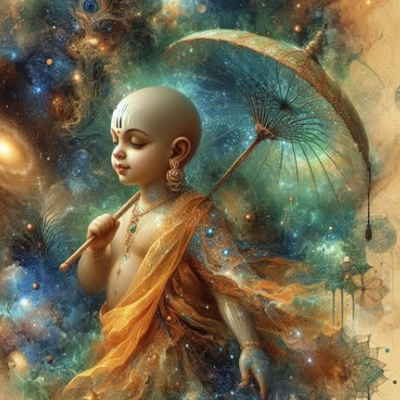
In due course, Vishnu entered the womb of Aditi and was born as Vamana — the dwarf — the twelfth son of Aditi and the youngest of the Adityas. His birth was accompanied by celestial signs: the gods assembled to witness it, the sages sang praises, the gandharvas played music, and the apsaras danced. The newborn Vamana was invested with the sacred thread and the other marks of a brahmin student. He received a staff from the sage Angiras, a water pot from Brahma, a fan of palm leaves from Sage Agastya — himself the son of Mitra and Varuna and thus indirectly connected to the Aditya lineage — deer skin and a garment from the Moon, and his distinctive umbrella from Aditi herself. Thus equipped as a brahmin student of diminutive stature, Vamana set out for the great sacrifice that Bali was performing on the banks of the Narmada river at the place called Bhrigu-kaksha.
✦ The Vamana Episode — Approaching Bali
Bali was at this time performing the Ashvamedha sacrifice — the royal horse sacrifice that declares universal sovereignty — under the supervision of his brahmin preceptors of the Bhrigu lineage. The sacrifice was being conducted with extraordinary generosity: Bali had pledged to give freely to any brahmin who came and asked, and he was known throughout the three worlds for the absolute and unqualified nature of his giving. This quality of perfect generosity — dana taken to its most heroic extreme — is presented in the Puranic sources as Bali's most admirable characteristic, even as his pride and his dominion over the three worlds at the gods' expense constitute the problem that the narrative must resolve.
Vamana arrived at the sacrificial ground — a small, dwarfish brahmin student, shining with an inexplicable inner radiance that caused all who saw him to feel drawn toward him with affection and reverence. Bali received him with great honour, washing his feet, offering him a seat, and asking what gift he desired. Vamana asked for three paces of land — as much land as he could cover in three strides of his small feet. Bali was amused and somewhat dismissive: such a small request from such a small brahmin seemed absurd, and Bali urged Vamana to ask for something more substantial — a kingdom, gold, elephants, horses. Vamana declined, saying that three paces of land was all he needed, and that a person who is content with what is sufficient has no need for more.
At this point Shukracharya, the sage-preceptor of the demons who recognised Vamana's true identity, intervened. He warned Bali urgently and explicitly: this was no ordinary brahmin student but Vishnu himself, born as the son of Kashyapa and Aditi for the express purpose of recovering the three worlds from Bali on behalf of the gods. To give Vamana the three paces would be to give away everything. Bali listened to Shukracharya's warning in full awareness and then declined to retract his offer. He acknowledged that to be tricked into giving a gift to Vishnu was not a defeat but an honour, and that no person of genuine generosity could withdraw a pledge once given to a brahmin who had asked in good faith. He took up the water vessel to pour the formal water-libation that would seal the gift — the act that in the Indian tradition of dana constitutes irrevocable completion of the giving.
Shukracharya, in a final attempt to prevent the gift, shrank himself to a tiny form and blocked the spout of the water vessel with his own body. Vamana, knowing what had been done, took a blade of darbha grass and used it to clear the spout, driving the grass into Shukracharya's eye in the process. This act blinded Shukracharya in one eye — a permanent injury that several Puranic texts record as the origin of Shukracharya's one-eyed condition. Bali poured the water and the gift was complete and irrevocable.
✦ The Trivikrama Expansion
The moment the water of the gift-libation touched his hand, Vamana began to expand. The small brahmin student grew with extraordinary speed, expanding in all directions simultaneously, until his body filled and then exceeded the entire cosmos. The assembled gods, sages, and celestial beings looked on in awe and reverence as the true nature of the dwarf was revealed. Vamana assumed the form of Trivikrama — the cosmic being of three strides — his body spanning all of creation.
With his first stride, Trivikrama covered the entire earth — all of its continents, oceans, mountains, and kingdoms. With his second stride, he covered the entire heavenly realm — all of Svarga, all the stellar regions, all the celestial worlds from the lowest to the highest. With these two strides he had covered the entirety of the three worlds — earth, atmosphere, and heaven — the very three worlds that Bali had pledged to give through his gift of three paces. There was no space remaining for the third stride.
Trivikrama turned to Bali and asked where he should place his third foot, since all of creation had been covered by the first two. Bali, maintaining the composure and dignity that characterise him throughout the episode, bowed his head and offered it as the place for the third stride. He had given his word, the gift was complete, and the consequences — however overwhelming — would be accepted without complaint or resistance. Trivikrama placed his foot on Bali's head and pressed him down through the earth into the underworld realm of Patala, the lowest of the seven subterranean worlds.
With Bali's submission and descent into Patala, the three worlds were freed from his dominion. Indra and the gods recovered Svarga. The cosmic order disrupted by Bali's conquest was restored. Trivikrama then contracted back to his normal divine form and stood before the subdued but unbroken Bali.
✦ The Boon to Bali and Vishnu's Promise
The resolution of the Vamana episode is one of the most theologically significant aspects of the narrative, and it distinguishes the Puranic account from a simple tale of divine victory over demonic power. Throughout the episode Bali had displayed qualities of extraordinary moral stature: absolute generosity, the willingness to honour his word at catastrophic personal cost, calm acceptance of consequences, and devotion — whether explicit or implicit — toward the divine being who had outwitted him. The Bhagavata Purana in particular is emphatic that Bali's conduct throughout was that of a great soul, and that his defeat at Vishnu's hands was not a punishment for wickedness but a necessary cosmic correction that did not diminish Bali's essential nobility.
In response to Bali's acceptance and submission, Vishnu granted him the sovereignty of Patala — the underworld realm — where he would rule as king, honoured and powerful within his new domain. More significantly, Vishnu promised to remain as Bali's doorkeeper — to station himself permanently at the entrance to Bali's palace in Patala, guarding and protecting his devotee for eternity. This promise — the supreme deity of the cosmos serving as the doorkeeper of a demon king — is presented in the Bhagavata Purana as a supreme expression of Vishnu's grace toward those who surrender to him completely: Bali's surrender, however involuntary in its origin, had taken the form of genuine acceptance, and Vishnu's response was to bind himself to Bali's service in return.
The Bhagavata Purana records that Lakshmi, Vishnu's consort, was concerned about Vishnu's self-imposed binding to Bali's doorkeeping service and sent the sage Narada to release Vishnu from this commitment after a period, which Narada accomplished by pointing out the obligation's terms. This detail adds a domestic and relational dimension to the otherwise cosmic narrative.
The tradition also records that Bali is among the immortal chiranjivis — long-lived beings who persist through vast stretches of cosmic time — and that he is destined to become the Indra of the next manvantara, the next cosmic age, when his accumulated merit and his relationship with Vishnu will elevate him to the highest position among the gods. This future elevation is granted by Vishnu as a further boon, consoling Bali for the loss of his present sovereignty while promising him a greater future one.
✦ Prahlada's Intercession
The Bhagavata Purana records that when Bali was pressed down into Patala by Trivikrama's foot, his grandfather Prahlada — the celebrated devotee of Vishnu who had himself been persecuted by the Daitya king Hiranyakashipu and protected by Vishnu in the Narasimha avatar episode — came forward and praised Vishnu with great devotion. Prahlada acknowledged that Bali's defeat was not a disgrace but a grace, that to be touched by Vishnu's foot was an honour beyond all human or divine achievement, and that the compression of Bali's pride through Vishnu's action was itself a form of divine mercy. The Bhagavata Purana uses Prahlada's intercession and his praise to articulate the theological interpretation of the episode: what appears to be a defeat is in reality a liberation from the pride of sovereignty, and Vishnu's action, however apparently harsh, is ultimately an act of grace toward a worthy being.
✦ Vishnu as One of the Twelve Solar Adityas
In the Puranic framework of the twelve Adityas as monthly solar manifestations, Vishnu is assigned the month of Shravana in some texts and Bhadrapada in others, though these assignments are complicated by the fact that Indra is also assigned Shravana in several recensions, pointing to the genuine inconsistency in the tradition's assignment of months across the full list of twelve. The Vishnu Purana and the Mahabharata's Anushasana Parva give the most authoritative Puranic assignments, but variation exists across manuscripts. Where Vishnu is assigned his presiding month, the cosmic functions attributed to him are the general functions of all the Adityas: the drawing up of water, the generation of warmth and light, and the sustaining of living beings through the solar power of the relevant season.
The Puranic solar Aditya framework sits somewhat awkwardly alongside the full Vaishnava theology in which Vishnu is the supreme being who transcends all cosmic categories including the monthly solar cycle. The tradition handles this tension by treating Vishnu's membership of the Aditya group as one aspect of his universal presence — he pervades the solar order as he pervades all of existence — rather than as a limitation of his nature. The twelve Adityas are understood in some Puranic passages as twelve aspects of a single solar reality, and Vishnu as the supreme deity pervades and underlies that reality in its entirety, not merely the one-twelfth assigned to his monthly portion.
✦ The Cosmic Three Strides — Vedic and Puranic Connections
The connection between the Rigvedic Vishnu's three strides and the Puranic Vamana-Trivikrama's three strides is one of the most celebrated examples in the history of Hindu religion of a Vedic mythological kernel being elaborated into a full Puranic narrative. In the Rigveda, Vishnu's three strides are cosmic measurements — acts that define the extent of the universe by the span of a divine being's steps. The strides are cosmogonic rather than narrative: they establish the spatial dimensions of the cosmos rather than telling a story of conflict and resolution.
In the Puranic Vamana narrative, this cosmic measurement is given a full narrative context: the three strides now have a purpose — the recovery of the three worlds — a protagonist — the dwarf who expands to cosmic size — an antagonist — Bali who must lose what he has taken — and a moral and theological resolution that addresses questions of sovereignty, generosity, grace, and the relationship between divine power and human nobility. The Puranic narrative does not replace the Vedic cosmic measurement but embeds it within a story that makes its significance concrete and humanly meaningful.
This elaboration reflects the general pattern by which the Puranic tradition related to the Vedic corpus: the hymns provided theological kernels — images, concepts, and divine characterisations — that the Puranas then expanded into full narratives with characters, conflicts, and resolutions, while maintaining explicit continuity with the Vedic source through quotation, reference, and the retention of key imagery.
✦ Textual Variants and Inconsistencies
The Vamana narrative exists across multiple primary sources with significant variation in detail, and several of the most important variants deserve explicit acknowledgment. The Vishnu Purana, the Bhagavata Purana, the Vamana Purana, the Matsya Purana, and the Mahabharata all give versions of the episode, and these do not agree on every point.
The Vamana Purana — a text dedicated specifically to this avatar — is the most elaborate single source for the episode and includes details not found in all other versions, including extended descriptions of Vamana's appearance, the equipment given to him at his investiture as a brahmin student, and the dialogue between Vamana and Bali. The Bhagavata Purana's eighth book is the most theologically developed version, particularly in its treatment of Bali's character, Prahlada's praise, and the significance of Vishnu's promise to serve as Bali's doorkeeper. The Vishnu Purana's account is more concise. The Mahabharata's references to the Vamana episode are scattered across several books rather than gathered in a single narrative.
The role of Shukracharya varies across versions: in some he intervenes explicitly and has his eye pierced by the darbha grass; in others his warning to Bali is present without the eye-piercing incident, or the incident is described differently. The Vamana Purana and the Bhagavata Purana both record the one-eyed Shukracharya incident, making it one of the more consistently attested variant details.
The precise nature and duration of Vishnu's promise to serve as Bali's doorkeeper also varies: some versions describe this as a permanent commitment, others as a limited one resolved by Narada's intervention. The Bhagavata Purana gives the most developed version of both the commitment and its resolution.
The tension between Vishnu as one of the twelve Adityas — a member of a specific divine group — and Vishnu as the supreme deity of the Vaishnava tradition is handled differently across texts and is not resolved in any single canonical way. The Bhagavata Purana is explicitly Vaishnava in its theology and frames the Vamana episode as an act of the supreme deity who graciously took birth as a son of Aditi; the Vishnu Purana similarly frames it within a supremacist Vaishnava theology. Texts of a less explicitly sectarian character treat the episode without necessarily asserting Vishnu's supremacy over all other gods as the frame within which it must be understood.
✦ Iconography of Vamana and Trivikrama
The iconography of Vamana presents two distinct forms corresponding to the two phases of the narrative. The first is the Vamana form proper — the dwarf brahmin student. In this form he is depicted as a short, rotund, cheerful-looking young brahmin, typically shown with a shaved head or a top-knot, holding a water pot (kamandalu), an umbrella, and a staff. His expression is typically gentle and pleasant, conveying the approachable, non-threatening character with which he approaches Bali. He is sometimes shown approaching Bali or standing before him in the act of requesting the three paces.
The second is the Trivikrama form — the cosmic being in mid-stride. In this form Vishnu is depicted at enormous scale, one leg raised high in the act of striding across the cosmos, his body filling the entire composition and dwarfing all other beings depicted around him. His raised foot may be shown touching or approaching the celestial realm; Brahma is sometimes depicted washing that foot with water from his ritual vessel, from which the Ganga is said to originate in some accounts. Bali may be shown below, small and humbled, as the cosmic being's third stride descends toward his head. This is one of the most visually dramatic of all Vishnu's avatara forms and appears frequently in temple sculpture across South and Southeast Asia.
Vishnu in his general iconographic form — the four-armed deity holding the conch, discus, mace, and lotus — is of course the most widely depicted divine form in the Vaishnava tradition, but this general form belongs to his universal identity rather than specifically to his Aditya or Vamana aspect.
✦ Theological Significance
Vishnu's presence in the Aditya group carries multiple layers of theological significance. At the most straightforward level, it integrates the supreme deity of the Vaishnava tradition into the ancient solar divine lineage, grounding Vishnu's cosmic identity in the same genealogical source — Kashyapa and Aditi — as all the other Adityas and thereby connecting his nature to the most ancient solar theology of the tradition.
At a deeper level, the Vamana narrative as the specific story of Vishnu's birth as an Aditya encodes several of the most important theological principles of the Vaishnava tradition. The episode demonstrates that divine power operates through apparent smallness and apparent limitation — the supreme deity approaches as a dwarf, as a student, as someone who seems to ask for very little, and it is precisely through this apparent smallness that the greatest cosmic act is accomplished. This principle — that Vishnu's power is most fully manifest when it is least obviously displayed — runs through many of his avatara narratives and is crystallised in the Vamana episode with particular clarity.
The episode also demonstrates the theological principle that genuine generosity and genuine surrender — even when directed toward a being who is technically an adversary — are recognised and rewarded by the divine. Bali's perfect generosity and his acceptance of his defeat without resentment transform what might have been a simple tale of divine victory over demonic pride into a narrative about the grace that flows toward those who give and surrender completely. The Bhagavata Purana's presentation of Bali as a great soul whose defeat is simultaneously his elevation exemplifies the tradition's sophisticated theological insistence that the divine does not simply punish the wicked but transforms those who are worthy, regardless of which side of the cosmic conflict they occupy.
✦ Connection to the Wider Genealogy
As a son of Kashyapa and Aditi in the Vamana birth, Vishnu is the youngest of the Adityas and the brother of Indra, Varuna, Mitra, Aryaman, Bhaga, Pushan, Amsha, Parjanya, Tvashtr, Vivasvat, and Dhata. As the younger brother of Indra he carries the epithet Upendra, and his Vamana birth is explicitly motivated by the desire to restore what Indra has lost — making the familial relationship structurally significant to the narrative.
Through his half-brother Vivasvat — another Aditya, the sun god proper — Vishnu is connected to the great solar dynasty of human kings, since Vivasvat's son Vaivasvata Manu is the progenitor of the current human race and the solar Ikshvaku dynasty that produced the kings of Ayodhya, including Rama — who is himself another avatar of Vishnu. The genealogical circularity here — Vishnu born as an Aditya is the brother of Vivasvat whose descendants include Rama who is also Vishnu — is characteristic of the Puranic tradition's way of weaving its theology into its genealogy, so that the supreme deity appears at multiple points in the lineage rather than being external to it.
Through Kashyapa's wife Diti, the demon Hiranyakashipu is Vishnu's half-brother — and Hiranyakashipu's grandson Bali is thus Vishnu's half-grandnephew, making the Vamana episode a family drama as well as a cosmic one. Bali's grandfather Prahlada — Hiranyakashipu's own son — had been the supreme devotee of Vishnu whom Vishnu protected in the Narasimha avatar, making Prahlada simultaneously Vishnu's devotee and the intermediary generation in the genealogical line that connects the demonic half-lineage to the Vamana episode. These interlocking genealogical relationships, characteristic of the Puranic system's comprehensive integration of all divine and semi-divine beings into a single family structure, give the Vamana episode its full depth as a narrative that operates simultaneously at the cosmic, familial, and theological levels.
✦ References
- Primary Sources
- Rigveda, Books I and VII (hymns to Vishnu; the three-stride passages): The foundational Vedic source for Vishnu as a deity of cosmic strides and solar goodwill; establishes the Vedic kernel from which the Trivikrama mythology develops.
- Vamana Purana (complete text): The primary Puranic text dedicated to the Vamana avatar; provides the most extended single account of Vamana's birth, his approach to Bali, the three strides, and the aftermath; contains details not consistently found in other versions.
- Bhagavata Purana, Skandha VIII, Chapters 13–23 (the Vamana narrative); Skandha VI, Chapters 6 and 18 (Aditya enumeration): The most theologically developed Puranic account of the Vamana episode; gives the fullest treatment of Aditi's Payovrata austerities, Bali's character, Prahlada's intercession, and Vishnu's promise to serve as Bali's doorkeeper.
- Vishnu Purana, Book I, Chapter 15 (Aditya enumeration); Book II, Chapter 6 (three strides); Book III (Vamana narrative): An important Puranic source for both the Aditya enumeration including Vishnu and the Vamana episode; gives a more concise account than the Bhagavata Purana.
- Mahabharata, Shanti Parva (Book XII); Anushasana Parva (Book XIII); Udyoga Parva (Book V); Vana Parva (Book III): Contains scattered references to the Vamana episode and enumerates Vishnu among the twelve Adityas with their solar functions; the Shanti Parva contains important theological discussions of Vishnu's nature.
- Matsya Purana, Chapters 6, 244–247: Contains the Aditya enumeration and a version of the Vamana narrative with variant details; an important cross-reference for the episode across Puranic sources.
- Padma Purana (relevant Kandas on the Vamana avatar): Contains additional narrative material on the Vamana episode with some variant details on the circumstances of the birth and the aftermath.
- Shatapatha Brahmana (passages on Vishnu's three strides): Contains early post-Vedic cosmological and ritual elaboration of Vishnu's three strides, bridging the Vedic and Puranic treatments of this mythology.
- Taittiriya Samhita and Taittiriya Brahmana (passages on Vishnu's strides): Contains Vedic and early Brahmana material on Vishnu's cosmic measurement and the ritual significance of his strides in the sacrificial context.
- Secondary Sources
- Macdonell, A. A. Vedic Mythology (1897): Scholarly analysis of the Vedic Vishnu, his three strides, his solar character, and his relationship to the Aditya group; essential for understanding the Rigvedic dimension of the figure.
- Mani, Vettam. Puranic Encyclopaedia (1975): Entries on Vamana, Vishnu, Trivikrama, Bali, Prahlada, Shukracharya, and the Adityas; invaluable for cross-referencing textual sources and variant accounts across the full Puranic corpus.
- Gonda, Jan. Aspects of Early Visnuism (1954): Detailed scholarly study of the early development of Vishnu's theology from the Rigvedic period through the Puranas; particularly relevant for understanding the connection between the Vedic three strides and the Puranic Trivikrama narrative.
- Matchett, Freda. Krishna: Lord or Avatara? (2001): Contains analysis of the avatara theology relevant to understanding Vishnu's birth as Vamana within the broader framework of divine descent in the Puranic tradition.
- Wisdomlib (wisdomlib.org), entries on Vamana, Trivikrama, Vishnu Aditya, Bali, Upendra, and Aditi's Payovrata: Aggregates verse references from digitised Puranic and epic texts; useful for locating variant readings and cross-textual comparisons across the primary corpus.