
About
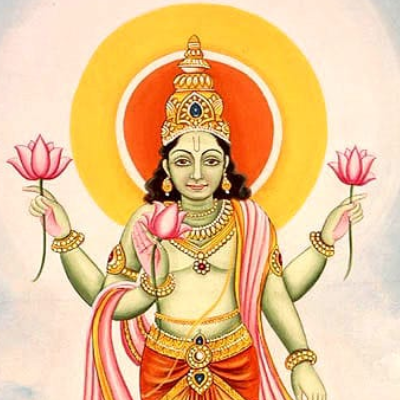
Amsha — Aditya of the Divine Share and Cosmic Portion
Amsha · Amshu · Amshuman · Ansha · Amsha Aditya · Anshumanta
Amsha is one of the twelve Adityas, the solar deities born to the sage Kashyapa and his wife Aditi, daughter of the patriarch Daksha. Of all the twelve Adityas, Amsha is among the least individually developed in the surviving primary sources — his name appears consistently in the canonical lists of the twelve, but he receives no independent hymns in the Rigveda, no dedicated mythological narrative of significance in the major Puranas, and no extended description of a personal domain comparable to those of his brothers Varuna, Mitra, Pushan, or Bhaga. His theological identity is almost entirely defined by his name and its meaning, by his membership of the Aditya group, and by the solar monthly function assigned to him in the Puranic system. He is enumerated in the Vishnu Purana, the Bhagavata Purana, the Mahabharata, and the Matsya Purana, among other texts, but always as a member of the group rather than as a figure with elaborated individual characteristics. It should be noted that the name Amshuman also designates a celebrated king of the solar dynasty — a grandson of the king Sagara of Ayodhya — who is a figure of considerable importance in the lineage narratives of the Ramayana and the Bhagavata Purana. This king Amshuman is a separate figure from the Aditya, and the two must not be conflated; the shared name reflects the Sanskrit word amsha meaning a ray of light or a portion, which was applied to both the solar deity and the solar king for related but distinct reasons.
✦ The Name
The name Amsha derives from the Sanskrit root amsh or ans, meaning to divide, to distribute, or to apportion. Amsha as a noun means a part, a portion, a share, or a fragment — specifically a share that falls to someone as their due allotment. As the name of a deity, Amsha therefore designates the one who is himself a portion or share, or alternatively the deity of the portion and the divine allotment. The theological resonance of this name within the Aditya group is significant: Amsha's name is closely related in both meaning and etymological territory to that of his brother Bhaga, whose name also derives from the concept of apportionment and distribution. Where Bhaga's root bhaj emphasises the act of distributing or sharing out, Amsha's root emphasises the resultant portion itself — the share that has been assigned. Together the two names encapsulate complementary aspects of the same cosmic function: the divine governance of what each being receives as their rightful allocation of the world's goods.
The form Amshu means a ray of light or a filament, and in this sense the name connects Amsha directly to his solar character as one of the Adityas: he is a ray or beam of the sun, a fragment of the great solar light that collectively constitutes the twelve Adityas in the Puranic solar theology. The form Amshuman means the one possessed of rays or the radiant one, derived from amshu combined with the suffix man indicating possession. This is the form of the name most commonly applied to the solar king of the Ikshvaku dynasty discussed separately below. The form Anshumanta carries the same meaning as Amshuman and appears in some manuscript traditions as a variant of the Aditya's name.
It is worth noting that the relationship between Amsha and Bhaga as near-synonyms in the Aditya list has led some scholars of Vedic religion to observe that the two names may represent a doubling of a single theological concept across the list — both names relating to the apportionment of cosmic goods — rather than two originally distinct divine personalities. This observation does not appear in the primary sources themselves, which treat both as members of the twelve without comment on their semantic proximity, but it is relevant to understanding why both deities remain relatively undeveloped as individual figures compared to the more functionally distinctive Adityas such as Varuna, Mitra, and Pushan.
✦ Lineage
- Father: Kashyapa — one of the seven great primordial sages and the supreme progenitor of all orders of living beings; son of Marichi, who was one of the mind-born sons of Brahma the creator. Through his many wives, Kashyapa fathered the gods, the demons, the Nagas, the birds, and all remaining categories of creatures that populate the three worlds.
- Mother: Aditi — daughter of the patriarch Daksha and wife of Kashyapa; the boundless and inexhaustible mother of all the Adityas; one of the most frequently invoked divine mothers in the Rigveda. Her name is understood to mean the unbounded or the free, signifying her nature as the unlimited cosmic source from whom the twelve solar deities emerge.
- Brothers (the Adityas): Dhata, Mitra, Varuna, Aryaman, Bhaga, Indra (Shakra), Vivasvat (Surya), Pushan, Parjanya, Tvashtr, and Vishnu. The canonical Puranic enumeration gives twelve Adityas as sons of Aditi and Kashyapa, though the Rigvedic enumerations are smaller and the composition of the group is not entirely uniform across all early texts.
- Maternal grandfather: Daksha — one of the great Prajapati lords created by Brahma to populate the cosmos and one of the central figures in the genealogical structure of Puranic cosmology.
- Spouse and children: The primary Vedic and Puranic sources do not record a wife, children, or any developed domestic or genealogical life for Amsha as an individual deity. He appears in the tradition exclusively as a member of the Aditya group and not as a progenitor of any significant lineage.
✦ Amsha in the Vedic Literature
In the Rigveda, Amsha does not appear as the recipient of any independent hymn. His name occurs in some passages listing the Adityas as a group, but he is not addressed directly or given any individual characterisation in the surviving hymns. This absence of individual Rigvedic treatment sharply distinguishes him from brothers such as Varuna, Mitra, Indra, Pushan, and Bhaga, all of whom receive dedicated hymns with developed theological content. The Rigvedic Adityas that receive individual hymns are those whose functions were most immediately relevant to the Vedic sacrificial system and to the daily and seasonal concerns of the Vedic community — Indra as the deity of battle and rain, Varuna as the deity of cosmic law and the consequences of sin, Pushan as the deity of cattle and safe journeys. Amsha's domain of the divine portion, while theologically coherent, may have been too abstract or too closely overlapping with Bhaga's domain to generate an independent hymn tradition.
In the Atharvaveda and the Brahmana literature, Amsha similarly appears as a name within lists of the Adityas rather than as an independently developed theological personality. The Shatapatha Brahmana, which provides extensive cosmological and ritual elaboration of Vedic themes, includes Amsha in its enumerations of the Adityas but does not develop his individual character or assign him specific ritual functions distinct from those of the Aditya group as a whole.
✦ Amsha as One of the Twelve Solar Adityas
In the Puranic system of the twelve Adityas as monthly solar manifestations, each Aditya presides over one month of the year, governing the solar power's character and function during that month. Amsha is assigned the month of Chaitra in some Puranic texts and the month of Magha in others, the variation reflecting the genuine inconsistency across the tradition in the assignment of specific months to specific Adityas. The Vishnu Purana's scheme and the Mahabharata's Anushasana Parva do not always agree precisely on every Aditya's month, and Amsha is among those whose assignment shows the most variation across manuscripts and recensions.
Where Amsha is assigned the month of Magha — broadly corresponding to January and February — his presiding period falls in the heart of the winter season, a time associated in Indian tradition with the great festival of Magha bathing, pilgrimage to sacred rivers, and the approach of spring. Where he is assigned Chaitra — broadly corresponding to March and April — he presides over the opening of the Hindu new year and the first month of the spring season. In either case, the cosmic functions assigned to him as a presiding Aditya are the general functions shared by all the Adityas: the drawing up and redistribution of water, the generation of warmth, the sustaining of living beings, and the maintenance of the orderly solar cycle.
✦ The Solar King Amshuman — A Distinct Figure
Because the name Amshuman is applied in the primary sources both to the Aditya and to a significant king of the solar Ikshvaku dynasty, it is necessary to address the royal Amshuman clearly and to establish that he is a distinct figure from the deity, sharing only a name and the solar associations that the name carries.
The king Amshuman was the grandson of the celebrated king Sagara of Ayodhya, a monarch of the solar Ikshvaku dynasty who ruled from the city of Ayodhya on the Sarayu river. Sagara was a king of immense power who performed the ashvamedha — the royal horse sacrifice — as a declaration of his universal sovereignty. The horse designated for the sacrifice was stolen by the god Indra, who hid it near the hermitage of the sage Kapila in the netherworld. Sagara's sixty thousand sons — born from one wife — and his son Asamanjas from another wife went to recover the horse and, encountering the meditating sage Kapila, disturbed him so violently that Kapila's wrathful gaze burned all sixty thousand sons to ash. Only Asamanjas's son Ansuman — the royal Amshuman — survived, as he had not participated in the disturbance. Amshuman went to the underworld, found the horse and the ashes of his uncles, and approached Kapila respectfully. Kapila, pleased with his courtesy, told Amshuman that the sixty thousand could only be liberated from their state and allowed to proceed to the afterlife if the celestial river Ganga — then flowing only in the heavens — could be brought down to earth to flow over their ashes. Kapila returned the horse to Amshuman, who brought it back to his grandfather Sagara to complete the sacrifice.
Amshuman spent the rest of his life performing austerities to bring the Ganga down from heaven but did not succeed in his lifetime. His son Dilipa continued the austerities without success. It was only in the generation of Dilipa's son Bhagiratha that the immense accumulated austerities finally compelled the descent of the Ganga — who had to be caught in Shiva's matted locks to prevent her force from shattering the earth — and the river flowed over the ashes of the sixty thousand sons of Sagara, releasing them. This narrative is given in the Valmiki Ramayana's Bala Kanda, in the Mahabharata's Vana Parva, in the Bhagavata Purana's ninth book, and in the Vishnu Purana, among other sources, and is one of the best-known origin stories of the river Ganga in the tradition.
The king Amshuman is not the Aditya Amsha. The connection between them is the name alone: both carry the solar radiance implicit in the word amsha or amshu, one as a cosmic deity of the Aditya group and the other as a king of the solar dynasty whose name signals his descent from the sun. The primary sources do not suggest any direct identification between the two figures, and they must be treated as distinct.
✦ Textual Variants and Inconsistencies
The textual record for Amsha as an Aditya presents several inconsistencies, most of which relate to his position within the Aditya list and his assigned month in the solar cycle. The canonical Puranic enumeration of twelve Adityas is given in the Vishnu Purana, the Bhagavata Purana, the Matsya Purana, and the Mahabharata, but the order in which the names appear and the specific monthly assignments vary across these texts and across manuscript traditions within each text. Amsha's position in the list and his monthly assignment show more variation than those of the more prominent Adityas such as Indra, Varuna, and Mitra, whose assignments are more consistently recorded.
Some manuscript traditions of the Vishnu Purana give the name as Amsha while others give Ansha — a variant spelling reflecting a difference in the treatment of the nasal consonant in Sanskrit transliteration — and still others give Amshu, the form meaning a ray of light. These are variant spellings of the same name rather than references to different deities, but they have contributed to some inconsistency in secondary references to this Aditya.
The Rigveda's smaller enumerations of the Adityas — which list six or seven members rather than twelve — do not include all the names that appear in the Puranic list of twelve, and Amsha is among those who may not appear in every early Vedic enumeration. The expansion from six or seven to twelve Adityas occurred over the period between the early Rigvedic hymns and the major Puranic compilations, and figures such as Amsha whose individual character is least developed in the Vedic corpus may have been added to the list at a relatively late stage of this expansion, drawn from the available vocabulary of solar and divine epithets rather than from a pre-existing independent deity tradition.
✦ Theological Significance
Amsha's theological significance as an individual deity is modest compared to the more prominent Adityas, but his name and its meaning carry genuine weight within the Puranic theological framework. As the deity of the divine share or portion — the amsha that each being receives as their allotment from the cosmic whole — Amsha represents the metaphysical principle that the universe's goods, energies, and even divine presences are distributed among beings and among the gods themselves as portions of a greater wholeness. This concept of amsha as a portion or fragment of the divine becomes theologically important in the Puranic and particularly the Vaishnava tradition in a context quite different from the Aditya Amsha himself: the Bhagavata Purana and related texts speak of all beings as amshas — portions or fragmentary manifestations — of the supreme deity Vishnu, and the concept of the divine amsha pervades the theology of divine descent and incarnation throughout the tradition.
In this wider theological context, the Aditya Amsha embodies at the level of a cosmic deity the same principle that Puranic theology applies at the level of metaphysics: that every being, every form of existence, and every manifestation of divine power is a share or portion of the greater whole from which it is drawn and to which it relates. Whether this connection between the Aditya's name and the broader theological vocabulary of amsha was consciously developed by the tradition or represents a convergence of meaning that was not explicitly theorised in the primary sources is difficult to determine from the surviving texts, which do not themselves draw this connection explicitly.
✦ Connection to the Wider Genealogy
As a son of Kashyapa and Aditi, Amsha belongs to the supreme tier of the divine lineage in Puranic cosmology. His father Kashyapa is the progenitor of all orders of beings without exception — through his many wives he generated the full diversity of divine, semi-divine, and earthly life. His mother Aditi, as the inexhaustible mother of the Adityas, is one of the tradition's most significant maternal figures, her very name encoding the unlimited generative capacity from which the twelve solar deities emerge.
Among Amsha's brothers the most cosmically consequential are Indra, king of the gods and lord of heaven; Varuna, lord of cosmic law and the waters; Vivasvat (Surya), the sun god proper, whose descendants include the god of death Yama, the progenitor of the current human race Vaivasvata Manu, and through Manu the entire line of human kings including the solar dynasty of Ayodhya; Vishnu, who in Puranic theology becomes the supreme deity of the Vaishnava tradition and whose avatars include Rama and Krishna; Tvashtr, the divine craftsman; Bhaga, whose domain of the divine share of fortune is semantically adjacent to Amsha's own; and Pushan, the deity of paths, pastoral care, and the guidance of souls. Through his maternal grandfather Daksha — the great Prajapati and organiser of the sacrifice whose destruction brought injury to several of the Adityas — Amsha is connected to the vast network of Daksha's daughters and their offspring that underlies the genealogical structure of the entire Puranic cosmos.
✦ References
- Primary Sources
- Rigveda, Books II, VIII, X (passages listing the Adityas as a group): The earliest textual basis for the Aditya enumeration; Amsha does not receive individual hymns but appears by name in group listings of the Adityas in some passages.
- Vishnu Purana, Book I, Chapter 15; Book II: The primary Puranic source for the canonical list of twelve Adityas including Amsha; assigns the presiding month and describes the general solar functions of the Aditya group.
- Bhagavata Purana, Skandha VI, Chapters 6 and 18: Lists the twelve Adityas as sons of Aditi and Kashyapa, including Amsha; provides genealogical information on the group.
- Mahabharata, Anushasana Parva (Book XIII); Udyoga Parva (Book V): Lists Amsha among the twelve Adityas with their presiding months; contains the epic's enumeration of the Aditya group in the context of solar cosmology.
- Matsya Purana, Chapters 6 and 171: Contains genealogical and cosmological material on the Adityas including Amsha, with details on the group's composition and monthly assignments.
- Valmiki Ramayana, Bala Kanda (narrative of King Amshuman and the descent of the Ganga): Contains the extended narrative of the royal Amshuman — grandson of Sagara — who is a distinct figure from the Aditya; essential for distinguishing the two bearers of this name in the tradition.
- Bhagavata Purana, Skandha IX (narrative of King Amshuman in the solar dynasty): Contains the Puranic version of the royal Amshuman's story and his place in the Ikshvaku genealogy; again a distinct figure from the Aditya.
- Shatapatha Brahmana (relevant passages on the Adityas): Contains early post-Vedic cosmological material on the Aditya group, including the enumeration in which Amsha appears.
- Secondary Sources
- Macdonell, A. A. Vedic Mythology (1897): Scholarly analysis of the Adityas as a group in the Vedic tradition, with discussion of the individual members including those with limited independent development such as Amsha; essential for contextualising Amsha within the Vedic solar theology.
- Mani, Vettam. Puranic Encyclopaedia (1975): Entries on Amsha, Amshuman, the Adityas, Sagara, and related figures; particularly useful for distinguishing the Aditya Amsha from the royal Amshuman and for cross-referencing textual sources across the Puranic corpus.
- Monier-Williams, Monier. Sanskrit-English Dictionary (1899): Essential for tracing the etymology of amsha, amshu, and related forms, establishing the semantic range of the name and its connections to the broader vocabulary of divine portions and solar rays in Sanskrit.
- Wisdomlib (wisdomlib.org), entries on Amsha, Amshu, Amshuman, the Adityas, and the descent of the Ganga: Aggregates verse references from digitised Puranic and epic texts; useful for locating variant readings, distinguishing between the Aditya and the king of the same name, and cross-referencing the Aditya enumeration across the primary corpus.