
About
Sahasika — Daitya Prince, Son of Mahabali, Cursed by Durvasa
Sahasika · Sahasika Daitya · Sāhasika
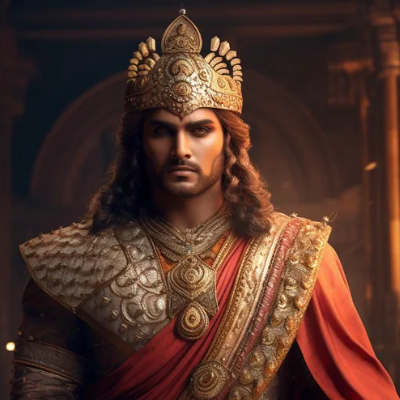
Sahasika is a Daitya prince recorded in the Garga Samhita, a Vaishnava scripture composed by the sage Garga Muni, as the powerful son of Mahabali — the celebrated Asura king who is himself the son of Virochana and the grandson of Prahlada. Sahasika appears in the eleventh chapter of the Vrindavana Khanda of the Garga Samhita, which is titled the Liberation of Dhenukasura, as the figure upon whom the wrathful sage Durvasa pronounced a transformative curse. His narrative arc moves from the life of a mighty Daitya prince engaged in celestial pastimes to an existence in animal form, culminating in liberation at the hands of Balarama — the elder brother of Krishna — in the sacred Talavana forest near Mathura.
✦ The Name
The name Sahasika derives from the Sanskrit root sahas, meaning boldness, audacity, or rash impulsiveness. In classical Sanskrit, sahasika denotes one who acts with heedless daring or without restraint, and the name carries a connotation of impetuous power. Within the narrative of the Garga Samhita, the name proves apt: the sage Durvasa addresses the prince with language that mirrors the word's meaning, rebuking him for conduct that is foolish and lacking in discernment. The name thus functions both as a personal designation and as an ironic commentary on the behaviour that brings about the prince's downfall.
✦ Lineage
- Father: Mahabali (also known as Bali Chakravarti or King Bali) — the righteous and celebrated Asura king who ruled the three worlds and, in a supreme act of surrender, offered his own head as the third step to Vamana, the dwarf avatar of Vishnu; son of Virochana and one of the most revered figures in Vaishnava Puranic tradition.
- Paternal Grandfather: Virochana — Daitya prince and son of Prahlada; the Garga Samhita verse identifies Mahabali explicitly as the son of Virochana, establishing Sahasika as Virochana's grandson.
- Paternal Great-grandfather: Prahlada — the deeply devoted bhakta of Vishnu, son of the Daitya king Hiranyakashipu, whose steadfast devotion was vindicated when Vishnu appeared as Narasimha, the man-lion avatar, to slay Hiranyakashipu and protect him.
- Brother: Banasura — the famously powerful thousand-armed Daitya warrior and devotee of Shiva, widely recorded in Puranic tradition as a son of Mahabali and therefore a brother of Sahasika.
- Ancestral Progenitors: The Daitya lineage descends from the sage Kashyapa and his wife Diti; all children born of this union constitute the Daitya race, of which Sahasika is a member through the line of Prahlada, Virochana, and Mahabali.
✦ The Pastime on Gandhamadana Mountain and the Curse of Durvasa
The Garga Samhita recounts that Sahasika was once engaged in joyful revels on Gandhamadana Mountain — a sacred and mythologically significant peak celebrated throughout Puranic literature — accompanied by a vast retinue of women. The clamour of musical instruments and the ringing of ankle-bells filled that forest with an overwhelming din. In a cave in the same vicinity, the sage Durvasa was at that moment seated in deep meditation upon the form of Krishna. Durvasa is one of the most feared sages of the Puranic tradition, famous for the severity of his ascetic practice and for the devastating power of his curses, which the texts say cause the entire universe to tremble. The uproar of Sahasika's revelry broke Durvasa's trance.
The sage emerged from his cave wearing wooden sandals, carrying a staff, his frame gaunt and emaciated from austerity, and his face blazing with the fire of accumulated wrath. Turning to Sahasika, Durvasa pronounced his curse in terms that were both a condemnation and a prophecy. He declared that the prince, whose behaviour resembled that of a dull and witless animal, would become a donkey. The curse as recorded in the Garga Samhita is unambiguous in its severity: Sahasika would assume the form of an ass and remain so for four hundred thousand years. At the close of that immense span of time, however, liberation was promised: in the sacred Talavana forest, within the transcendental region surrounding Mathura on earth, Sahasika would receive moksha at the hands of Balarama, the elder brother of Krishna and the wielder of the plough.
✦ Liberation by Balarama in the Talavana Forest
The curse of Durvasa thus folded within itself the seed of Sahasika's ultimate liberation. The Garga Samhita verse specifies the Talavana forest — a grove sacred to Vaishnava tradition and connected with the childhood pastimes of Krishna and Balarama in the region of Mathura — as the site of this release. Balarama, also known as Baladeva or Halayudha, is understood in Vaishnava theology as the first expansion of Vishnu and the elder brother of Krishna; he is the possessor of extraordinary physical strength and the agent of several liberations in the Vrindavana Khanda narratives. The chapter context of the Garga Samhita in which Sahasika's story appears — the Liberation of Dhenukasura — concerns Balarama's slaying of the demonic donkey Dhenukasura in the Talavana forest, and Sahasika's identity as the Daitya prince who was reborn in ass-form is the backstory provided to explain the previous existence of that figure.
✦ Theological and Narrative Significance
Sahasika's story serves several purposes within the theological framework of the Garga Samhita and the broader Vaishnava tradition. First, it provides a Puranic backstory for the demon Dhenukasura — explaining through the device of a sage's curse how a Daitya prince of distinguished lineage came to inhabit an animal body. Second, the narrative reinforces the Puranic doctrine that even a degraded rebirth, when it terminates through contact with a divine avatar, results in liberation rather than continued bondage. The liberation granted by Balarama's hand is thus presented not as punishment fulfilled but as grace accomplished: the curse of Durvasa becomes the mechanism through which Sahasika reaches moksha. Third, the episode illustrates the Puranic characterisation of Durvasa as a sage of terrifying potency whose anger, however fierce, is ultimately subordinate to the larger design of Vishnu's avatars.
The narrative also participates in the recurring Puranic pattern of the Daitya lineage producing figures whose stories are ultimately resolved through Vaishnava intervention. Sahasika's great-grandfather Prahlada achieved salvation through devotion to Vishnu; his father Mahabali attained honour and a promised future sovereignty through submission to Vamana; and Sahasika himself, despite the ignominy of his curse, reaches final liberation through the grace of Balarama. This pattern of Daitya-lineage figures ascending to liberation through some form of contact with Vishnu or his expansions is a consistent theological thread in Vaishnava Puranic literature.
✦ Connection to the Wider Genealogy
Sahasika occupies a notable position within the Daitya genealogy. His father Mahabali is one of the seven Chiranjivi — immortal or perpetually living beings — acknowledged in certain Puranic and popular traditions, and his story forms the central narrative of the Vamana Purana as well as key sections of the Bhagavata Purana's eighth skandha. Through his great-grandfather Prahlada, Sahasika is connected to the Narasimha episode, one of the most theologically significant of the Vaishnava avatara narratives. Through his brother Banasura, he is connected to the Usha-Aniruddha episode recorded in the tenth skandha of the Bhagavata Purana and other Puranas, in which Banasura's daughter Usha falls in love with Aniruddha, grandson of Krishna, leading to a dramatic confrontation between Krishna and Shiva — Banasura's patron deity. The entire lineage descends from the progenitor sage Kashyapa through his wife Diti, situating the Daitya race within the cosmic genealogy that emanates from the creator Brahma.
✦ References
- Garga Samhita, Vrindavana Khanda, Canto 2, Chapter 11 (Liberation of Dhenukasura), Verses 2.11.34–39: Primary source. These verses, narrated by the sage Narada, constitute the sole directly verified textual record of Sahasika's identity, his revels on Gandhamadana Mountain, the disturbance of Durvasa's meditation, the curse to become a donkey, the duration of four hundred thousand years, and the prophecy of liberation by Balarama's hand in Talavana forest.
- Bhagavata Purana, Skandha VIII, Chapters 15–23: Primary source for the lineage of Mahabali — as son of Virochana and grandson of Prahlada — and for the narrative of the Vamana avatar; establishes the genealogical context in which Sahasika is situated.
- Bhagavata Purana, Skandha VII, Chapters 1–10: Primary source for the Prahlada narrative and the Narasimha episode; background to Sahasika's great-grandfather.
- Bhagavata Purana, Skandha X, Chapters 62–63: Primary source for the Banasura narrative, which establishes Banasura as a son of Mahabali and thus as Sahasika's brother.
- Vamana Purana: Extended treatment of the Mahabali and Vamana narrative; reinforces the genealogical context of Sahasika's family.
- Wisdomlib.org — Sahasika concept page and Garga Samhita English translation (Danavir Goswami): Modern reference. The translated verses 2.11.34–39 of the Garga Samhita, accessible via Wisdomlib, were consulted to verify the Sanskrit and English rendering of the primary episode; the word-by-word translation confirmed the specific details of location (Gandhamadana), duration (four hundred thousand years), and liberation site (Talavana).