
About
Vishnu — Preserver of the Cosmos, Second of the Trimurti
Narayana · Hari · Keshava · Madhava · Govinda · Purushottama · Vaikuntha · Janardana · Achyuta · Shridhar · Trivikrama · Vishvambhara · Hrishikesha · Padmanabha · Damodara · Vasudeva · Chaturbhuja · Shyamasundara · Anantashayana
Vishnu is the Preserver among the three principal aspects of the divine — Brahma the Creator, Vishnu the Preserver, and Shiva the Destroyer — collectively known as the Trimurti. In the genealogical reference system to which this profile belongs, Para Brahman is placed as the absolute root, the undifferentiated supreme ground from which all manifest divinity descends. Vishnu, Brahma, Shiva, and Adi Parashakti are positioned as the four primary nodes beneath Para Brahman, representing the first differentiation of the absolute into functional divine principles. Vishnu's specific function within this structure is Sthiti — the sustenance and maintenance of the created order — and he discharges this function through periodic descents into the world known as avataras. In the Vedic corpus, Vishnu appears as a solar deity of the second rank among the Adityas, celebrated chiefly for his three cosmic strides. In the Puranic and epic literature, he expands into the supreme personal deity of the Vaishnava traditions, identified with the Para Brahman itself by Vaishnava theologians, the source of cosmic creation through Brahma who emerges from the lotus at his navel, and the ultimate refuge of gods, sages, and mortals in times of cosmic crisis. His primary textual sources include the Rigveda, the Shatapatha Brahmana, the Mahabharata and its supplement the Harivamsa, the Ramayana, and the eighteen Mahapuranas — most extensively the Bhagavata Purana, the Vishnu Purana, the Garuda Purana, the Agni Purana, the Padma Purana, the Varaha Purana, and the Narada Purana.
✦ The Name
The name Vishnu derives from the Sanskrit root vish, meaning to pervade, to enter, or to be all-pervasive. The name thus designates the one who permeates all of existence, who is present in every particle of the cosmos, sustaining it from within. This etymological meaning aligns directly with his cosmological function: he does not merely govern the universe from outside it but pervades and sustains it from within. The Vishnu Purana and the Bhagavata Purana both elaborate on this derivation, connecting the name to the doctrine of divine immanence.
Narayana is among the most theologically weighted of his names and carries multiple layers of meaning. One derivation understands it as "he whose abode (ayana) is the waters (nara)" — the primordial cosmic waters upon which he rests in his anantashayana form. A second derivation reads it as "he who is the refuge (ayana) of all beings (nara)" — all sentient beings find their ultimate shelter in him. A third, found in the Mahabharata's Shanti Parva, derives it from a primordial being Nara, understanding Narayana as the son or descendant of Nara. In the Pancharatra theological tradition, Narayana is the name for the supreme Para Brahman in his personal, immanent aspect, distinct from the impersonal Brahman of Advaita philosophy. The Narayana Sukta of the Atharvaveda and the Yajurveda treats this name as the highest designation of the divine.
Hari derives from the root hri, to take away or to remove. It signifies the one who removes or destroys sin, ignorance, suffering, and the cycle of rebirth. The name also connects to a word for a tawny or golden-green colour, and some traditions associate it with Vishnu's golden lustre. In devotional Vaishnava literature, Hari is one of the most widely used names, appearing throughout the Bhagavata Purana and the devotional poetry of the Alvars.
Keshava admits of multiple derivations: the one with beautiful or abundant hair; the slayer of the demon Keshi (an avatara episode in which Krishna kills the horse-demon Keshi); or, in a Vedantic reading, a compound of Ka (Brahma), A (Vishnu), and Isha (Shiva), designating the one who encompasses all three members of the Trimurti. Madhava connects to the word for spring (Madhu) or to the Madhu clan, signifying the lord of sweetness or the consort of the goddess Ma (Lakshmi). It also names him as the destroyer of the demon Madhu. Govinda means the protector of cows, the finder of cows, or the lord of the earth (go meaning both cow and earth) — a name particularly associated with Krishna's pastoral identity but applied to Vishnu universally in the tradition. Purushottama means the Supreme Person or the Uttama (highest) Purusha — the name used in the Bhagavad Gita's fifteenth chapter to designate Vishnu-Krishna as transcending both the perishable (kshara) and the imperishable (akshara) aspects of existence. Vaikuntha designates both the divine abode and, by extension, the deity himself — the one who grants liberation (mukti) or who cannot be obstructed. Janardana means the one who is sought by humans for boons, or the one who drives away enemies of the people. Achyuta means the unfallen, the infallible, the one who never falls from his supreme position — a name expressing his absolute perfection. Hrishikesha means the lord of the senses or the one who controls the senses of all beings. Padmanabha means the one whose navel bears a lotus — the lotus from which Brahma the creator is born. Damodara, meaning the one whose belly is bound by a rope, refers specifically to the Krishna avatara episode in which Yashoda ties the child Krishna to a mortar as punishment, though it is used as a universal Vishnu epithet.
✦ The Vishnu Sahasranama
The Vishnu Sahasranama, the Hymn of the Thousand Names of Vishnu, is preserved in the Anushasana Parva of the Mahabharata. It arises from a dialogue between the dying patriarch Bhishma — son of King Shantanu and the river goddess Ganga, lying on his bed of arrows on the Kurukshetra battlefield — and the Pandava king Yudhishthira. Yudhishthira asks Bhishma what is the one supreme reality, what single name or formula, if contemplated, would lead a person to liberation. Bhishma responds by reciting a sequence of one thousand names of Vishnu, each name encoding a particular divine quality, cosmic function, or theological attribute. The Sahasranama is thus not merely a liturgical text but a compressed theological treatise in the form of nomenclature. Each of the thousand names has been the subject of extensive commentary — the most celebrated being the twelfth-century commentary by the Advaita philosopher Adi Shankaracharya and the commentary by the Vaishnava theologian Parasara Bhatta. The text is recited daily in Vaishnava temples and households across the tradition and is considered among the most sacred Vaishnava liturgical texts. The Padma Purana also contains a version of the Sahasranama, and the Skanda Purana preserves additional name-lists of Vishnu that supplement the Mahabharata version.
✦ Vedic Identity
In the Rigveda, Vishnu occupies a position considerably more modest than his later Puranic stature. He appears in approximately five dedicated hymns and in several shared hymns alongside Indra, the king of the gods. His Vedic identity is fundamentally solar — he is associated with light, with the traversal of the sky, and with the maintenance of cosmic order through his movement. His signature mythological act in the Rigveda is the taking of three strides across the universe — a feat celebrated repeatedly in the hymns and described as encompassing all of existence within those three steps. The highest step, called his supreme abode (parama pada), is described as a place of radiant light where the virtuous dwell after death, a place visible only to the wise like an eye in the sky. This Vedic image becomes the embryo of the later concept of Vaikuntha, the divine abode.
In the Vedic ordering, Vishnu is numbered among the twelve Adityas — the solar deities born of Aditi, the mother of the gods. The Rigveda presents him as a close ally and friend of Indra: the two deities cooperate in the slaying of the serpent Vritra, and several hymns are addressed jointly to Indra-Vishnu as a divine pair. Vishnu's three strides in the Rigveda are not yet connected to any narrative about a demon king — they are a pure cosmogonic act, a measurement and establishment of the universe. It is only in the later Brahmana literature, the Shatapatha Brahmana in particular, that the three strides begin to be connected to a conflict with the Asuras and to the figure of a dwarf form of Vishnu — the seed of the later Vamana avatara narrative.
The Shatapatha Brahmana, a prose text associated with the Shukla Yajurveda, represents a crucial transitional moment in Vishnu's theological development. Here Vishnu begins to appear as a figure of greater cosmological importance. The Brahmana contains an early version of the Varaha (boar) mythology in which a boar raises the earth from the primordial waters — though in this early version the boar is identified with Prajapati rather than explicitly with Vishnu. The text also contains the earliest connected narrative of the dwarf who tricks the Asuras to reclaim the three worlds, which the Rigveda had described only as a cosmogonic act without narrative context. The Atharvaveda and the various Yajurvedic Samhitas contain hymns to Vishnu and Narayana that begin to elevate him toward theological supremacy, and the Narayana Sukta of the Taittiriya Aranyaka identifies Narayana with the highest Brahman in terms that anticipate Puranic Vaishnavism.
The transition from the Vedic Vishnu — solar, friendly, cosmogonically active but secondary to Indra — to the Puranic Vishnu — supreme personal deity, cosmic preserver, lord of avataras — represents one of the most significant theological developments in the history of Indian religion. This transition is gradual, traceable across the Brahmanas, the Upanishads (particularly the Mahanarayana Upanishad), the epics, and the early Puranas, and reaches its fullest elaboration in the Bhagavata Purana.
✦ Lineage
- Cosmic Position: Vishnu is placed in this genealogical system as one of the four primary divine nodes beneath Para Brahman, the absolute root. He is the Preserver aspect of the divine triad.
- Father (Puranic/Epic): Kashyapa — the great Prajapati sage, son of Marichi and grandson of Brahma, who is the progenitor of gods, demons, humans, and all living beings. Vishnu's birth from Kashyapa and Aditi places him within the Aditya group of solar deities in the epic and Puranic genealogical framework.
- Mother (Puranic/Epic): Aditi — the boundless mother goddess, wife of the sage Kashyapa, and the divine matrix from whom all the Adityas are born. Aditi is among the most ancient Vedic goddesses, personifying the infinite and the inexhaustible. She is also the mother of the Vamana avatara in his specific physical birth — in that incarnation, Vishnu is born to Aditi and Kashyapa as their son in answer to Aditi's penance.
- Siblings: The twelve Adityas — Mitra, Varuna, Aryaman, Bhaga, Daksha (in some lists), Amsha, Tvashta, Savita, Pusha, Shakra (Indra), Vivasvat, and Vishnu himself as the twelfth. The numbering and names of the Adityas vary across texts — the Rigveda lists seven or eight, while the Puranas standardise twelve. As the twelfth and most celebrated Aditya, Vishnu is the most exalted among his divine siblings in the Puranic framework.
- Primary Consort: Lakshmi (also Sri) — the goddess of prosperity, fortune, beauty, and divine grace. Lakshmi is Vishnu's eternal consort, inseparable from him in both cosmic and iconographic terms. She is described as arising from the churning of the cosmic ocean (Samudra Manthan) in the Puranic narratives, though the Rigveda's Sri Sukta already celebrates her as a goddess of abundance. She accompanies Vishnu in each of his avatara descents, appearing as Sita in the Rama avatara, as Rukmini in the Krishna avatara, and so forth. She resides with him in Vaikuntha and is depicted seated on his lap or standing beside him in iconography.
- Second Consort: Bhudevi (also Bhumi Devi) — the goddess of the earth, the personification of the terrestrial world. Bhudevi is Vishnu's second consort, recognised universally across Vaishnava traditions. She appears as Sita (daughter of the earth) in the Rama avatara and as Satyabhama in the Krishna avatara. The Varaha Purana, devoted to Vishnu's Varaha manifestation, gives particular prominence to Bhudevi as the earth raised from the cosmic waters by Varaha.
- Third Consort: Nila Devi (also Nappinnai in Tamil tradition) — recognised specifically within the Sri Vaishnava tradition of South India as Vishnu's third consort. She is celebrated in the Nalayira Divya Prabandham, the Tamil devotional canon of the Alvars, particularly in the poetry of Andal (Goda Devi). In the Krishna narrative she appears as Nappinnai, the cowherd maiden. She is less prominent in the Sanskrit Puranic sources but is theologically significant within the Sri Vaishnava sampradaya.
- Children (in specific narrative traditions): Kamadeva, the god of love and desire, is identified in certain Puranic passages as a son of Vishnu and Lakshmi — though other texts, including the Shatapatha Brahmana, give him different parentage. This identification is not universally consistent across texts.
- Divine Vehicle (Vahana): Garuda — the great eagle-king, son of the sage Kashyapa and his wife Vinata (making Garuda a half-brother of Vishnu in the genealogical framework). Garuda is Vishnu's eternal vehicle and one of his most important associates. He carries Vishnu through the heavens, serves as his battle standard, and is himself an object of worship in the tradition. The Garuda Purana takes its name from this association.
- Divine Couch (Shayana): Ananta Shesha (also Adishesha) — the primordial cosmic serpent upon whose coils Vishnu rests in his anantashayana form upon the ocean of milk. Ananta Shesha is the king of the Nagas (serpent beings), son of Kashyapa and Kadru in the Puranic genealogy. He bears the weight of all the worlds upon his hoods. He manifests as Balarama (elder brother of Krishna) in the Dvapara Yuga and as Lakshmana (brother of Rama) in the Treta Yuga, serving Vishnu's avatara in each age.
✦ Cosmic Role and the Trimurti
The Trimurti — the three-form divine — is the theological framework by which the Puranic tradition organises the primary functions of cosmic governance. Brahma undertakes Srishti (creation), Vishnu undertakes Sthiti (preservation and sustenance), and Shiva undertakes Samhara (dissolution and transformation). These three functions are understood as continuous, simultaneous, and interdependent — creation, preservation, and dissolution are not sequential events but ongoing cosmic processes. The Trimurti concept is most fully elaborated in the Kurma Purana, the Matsya Purana, and the Shiva Purana, and receives classic expression in Kalidasa's Kumarasambhava.
Vishnu's function of Sthiti is not merely passive maintenance. It encompasses the active protection of dharma — the moral, cosmic, and social order — and the suppression of forces that threaten that order. When adharma (disorder, injustice, evil) gains the upper hand in any cosmic age, it is Vishnu who responds by descending into the world in an appropriate form, correcting the imbalance, and restoring the conditions under which righteous life is possible. This is the theological basis for the avatara doctrine.
Vishnu's relationship with Brahma is one of origination: Brahma emerges from a lotus that grows from Vishnu's navel as Vishnu rests in cosmic sleep on Ananta Shesha. Brahma is thus Vishnu's creature in the most literal sense — the creator god is himself created from the preserver's body. This relationship establishes a clear cosmological hierarchy within the Vaishnava reading of the Trimurti, though texts of Shaiva or Shakta orientation present alternative hierarchies. The Bhagavata Purana narrates that when Brahma first emerges from the lotus, he does not know who he is or where he came from, and must perform tapas (austerities) before he is able to receive creative knowledge from Vishnu.
Vishnu's relationship with Shiva is theologically complex and varies substantially across sectarian traditions. The Vaishnava Puranas (Vishnu Purana, Bhagavata Purana, Garuda Purana) generally present Vishnu as supreme and Shiva as a great devotee of Vishnu or as a being created by or subordinate to him. The Shaiva Puranas (Shiva Purana, Linga Purana, Skanda Purana) present the inverse hierarchy, with Vishnu worshipping Shiva and receiving his powers from him. The Smarta tradition, following Shankaracharya, treats both as equivalent manifestations of the same Para Brahman. The synthesis known as Harihara — a combined deity with one half Vishnu and one half Shiva — represents an iconographic resolution of this theological tension and appears in the Puranas as an expression of the ultimate unity of the two. The famous episode of the pillar of light (the Jyotirlinga or Lingodbhava), narrated in Shaiva Puranas, describes Brahma and Vishnu competing to discover the top and bottom of an infinite pillar of flame — a contest in which both fail, acknowledging Shiva's supremacy. The Bhagavata Purana, by contrast, narrates Vishnu's supremacy through different episodes. These variant accounts are recorded honestly in this profile as reflecting different sectarian positions within the larger tradition.
✦ The Cosmic Form and Abode
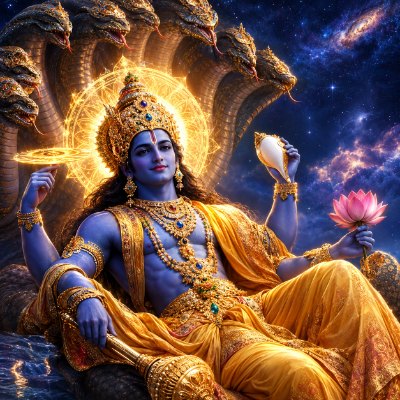
Anantashayana: Vishnu's most celebrated cosmic image is that of Anantashayana — his reclining form upon the coils of the cosmic serpent Ananta Shesha, floating upon the Kshirasagara, the ocean of milk. This is his state between cycles of creation, during which the universe does not exist in manifest form and Vishnu rests in the cosmic sleep called yoganidra. From his navel during this state grows the lotus that bears Brahma, who will initiate the next cycle of creation. This image — Vishnu reclining, Lakshmi at his feet, Brahma emerging from the lotus at his navel, surrounded by the attending gods — is among the most iconic in all of Hindu art and is found in temple sculptures across the subcontinent from the Gupta period onward. The anantashayana image is most famously enshrined at Thiruvananthapuram (Trivandrum) in Kerala, in the Padmanabhaswamy temple, one of the most celebrated Vaishnava shrines.
Vaikuntha: Vaikuntha is Vishnu's eternal divine abode, described across the Puranas as a realm beyond the material universe, beyond the reach of time, suffering, or death. The Bhagavata Purana describes it as luminous beyond description, a world of spiritual matter (chit) rather than material matter (achit), where everything — the trees, the rivers, the residents themselves — is made of pure consciousness. Its residents are liberated souls who have attained moksha and eternal attendants (Nitya Suris) who have never been subject to material bondage. The gates of Vaikuntha are famously guarded by Jaya and Vijaya, two attendants whose story — their repeated curses and reincarnations as adversaries of Vishnu in successive ages — forms a major narrative thread across the Puranas. The Vishnu Purana, the Bhagavata Purana, and the Padma Purana all contain detailed descriptions of Vaikuntha's splendour.
The Four-Armed Form (Chaturbhuja): Vishnu's standard iconographic form has four arms, each bearing one of his four principal attributes. The upper right hand holds the Sudarshana Chakra (the discus); the upper left hand holds the Panchajanya Shankha (the conch); the lower right hand is in the Abhaya Mudra (the gesture of protection and fearlessness) or holds the Kaumodaki Gada (the mace); and the lower left hand holds a Padma (lotus). In some iconographic traditions the arrangement of attributes varies, but the four attributes themselves are consistent. The Vishnu Purana and the Padma Purana provide the most detailed descriptions of the iconographic form and the theological significance of each attribute.
The Srivatsa Mark: On Vishnu's chest is the Srivatsa — an auspicious mark, variously described as a curl of hair, a whorl, or a specific sacred sign — which is the permanent dwelling place of the goddess Sri (Lakshmi). The Srivatsa is inseparable from Vishnu's body and identifies him in contexts where he appears in disguised or human form; it is one of the marks by which sages and devotees recognise him.
The Kaustubha Gem: Around Vishnu's neck hangs the Kaustubha, a gem of extraordinary radiance that arose from the churning of the cosmic ocean. The Bhagavata Purana describes it as the most brilliant of all jewels and as a symbol of the pure consciousness (chit) aspect of Para Brahman. It rests on Vishnu's chest alongside the Vaijayanti garland — a garland of five kinds of flowers or gems representing the five elements, signifying his lordship over the material universe.
Colour: Vishnu is uniformly described as Shyamasundara — dark blue or blue-black in colour, the colour of a rain cloud or the deep ocean sky. This colour symbolises his infinite, boundless nature — the sky and ocean are dark in their depths precisely because they are immeasurably vast. He wears Pitambara — golden or yellow silk garments — which contrast with the dark skin to striking visual effect and carry their own symbolic valence: the gold of the sun, of enlightenment, of sovereign power.
Garuda as Vahana: Garuda, the great divine eagle, serves as Vishnu's vahana (divine vehicle) and is among the most celebrated of divine animals in Hindu tradition. Garuda is the son of the sage Kashyapa and his wife Vinata — making him, in the genealogical framework, a half-brother of the Adityas including Vishnu. He is the enemy of serpents (Nagas) by hereditary enmity, which arose from a conflict between his mother Vinata and Kadru (mother of the Nagas) narrated in the Adi Parva of the Mahabharata. Garuda's rescue of his mother from serpent bondage by stealing the amrita (nectar of immortality) from the gods is narrated in the Mahabharata and the Vishnu Purana. After this feat, Vishnu appeared to Garuda and offered him a boon; Garuda asked to become Vishnu's vehicle, and Vishnu agreed, also making Garuda immortal. Garuda is himself worshipped as a deity, and the Garuda Purana is named in his honour. He serves as Vishnu's battle standard as well as his mount, and images of Garuda in worship posture (Garudasana) are found before the sanctum of Vishnu temples universally.
Ananta Shesha: Ananta Shesha (also Adishesha or simply Shesha, meaning remainder or that which remains) is the primordial cosmic serpent upon whose coils Vishnu rests. In the Puranic cosmology, when all creation is dissolved at the end of a kalpa, Shesha alone remains, bearing the residual impressions of the dissolved universe — hence his name "that which remains." He is described as having a thousand hoods, each bearing a gem whose collective radiance illuminates the cosmic void. He is the king of the Nagas, born of Kashyapa and Kadru in the Puranic genealogy. In the order of avataras, Ananta Shesha himself incarnates to serve Vishnu's avatara forms — as Lakshmana (the faithful younger brother of Rama) in the Treta Yuga, and as Balarama (the elder brother of Krishna) in the Dvapara Yuga.
✦ The Sudarshana Chakra
The Sudarshana Chakra — meaning the auspicious (su) vision (darshana) discus (chakra) — is Vishnu's primary weapon and one of the most theologically significant divine arms in the Hindu tradition. It is a spinning discus of blazing light and fire, described in the Puranas as capable of severing anything, traversing any distance, and returning to Vishnu's finger after completing its mission. The Chakra is not merely a weapon but a living entity with its own divine identity: it is worshipped independently in the Pancharatra tradition and is given theological status as one of the five primary weapons of Vishnu, along with the conch Panchajanya, the mace Kaumodaki, the sword Nandaka, and the bow Sharanga.
The Mahabharata and the Vishnu Purana narrate the origin of the Sudarshana Chakra. The celestial architect Vishvakarma fashioned it from the radiant material of the sun, cutting away a portion of the sun's brilliance to create the weapon. It was then given to Vishnu. In another account in the Linga Purana and Shiva Purana, Vishnu received the Sudarshana by worshipping Shiva with a thousand lotus flowers daily, and when one flower was missing, Vishnu offered his own eye as a substitute — pleased by this devotion, Shiva granted the Sudarshana. In worship contexts, the Sudarshana Chakra is worshipped at Vishnu temples — notably Srirangam — with its own shrine, mantras, and ritual calendar. The Sudarshana Ashtakam, attributed to Yamunacharya, is a celebrated hymn to the Chakra. In narrative episodes, the Sudarshana severs the body of Sati (Shiva's first consort) into fifty-one pieces when Vishnu uses it to end Shiva's grief — these pieces fall to earth and become the Shakti Peethas, the sacred sites of the goddess.
✦ The Four Vyuhas — Pancharatra Doctrine
The Pancharatra Agama tradition — one of the two principal Vaishnava Agamic traditions alongside the Vaikhanasa — elaborates a sophisticated theology of divine emanation in which Vishnu-Narayana manifests in a sequence of four cosmic forms called the Vyuhas (emanations or arrays). This doctrine is systematised in the Pancharatra Samhitas (collections of Agamic texts) and is reflected in the Mahabharata's Shanti Parva and the Harivamsa.
Vasudeva is the first and supreme Vyuha, the Para (highest) form — Vishnu in his absolute, transcendent aspect, the source from which all other Vyuhas emanate. He embodies the qualities of jnana (knowledge), bala (strength), aishvarya (sovereignty), shakti (power), virya (heroism), and tejas (radiance) in their fullness and equality. In the genealogical narrative, Vasudeva is also the name of Krishna's earthly father (the Yadava chieftain who is the biological father of the Krishna avatara), and the Sanskrit Vasudeva (son of Vasudeva) is one of Krishna's epithets — a deliberate theological conflation in which the human name and the cosmic title converge.
Sankarshana is the second Vyuha, emanating from Vasudeva. He is associated with the principle of individual soul (jiva) and the faculty of the ego (ahamkara). He embodies jnana and bala in predominance. Sankarshana is also identified with Balarama, Krishna's elder brother and the incarnation of Ananta Shesha, drawing together the cosmic theological category and the narrative avatara identity.
Pradyumna is the third Vyuha, emanating from Sankarshana. He is associated with the cosmic mind (manas) and the quality of aishvarya and virya in predominance. In narrative terms, Pradyumna is the son of Krishna and Rukmini, and is identified as the incarnation of Kamadeva (the god of love) who was burned to ash by Shiva's third eye and reborn as Pradyumna.
Aniruddha is the fourth Vyuha, emanating from Pradyumna. He is associated with the cosmic ego (chitta) and embodies shakti and tejas in predominance. In the narrative tradition, Aniruddha is the grandson of Krishna, son of Pradyumna and Rukmavati (or in some accounts Mayavati), whose abduction by Usha (daughter of the Asura Banasura) and subsequent rescue by Krishna is narrated in the Bhagavata Purana and the Harivamsa. The four Vyuhas together constitute a complete model of cosmic emanation from the supreme personal deity down through successively more specific cosmic principles, and they govern the four aspects of the inner instrument (antahkarana): intellect, ego, mind, and consciousness.
Beyond the four primary Vyuhas, the Pancharatra tradition elaborates further emanations: the Vibhava forms (the avataras), the Antaryami form (the indwelling presence of Vishnu within every being's heart), and the Archa form (the consecrated temple image). These five levels of divine presence — Para, Vyuha, Vibhava, Antaryami, and Archa — constitute the complete Pancharatra theology of divine accessibility, by which the transcendent deity makes himself available at progressively more proximate levels to the devotee.
✦ The Avatara Doctrine
The avatara doctrine — the theology of Vishnu's periodic descent into the world — is one of the most distinctive and elaborately developed concepts in Hindu theology. The Sanskrit word avatara derives from the prefix ava (down) and the root tri (to cross), meaning a crossing-down or descent. An avatara is not an incarnation in the sense of a soul entering a new body through the ordinary mechanism of rebirth, but a voluntary, purposive, and fully conscious descent of the divine into manifest form for a specific cosmic purpose.
The theological basis of the avatara doctrine is stated most classically in the Bhagavad Gita (fourth chapter), where Krishna declares that whenever dharma declines and adharma rises, he manifests himself from age to age to protect the righteous, destroy the wicked, and re-establish the order of dharma. This declaration grounds the avatara in a moral-cosmic necessity: it is not arbitrary divine caprice but a structured response to specific conditions of cosmic imbalance.
The Bhagavata Purana's first book contains the most philosophically sophisticated treatment of the avatara doctrine in all of Sanskrit literature. It distinguishes between the unlimited avataras of Vishnu — stating that they are as innumerable as the streams flowing from an inexhaustible lake — and then proceeds to enumerate twenty-two named avataras in a celebrated passage. It further distinguishes between different types of avatara: the Purusha avataras (the three cosmic Purushas involved in creation), the Guna avataras (Brahma, Vishnu, and Shiva as the three guna-based cosmic functions), the Manvantara avataras (one for each of the fourteen Manus who govern successive cosmic time periods), the Yuga avataras (manifestations appropriate to each of the four ages), and the Lila avataras (the narrative descents for specific cosmic purposes — the Dashavatara and others). This taxonomy shows the avatara doctrine as a comprehensive theological architecture rather than simply a list of stories.
The avatara forms divide into two categories in this genealogical system. Direct divine manifestations — in which Vishnu assumes a form without biological birth through a human or divine mother — are placed as nodes directly under Vishnu in the genealogical tree. These include Matsya, Kurma, Varaha, Narasimha, Hayagriva, Hamsa, and similar forms. Physical birth avataras — in which Vishnu is born through a biological mother and enters the world through the normal process of birth — are placed under their respective birth-mother nodes in the tree. These include Vamana (born of Aditi and Kashyapa), Parashurama (born of Renuka and the sage Jamadagni), Rama (born of Kaushalya and King Dasharatha of Ayodhya), and Krishna (born of Devaki and Vasudeva in the Yadava clan).
✦ The Avataras — Catalogue
The following catalogue lists the principal avataras of Vishnu as enumerated and described across the major Puranas. Each entry notes the type of avatara (direct manifestation or physical birth) and the relevant textual source for that identification. Standalone profiles exist in this genealogical system for the major avataras; this catalogue functions as a comprehensive reference list within the Vishnu profile.
The Dashavatara — The Ten Principal Avataras
- Matsya (The Fish): Direct divine manifestation. Vishnu assumes the form of a great fish to save the primordial sage Manu and the seeds of all life from a catastrophic cosmic flood, and to recover the Vedas stolen by the demon Shankhasura (or Hayagriva in some accounts) from the sleeping Brahma. The Matsya Purana and the Shatapatha Brahmana contain the earliest versions of the flood narrative. Placed directly under Vishnu in the genealogical tree.
- Kurma (The Tortoise): Direct divine manifestation. Vishnu takes the form of a cosmic tortoise to serve as the pivot and base for Mount Mandara during the churning of the cosmic ocean (Samudra Manthan) by gods and demons seeking the amrita. The Vishnu Purana and Bhagavata Purana narrate this episode in detail. Placed directly under Vishnu in the genealogical tree.
- Varaha (The Boar): Direct divine manifestation. Vishnu assumes the form of a great boar to dive into the cosmic waters and rescue the earth goddess Bhudevi, who has been dragged to the depths by the demon Hiranyaksha. The Varaha Purana is dedicated to this manifestation. Placed directly under Vishnu in the genealogical tree.
- Narasimha (The Man-Lion): Direct divine manifestation. Vishnu manifests as a being half-man and half-lion — neither fully human nor fully animal — to destroy the demon king Hiranyakashipu, who had obtained a boon protecting him from death by man or beast, by day or night, inside or outside, on the earth or in the sky, by any weapon. Vishnu destroys him at the threshold (neither inside nor outside), at twilight (neither day nor night), with his claws (not a weapon), on his lap (neither earth nor sky), in the form of Narasimha (neither man nor beast). The Bhagavata Purana's seventh book narrates this episode in full. Placed directly under Vishnu in the genealogical tree.
- Vamana (The Dwarf): Physical birth avatara. Vishnu is born as the dwarf son of Aditi and Kashyapa in answer to Aditi's penance for the restoration of the three worlds, which have been conquered by the Asura king Mahabali (also Bali). Vamana approaches Mahabali at a sacrificial ceremony and requests three paces of land. Mahabali grants the boon; Vamana expands into Trivikrama (the three-strider) and measures the three worlds in two strides, placing the third on Mahabali's head and sending him to the underworld. Placed under Aditi's node in the genealogical tree.
- Parashurama (Rama with the Axe): Physical birth avatara. Vishnu is born as the son of the sage Jamadagni and his wife Renuka, the daughter of a king. He bears the axe (parashu) given to him by Shiva and is tasked with the destruction of the corrupt Kshatriya warrior class, which he accomplishes twenty-one times over. The Mahabharata and the Brahma Purana narrate his story in detail. He is also the guru of Bhishma, Drona, and Karna in the epic tradition. Placed under Renuka's node in the genealogical tree.
- Rama (The Ideal King): Physical birth avatara. Vishnu is born as Rama, the eldest son of King Dasharatha of Ayodhya and his first queen Kaushalya, of the Solar dynasty. He is the hero of the Ramayana of Valmiki and is accompanied by his wife Sita (an incarnation of Lakshmi), his brother Lakshmana (an incarnation of Ananta Shesha), and the devotee Hanuman. The primary purpose of his descent is the destruction of the demon king Ravana. Placed under Kaushalya's node in the genealogical tree.
- Krishna (The Dark One): Physical birth avatara. Vishnu is born as Krishna, the eighth son of Devaki and Vasudeva in the Yadava clan, imprisoned at the time of his birth by the tyrannical king Kamsa. Krishna's life — from childhood in Vrindavana, through the slaying of Kamsa, to his role in the Mahabharata war as Arjuna's charioteer and the speaker of the Bhagavad Gita — constitutes the largest and most theologically developed of all the avatara narratives. The Bhagavata Purana's tenth book, the Harivamsa, and the Mahabharata are the primary sources. Placed under Devaki's node in the genealogical tree.
- Balarama (The Strong Rama) or Buddha: The ninth position in the Dashavatara is textually contested. The Bhagavata Purana and several Puranas place Balarama (Krishna's elder brother, an incarnation of Ananta Shesha, born of Devaki or Rohini) in the ninth position, reflecting the theological importance of Ananta Shesha as eternally associated with Vishnu. Other Puranas — particularly those composed in or after the period of Buddhist cultural prominence — replace Balarama with Gautama Buddha, presenting the Buddha as a Vishnu avatara who appeared to delude the wicked (a polemical framing that varies significantly across texts). Both versions are attested in the textual tradition and represent a genuine inconsistency across sources.
- Kalki (The Destroyer of Filth): Future avatara. Kalki has not yet appeared in the current cosmic time frame. He is prophesied to appear at the end of the present Kali Yuga, mounted on a white horse and bearing a blazing sword, to destroy the wicked, end the present age, and initiate the return of the Satya Yuga. The Kalki Purana is devoted to this future avatara. No genealogical node has been created for Kalki in the present genealogical tree, as his manifestation remains future and his narrative remains prophetic rather than historical.
Additional Avataras Named in the Bhagavata Purana and Other Texts
- Purusha Avataras — The Three Cosmic Purushas: The Bhagavata Purana identifies three primary cosmic Purusha forms of Vishnu involved in creation. The first is Maha-Vishnu (Karanodakashayi Vishnu), who lies in the causal ocean and from whose pores universes emerge with each breath. The second is Garbhodakashayi Vishnu, who enters each universe and from whose navel the lotus bearing Brahma arises. The third is Kshirodakashayi Vishnu, the Supersoul who dwells within the heart of every living being and within every atom — this is the Antaryami (inner controller) form. These three Purusha forms represent the cosmic-creative aspect of the avatara doctrine rather than narrative descent.
- Nara-Narayana: Direct divine manifestation — twin sages who are partial (amsha) avataras of Vishnu, born as the sons of Dharma (the deified principle of righteousness) and his wife Murti (daughter of Daksha) in the Puranic genealogy. They perform severe austerities at Badrikashrama (Badrinath) for the good of the universe. In the Mahabharata, Nara is identified with Arjuna and Narayana with Krishna, establishing a cosmic precedent for the Pandava-Krishna relationship. The Nara-Narayana avatara is particularly significant in connecting the divine-cosmic level to the human-epic level of the genealogical tradition. Their hermitage at Badrinath remains one of the four Dhams (sacred pilgrimage sites) of Vaishnavism.
- Kapila: Direct divine manifestation. Vishnu manifests as the sage Kapila, son of the Prajapati Kardama and his wife Devahuti (herself the daughter of the first Manu, Svayambhuva Manu). Kapila is the founder of the Samkhya philosophical system — one of the six classical schools of Indian philosophy — and is described in the Bhagavata Purana as having taught his mother Devahuti the path of devotional knowledge. This is distinct from the historical Kapila associated with the classical Samkhya school; the Puranic Kapila is presented as a Vishnu avatara while the philosophical tradition's Kapila is a separate historical figure.
- Dattatreya: Amsha (partial) avatara of the Trimurti — Brahma, Vishnu, and Shiva simultaneously. Born of the sage Atri and his wife Anasuya, who is celebrated for her supreme chastity and purity. In this genealogical system, Dattatreya is placed under his mother Anasuya's node, reflecting his biological birth. A separate standalone profile exists for Dattatreya. He is worshipped as an independent deity particularly in Maharashtra, Karnataka, and Andhra Pradesh, and his tradition bridges the Vaishnava and Shaiva streams.
- Dhanvantari: Direct divine manifestation. Vishnu manifests as Dhanvantari, the physician of the gods and the father of Ayurveda (the science of life and medicine), arising from the churning of the cosmic ocean bearing a pot of amrita. The Bhagavata Purana and the Agni Purana describe him as a partial avatara. He is worshipped as the deity of medicine and healing and his appearance from the Samudra Manthan is celebrated on the day before Diwali as Dhanteras.
- Mohini: Direct divine manifestation — Vishnu assumes the form of an enchantingly beautiful woman to distract the Asuras and distribute the amrita obtained from the Samudra Manthan exclusively to the gods. A standalone profile exists for Mohini in this genealogical system. The Bhagavata Purana and the Matsya Purana narrate this episode. Placed directly under Vishnu in the genealogical tree.
- Hamsa (The Swan): Direct divine manifestation. Vishnu manifests as a divine swan in response to a question posed by the Sanakas (the four eternal child-sages, sons of Brahma) and teaches Brahma the supreme knowledge. The Bhagavata Purana narrates this episode briefly; the Hamsa Gita (embedded within the Bhagavata) contains the teaching. The swan form connects to the symbolism of discrimination (viveka) — the swan's mythological ability to separate milk from water symbolises the discrimination of the real from the unreal.
- Hayagriva (The Horse-Headed): Direct divine manifestation. Vishnu assumes the form of a deity with a horse's head to recover the Vedas stolen by two demons (Madhu and Kaitabha in some versions; a demon named Hayagriva in others) from the sleeping Brahma or from the cosmic waters. The Devi Bhagavata Purana narrates an extended version of this myth in which the stolen Vedas are recovered specifically through Hayagriva's intervention. The Pancharatra tradition worships Hayagriva as a form of great wisdom and learning, and he is particularly venerated in the Sri Vaishnava tradition. Placed directly under Vishnu in the genealogical tree.
- Prithu: Considered a partial avatara by the Bhagavata Purana. Prithu is the first consecrated king (raja) — he is produced from the arm of the slain evil king Vena by the churning of Vena's corpse by sages, and is born fully formed as a king. He chases the earth goddess (Bhudevi in her cow form) who has hidden all plants and nutrients within herself, forces her to release them, and establishes the conditions for agriculture and civilised life. The Bhagavata Purana's fourth book narrates this episode at length.
- Rishabha: Mentioned in the Bhagavata Purana as a partial avatara. Rishabha is a great king who renounces his kingdom, practises extreme austerity, and teaches his sons (the hundred Bharatas, one of whom gives his name to India) the path of renunciation and liberation. He is also identified by some commentators with the first Tirthankara of Jainism — an identification that, like the Buddha avatara, reflects the broader cultural negotiation between Hinduism and its contemporaneous traditions.
- Vyasa (Krishna Dvaipayana): Mentioned as a partial avatara of Vishnu in the Bhagavata Purana and the Vishnu Purana. Vyasa is the sage who is credited with compiling and arranging the Vedas, composing the Mahabharata (including the Bhagavad Gita), composing the eighteen Mahapuranas, and teaching the Vedas to four primary disciples (Paila, Vaishampayana, Jaimini, and Sumantu). He is the son of the sage Parashara and the fisherwoman Satyavati (who later became the mother of Mahabharata's principal dynastic line through her marriage to King Shantanu). He is born dark and on an island, hence named Krishna Dvaipayana. His role as compiler-sage makes him the literary foundation of almost all primary sources cited in this profile.
- Narada: In some Puranic listings, Narada — the divine sage who moves between all the worlds and is the greatest devotee of Vishnu — is listed as a partial avatara. He is the son of Brahma in most accounts. He is the author of the Narada Bhakti Sutras (the aphorisms on devotion) and appears in virtually every major Puranic narrative as a catalyst, messenger, or guide. His status as avatara is not universally accepted across texts.
- Arihat: A standalone profile exists for Arihat in this genealogical system.
- Ekadashi: The sacred day of Ekadashi (the eleventh day of each lunar fortnight) is presented in the Padma Purana as a manifestation of Vishnu's divine energy, personified as a goddess who emerged from his body to combat the demon Mura. A standalone profile exists for Ekadashi in this genealogical system.
✦ Major Narrative Episode: The Three Strides — Trivikrama
The myth of Vishnu's three strides exists in two distinct but related forms — the Vedic cosmogonic version and the Puranic narrative version — and tracing both reveals the development of Vishnu's mythology across the tradition.
In the Rigvedic hymns, Vishnu takes three strides across the universe — one stride at the eastern horizon, one at the zenith, and one at the western horizon — encompassing all of existence in this measurement. The act is purely cosmogonic: it is the establishment and measurement of cosmic space. No demon, no conflict, no sacrifice is involved — only the majestic traversal. The highest stride, called Vishnu's highest step or his supreme abode, is described as a place of light where the righteous dwell, visible to the sage as an eye in the sky. The Rigveda celebrates this act with admiration, presenting Vishnu as a vast, beneficent deity whose strides define the space within which all life and all cosmic order exist.
The Shatapatha Brahmana introduces a narrative context for the strides: the gods and demons are in conflict; the gods, being weaker, must obtain their share of the universe through a sacrificial bargain; Vishnu as the sacrifice itself measures out the earth for the gods, taking as much space as he can cover in three strides. Here the three strides have become a clever cosmogonic manoeuvre rather than a spontaneous act of divine power.
In the Puranic version — most fully narrated in the Bhagavata Purana and the Vishnu Purana — the three strides are fully embedded in the Vamana avatara narrative. The great Asura king Mahabali (grandson of Prahlada and great-grandson of Hiranyakashipu) has, through his virtue, austerity, and generous sacrificial practice, conquered the three worlds and displaced Indra from his throne. The gods approach Vishnu for help. At Aditi's penance, Vishnu agrees to be born as Aditi and Kashyapa's son — Vamana, the dwarf brahmin. Vamana approaches Mahabali at a great sacrifice and asks for three paces of land. Mahabali's guru, the sage Shukracharya (the preceptor of the Asuras), recognises Vamana as Vishnu and warns Mahabali not to grant the boon. Mahabali, committed to his pledge and regarding it as an honour to give to Vishnu even if it means his downfall, overrules his guru and grants the boon. Vamana immediately expands into the cosmic giant Trivikrama — one stride covers the earth, the second covers all the heavens, and there is no space left for a third stride. Mahabali offers his own head, and Vishnu places his foot upon it, pressing Mahabali down to the underworld (Patala). Vishnu, moved by Mahabali's extraordinary virtue and self-surrender, grants him immortality, sovereignty over Patala, and the promise that Mahabali will become Indra in a future Manvantara. The festival of Onam in Kerala commemorates Mahabali's annual return to visit his former kingdom.
✦ Major Narrative Episode: Samudra Manthan — The Churning of the Cosmic Ocean
The Samudra Manthan — the churning of the ocean of milk — is among the most celebrated episodes in all of Puranic literature and the episode in which Vishnu's active role as cosmic manager is most dramatically displayed. The narrative is narrated in the Mahabharata's Adi Parva, the Vishnu Purana, and the Bhagavata Purana, with variations in detail across these accounts.
The event is precipitated by the curse of the sage Durvasa. Indra, king of the gods, receives a garland of divine flowers from Durvasa and carelessly allows it to be trampled by his elephant Airavata, which Durvasa interprets as disrespect. Enraged, Durvasa curses Indra and all the gods to lose their prosperity, power, and vitality. As the gods weaken, the Asuras seize the opportunity to overwhelm them. The gods approach Brahma and then Vishnu for guidance. Vishnu advises the gods to make a diplomatic truce with the Asuras and propose a joint churning of the cosmic ocean to obtain the amrita — the nectar of immortality — with the understanding that both sides will share in the treasure. The Asuras agree, not knowing that Vishnu intends to ensure the gods alone receive the amrita.
Mount Mandara is uprooted to serve as the churning staff, and the cosmic serpent Vasuki is used as the churning rope. Vishnu himself manifests as the Kurma avatara — a great cosmic tortoise — and dives to the bottom of the ocean to serve as the pivot upon which Mandara rests. The gods hold Vasuki's tail; the Asuras hold his head (a position that turns out to their disadvantage, as Vasuki breathes poisonous fire over them during the churning). The churning begins.
From the churning emerge, in sequence, a series of cosmic treasures and beings. First comes the deadly poison Halahala (or Kalakuta), which threatens to destroy all creation — Shiva drinks this poison to save the universe, which turns his throat blue and gives him the epithet Nilakantha. Then arise: Kamadhenu the wish-granting cow, Ucchaishravas the divine horse (claimed by both Aditi and Diti, precipitating a conflict), Airavata the divine elephant, Kaustubha the gem (which Vishnu takes for himself), the Parijata divine tree, the Apsaras (celestial dancers), the goddess Sri-Lakshmi who chooses Vishnu as her eternal consort, Varuni the goddess of wine, the conch Panchajanya, the bow Sharanga, and finally Dhanvantari — carrying the pot of amrita.
When Dhanvantari emerges with the amrita, the Asuras seize the pot. Vishnu then manifests as Mohini — an impossibly beautiful woman — who enchants the Asuras into allowing her to distribute the amrita. Mohini gives all the amrita to the gods; one demon, Svarbhanu (or Rahu), disguises himself as a god and receives a sip, but is discovered by the sun and moon, and Vishnu severs his head with the Sudarshana Chakra. The immortalised head and body become Rahu and Ketu, the shadow planets of Vedic astronomy. The gods, restored and strengthened by the amrita, defeat the Asuras and reclaim the three worlds. Vishnu's role in the Samudra Manthan is thus threefold: as Kurma (the tortoise base), as Mohini (the distributor of amrita), and as the cosmic intelligence that designs and manages the entire operation.
✦ Major Narrative Episode: Gajendra Moksha
The Gajendra Moksha — the liberation of the elephant Gajendra — is narrated in the eighth book of the Bhagavata Purana and is one of the most celebrated episodes illustrating the speed and unconditional grace of Vishnu's response to a devotee's surrender. The episode also carries a theological freight about the nature of liberation and the efficacy of total self-surrender.
A great elephant king named Gajendra, lord of a herd on the slopes of Mount Trikuta, enters a lake to bathe and refresh himself and his wives. A powerful crocodile seizes his leg and holds him fast in the water. Gajendra struggles for a thousand years (a Puranic measure of the agony's duration) but cannot free himself. His strength fails, his family abandons him, and he has no resource left. In his extremity, Gajendra recalls a hymn of praise to the supreme deity that he had known in a previous life (when he had been the king Indradyumna, cursed to become an elephant by the sage Agastya for failing to rise and greet him respectfully). He recites this hymn — the Gajendra Stuti — calling not upon any specific deity by name but upon the formless, nameless absolute who is the ground of all being. Vishnu, hearing this call of total surrender, immediately abandons his divine resting state and rushes to Gajendra's aid — without even taking time to put on his garments or arms, according to some tellings. He slays the crocodile with the Sudarshana Chakra and liberates Gajendra. The crocodile is revealed to be a Gandharva (celestial musician) named Huhu, who had been cursed by the sage Devala to become a crocodile; he is also liberated by Vishnu's presence. Gajendra himself is liberated from his elephant existence and attains Vaikuntha. The theological message is explicit in the text: total surrender to the divine, without specification of form, reaching only to the absolute ground, brings immediate liberation regardless of the suppliant's current bodily form.
✦ Major Narrative Episode: Narasimha and Hiranyakashipu
The Narasimha episode is narrated principally in the seventh book of the Bhagavata Purana and is among the theologically richest of all the avatara narratives, combining elements of devotional theology, cosmological speculation, and the limits of divine boons.
Hiranyakashipu is the elder of the two demon brothers Hiranyakashipu and Hiranyaksha, who are themselves the first incarnations of Vishnu's doorkeepers Jaya and Vijaya, cursed to take three births as enemies of Vishnu before returning to Vaikuntha. When Vishnu kills Hiranyaksha in the Varaha episode, Hiranyakashipu is consumed with grief and rage and undertakes the most ferocious austerities ever performed by a mortal — austerities so intense that the heat from his body begins to threaten the universe. Brahma, compelled by the power of these penances, appears and grants Hiranyakashipu a boon. Hiranyakashipu crafts his boon with extraordinary care, requesting that he cannot be killed by any weapon, by any man or beast, by any god or demon or serpent, by day or night, inside or outside, on the earth or in the sky, alive or dead. Brahma grants these conditions and Hiranyakashipu becomes effectively invincible. He conquers the three worlds, drives the gods from heaven, and establishes himself as supreme, demanding that all worship be directed to him alone.
His own son Prahlada, however, is an unshakeable devotee of Vishnu from birth. Hiranyakashipu subjects Prahlada to every form of torture and threat to break this devotion, but Prahlada remains serene, protected by Vishnu's grace at each attempt. At last, Hiranyakashipu demands that Prahlada show him where this Vishnu is. Prahlada replies that Vishnu is everywhere — in every atom, in every object, in the pillar before them. Hiranyakashipu strikes the pillar in a rage. It splits open and from it emerges Narasimha — Vishnu in a form that satisfies none of Hiranyakashipu's protective conditions. At the threshold of the palace (neither inside nor outside), at twilight (neither day nor night), Narasimha places Hiranyakashipu upon his lap (neither earth nor sky), and tears him apart with his claws (not a weapon), in a form that is neither man nor beast. Hiranyakashipu is destroyed. The theology is precise: the conditions of the boon are met exactly, demonstrating that divine law is not violated but fulfilled through a form that transcends normal categorical boundaries. Prahlada worships the fearsome Narasimha with hymns of praise, and Vishnu resumes his benign form, granting Prahlada sovereignty and ultimately liberation.
✦ Major Narrative Episode: Madhu and Kaitabha
The episode of Madhu and Kaitabha is narrated in the Mahabharata's Shanti Parva, the Devi Mahatmya (Markandeya Purana), and the Devi Bhagavata Purana. It is set at the cosmic dissolution between world-cycles, when Vishnu lies asleep on Ananta Shesha in the cosmic ocean and there is no created universe. From Vishnu's sleeping ears emerge two demons — Madhu (meaning sweet or honey) and Kaitabha — who immediately begin to threaten Brahma, who sits on the lotus growing from Vishnu's navel, waiting to begin the next act of creation.
Brahma, unable to awaken Vishnu because the goddess Yoganidra (divine sleep, associated with Adi Parashakti) holds him in slumber, praises Yoganidra with hymns asking her to release Vishnu so that he may deal with the demons. Yoganidra withdraws from Vishnu; he awakens and immediately engages Madhu and Kaitabha in combat. The battle lasts five thousand years. The two demons, who have received a boon that they may choose the manner of their own death, are not defeated but become enchanted by Vishnu and offer to grant him any boon. Vishnu asks that they allow him to slay them. Recognising that the earth is covered by water and they do not wish their bodies to pollute it, they ask that Vishnu slay them upon the dry surface of his thighs. Vishnu expands his thighs to form a dry surface above the waters and slays the two demons there. From their flesh and marrow the earth is formed — giving the earth the name Medini (from medas, marrow). This episode is particularly notable because the Devi Mahatmya version gives significant agency to the goddess Mahamaya in enabling Vishnu's awakening, illustrating the tradition's recognition of the complementary relationship between Vishnu and the divine feminine.
✦ Major Narrative Episode: The Rescue of the Earth — Varaha
The Varaha (boar) episode exists in two principal versions across the texts, an earlier Vedic form and a later Puranic narrative form. The Shatapatha Brahmana contains the earliest version in which a boar called Emusha raises the earth from the waters — here the boar is identified with Prajapati (the creator) rather than explicitly with Vishnu. The Taittiriya Samhita contains a similar brief account.
In the full Puranic version narrated in the Bhagavata Purana and the Varaha Purana, the demon Hiranyaksha — the younger brother of Hiranyakashipu and the second incarnation of Jaya and Vijaya — seizes the earth goddess Bhudevi and drags her down to the bottom of the cosmic ocean. The universe is in chaos without the earth as its foundation. Vishnu manifests as a great divine boar — the Varaha — and dives into the cosmic ocean. He battles Hiranyaksha for a thousand divine years in the depths of the water. Finally, with his tusks and his divine discus, he slays Hiranyaksha and lifts the earth on his tusks from the ocean floor, restoring her to her proper position in the cosmos. The Varaha Purana is devoted to an extended conversation between Varaha and the earth goddess Bhudevi, in which Varaha (as Vishnu) teaches her cosmic knowledge, cosmological geography, and devotional theology. The episode establishes the earth as Vishnu's consort — she is Bhudevi precisely because she was saved and held by the divine boar — one of the theological foundations for the veneration of Bhudevi alongside Lakshmi as Vishnu's consort.
✦ Major Narrative Episode: The Vishvarupa — Cosmic Form Shown to Arjuna
The revelation of the Vishvarupa — the Universal Form — to the warrior Arjuna on the Kurukshetra battlefield is narrated in the eleventh chapter of the Bhagavad Gita, which is embedded within the Bhishma Parva of the Mahabharata. It is the most direct and theologically overwhelming direct manifestation of Vishnu's full divine nature in the entire epic tradition.
Arjuna, the Pandava hero and son of Indra, has heard Krishna's teaching through the first ten chapters of the Gita. He asks Krishna to show him his divine form as described in the teaching. Krishna grants Arjuna divine sight (divya drishti) — the ability to see what ordinary human senses cannot perceive — and reveals his Vishvarupa. The form Arjuna sees is infinite in extent, with countless faces, countless arms, countless weapons, the radiance of a thousand suns simultaneously, containing all the gods, all worlds, all beings simultaneously, with mouths like blazing fires into which all the warriors of both armies are being drawn and consumed. Arjuna is overwhelmed with awe and terror and begs Krishna to resume his ordinary human form. The episode establishes beyond theological ambiguity that Krishna-as-charioteer and Vishnu-as-cosmic-deity are one and the same being, and that the human-scale relationship between devotee and deity conceals an infinite divine reality. The Vishvarupa passage has been among the most studied and commented upon in all of Sanskrit literature, from Shankaracharya and Ramanuja to twentieth-century interpreters.
✦ Major Narrative Episode: The Pillar of Light — Lingodbhava
The episode of the pillar of light is narrated in the Shaiva Puranas — particularly the Shiva Purana and the Linga Purana — and represents the Shaiva tradition's theological assertion of Shiva's supremacy over Brahma and Vishnu. It is recorded here as a textual variant reflecting a genuinely different sectarian position within the broader Hindu tradition.
In this narrative, Brahma and Vishnu are engaged in a contest to determine which of them is superior. Suddenly an infinite pillar of blazing fire appears, extending without limit into the heavens above and the earth below. Brahma takes the form of a swan and flies upward to find the top of the pillar; Vishnu takes the form of a great boar and dives downward to find its bottom. Both travel for thousands of years and neither finds an end. Brahma, returning, falsely claims to have reached the top — a claim supported by the perjured testimony of the Ketaki flower, which Brahma had found floating down from above and claimed as his witness. Vishnu, returning, honestly admits his failure to find the bottom. Shiva emerges from the pillar and identifies himself as its infinite source, affirming Vishnu's honesty and condemning Brahma's falsehood (which results in Brahma being denied temples and regular worship). This episode is not narrated in Vaishnava Puranas and represents the Shaiva theological counter-position to Vaishnava claims of Vishnu's supremacy.
✦ Major Narrative Episode: Sati and the Shakti Peethas
This episode, narrated in the Devi Bhagavata Purana, the Kalika Purana, and the Skanda Purana, involves Vishnu's use of the Sudarshana Chakra in a context connected to Shiva's grief and the origin of the Shakti Peethas — the sacred sites of the goddess. After Sati, the daughter of the Prajapati Daksha and the first wife of Shiva, immolates herself at her father's sacrificial ceremony in protest of the insult offered to Shiva, Shiva is overcome with uncontrollable grief. He wanders the three worlds carrying Sati's body, unable to release it, and the intensity of his mourning begins to destabilise the cosmos. The gods approach Vishnu to resolve the crisis. Vishnu follows Shiva and, with the Sudarshana Chakra, gradually dismembers Sati's body as Shiva carries it — the pieces fall to the earth one by one. As each piece falls, Shiva's grief proportionally diminishes, until the body is entirely gone and Shiva is freed from his all-consuming sorrow. The places where Sati's body parts fall become sacred sites — the Shakti Peethas — each one a temple to a specific form of the goddess, presided over by a local Bhairava (form of Shiva). The tradition counts anywhere from four to one hundred and eight such peethas, with fifty-one being the most commonly cited number in the texts. This episode uniquely involves Vishnu in the founding of the Shakti Peetha geography, establishing a connection between Vaishnava, Shaiva, and Shakta traditions at a narrative level.
✦ Vishnu's Role in the Mahabharata
Vishnu's presence in the Mahabharata is primarily through the Krishna avatara, but the epic also contains extensive material about Vishnu in his cosmic and theological dimensions that goes beyond the narrative of Krishna as a human character. The Shanti Parva contains the Narayaniya section — a long theological discourse on Vishnu-Narayana that is one of the most important early Vaishnava theological texts and contains the seeds of the Pancharatra doctrine. The Udyoga Parva contains Vishnu's manifestation before Duryodhana and Arjuna when they come to seek his alliance — his offer of either himself (unarmed, as a non-combatant) or his army, and Arjuna's choice of Vishnu himself, is theologically significant. The Anushasana Parva contains the Vishnu Sahasranama. The Drona Parva contains the episode of the Vishvarupa shown to Uttanka by Krishna after the war, an echo of the Gita's revelation. Throughout the epic, Vishnu-Krishna functions as the theological ground of the narrative's moral and cosmic meaning.
✦ Theological and Philosophical Significance
Vaishnavism is the theological tradition centred on Vishnu-Narayana as the supreme deity, and it is one of the two or three largest streams of Hindu religious practice. It encompasses diverse sub-traditions (sampradayas) with varying philosophical emphases, all sharing the commitment to Vishnu's primacy and the path of bhakti (devotion) as the principal means of liberation.
The Bhagavata Theology of Bhakti: The Bhagavata Purana, composed probably between the eighth and tenth centuries CE in South India, is the most philosophically sophisticated of the Vaishnava Puranas and the fountainhead of bhakti theology in its most developed form. It presents bhakti — devotional love for Vishnu — not merely as a path to liberation but as the highest human experience in itself, superior to jnana (knowledge), karma (ritual action), and yoga as isolated practices. The Bhagavata's tenth book, dedicated to Krishna's life, generated an enormous devotional literary tradition across regional languages of India.
Vishishtadvaita (Qualified Non-Dualism): The philosopher Ramanuja (1017–1137 CE) of the Sri Vaishnava tradition articulated the most systematic and influential Vaishnava philosophical theology. In Vishishtadvaita, Brahman (the absolute) is identical with Vishnu-Narayana, but this Brahman is not featureless — it has attributes (vishishta), specifically the attributes of consciousness and matter, which constitute Brahman's body. Individual souls (jivas) and the material world are real and are the body of Brahman-Vishnu, distinct from him but not separate. Liberation means attaining the divine abode Vaikuntha and experiencing eternal devotional proximity to Vishnu, not dissolution into an undifferentiated absolute.
Dvaita (Dualism): Madhvacharya (1238–1317 CE) of the Udupi tradition articulated a radical dualism in which Vishnu is the only truly independent reality (svatantra), while souls and matter are permanently dependent upon but distinct from him. Unlike Advaita or Vishishtadvaita, Dvaita maintains an eternal, irreducible distinction between Vishnu, individual souls, and matter. Liberation in Madhva's framework means eternal blissful proximity to Vishnu in Vaikuntha, experiencing divine joy in perpetual devotion. Madhva also uniquely among major philosophers asserts a predestinarian distinction between souls permanently destined for liberation, souls perpetually cycling in samsara, and souls destined for eternal damnation — a position found nowhere else in classical Indian philosophy.
Relationship with Advaita: The Advaita Vedanta of Shankaracharya treats Vishnu as the highest saguna Brahman — Brahman as qualified by attributes and available to devotion. In the ultimate analysis of Advaita, Brahman is nirguna (without qualities) and the distinction between Vishnu and the devotee dissolves in the highest knowledge. Vishnu is thus real at the level of vyavaharika (practical/phenomenal) reality but not at the level of paramarthika (ultimate) reality. This position is rejected by both Ramanuja and Madhva as failing to honour the genuine reality of devotional relationship. Shankaracharya's Panchayatana worship system includes Vishnu as one of five principal deities to be worshipped, placing him within a broader system rather than as the unique supreme.
Nimbarka, Vallabha, and Chaitanya: Several other Vaishnava acharyas developed influential sub-traditions. Nimbarkacharya articulated Dvaitadvaita (simultaneous difference and non-difference). Vallabhacharya (1479–1531 CE) developed Shuddhadvaita (pure non-dualism) with a focus on Krishna's Vrindavana form and the path of pushti (grace). Chaitanya Mahaprabhu (1486–1534 CE) of Bengal articulated Achintya Bhedabheda (inconceivable simultaneous difference and non-difference) and generated the most emotionally intense bhakti movement in Krishna devotion, whose legacy includes the Gaudiya Vaishnava tradition.
✦ Iconography and Worship
Vishnu's iconography is among the most codified and consistent in the Hindu tradition. The Vishnu Dharmottara Purana, the Agni Purana, and the Pancharatra Samhitas provide detailed prescriptions for the divine image. The four attributes — Shankha (conch), Chakra (discus), Gada (mace), and Padma (lotus) — are universally distributed across his four arms, though the specific arrangement of which attribute occupies which arm is subject to twenty-four recognised variations (each variation corresponds to one of twenty-four names of Vishnu and is prescriptively linked to specific ritual contexts). The conch Panchajanya, when blown, produces the primordial sound Aum and represents the five elements. The mace Kaumodaki represents the power of time, knowledge, and the authority of the Vedas. The lotus represents the unfolding of creation and the purity of the divine nature. The Sudarshana Chakra, described separately above, represents the divine will in action.
The two principal Agamic traditions governing Vishnu temple worship are the Pancharatra and the Vaikhanasa. The Pancharatra tradition, associated with the Sri Vaishnava sampradaya and with temple traditions across South India, organises worship around the Vyuha theology and the Pancharatra Samhitas. The Vaikhanasa tradition, tracing its lineage to the sage Vikhanasa and claiming great antiquity, organises worship according to its own Samhitas and is practised at several important temples including Tirupati. Both traditions follow the Agamic prescriptions for image installation, daily worship rituals (upacharas), festival calendars, and the construction of temple sacred geography.
The 108 Divya Desams: The Sri Vaishnava tradition venerates 108 sacred Vishnu temples (Divya Desams) celebrated in the Nalayira Divya Prabandham — the Four Thousand Divine Verses composed by the twelve Alvars, Tamil poet-saints who composed their devotional hymns between approximately the sixth and ninth centuries CE. The Alvars' devotional poetry, collected and systematised by the theologian Nathamuni, constitutes the Dravida Veda of the Sri Vaishnava tradition and has the same theological authority as the Sanskrit Vedas within that sampradaya. Of the 108 Divya Desams, 106 are in India (predominantly in Tamil Nadu), one is in Nepal (Muktinath), and one is the celestial Vaikuntha. The most celebrated include Srirangam (the Ranganathaswamy temple, the largest functioning Hindu temple in the world by area), Tirupati (Venkateswara temple, the most visited religious site in the world), Kanchipuram (the Varadaraja Perumal temple), and Thiruvananthapuram (the Padmanabhaswamy temple, site of the anantashayana image).
The Char Dham: The four Dhams (sacred pilgrimage sites) of Vaishnavism are Badrinath (associated with Nara-Narayana), Dwaraka (associated with Krishna), Puri (associated with Jagannatha, a form of Vishnu-Krishna), and Rameswaram (associated with Rama's bridge to Lanka — though Rameswaram is also a major Shaiva site, its inclusion in the Vaishnava pilgrimage circuit reflects the syncretic geography of Hindu pilgrimage). The broader Char Dham pilgrimage (Badrinath, Dwaraka, Puri, Rameswaram) is the most comprehensive pan-Indian pilgrimage circuit in Hinduism.
✦ Textual Variants and Inconsistencies
Vedic vs Puranic Vishnu: The Vedic and Puranic presentations of Vishnu are genuinely discontinuous in theological weight. In the Rigveda he is a friendly, important, but secondary deity — appreciated for his three strides and his partnership with Indra but clearly not the supreme being. In the Puranas he is unambiguously the cosmic supreme in the Vaishnava texts. This theological development is not a simple linear progression but a complex process involving the absorption of multiple regional deities (including Krishna of the Vrishni clan, originally a separate human hero; Narayana of the Sattvata tradition; and Hari of the bhakti communities) into a unified Vishnu-Narayana figure.
Avatara List Variants: The avatara lists vary significantly across texts. The Bhagavata Purana lists twenty-two named avataras and then declares them unlimited. The Agni Purana gives a different list with ten as primary. The Garuda Purana, Matsya Purana, and Padma Purana each give somewhat different compositions of the standard list. The position of Balarama versus Buddha in the Dashavatara is the most consistent textual inconsistency, as noted in the catalogue section. The status of several figures — Narada, Hayagriva, Hamsa — as full or partial avataras is also handled differently across texts.
Shaiva vs Vaishnava Puranas on Hierarchy: The Shaiva Puranas (Shiva Purana, Linga Purana, Skanda Purana) consistently present a hierarchy in which Shiva is supreme and Vishnu is a great devotee who derives his powers from Shiva's grace. The Lingodbhava episode (described above), Vishnu's thousand-lotus worship of Shiva, and Shiva's granting of the Sudarshana Chakra to Vishnu are all narrative expressions of this hierarchy in Shaiva texts. The Vaishnava Puranas present the inverse. This is not a textual error or inconsistency within a single tradition but a reflection of the genuine theological competition and coexistence of two major religious traditions, each using Puranic literature to assert its position.
The Harivamsa Supplement: The Harivamsa, appended to the Mahabharata as a supplement (khila), significantly expands the Krishna narrative beyond what the main epic contains and provides the most extensive genealogical treatment of the Vrishni-Yadava clan. It also contains cosmological and theological material that develops the Vishnu-Krishna identification more fully than the main epic text. Some material in the Harivamsa — particularly regarding Krishna's childhood in Vrindavana — anticipates the Bhagavata Purana's treatment and raises questions of textual priority and direction of influence that remain subjects of scholarly investigation.
Parentage of Vishnu: In the Vedic framework, Vishnu is an Aditya — one of the sons of Aditi, and the identity of a specific father is not always specified. In the Puranic framework, Kashyapa is consistently identified as the father of the Adityas including Vishnu. However, in Vaishnava theological texts, Vishnu is treated as the supreme self-existent being (svayambhu) who transcends genealogical categories — his placement within the Kashyapa lineage applies specifically to his manifestation as one of the Adityas and to specific avataras like Vamana, not to his ultimate theological status.
✦ Connection to the Wider Genealogy
Vishnu's position in this genealogical system — as one of the four primary divine nodes beneath Para Brahman — makes him the generative source of several of the most important dynastic and genealogical lines traced in the larger project. Through his avataras, both direct manifestations and physical births, he touches and shapes virtually every major lineage in the Puranic tradition.
The Solar Dynasty (Suryavamsha or Ikshvaku lineage) receives its most celebrated avatara in Rama, born of Kaushalya and Dasharatha of the Ikshvaku line. The Valmiki Ramayana traces this dynasty from Manu (the first human, born of the sun god Vivasvat, himself an Aditya and thus a brother of Vishnu in the Puranic genealogy) through a long sequence of kings to Dasharatha and Rama. Through the Rama avatara, Vishnu's divine presence defines the Solar Dynasty's highest moment.
The Lunar Dynasty (Chandravamsha) — which generates both the Pandavas and the Kauravas of the Mahabharata — is touched by Vishnu through the Nara-Narayana identification: Arjuna, the Pandava hero, is identified as the human manifestation of the eternal sage Nara (the companion of Narayana), and his relationship with Krishna-Narayana on the Kurukshetra battlefield is the cosmic re-enactment of the eternal friendship between Nara and Narayana at Badrikashrama. Through the Yadava-Vrishni line — a branch of the Lunar Dynasty — Vishnu descends as Krishna, born of Devaki and Vasudeva.
Brahma's emergence from Vishnu's navel places all of Brahma's creation — the Prajapatis, the great sages, the progenitors of all living beings — as downstream from Vishnu in the cosmic generative sequence. This gives Vishnu a structural primacy over the entire genealogical tree at the cosmological level, even while in the human-genealogical level he enters specific lineages through the physical birth of his avataras.
Ananta Shesha's incarnations as Lakshmana (in the Rama avatara) and as Balarama (in the Krishna avatara) create a consistent pattern in which Vishnu's eternal companion and couch also descends to serve the avatara — connecting the cosmic level (the serpent throne of the anantashayana image) to the human narrative level (the devoted brother).
✦ References
Primary Sources
- Rigveda, Books 1, 6, 7, and 8 (various hymns): Contains the earliest Vedic material on Vishnu — the three-stride hymns, his solar associations, and his partnership with Indra; establishes the cosmogonic act of Trivikrama without a narrative antagonist.
- Atharvaveda, Narayana Sukta: An early elevation of Narayana toward theological supremacy, identifying him with the highest Brahman in terms that anticipate Puranic Vaishnavism.
- Yajurveda (Taittiriya Samhita and Shukla Yajurveda), various: Contains hymns to Vishnu and early versions of the Vamana-dwarf mythology; the Taittiriya Aranyaka's Narayana Sukta is among the most important early Vaishnava theological texts.
- Shatapatha Brahmana, multiple books: The crucial transitional text that begins to provide narrative context for the three strides and introduces early versions of the Varaha and Vamana myths; represents the theological bridge between Vedic and Puranic Vishnu.
- Mahanarayana Upanishad (Taittiriya Aranyaka, Book 10): Identifies Narayana fully with the supreme Brahman and forms the doctrinal foundation for Vaishnava Upanishadic theology.
- Mahabharata, Adi Parva, Udyoga Parva, Bhishma Parva, Shanti Parva (Narayaniya section), Anushasana Parva, Drona Parva: The epic provides Vishnu's role in the Kurukshetra war through the Krishna avatara, the Vishvarupa revelation, the Vishnu Sahasranama, the Narayaniya theological discourse (one of the earliest Pancharatra texts), and multiple genealogical and cosmological passages.
- Bhagavad Gita (Bhishma Parva, chapters 1–18): The philosophical and devotional core of Vishnu-Krishna theology; provides the avatara doctrine's classical formulation, the Vishvarupa revelation, and the Purushottama theology.
- Harivamsa (supplement to the Mahabharata): Extends the Krishna narrative and provides the most detailed Puranic genealogy of the Vrishni-Yadava clan; develops the Vishnu-Krishna identification and contains cosmological material on Vishnu's nature.
- Valmiki Ramayana, Bala Kanda and throughout: Establishes Rama as a Vishnu avatara and contains hymns and passages affirming Vishnu's divine identity through the Rama narrative.
- Vishnu Purana: One of the earliest and most systematically theological of the Mahapuranas; provides foundational accounts of Vishnu's nature, the Vyuha doctrine, the avatara narratives (Varaha, Vamana, Narasimha), Garuda's story, and extensive genealogical material on the Solar and Lunar dynasties.
- Bhagavata Purana, Books 1, 2, 3, 4, 7, 8, 10, 11, 12: The most philosophically developed and devotionally influential of the Vaishnava Puranas; provides the avatara taxonomy, the Gajendra Moksha, the Narasimha and Prahlada narrative, the Samudra Manthan, the Vamana-Trivikrama episode, the complete Krishna narrative (Book 10), and the Hamsa Gita.
- Garuda Purana: Named for Vishnu's vahana; provides iconographic prescriptions, the avatara list, and eschatological material on the soul's journey after death under Vishnu's governance.
- Agni Purana: Provides an important avatara list and detailed iconographic prescriptions for Vishnu images; its treatment of the Dashavatara is one of the canonical alternative lists.
- Padma Purana: Contains the Ekadashi narrative (Mohini's role and Vishnu's Ekadashi manifestation), a version of the Vishnu Sahasranama, descriptions of Vaikuntha, and extensive worship material.
- Varaha Purana: Devoted to the Varaha manifestation; contains extended cosmological and devotional teaching given by Vishnu-as-Varaha to Bhudevi; important for the theology of Bhudevi as consort.
- Matsya Purana: Contains the Matsya avatara narrative in detail, the Samudra Manthan account, and genealogical material; one of the earlier Mahapuranas with important Vishnu material.
- Narada Purana: Provides devotional material on Vishnu worship, the Narada avatara discussion, and pilgrimage geography of Vaishnava sacred sites.
- Skanda Purana: The largest of the Puranas; contains the Sati-Shakti Peetha narrative (Vishnu's use of the Sudarshana), pilgrimage material on Vishnu temples, and syncretic episodes involving Vishnu and Shiva.
- Shiva Purana and Linga Purana: Shaiva texts that present the Lingodbhava episode and Vishnu's subordinate position relative to Shiva; important for the honest documentation of sectarian variants in this profile.
- Devi Bhagavata Purana and Devi Mahatmya (Markandeya Purana): Shakta texts that narrate the Madhu-Kaitabha episode with significant agency given to the goddess Mahamaya; important for the Shakta variant of the Vishnu cosmology.
- Kalika Purana and Devi Bhagavata Purana: Sources for the Shakti Peetha narrative and Vishnu's role through the Sudarshana in the dismemberment of Sati's body.
- Pancharatra Samhitas (Ahirbudhnya Samhita, Jayakhya Samhita, Sattvata Samhita, and others): Primary Agamic sources for the Vyuha theology, the five levels of divine presence, and the Pancharatra worship system.
- Nalayira Divya Prabandham (hymns of the twelve Alvars, compiled by Nathamuni, 9th century CE): Tamil Vaishnava devotional canon; establishes the 108 Divya Desams, celebrates Nila Devi as Vishnu's third consort, and constitutes the Dravida Veda of the Sri Vaishnava tradition.
- Bhagavad Gita commentaries — Shankaracharya (8th century CE), Ramanuja (Gitabhashya, 12th century CE), Madhvacharya (13th century CE): The three principal philosophical commentaries, each presenting a different metaphysical framework for understanding Vishnu's nature and the relationship between the divine and the devotee.
Secondary Sources
- Vettam Mani, Puranic Encyclopaedia (1975): Comprehensive reference work providing cross-textual identification of avatara lists, genealogical variants, and episode locations across the Puranas; used for cross-referencing textual sources throughout this profile.
- Wisdomlib (wisdomlib.org): Online reference providing Sanskrit textual access, chapter and verse identifications, and cross-referencing of Puranic material; used for locating specific passages in the Bhagavata, Vishnu, and other Puranas.
- A. A. Macdonell, Vedic Mythology (1897): Classic scholarly study of Vishnu's Vedic identity and the three-stride hymns; provides the philological foundation for the Vedic Identity section.
- Jan Gonda, Aspects of Early Visnuism (1954): Scholarly study of the development from Vedic Vishnu to Puranic Vishnu, the solar associations, and the three strides; foundational for understanding the Vedic-to-Puranic transition.
- Friedhelm Hardy, Viraha-Bhakti (1983): Study of the development of Krishna-Vishnu devotionalism and the role of the Tamil Alvars; relevant to the Bhagavata theology and the Divya Desam tradition.