
About
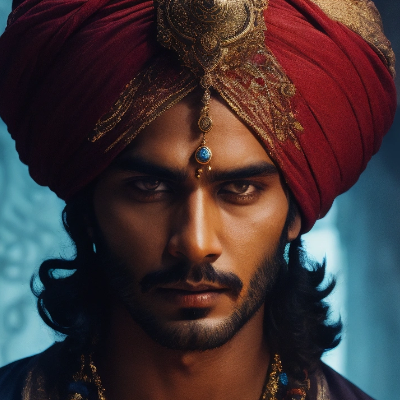
Ashtaka — Son of Vishvamitra and Madhavi, Rajarishi and Performer of the Ashvamedha
Ashtaka · Ashtaka Vaishvamitra
Ashtaka is a Rajarishi — a royal sage combining the qualities of a king and a spiritually elevated man — who appears in the Mahabharata as the son of the Brahmarishi Vishvamitra and Madhavi, the daughter of King Yayati of the Lunar dynasty. He is named in the Mahabharata's Udyoga Parva at Chapter 119, verse 18, as part of the Galavacharita — the narrative of the sage Galava's quest to fulfil his guru-dakshina to Vishvamitra — and is described as renowned for his performance of great sacrificial rites, including the Ashvamedha or horse sacrifice. His story is told by Markandeya to the Pandavas and is also narrated by Narada to the blind king Dhritarashtra. Ashtaka is further identified in the Mahabharata's Adi Parva, Chapter 86, verse 5, as a Rajarishi, and participates alongside his half-brothers — Pratardana, Vasumanas, and Shibi — in the celebrated episode in which the four kings jointly restore their maternal grandfather Yayati to the heavenly realm by transferring to him the merit accumulated through their own virtuous deeds.
✦ The Name
The name Ashtaka is derived from the Sanskrit ashta, meaning eight. Names formed from the numeral eight appear across Vedic and Puranic literature, often in connection with sacrificial or ritual contexts — the number eight carrying significance in Vedic cosmology. In the Mahabharata his name is sometimes accompanied by the patronymic form Vaishvamitra, designating him as the son of Vishvamitra. He is identified in the Vettam Mani Puranic Encyclopaedia as a Rajarishi, a class of king-sage who possesses both royal authority and spiritual merit.
✦ Lineage
- Father: Vishvamitra — one of the seven Brahmarishis and one of the most celebrated sages in the Hindu tradition, originally a Kshatriya king of the Kushika lineage who attained the highest level of sagehood through prolonged and fierce austerities. He is credited with composing the greater part of the third Mandala of the Rigveda, including the Gayatri Mantra, and appears throughout the Ramayana, Mahabharata, and Puranas as a figure of extraordinary spiritual power and complex character. Vishvamitra received Madhavi from the sage Galava as part of the guru-dakshina transaction described in the Galavacharita, and Ashtaka was the son born from that union. After Ashtaka's birth, Vishvamitra handed over to him the six hundred horses that had been collected as part of Galava's guru-dakshina payment and retreated to the forest.
- Mother: Madhavi — the daughter of King Yayati, the celebrated sovereign of the Lunar dynasty who appears in the Mahabharata's Adi Parva as a king whose excessive pride eventually caused him to be expelled from the heavenly realm to which his virtues had initially earned him entry. Madhavi was endowed by divine grace with the ability to restore her virginity after each birth, a quality that enabled her to be given successively to four royal husbands. Ashtaka was her fourth and final son. After his birth, Madhavi was returned to her father Yayati. She subsequently refused the offers of marriage made at the swayamvara Yayati arranged for her and retired to the forest as a hermit, living in asceticism for the remainder of her life.
- Maternal grandfather: Yayati — king of the Lunar dynasty, son of Nahusha, and father of Yadu and Puru among others. Yayati had spent a long period in the heavenly realm before being expelled by Indra for the sin of comparing himself to others in merit. His four grandsons through Madhavi — Ashtaka, Pratardana, Vasumanas, and Shibi — later pooled their accumulated merit to restore him to heaven.
- Half-brothers through their shared mother Madhavi: Pratardana — born to King Divodasa of Kashi; Vasumanas — born to King Haryashva; and Shibi — born to King Aushinara of the Bhojas. All four were sons of Madhavi by four different royal fathers and were accordingly heirs to four separate kingdoms. The Mahabharata presents them as a fraternal group united by their common mother and their shared devotion to their maternal grandfather Yayati.
✦ The Galavacharita and the Circumstances of Ashtaka's Birth
The Galavacharita, found in the Mahabharata's Udyoga Parva at Chapters 104 through 121, narrates the circumstances that led to Ashtaka's birth. The sage Galava had been a devoted student of Vishvamitra and upon completing his education wished to present his teacher with an appropriate guru-dakshina — the gift of honour owed to a teacher upon the conclusion of a student's training. Vishvamitra repeatedly declined to accept any payment, but Galava persisted. Vishvamitra ultimately demanded eight hundred white horses with black ears — an extraordinarily rare variety — as the price of releasing Galava from his sense of obligation.
Unable to obtain such horses by any ordinary means, Galava sought the counsel of the divine eagle Garuda, who accompanied him in his search. Eventually they came to the court of King Yayati, who could not provide the horses but offered his daughter Madhavi instead, explaining that she was endowed with the boon of restored virginity after each birth and could bear a son to any man of virtue, after which she would be free to be given to another. The merit of sons so born, Yayati explained, could serve as the equivalent of the horses Galava needed. Following this arrangement, Madhavi was successively given to King Haryashva, who fathered Vasumanas upon her; to King Divodasa of Kashi, who fathered Pratardana; and to King Aushinara, who fathered Shibi. These three sons provided six hundred horses collectively, leaving two hundred still owed. On Garuda's advice, Galava presented the six hundred horses along with Madhavi to Vishvamitra to settle the remaining portion of the debt. Vishvamitra accepted this arrangement and Madhavi bore him Ashtaka.
✦ The Ashvamedha and the Aerial Journey
The Mahabharata describes Ashtaka as renowned for his performance of great sacrifices, most notably the Ashvamedha — the horse sacrifice, a rite of enormous ritual prestige associated with sovereignty and the accumulation of spiritual and royal merit. The Puranic Encyclopaedia of Vettam Mani records that Ashtaka performed an Ashvamedha to which all the kings of his time were invited, including his three half-brothers Pratardana, Vasumanas, and Shibi.
Following the sacrifice, Ashtaka undertook an aerial journey towards the heavenly realm accompanied by his three half-brothers. On the way they encountered Narada — the wandering celestial sage and son of Brahma, who moves freely between the three worlds and is a figure of divine knowledge and often disruptive truth-telling. Narada joined them on their journey. The brothers posed to Narada a succession of questions: if only four of them could ascend to heaven, who would have to step down? Narada answered that it would be Ashtaka. His reason was that when he had stayed at Ashtaka's house, he had observed a great number of cows, and when he asked about them Ashtaka had spoken of them with pride as donations he intended to make — indicating that the motive of self-display had entered his giving, thereby diminishing the full merit of his generosity. The presence of pride in a meritorious act was sufficient, in Narada's assessment, to place Ashtaka below the threshold of the others.
Narada then answered the same question as applied to Pratardana when only three could ascend, offering a parallel explanation regarding a flaw in that king's conduct. Of the four, Shibi was judged the greatest in accumulated merit, as he had given away everything without reservation and without any admixture of pride or calculation. During the journey Shibi's chariot was observed to move faster than the others and to arrive in heaven ahead of them. When Ashtaka asked Yayati the reason for this, Yayati explained that Shibi had surpassed them all in the completeness of his renunciation.
✦ Restoring Yayati to Heaven
The Mahabharata contains two related passages concerning the four sons of Madhavi and their maternal grandfather Yayati. In the Adi Parva, Chapters 87 to 93, Ashtaka, Pratardana, Vasumanas, and Shibi are described as encountering Yayati as he falls from the heavenly realm — having been expelled by Indra for the pride of comparing his own merit to that of others. The four kings together transfer their accumulated merit to their grandfather, and by virtue of their combined good deeds Yayati is restored to the heavenly realm once more.
In the Udyoga Parva account at Chapter 122, verses 13 and 14, it is specifically recorded that Ashtaka gave away his good karma to Yayati. The four kings jointly address their grandfather, identifying themselves as his daughter's sons born in four royal lines, and by the merit of their collective virtuous deeds they cause him to ascend once more to the heavenly realm. The Mahabharata records their collective declaration — that they were endued with royal attributes and possessed of every virtue, and that by the power of their good deeds Yayati should ascend to heaven.
✦ Textual Variants and Inconsistencies
The Wikipedia article on Pratardana introduces a variant that conflicts with the Galavacharita account: it identifies Pratardana as the son of King Divodasa and Madhavi, but further states that Pratardana himself had a son named Ashtaka, which would make Ashtaka Pratardana's son rather than his half-brother. This variant cannot be reconciled with the Mahabharata's Udyoga Parva account of the Galavacharita, in which Ashtaka is unambiguously Vishvamitra's son by Madhavi and is treated as a contemporary and sibling-equivalent of Pratardana rather than as his descendant. The two accounts reflect either a confusion of genealogical lines in the manuscript tradition, or the existence of a separate figure also named Ashtaka in Pratardana's own lineage. The Galavacharita account, as the primary and more elaborated source, is followed in this profile.
The Vettam Mani Puranic Encyclopaedia identifies Ashtaka as a Rajarishi, a designation confirmed by the Mahabharata's Adi Parva. The Puranic Encyclopaedia also notes that his story is told by Markandeya to the Pandavas, which represents a different narrative frame from the Udyoga Parva account told by Narada to Dhritarashtra — indicating that the episode was circulated in at least two distinct narrative framings within the Mahabharata tradition.
✦ Theological Significance
Ashtaka's narrative carries several interlocking theological themes. His birth is embedded in the deeply fraught story of Madhavi's transmission between kings — a narrative that raises persistent questions in the Mahabharata about the treatment of women as instruments of male obligation and the ethical weight of boons that reduce a person to a transactional medium. Ashtaka himself, born of this arrangement, grows into a king of genuine virtue and generous impulse, performing the Ashvamedha and accumulating merit through sacrifices and gifts.
The episode of Narada's assessment of the four kings encodes a central Mahabharata concern: the distinction between giving that is purely meritorious and giving that is compromised by pride, the desire for recognition, or the pleasure of self-display. Ashtaka's deficiency — his proud observation of the cows he intended to donate — serves as a precise illustration of how the quality of a good act is determined not only by the act itself but by the internal state accompanying it. The comparison between Ashtaka and Shibi, who gave without any admixture of pride, is used to demonstrate gradations of moral excellence among what are otherwise uniformly virtuous kings.
The act of the four sons transferring their accumulated merit to their maternal grandfather Yayati illustrates the Mahabharata's teaching on the spiritual obligations flowing through the maternal line alongside the paternal, and on the possibility of freely transferring meritorious karma between persons bound by ties of kinship and devotion.
✦ References
- Mahabharata, Udyoga Parva, Chapter 119, verse 18: Names Ashtaka as a son of Vishvamitra born of Madhavi within the Galavacharita narrative; the primary source for his parentage and his designation as a Rajarishi.
- Mahabharata, Udyoga Parva, Chapters 104–122 (Galavacharita): Provides the full narrative context of Ashtaka's birth, the circumstances of the guru-dakshina, the aerial journey, Narada's assessment of the four kings, and the restoration of Yayati to heaven.
- Mahabharata, Udyoga Parva, Chapter 122, verses 13–14: Records Ashtaka's specific act of transferring his accumulated good karma to his maternal grandfather Yayati.
- Mahabharata, Adi Parva, Chapters 87–93: Describes the encounter of Ashtaka, Pratardana, Vasumanas, and Shibi with the falling Yayati and the collective restoration of their grandfather to heaven; identifies Ashtaka as a Rajarishi at Chapter 86, verse 5.
- Vettam Mani, Puranic Encyclopaedia (Motilal Banarsidass, 1975): Entry on Ashtaka identifying him as a Rajarishi, son of Vishvamitra born of Madhavi, and recording the Ashvamedha episode and the aerial journey with the Narada assessment.
- Wikipedia, Madhavi (princess) article: Used for cross-referencing the structure of the Galavacharita, the sequence of Madhavi's four unions, and the identification of Ashtaka as renowned for sacrificial rituals.
- Wikipedia, Pratardana article: Consulted for the textual variant that places Ashtaka as Pratardana's son rather than his half-brother; this variant is noted in the profile as a genealogical inconsistency within the manuscript tradition.