
About
Divodasa — King of Kashi, Second Husband of Madhavi
Divodasa · Bhaimaseni · Kashisha · Saudeva · Sudevatanaya · Rajarshi of Kashi
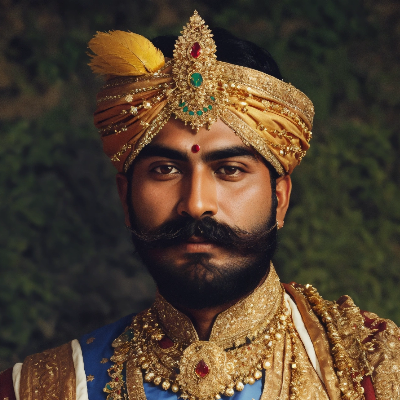
Divodasa is a king of Kashi — the ancient city also known as Varanasi or Benares — who appears in the Mahabharata's Udyoga Parva as the second of the four men to whom the princess Madhavi was given during the Galavacharita episode, and in several other passages across the Mahabharata and the Puranic literature as a figure of independent historical and narrative significance in the traditions of the Kashi dynasty. In the Galavacharita he is identified as the son of Bhimasena — also called Bhimaratha — a king of Kashi, and is described as virtuous, devoted to truth, possessed of great prowess, and with his passions under control. He received Madhavi from the sage Galava, fathered upon her a son named Pratardana, paid Galava two hundred of the rare white horses with black ears, and returned Madhavi at the appointed time with complete fidelity to his word. The Puranic Encyclopaedia records him additionally as a king who built the city of Varanasi at the behest of Indra, who fought prolonged wars against the kings of Hehaya, and who is placed in the assembly of Yama as a righteous king after his death. The name Divodasa is borne by several distinct figures in the Sanskrit tradition, and the relationship between these figures is addressed below.
✦ The Name
The name Divodasa is a Sanskrit compound of diva or divo, meaning heaven or the sky, and dasa, meaning servant or slave. The compound thus denotes servant of heaven or slave of the sky — a name with pronounced religious resonance, indicating a king who regards himself as the instrument or devotee of the divine. The name is ancient, appearing in the Rigveda in connection with a celebrated king who is a patron of the Vedic poet Bharadvaja, and it recurs across the Mahabharata and Puranic literature attached to the Kashi dynastic tradition. The epithets by which the Mahabharata also refers to this Divodasa — Bhaimaseni, meaning son of Bhimasena; Kashisha, meaning lord of Kashi; Saudeva and Sudevatanaya, meaning son of Sudeva — confirm both his patronymic identity and his royal position.
✦ Lineage
- Father: Bhimaratha — also called Bhimasena and Sudeva, a king of Kashi. The Wisdomlib genealogical entry for the Kashi dynasty traces the line: Pururava — Ayu — Kshatra Vriddha — Suhotra — Kasya — Kasi — Rashtra — Dirghatama — Dhanvantari — Ketumat — Bhimaratha — Divodasa — Pratardana. This places Divodasa in the Lunar dynasty through the line of Ayu, son of Pururavas, and connects the Kashi dynasty to the broader Chandravamsha genealogy of the Mahabharata.
- Wife (in the Galavacharita): Madhavi — the daughter of King Yayati of the Lunar dynasty, endowed with the divine boon of restored virginity after each birth and destined to bear sons who would become great kings. She was brought to Divodasa by the sage Galava as the second stage of the guru-dakshina transaction, after having previously borne Vasumanas to Haryashva of Ayodhya.
- Son through Madhavi: Pratardana — born of Divodasa and Madhavi, renowned for extraordinary martial courage, and known by several other names including Dyumna, Shatrujit, Vatsa, Ritadhvaja, and Kuvalayashva. Pratardana became king of Kashi after his father and is one of the four sons of Madhavi who together restored Yayati to the heavenly realm.
- Son through queen Drishadvati (Puranic account): The Vayu Purana and Vishnu Purana record that Divodasa's wife Drishadvati bore him Pratardana, presenting an alternative maternal lineage for Pratardana from that given in the Galavacharita. This is a significant textual variant discussed further below.
✦ The Episode in the Galavacharita
The Mahabharata's Udyoga Parva, Chapter 117, narrates Galava's approach to Divodasa. After receiving two hundred horses and Pratardana from the arrangement with Haryashva at Ayodhya, Galava brought Madhavi to the court of Kashi's king. The Mahabharata's text, as preserved in the Kisari Mohan Ganguli translation, records Galava addressing Madhavi and describing Divodasa as the illustrious ruler of the Kasis, son of Bhimasena, endued with great prowess, virtuous, devoted to truth, and with his passions under control.
When Galava arrived before Divodasa and presented his request — that the king father a son upon Madhavi in exchange for the two hundred horses he possessed — Divodasa responded without hesitation. The Mahabharata records his words: he had already heard of the matter before Galava's arrival, and he regarded it as a mark of great honour that Galava had passed over all other kings and come to him. His agreement was immediate and wholehearted. Divodasa received Madhavi, and she bore him Pratardana. True to his word and devoted to truth — qualities the Mahabharata emphasises as his defining characteristics — Divodasa returned Madhavi and the horses to Galava at the appointed time, completing his part of the arrangement without demur.
✦ Other Mahabharata and Puranic Appearances
The Puranic Encyclopaedia's entry on Divodasa, drawing on several Mahabharata Parvas, records the following additional episodes. In the Sabha Parva, Chapter 8, verse 12, Divodasa is described as sitting in the assembly of Yama and offering worship to that god — a standard Mahabharata device indicating his posthumous status among the righteous departed. In the Shanti Parva, Chapter 96, verse 21, a passage records that Divodasa once plundered the sacred accessories of his enemies and that the Agnihotra — the sacred fire ritual — vanished as a consequence of this act, suggesting an episode in which excessive military conduct had ritual repercussions. In the Anushashana Parva, Chapter 30, verse 16, the Mahabharata records that it was at the behest of Indra that Divodasa built the city of Varanasi, a foundation myth that connects the sacred city to divine command and to this particular king.
The Puranic Encyclopaedia also records a prolonged conflict in which Divodasa fought the king of Hehaya for one thousand days, lost his army in the course of this war, and subsequently went to the sage Bharadvaja and performed the Putrakameshti sacrifice — a rite performed specifically to obtain a son — as a result of which Pratardana was born to him. This version of Pratardana's birth differs entirely from the Galavacharita account, in which Pratardana is born of Madhavi, and represents a parallel or alternative narrative tradition preserved in the Shanti Parva context.
The Harivamsha contains a full chapter narrating the legend of Divodasa as king of Kashi. In this account, Divodasa fought against Bhadrashrenya — a king of the Yadu dynasty — and eventually defeated the hundred sons of Bhadrashrenya who had seized Kashi, recovering his ancestral kingdom. The Vayu Purana, Brahmanda Purana, and Kashi Khanda of the Skanda Purana all contain further material on Divodasa and the Kashi dynasty in which he is a central figure.
✦ Textual Variants and the Multiple Divodasa Problem
The name Divodasa is borne by several figures across the Sanskrit tradition, and the Wisdomlib dictionary entry lists at minimum six distinct individuals who carry this name across different texts and contexts. The most significant for this profile are: the Divodasa of the Galavacharita who is the son of Bhimasena and receives Madhavi; the Divodasa of the Rigveda who is a royal patron of the poet Bharadvaja in the hymns and whose relationship to the later Kashi king of the same name is debated; and the celebrated Divodasa Dhanvantari — the king of Kashi who is identified in the Sushruta Samhita tradition as the teacher of Sushruta, son of Vishvamitra, and who is regarded in that tradition as an incarnation of Dhanvantari, the divine physician. The Wisdomlib genealogical line for the Kashi dynasty — Dhanvantari — Ketumat — Bhimaratha — Divodasa — Pratardana — places the Galavacharita Divodasa one generation below a king named Ketumat who was himself the son of Dhanvantari, meaning that Divodasa Dhanvantari and Divodasa son of Bhimaratha are likely different figures separated by at least two generations in the Kashi dynastic line.
A further variant concerns the mother of Pratardana. The Galavacharita of the Udyoga Parva states that Pratardana was born of Madhavi. The Vayu Purana and the Vishnu Purana, following the Kashi dynastic lineage, record that Divodasa's queen Drishadvati bore him Pratardana. The Wikipedia article on Madhavi notes that Drishadvati is also one of the alternate names used for Madhavi herself in the Brahmanda Purana, Matsya Purana, and Vayu Purana. This creates the possibility — though it cannot be confirmed — that the Puranic accounts identifying Drishadvati as Pratardana's mother and the Mahabharata Galavacharita identifying Madhavi as his mother may be referring to the same woman under different names. If so, the apparent contradiction between the two accounts would dissolve. If Drishadvati and Madhavi are treated as distinct women, the two accounts represent irreconcilable variant genealogies. Both possibilities are honestly noted here.
✦ References
- Mahabharata, Udyoga Parva, Chapter 117: Primary source for the Galavacharita episode in which Divodasa receives Madhavi from Galava, fathers Pratardana, pays two hundred horses, and returns Madhavi; describes Divodasa as son of Bhimasena, virtuous, devoted to truth, and with his passions under control.
- Mahabharata, Sabha Parva, Chapter 8, verse 12: Places Divodasa in the assembly of Yama offering worship among the righteous dead.
- Mahabharata, Shanti Parva, Chapter 96, verse 21: Records Divodasa plundering the sacred accessories of enemies with the consequence of the Agnihotra's disappearance.
- Mahabharata, Anushashana Parva, Chapter 30, verse 16: States that Divodasa built the city of Varanasi at Indra's behest.
- Harivamsha, Chapter 29: Contains the full account of Divodasa's legend as king of Kashi, including his wars against Bhadrashrenya and his recovery of the kingdom.
- Vayu Purana, Chapter 92; Vishnu Purana, Book IV, Chapter 8: Place Divodasa in the Kashi dynastic genealogy and record that he fathered Pratardana through his queen Drishadvati.
- Brahmanda Purana, Book III, Chapter 67: Contains parallel genealogical material on the Kashi dynasty and Divodasa's line.
- Vettam Mani, Puranic Encyclopaedia (Motilal Banarsidass, 1975): Entry on Divodasa, the most comprehensive secondary compilation of his appearances across the Mahabharata Parvas and Puranas, with specific verse references.
- Wisdomlib, Divodasa definitions entry: Used for identifying the multiple distinct figures bearing this name and for the Kashi dynastic genealogy placing Divodasa in relation to Dhanvantari and Bhimaratha.