
About
Pratardana — Son of Divodasa and Madhavi, King of Kashi, Warrior of Many Names
Pratardana · Dyumna · Dyuman · Shatrujit · Vatsa · Ritadhvaja · Kuvalayashva · son of Divodasa · Kashi king
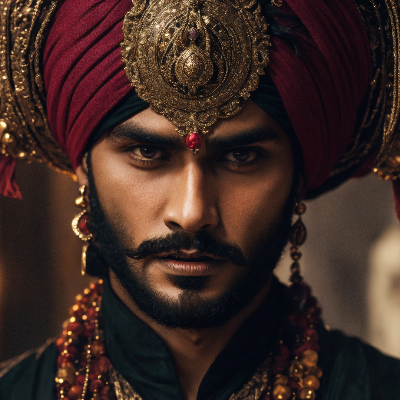
Pratardana is a king of Kashi — the ancient city of Varanasi — who appears in the Mahabharata and in the Bhagavata Purana, Brahmanda Purana, and Vayu Purana as the son of Divodasa, king of Kashi, and is one of the four sons of Madhavi, the daughter of King Yayati of the Lunar dynasty. He is identified in the Mahabharata's Udyoga Parva, Chapter 117, as the son born to Divodasa and Madhavi during the Galavacharita episode, and is described in the Mahabharata as renowned for extraordinary martial courage — a characterisation that is borne out across his several narrative appearances in the epic. He bears no fewer than five additional names and epithets — Dyumna or Dyuman, Shatrujit, Vatsa, Ritadhvaja, and Kuvalayashva — each of which the tradition explains by a specific episode or quality. He participated with his three half-brothers in the restoration of Yayati to heaven, and he appears in several further episodes in the Shanti Parva, Anushashana Parva, and other parts of the Mahabharata. He is the father of Alarka, the celebrated king of Kashi who appears in Puranic literature as an exemplar of enlightened kingship.
✦ The Names
The Bhagavata Purana, Book IX, Chapter 17, verses 4 and 5, and the Brahmanda Purana provide the tradition-sanctioned explanations for Pratardana's multiple names. The primary name Pratardana derives from the Sanskrit root tarda or tardana, meaning one who pierces or defeats, with the prefix pra indicating intensification — thus denoting the great piercer or the supreme defeater. The Wisdomlib entry records that he was called Dyumna or Dyuman as the son of Divodasa, this being the form of his name associated with his Kashi dynastic identity. He was called Shatrujit — meaning conqueror of enemies — for destroying the line of Bhadrashrenya, the Yadava king whose sons had seized the kingdom of Kashi from Divodasa's ancestors. He was called Vatsa — meaning calf or beloved child — by his father Divodasa as a term of affection. He was called Ritadhvaja — meaning one whose banner is truth — for his quality of absolute truthfulness. He was called Kuvalayashva — meaning one who possesses the horse Kuvalaya — for owning a celebrated horse of that name.
✦ Lineage
- Father: Divodasa — king of Kashi, son of Bhimaratha, a ruler of the ancient Kashi dynasty descended through the Lunar line. Described in the Mahabharata as virtuous, devoted to truth, possessed of great prowess, and with his passions under control.
- Mother (Galavacharita account): Madhavi — the daughter of King Yayati of the Lunar dynasty, endowed with the divine boon of restored virginity after each birth and destined to bear sons who would become great kings. Pratardana was the second of her four sons, born after Vasumanas and before Shibi and Ashtaka.
- Mother (Puranic dynastic account): The Vayu Purana and Vishnu Purana record Drishadvati as the queen of Divodasa through whom Pratardana was born. As noted in the Divodasa profile above, the Puranas also use Drishadvati as an alternate name for Madhavi herself, creating the possibility that both accounts refer to the same woman, though this cannot be confirmed.
- Maternal grandfather: Yayati — king of the Lunar dynasty, son of Nahusha, who was expelled from the heavenly realm and later restored to it through the collective merit of his four grandsons through Madhavi.
- Half-brothers through their shared mother Madhavi: Vasumanas — son of Haryashva of Ayodhya, renowned for extraordinary generosity and the title Danapati; Shibi — son of Aushinara, renowned for supreme devotion to truth and righteousness; and Ashtaka — son of Vishvamitra, renowned for great sacrifices.
- Son: Alarka — described in the Bhagavata Purana, Brahmanda Purana, and related Puranic literature as the son of Pratardana and a celebrated king of Kashi in his own right, famous for his long reign, righteous governance, and spiritual attainments. The Brahmanda Purana additionally names Vatsa and Garga as sons of Pratardana.
✦ Birth — Two Accounts
The Mahabharata contains two distinct accounts of Pratardana's birth that cannot be fully reconciled. The Galavacharita of the Udyoga Parva, Chapter 117, records that Pratardana was born to Divodasa and Madhavi as part of the guru-dakshina transaction in which Madhavi was given to Divodasa by the sage Galava. The Shanti Parva and associated Puranic accounts record a different birth narrative: that Divodasa, having suffered catastrophic military defeat at the hands of the sons of Vitahavya — in a related but different war from his conflict with Bhadrashrenya's sons — went to the sage Bharadvaja and performed the Putrakameshti sacrifice, a rite specifically designed to produce a son. As a result of this sacrifice, a son named Pratardana was born to him, gifted by Bharadvaja with the concentrated power of the entire universe poured into his body through yogic means, so that the child grew instantly to the stature and accomplishments of a thirteen-year-old, mastered the Vedas and the science of arms simultaneously, and appeared in full armour with bow in hand ready to fight his father's enemies.
These two accounts of Pratardana's birth — one through Madhavi in the Galavacharita, one through the Putrakameshti sacrifice in the Shanti Parva — are irreconcilable as they stand in the primary texts. The Puranic Encyclopaedia of Vettam Mani treats them as aspects of the same figure, a common Puranic approach when parallel narratives concern a king of established fame, and this profile follows that convention while noting the discrepancy honestly.
✦ The War against the Vitahavyas
The Shanti Parva and associated Puranic accounts record that Pratardana, born and immediately endowed with full military power through Bharadvaja's blessing, was sent by his father Divodasa to avenge the destruction wreaked upon the Kashi kingdom by the sons of Vitahavya. The Vitahavyas were a royal clan who had previously devastated the Kashi kingdom, killing much of Divodasa's family. Pratardana crossed the Ganga, marched against the city of the Vitahavyas, and was met by their forces. The sons of Vitahavya, who were accomplished warriors, poured arrows on him from all directions. Pratardana defeated them in battle.
Vitahavya himself fled to the hermitage of the sage Bhrigu and sought sanctuary. Pratardana pursued him and demanded that the refugee be surrendered. Bhrigu, unwilling to break the sacred duty of offering protection to one who had sought refuge, declared that there was no Kshatriya at his hermitage — at which point the Mahabharata records that Vitahavya, by virtue of being proclaimed a Brahmin by the mouth of Bhrigu, actually attained Brahmin status. Pratardana, honouring the sage's declaration and the transformation it had effected, withdrew without further pursuit. This episode is cited in the Mahabharata as a noteworthy example of the power of a sage's pronouncement to effect an actual change in a person's varna.
✦ Other Episodes
The Puranic Encyclopaedia records several further episodes and references across the Mahabharata. In the Shanti Parva, Chapter 166, verse 80, it is recorded that Emperor Shibi — one of Pratardana's half-brothers through Madhavi — gave Pratardana a sword, an act of royal gift between the sons of the same mother. In the Shanti Parva, Chapter 224, verse 20, Pratardana is recorded as having given the gift of a netra — an eye — to Brahmins, an unusual and significant act of royal generosity in the ritual context. The Shanti Parva, Chapter 100, records that Pratardana acquired knowledge of sword-fighting from the Sivis, the people of his half-brother Shibi's kingdom, establishing a connection between the Kashi and Sivi royal traditions. In the Anushashana Parva, Chapter 137, verse 5, Pratardana is recorded as having courted death after appointing his sons for the service of Brahmins — an act of voluntary death following the fulfilment of his royal and religious duties.
The Wikipedia article on Pratardana records an episode in which Vishvamitra — Pratardana's uncle through his half-brother Ashtaka — grew furious at a perceived slight from the king of Kashi and, in his anger, threatened to destroy the Kashi king before sunset. Pratardana, terrified, sought the intercession of the sage Narada, who directed him to Anjana, the mother of Hanuman. Anjana in turn asked her son Hanuman for help. Hanuman carried Pratardana to the banks of the river Sarayu and instructed him to wade waist-deep into the water and repeat the name of Rama, which protected him from Vishvamitra's wrath. This episode, which involves Rama and therefore likely belongs to a post-Ramayana compositional layer, is noted here as it appears in the Wikipedia source but cannot be verified against the specific Mahabharata or Puranic chapter reference in the sources consulted.
✦ Restoration of Yayati to Heaven
Pratardana participated alongside his three half-brothers — Vasumanas, Shibi, and Ashtaka — in the act of transferring their accumulated merit to their maternal grandfather Yayati, thereby restoring him to the heavenly realm. In the aerial journey episode narrated in the Mahabharata's Udyoga Parva, where the four brothers were assessed by Narada on the purity of their respective merits, Pratardana ranked second after Shibi and ahead of Vasumanas and Ashtaka in Narada's judgement — an assessment that placed him among the most meritorious of the four, below only Shibi in the completeness and purity of his virtue.
✦ References
- Mahabharata, Udyoga Parva, Chapter 117: Primary source for Pratardana's birth to Divodasa and Madhavi in the Galavacharita; identifies him as renowned for martial courage.
- Mahabharata, Shanti Parva, Chapter 96: Contains the Putrakameshti birth narrative in which Bharadvaja blesses Divodasa with a supernaturally gifted son sent against the Vitahavyas; the principal source for the Vitahavya war episode.
- Mahabharata, Shanti Parva, Chapter 100, verse 8: Records Pratardana acquiring sword-fighting knowledge from the Sivis.
- Mahabharata, Shanti Parva, Chapter 166, verse 80: Records Shibi's gift of a sword to Pratardana.
- Mahabharata, Shanti Parva, Chapter 224, verse 20: Records Pratardana's gift of an eye to Brahmins.
- Mahabharata, Anushashana Parva, Chapter 137, verse 5: Records Pratardana courting death after appointing his sons to the service of Brahmins.
- Bhagavata Purana, Book IX, Chapter 17, verses 4–5: Names Pratardana as the son of Dyuman, son of Divodasa, and provides the etymology of his several names including Shatrujit, Vatsa, Ritadhvaja, and Kuvalayashva; names Alarka as his son.
- Brahmanda Purana, Book III, Chapter 67; Vayu Purana, Chapter 92: Provide parallel genealogical material on Pratardana's position in the Kashi dynastic sequence and his parentage through Drishadvati.
- Vettam Mani, Puranic Encyclopaedia (Motilal Banarsidass, 1975): Entry on Pratardana, the most comprehensive secondary compilation of his Mahabharata and Puranic appearances with specific chapter and verse references across multiple Parvas.
- Wikipedia, Pratardana article: Used for the episode involving Vishvamitra's threat, Narada's intercession, and Hanuman's protection, and for the identification of Alarka as Pratardana's son.