
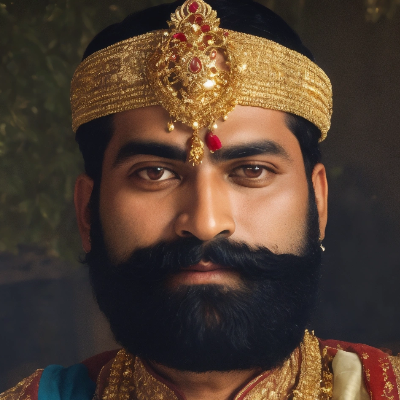
About
Usinara — King of the Bhojas, Third Husband of Madhavi
Usinara · Aushinara · Ushinara · king of the Bhoja country
Usinara is a king identified in the Mahabharata's Udyoga Parva at Chapter 118 as a ruler of the Bhoja country — a sub-group of the Yadava clan — who appears as the third of the four men to whom the princess Madhavi was given during the Galavacharita episode. He possessed two hundred of the rare white horses with black ears that the sage Galava required as guru-dakshina for his teacher Vishvamitra, and from his union with Madhavi was born the celebrated king Shibi, renowned throughout the epic and Puranic tradition as the supreme exemplar of the virtue of protection and the duty of refuge. Usinara's own fame in the Mahabharata is tied almost entirely to his son — the Mahabharata itself records the gods declaring that in the three worlds there had never been, was not, and would never be a second person equal to the son of Usinara. A significant genealogical complexity attaches to Usinara: the Bhagavata Purana places him in the lineage of Yayati's son Anu, which would make him a descendant of Yayati through the male line, while the Galavacharita makes Madhavi — Yayati's daughter — the mother of his son Shibi. Both traditions are recorded below.
✦ The Name
The name Usinara — also rendered Ushinara and Aushinara — is most commonly understood as a proper name associated with a people and a territory as much as with an individual king. The Usinara kingdom and the Usinara people appear across the Mahabharata as a distinct ethnic and political entity in the northwest of the Indian subcontinent, associated by modern scholars with the region of the Punjab. The patronymic form Aushinara — meaning son or descendant of Usinara — is used in the Mahabharata at Chapter 5.118 as a description of the king who received Madhavi, and at Sabha Parva to describe Usinara's daughter who married the sage Gautama. In some passages the people of this region are identified as the Sivis or Sibis — the name of Shibi's lineage — indicating that the Usinara dynasty and the Sivi kingdom were understood as deeply interconnected.
✦ Lineage
- Dynasty and ancestry (Puranic account): The Bhagavata Purana, Book IX, Chapter 23, verses 1 through 4, places Usinara in the following genealogical line descending from Yayati's fourth son Anu: Anu — Shabhanara — Kalanara — Srnjaya — Janamejaya — Mahasala — Mahamana — Usinara. In this account Usinara had four sons: Shibi, Vara, Krmi, and Daksha. This lineage makes Usinara a descendant of Yayati through Anu, and the Usinaras, Sivis, Madras, and Kekayas are described in the Bhagavata Purana as direct descendants of Yayati's son Anu.
- Clan affiliation (Mahabharata): The Mahabharata at Chapter 5.118 identifies Usinara as a Bhoja — a sub-group of the Yadavas. The Hindupedia entry on Usinara identifies him as a king of the Chandravamsha ruling over the Bhoja country. The AncientVoice analysis notes that his Bhoja-Yadava identity may be reconcilable with descent from Anu if the Anu-descended line had at some point been absorbed into or allied with the Bhoja-Yadava sphere. These genealogical identifications reflect the fluid and overlapping nature of clan designations in the Mahabharata tradition.
- Wife (in the Galavacharita): Madhavi — the daughter of King Yayati of the Lunar dynasty, endowed with the divine boon of restored virginity after each birth and destined to bear sons who would become great kings. She was brought to Usinara by the sage Galava as the third stage of the guru-dakshina transaction, after having previously borne Vasumanas for Haryashva and Pratardana for Divodasa.
- Son through Madhavi: Shibi — born of Usinara and Madhavi, renowned throughout the Mahabharata and Puranic tradition for his absolute devotion to truth and righteousness and for the celebrated episode in which he offered pieces of his own flesh, and ultimately his entire body, to protect a dove that had sought refuge with him from a hawk, the two birds being the gods Agni and Indra in disguise.
- Daughter: Aushinara — named in the Sabha Parva of the Mahabharata as a daughter of Usinara who married the sage Gautama at Magadha and bore him many children including kings such as Kakshivat.
✦ The Episode in the Galavacharita
The Mahabharata's Udyoga Parva, Chapter 118, narrates Galava's approach to Usinara after collecting four hundred horses and two sons — Vasumanas and Pratardana — from the earlier arrangements with Haryashva and Divodasa. Usinara possessed the third group of two hundred horses, and he desired an heir. The same arrangement was proposed: he would receive Madhavi, father a son upon her, pay his two hundred horses to Galava, and return her. Usinara accepted this arrangement. The Mahabharata records that from his union with Madhavi, Shibi was born — a son described throughout the epic as renowned for his devotion to truth and righteousness.
The Mahabharata also records a statement of Usinara's philosophy of kingship in connection with this passage — that his wealth existed for the benefit of his subjects residing in his city and country, and not for his own comfort and enjoyment, and that a king who gave away the wealth of others for his own pleasure could never earn virtue or fame. This declaration positions Usinara as a king of genuine dharmic awareness, consistent with the portrait of a ruler whose son became the tradition's supreme example of righteous giving.
✦ The Genealogical Inconsistency
The Bhagavata Purana's placement of Usinara in the lineage of Yayati's son Anu creates a direct conflict with the Galavacharita's identification of Madhavi — Yayati's daughter — as Shibi's mother through Usinara. If Usinara is Yayati's great-great-great-grandson through Anu, and Madhavi is Yayati's daughter, then Shibi would be simultaneously a distant patrilineal descendant of Yayati and a direct matrilineal grandchild of the same Yayati through the Galavacharita arrangement. The generations required by the Bhagavata Purana lineage and those implied by the Galavacharita episode are not compatible within a single consistent chronology. These two traditions — the Puranic dynastic genealogy and the Mahabharata narrative of the Galavacharita — appear to reflect independent streams of the tradition that were not harmonised across the corpus. Both are recorded here as they stand in their respective primary sources.
✦ References
- Mahabharata, Udyoga Parva, Chapter 118: Primary source for Usinara's role in the Galavacharita; records his identity as a Bhoja king, his possession of two hundred horses, his reception of Madhavi, and the birth of Shibi. Also records his statement of dharmic kingship.
- Mahabharata, Sabha Parva: Records that Usinara had a daughter named Aushinara who married the sage Gautama and bore many children including monarchs like Kakshivat.
- Mahabharata, Drona Parva, Chapter 7, verse 10: Records the gods declaring that in the three worlds there had never been and would never be a second person equal to the son of Usinara — the most exalted praise attached to him across the epic, spoken of his son Shibi.
- Bhagavata Purana, Book IX, Chapter 23, verses 1–4: Places Usinara in the genealogical sequence Anu — Shabhanara — Kalanara — Srnjaya — Janamejaya — Mahasala — Mahamana — Usinara; names Shibi, Vara, Krmi, and Daksha as his sons.
- Hindupedia, Usinara entry: Identifies him as a king of the Chandravamsha ruling the Bhoja country, with Madhavi as his wife and Shibi as his son.
- Wikipedia, Usinara Kingdom article: Used for the identification of the Usinaras as associated with the Sivis, the Bhagavata Purana's descent from Anu, and the presence of Usinara's son at Draupadi's swayamvara.
- Vettam Mani, Puranic Encyclopaedia (Motilal Banarsidass, 1975): Entry on Shibi records Usinara as his father and provides the relevant Mahabharata chapter references.