
About
Dhruva — Son of Angada and Prince of the Vanara Lineage
Dhruva · Dhruva Vanara · Angada-putra
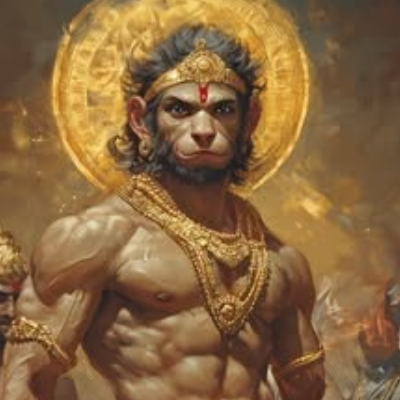
Dhruva, identified in certain genealogical passages of the Puranic and epic tradition as a son of Angada — the Vanara prince of Kishkindha and son of Vali — is among the most sparsely attested figures connected to the Vanara lineage of the Ramayana. His name appears in the genealogical lists that trace the descent of the Vanara royal line of Kishkindha beyond the primary narrative of the Valmiki Ramayana, but he receives no independent narrative, no individual episodes, and no characterisation in any of the primary sources in which his name occurs. The honest scope of what can be stated about this figure with confidence is therefore narrow: he is recorded as belonging to the lineage of Angada and through him to the lineage of Vali, Indra, and the Aditya group, but beyond this genealogical placement the primary sources provide no additional information. It should also be noted that the name Dhruva is shared by one of the most celebrated figures in the entire Puranic tradition — Dhruva the son of King Uttanapada and devotee of Vishnu, whose story is given at great length in the Bhagavata Purana and other Puranas, and who became the pole star through the power of his austerities. That Dhruva is a human prince of the lunar or solar royal lineage and is entirely distinct from any Vanara figure of the same name. The two must not be conflated, and the present profile concerns only the Dhruva identified in the relevant genealogical tradition as the son of Angada the Vanara.
✦ The Name
The name Dhruva derives from the Sanskrit root dhru or dhriv, meaning to be fixed, to be firm, or to be immovable. Dhruva as an adjective means fixed, firm, steady, or permanent, and as a noun it designates the pole star — the star that does not appear to move in the night sky and around which all other stars appear to revolve. The name therefore carries connotations of constancy, permanence, and unwavering stability. Within the Vanara lineage, the name Dhruva is applied without any explanation of why this name was chosen, and no narrative is preserved that would illuminate whether the name was given prophetically, descriptively, or simply as a name in common use within the tradition of the time.
The association of the name with the pole star gives it a cosmic resonance that connects it, at least etymologically, to the solar and celestial dimensions of the Vanara lineage — a lineage descended from Indra through Vali and from Varuna through Tara, both of whom are Adityas with cosmic domains. Whether this resonance was intentional in the application of the name to Angada's son cannot be determined from the surviving sources.
✦ Lineage
- Father: Angada — Vanara prince of Kishkindha; son of Vali and Tara; yuvaraja of the Vanara kingdom appointed by Rama; leader of the southern search party that located Lanka; emissary of Rama to Ravana's court; one of the foremost warriors in the campaign against Ravana; grandson of Indra through Vali and grandson of Varuna through Tara's father Sushena.
- Paternal grandfather: Vali — king of Kishkindha; son of Indra the king of the gods; elder brother of Sugriva; possessor of the boon by which he received half the strength of any direct opponent; slain by Rama in the Kishkindha Kanda of the Valmiki Ramayana.
- Paternal grandmother: Tara — daughter of Sushena the Vanara elder and physician, himself the son of Varuna; wife first of Vali and subsequently of Sugriva; celebrated for her beauty, intelligence, and prophetic counsel; included in some enumerations of the Panchakanya.
- Paternal great-grandfather (divine): Indra — king of the gods, lord of Svarga, wielder of the thunderbolt, one of the twelve Adityas born to the sage Kashyapa and his wife Aditi; through this line Dhruva is the great-great-grandson of Kashyapa and of Aditi, daughter of the patriarch Daksha.
- Paternal great-grandmother (divine, through Tara's line): Varuna — lord of the cosmic waters, the western direction, and one of the twelve Adityas born to Kashyapa and Aditi; Sushena was identified as Varuna's son, making Varuna Tara's grandfather and Angada's maternal great-grandfather, and Dhruva's paternal great-great-grandfather through the maternal line of Angada.
- Mother: The primary sources do not record the name or identity of Angada's wife and Dhruva's mother. This information is absent from the Valmiki Ramayana and from the principal Puranic genealogical passages that mention Dhruva's name.
✦ Textual Basis and Limitations
The identification of Dhruva as a son of Angada the Vanara appears in genealogical lists preserved in certain Puranic texts that trace the extended lineages of the beings who participated in the Ramayana. The principal Puranas that contain genealogical information on the Vanara lineages beyond the immediate narrative of the Valmiki Ramayana include the Brahma Purana, the Bhagavata Purana, and the Skanda Purana, though the specific passage in which Dhruva is named as Angada's son is found in limited manuscript traditions and is not among the most frequently cited or widely attested genealogical records of the Vanara royal line. The Valmiki Ramayana itself does not name any children of Angada, and the genealogical extension to Dhruva belongs to the post-Ramayana Puranic tradition of tracing lineages beyond the endpoints of the epic narrative.
This profile must therefore be clear about the nature and limits of the evidence. Dhruva as a son of Angada is a genealogical record rather than a narrative figure. He has no story of his own in the surviving primary sources, no episodes, no speeches, no described qualities or characteristics, and no theological significance as an individual. What can be stated about him with confidence is confined to his place in the lineage — as the son of Angada, the grandson of Vali, the great-grandson of Indra, and a member of the Vanara royal lineage of Kishkindha — and to the significance of that lineage as established through the primary narrative of the Ramayana and the divine genealogies that underlie it.
To elaborate beyond these established facts — to assign Dhruva qualities, roles, episodes, or significance not recorded in the primary sources — would be to depart from the factual standard that this genealogical reference work maintains. The profile therefore stands as a record of what is known, which is the genealogical position alone, and does not attempt to supplement the primary source record with inference or invention.
✦ Distinction from Dhruva the Pole Star Devotee
Because the name Dhruva is most widely known in the Hindu tradition as the name of the celebrated child-devotee of Vishnu whose story is told at length in the Bhagavata Purana's fourth book and in the Vishnu Purana, it is essential to establish clearly that this figure is entirely distinct from Angada's son. The Dhruva of the Bhagavata Purana is the son of King Uttanapada — a king of the human solar or lunar royal lineage — and his mother Suniti, a queen who was displaced from royal favour by her co-wife Suruchi. Dhruva, at the age of five, undertook extraordinary austerities in the forest of Madhuvana to obtain the vision and blessing of Vishnu, and as a result of these austerities was granted by Vishnu a place of supreme permanence in the cosmos — the pole star, around which all other stars revolve and which does not set. He is one of the most celebrated devotees of Vishnu in the entire Puranic tradition, and his story is among the best-known in Hindu religious culture.
This Dhruva belongs to the human royal world, not to the Vanara world of the Ramayana. He has no connection to Angada, Vali, or the Kishkindha lineage. His association with the pole star through the specific narrative of his austerities and Vishnu's blessing is a distinct mythological tradition from the Vanara genealogy in which the name Dhruva also appears. The shared name is a coincidence of Sanskrit nomenclature — Dhruva was a common enough name, given its meaning of firmness and permanence — and does not imply any narrative, genealogical, or theological connection between the two figures.
✦ Connection to the Wider Genealogy
Although Dhruva as an individual figure is without independent narrative, his position in the Vanara lineage of Kishkindha places him at the end of one of the most divinely connected genealogical chains in the Ramayana tradition. Through his father Angada and his grandfather Vali, he descends from Indra — the king of the gods and one of the twelve Adityas born to the sage Kashyapa and his wife Aditi. Through his paternal grandmother Tara and her father Sushena, he descends from Varuna — another of the twelve Adityas born to Kashyapa and Aditi. The convergence of two Aditya lineages in his ancestry — Indra through his father's side and Varuna through his mother's father's side — gives Dhruva a divine genealogy of unusual depth even within the context of the Vanara world, where divine descent is the norm rather than the exception among the principal families.
Through the Aditya connection common to both his paternal and maternal ancestral lines, Dhruva is genealogically connected to the full group of twelve Adityas born to Kashyapa and Aditi — including Mitra, Aryaman, Bhaga, Pushan, Amsha, Tvashtr, Vivasvat (Surya), Parjanya, Dhata, and Vishnu. Through Vivasvat, Dhruva's lineage connects at the divine level to the solar dynasty of human kings — from Vivasvat through Vaivasvata Manu through the Ikshvaku kings of Ayodhya — the same dynasty that produced the hero Rama, whose campaign against Ravana constituted the central purpose of Angada's most significant service. Through Kashyapa and Aditi, Dhruva's lineage reaches back to Daksha — the patriarch whose daughters include Aditi herself and whose family underlies the entire genealogical structure of the Puranic cosmos — and through Kashyapa to Marichi, one of the mind-born sons of Brahma the creator.
The Vanara royal lineage of which Dhruva is a late member thus traces its divine origin through two separate Aditya lines back to the primordial creative act of Brahma, encompassing along the way the king of the gods, the lord of the cosmic waters, the great progenitor Kashyapa, the boundless mother Aditi, and the patriarch Daksha — a genealogical depth that reflects the Puranic tradition's understanding of the Vanara community of Kishkindha not as a merely animal or peripheral world but as a community embedded within the same divine lineage structures that underlie the rest of the cosmos.
✦ References
- Primary Sources
- Valmiki Ramayana (Kishkindha Kanda and Yuddha Kanda): The primary source for the narrative lives of Angada, Vali, and Tara — Dhruva's father, grandfather, and grandmother respectively — which provide the genealogical foundation from which Dhruva's lineage derives. The Valmiki Ramayana itself does not name Dhruva as Angada's son.
- Bhagavata Purana, Skandha IX (genealogical passages on the Vanara lineages): Among the Puranic texts that contain extended genealogical records tracing lineages beyond the immediate narrative of the Ramayana; relevant passages in the ninth book address post-Ramayana lineage continuations including those of the Vanara royal families.
- Brahma Purana (genealogical sections relating to the Vanara lineages): Contains genealogical material on the beings of the Ramayana period and their descendants; a potential source for the identification of Dhruva as Angada's son within the tradition of post-narrative genealogical record-keeping.
- Bhagavata Purana, Skandha IV, Chapters 8–12 (the story of Dhruva son of Uttanapada): The primary source for the celebrated Dhruva of the pole star narrative — cited here exclusively for the purpose of establishing that this figure is entirely distinct from the Vanara Dhruva son of Angada.
- Vishnu Purana, Book I, Chapters 11–12 (the story of Dhruva son of Uttanapada): Another major source for the pole star Dhruva narrative — again cited solely to establish the distinction between the two figures of this name.
- Secondary Sources
- Mani, Vettam. Puranic Encyclopaedia (1975): Entries on Angada, Vali, Tara, Sushena, and the Vanara lineages; the entry on Dhruva in this work addresses the pole star devotee rather than the Vanara figure, which itself reflects the relative obscurity of the Vanara Dhruva in the tradition; useful for confirming the distinction between the two and for cross-referencing the genealogical records of the Kishkindha royal line.
- Goldman, Robert P. (general editor). The Ramayana of Valmiki: An Epic of Ancient India (Princeton University Press, Kishkindha Kanda and Yuddha Kanda volumes): Critical edition and translation with notes; provides the fullest scholarly treatment of Angada's narrative and genealogy within the Valmiki text, against which the post-narrative Puranic genealogical extension to Dhruva can be contextualised.
- Wisdomlib (wisdomlib.org), entries on Angada, Vali, Tara, and the Vanara royal lineage: Aggregates verse references from digitised Puranic and epic texts; useful for locating the specific passages in which the genealogical extension of the Vanara royal line beyond Angada is recorded and for identifying the textual basis of Dhruva's attribution as Angada's son.