
About
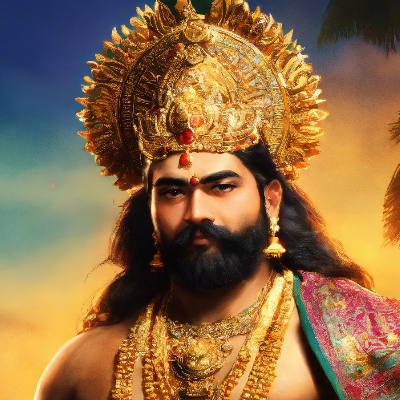
Nabhi — Progenitor King and Father of Rishabha
Nabhi · Nabhi Chakravartin · son of Agnidhara · Ajanabandhava
Nabhi is one of the nine sons born to the patriarch Agnidhara and the apsara Purvachitti. Agnidhara was a son of Priyavrata, who was himself a son of Svayambhuva Manu, the first Manu of the current cosmic cycle. Purvachitti was a celestial dancer sent by Brahma to distract Agnidhara from his austerities; she became his wife and bore him nine sons, of whom Nabhi was the eldest. Nabhi is chiefly celebrated in the tradition as the father of Rishabha, the great sage-king who is regarded in the Bhagavata Purana as an avatara of Vishnu, and from whom the lineage of the hundred Bharata princes descends. The subcontinent known as Bharatavarsha takes its name ultimately from Bharata, the eldest son of Rishabha. Nabhi's principal appearances are in the Bhagavata Purana and the Vishnu Purana.
✦ The Name
The name Nabhi in Sanskrit carries the primary sense of navel or centre-point, and by extension denotes the hub or axis around which a wheel or a lineage revolves. In a genealogical context this is significant: Nabhi functions as the pivot from whom the great Bharata lineage radiates. The epithet Ajanabandhava, meaning one who is a kinsman to those without a master, appears in later devotional contexts and reflects his association with the divine through his son Rishabha.
✦ Lineage
- Father: Agnidhara, son of Priyavrata and king of Jambudvipa, who divided his realm among his nine sons.
- Mother: Purvachitti, an apsara of the celestial realms sent by Brahma to draw Agnidhara away from his penances; she became his wife and bore him nine sons before returning to the heavens.
- Brothers: Kimpurusha, Harivarsha, Ilavrita, Ramya, Hiranvat, Kuru, Bhadrasva, and Ketumala — each granted by Agnidhara a distinct region of Jambudvipa corresponding to his name.
- Spouse: Merudevi, daughter of the cosmic mountain Meru's lord, Sumeru. The Bhagavata Purana names her as the wife through whom Nabhi prayed for a son surpassing all beings in virtue.
- Son: Rishabha, regarded in the Bhagavata Purana as a partial or full manifestation of Vishnu, a great ascetic king who renounced his throne and attained liberation. Rishabha fathered one hundred sons, the eldest of whom, Bharata, gave his name to the subcontinent Bharatavarsha.
✦ The Varsha of Nabhi
When Agnidhara divided the continent of Jambudvipa among his nine sons, he assigned to Nabhi the region known as Hima, or in some recensions Himahva, the northern highland territory adjacent to the Himalayan ranges. This region is also sometimes identified with what later became known as Bharatavarsha once Bharata — Rishabha's son and Nabhi's grandson — came to rule it. The Vishnu Purana and Bhagavata Purana agree on this inheritance, though the precise boundaries described differ slightly between them.
✦ The Sacrifice and the Birth of Rishabha
The most celebrated episode connected to Nabhi in the Bhagavata Purana is his performance of a great sacrifice at which Vishnu himself appeared. Nabhi and Merudevi had no son, and Nabhi desired an heir of supreme excellence. The officiating priests conducted the rites with great precision, and Vishnu manifested before the assembly. The assembled sages and Nabhi praised the deity and requested a son equal to Vishnu himself in every quality. Vishnu responded by declaring that no being equal to himself could be born, but that he would himself take birth as Nabhi's son. Rishabha was accordingly born as that son, fulfilling Nabhi's wish in the most complete manner possible.
✦ Theological Significance
Nabhi occupies a structurally important position in Vaishnava theology as the human vehicle through whom Vishnu chose to descend as Rishabha. The account in the Bhagavata Purana presents Nabhi not merely as a genealogical link but as a devoted king whose sincere longing and ritual piety created the conditions for an avatara. His role is thus comparable to that of other pious progenitors in the Puranic tradition who, through righteous conduct and sacrifice, became parents of divine or semi-divine beings.
✦ Connection to the Wider Genealogy
Nabhi stands in the fifth generation of descent from Brahma in the Svayambhuva line: Brahma begat Svayambhuva Manu, who begat Priyavrata, who begat Agnidhara, who begat Nabhi. Through his son Rishabha and grandson Bharata, Nabhi is the fountainhead of the human lineage that gave Bharatavarsha its name and through whom many of the royal dynasties of the Puranic tradition trace their remote ancestry.
✦ References
- Bhagavata Purana, Skanda 5, Chapters 1–4: Primary source for the account of Agnidhara, Purvachitti, the nine sons, Nabhi's inheritance, his marriage to Merudevi, and the sacrifice at which Rishabha was born.
- Vishnu Purana, Book 2, Chapters 1–2: Provides the division of Jambudvipa among the sons of Agnidhara and confirms Nabhi's region and his son Rishabha.
- Vettam Mani, Puranic Encyclopaedia (1975): Modern reference summarising Nabhi's genealogical position and his role in the Rishabha narrative.