
About
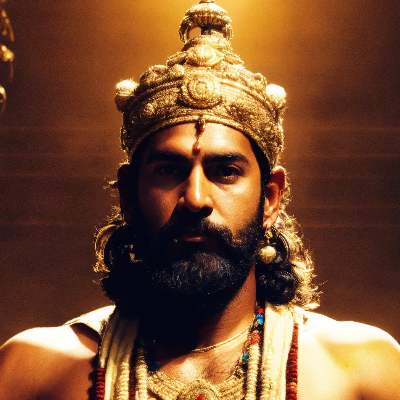
Kuru — Sovereign of the Uttarakuru Varsha
Kuru · son of Agnidhara · lord of Uttarakuruvarsha · Kuru of the Northern Region
Kuru is the seventh of the nine sons born to Agnidhara and the apsara Purvachitti. Agnidhara was a son of Priyavrata and a grandson of Svayambhuva Manu. Purvachitti was a celestial dancer of Brahma's realm who became Agnidhara's wife and bore his nine sons before returning to the heavens. Upon dividing Jambudvipa, Agnidhara assigned to Kuru the northernmost of the nine varshas, known as Uttarakuruvarsha — the northern Kuru land — a region of great sanctity in the Puranic and Vedic geographical imagination. It is important to note that this Kuru, son of Agnidhara, is a distinct figure from the celebrated Kuru who is the ancestor of the Kauravas and Pandavas of the Mahabharata; that Kuru belongs to the Lunar dynasty and is a descendant of Puru, many generations removed from the Svayambhuva-Priyavrata line. The two figures share only their name. The son of Agnidhara is recorded in the Bhagavata Purana and the Vishnu Purana.
✦ The Name
The name Kuru is ancient and appears across multiple layers of Sanskrit literature with different referents. In the context of the son of Agnidhara, Kuru functions as the eponymous sovereign of Uttarakuruvarsha. The Uttarakuru, or northern Kuru, land is mentioned as early as the Atharva Veda and the Aitareya Brahmana as a distant northern land of abundance and immortality. It is treated in those sources as a semi-legendary territory beyond the Himalayan ranges. The Puranic tradition absorbed this earlier Vedic and epic geographic concept into its cosmographic system by making Kuru son of Agnidhara its eponymous ruler.
✦ Lineage
- Father: Agnidhara, king of Jambudvipa and son of Priyavrata.
- Mother: Purvachitti, an apsara of the celestial realms, wife of Agnidhara.
- Brothers: Nabhi, Kimpurusha, Harivarsha, Ilavrita, Ramya, Hiranvat, Bhadrasva, and Ketumala — the co-inheritors of the nine divisions of Jambudvipa.
✦ The Varsha of Kuru
Uttarakuruvarsha is the northernmost of the nine divisions of Jambudvipa and is situated beyond the Shringavat mountains according to the Bhagavata Purana's cosmographic account. The region has an ancient reputation in Sanskrit literature as a paradise-like land where the inhabitants live extraordinarily long lives, where the trees yield all desired fruits and flowers perpetually, and where the conditions of the Krita Yuga — the age of perfection — are said to prevail permanently. This conception of Uttarakuru appears in Vedic literature, in the Mahabharata, in the Ramayana, and in multiple Puranas, making it one of the most consistently described ideal lands in the entire Sanskrit tradition.
✦ Textual Variants and Inconsistencies
The name Kuru is shared between the son of Agnidhara and the celebrated ancestor of the Kaurava and Pandava dynasties of the Mahabharata. The Mahabharata's Kuru is a king of the Lunar dynasty, descended from Puru, Yayati, and ultimately from the god Soma; he is many generations removed from the Priyavrata line and belongs to an entirely separate genealogical stream. The Puranas themselves are careful to place the two Kurus in different cosmographic and genealogical contexts, but the shared name has occasionally led to confusion in secondary literature. The primary sources do not connect the two figures in any way.
✦ Connection to the Wider Genealogy
Kuru son of Agnidhara is a great-grandson of Svayambhuva Manu through the Priyavrata-Agnidhara line. His brother Nabhi fathered Rishabha, from whom the lineage of Bharata descends. No sons or further descendants are attributed to this Kuru in the principal Puranic sources.
✦ References
- Bhagavata Purana, Skanda 5, Chapters 1–2: Names Kuru as a son of Agnidhara and assigns him the Uttarakuru varsha of Jambudvipa.
- Vishnu Purana, Book 2, Chapter 1: Lists Kuru among the nine sons of Agnidhara with the Uttarakuru territorial assignment.
- Atharva Veda and Aitareya Brahmana: Earlier Vedic sources that describe Uttarakuru as a semi-legendary northern paradise, providing the textual background absorbed into the Puranic cosmographic system.
- Vettam Mani, Puranic Encyclopaedia (1975): Modern reference work distinguishing the multiple figures named Kuru in the Sanskrit tradition and summarising the sons of Agnidhara.