
About
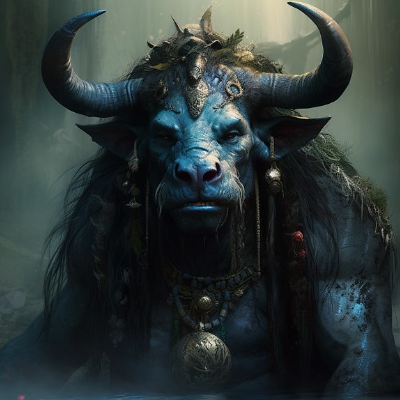
Mahishi — She-Buffalo Consort of Rambha the Danava, Mother of Mahishasura
Mahishi · Leela · Shyamala
Mahishi is the consort of Rambha, a Danava chieftain who was a son of the progenitor sage Kashyapa and his wife Danu, the mother of the Danava race. From her union with Rambha was born Mahishasura, the buffalo-demon whose conquest of the three worlds and subsequent destruction at the hands of the goddess Durga forms the central narrative of the Devi Mahatmya. The name Mahishi appears as a proper name in the Vamana Purana and the Devi Bhagavata Purana. In the Devi Mahatmya of the Markandeya Purana she is referred to simply as a she-buffalo without a formal proper name. Separate regional and later Puranic traditions, particularly those associated with the Sabarimala Ayyappa cult of Kerala, provide an extended backstory for her identity as a cursed celestial being, details absent from the earliest core texts.
✦ The Name
The Sanskrit word Mahishi carries two distinct meanings. In its primary sense it means she-buffalo, denoting the female of the buffalo species. In a secondary royal sense the same word means great queen or chief consort, being used in the Vedic and epic literature to designate the principal wife of a king. In the context of this figure both meanings are operative: she is literally a she-buffalo in the narrative of the Vamana Purana and the Devi Bhagavata Purana, and her name thus functions as a descriptive rather than an honorific. In the Devi Mahatmya she receives no proper name and is identified only by her species.
✦ Lineage
- Consort: Rambha — a Danava chieftain, son of the progenitor sage Kashyapa and Danu; he obtained a boon of a powerful son through intense austerities and subsequently encountered Mahishi near the river Indus while he was himself in the form of a buffalo, as recorded in the Devi Bhagavata Purana.
- Son: Mahishasura — the buffalo-demon, born of her union with Rambha; he inherited his father's boon of near-invincibility, conquered the three worlds, expelled the gods from heaven, and was ultimately slain by the goddess Durga in her form as Chandika, an event commemorated in the festival of Navaratri.
✦ The Union with Rambha
The Devi Bhagavata Purana describes the encounter between Rambha and Mahishi as taking place near the river Indus. Rambha, having assumed the form of a buffalo, was overcome with desire upon seeing her and united with her. The text characterises her as a passionate she-buffalo. From this union Mahishasura was born, possessing the dual ability to assume either a human or a buffalo form at will, a capacity that reflected both his Danava patrimony and the nature of his mother. The Vamana Purana in Chapter 17 names her explicitly as Mahishi in the context of this same narrative.
✦ The Tradition of Leela and the Sabarimala Account
A distinct and substantially different account of Mahishi's identity appears in the literature associated with the Sabarimala Ayyappa tradition of Kerala. The primary text for this tradition, the Sree Bhoothanaathopakhyaanam, identifies Mahishi as the reincarnation of a woman named Leela, who was the wife of the sage Dattatreya. Dattatreya is a figure venerated in the Puranic tradition as an avatar embodying the combined essence of Brahma, Vishnu, and Shiva. According to this account, Leela challenged her husband's spiritual authority and was cursed by him to be reborn as a she-buffalo devoid of higher consciousness. In this reincarnate form she became Mahishi, the consort of Rambha and mother of Mahishasura. This backstory is not present in the Vamana Purana, the Devi Bhagavata Purana, or the Markandeya Purana, and belongs to a later regional stratum of the tradition.
✦ Textual Variants and Inconsistencies
The earliest stratum of texts — the Markandeya Purana's Devi Mahatmya — presents no named or genealogically elaborated consort for Rambha; Mahishasura simply appears as a powerful demon with no maternal lineage stated. The Vamana Purana and the Devi Bhagavata Purana introduce the name Mahishi and provide the narrative of the union near the Indus. The Sabarimala tradition's Sree Bhoothanaathopakhyaanam then adds the identification of Mahishi as the reincarnation of Leela, wife of Dattatreya, representing a substantially later and regionally specific layer of elaboration. A further regional variant, present in some South Indian folklore, names the figure as Shyamala, a princess cursed by a sage to take buffalo form after accidentally disturbing his meditation. This Shyamala tradition is not corroborated in the major Mahapuranas and represents a local narrative strand. The three accounts — the unnamed she-buffalo of the Devi Mahatmya, the named Mahishi of the Vamana Purana and Devi Bhagavata, and the cursed Leela or Shyamala of later regional literature — should be understood as distinct textual layers rather than a single harmonised account.
✦ Connection to the Wider Genealogy
Through her son Mahishasura, Mahishi is genealogically connected to the Danava lineage descending from the progenitor Kashyapa and his wife Danu. Mahishasura's career as the conqueror of heaven and his subsequent destruction by the goddess Durga is the event that gives rise to one of the most widely observed festivals in Hinduism. In the Sabarimala tradition, Mahishasura's sister — also referred to as Mahishi, creating a nominal overlap with his mother — is a separate demoness who sought revenge for his death and was ultimately slain by Ayyappa, the divine son of Shiva and Mohini. The mother Mahishi and this vengeful sister Mahishi are distinct figures who share a name, and the two should not be conflated, though some interpretive traditions have treated them as part of a single cursed lineage connected through Rambha.
✦ References
- Primary Sources:
- Vamana Purana, Chapter 17: The earliest Mahapuranic source to name Rambha's consort explicitly as Mahishi and to situate her within the origin narrative of Mahishasura.
- Devi Bhagavata Purana, Book 5, Chapter 2: Describes the encounter between Rambha and Mahishi near the river Indus, characterises her as a passionate she-buffalo, and provides the extended origin narrative of Mahishasura's birth.
- Markandeya Purana, Chapters 81–93 (Devi Mahatmya): The foundational text for the Mahishasura narrative; refers to his mother only as a she-buffalo without assigning her a proper name or genealogy.
- Sree Bhoothanaathopakhyaanam: The primary textual source for the Sabarimala Ayyappa tradition; identifies Mahishi as the reincarnation of Leela, wife of the sage Dattatreya, and provides the cursed-celestial-being backstory absent from the Mahapuranas.
- Secondary Sources:
- Mani, Vettam. Puranic Encyclopaedia. Motilal Banarsidass, 1975: Provides consolidated entries on Mahishi and Mahishasura drawing on multiple Puranic sources, noting the distinctions between the named and unnamed treatments across texts.