
About
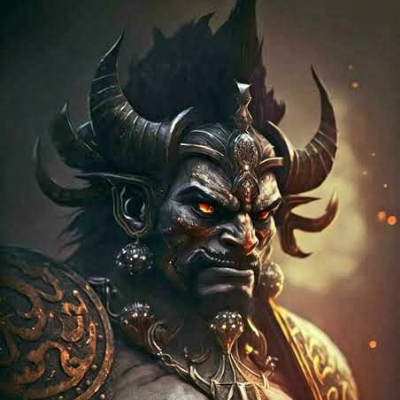
Mahishasura — Danava King, Conqueror of Heaven, Slain by Durga
Mahishasura · Mahisha · Mahishamardana's Adversary · Son of Rambha · Lord of the Buffalo
Mahishasura is a Danava king whose conquest of the three worlds and subsequent destruction at the hands of the goddess Durga constitutes one of the most celebrated narratives in the Hindu goddess tradition. He is the son of Rambha, a Danava chieftain who was himself a son of the progenitor sage Kashyapa and his wife Danu, the mother of the Danava race, and of Mahishi, a she-buffalo whom Rambha encountered and united with after obtaining a boon guaranteeing him a supremely powerful son. Mahishasura inherited a dual nature from his parentage, being capable of assuming either a human form or a buffalo form at will. His destruction by the goddess Durga, who was manifested through the combined divine energies of the principal gods, is commemorated across the Hindu tradition in the festival of Navaratri and Vijayadashami. The foundational account of his career and death is given in the Devi Mahatmya, which forms part of the Markandeya Purana, supplemented by the Devi Bhagavata Purana and the Vamana Purana for his origin narrative. He is also the father of Gajasura, a demon who performed austerities to avenge his death, as recorded in the Skanda Purana.
✦ The Name
The name Mahishasura is a compound of two Sanskrit elements. Mahisha means buffalo or he-buffalo, and asura in the Puranic usage denotes a powerful non-divine being or demon standing in opposition to the gods. The compound thus means the buffalo-demon or the demon who is a buffalo. The name Mahisha is also used independently as a shorter form. The goddess who slays him is consequently called Mahishasuramardini, meaning she who crushes or destroys Mahishasura, one of the most widely used epithets of Durga across both Sanskrit and vernacular devotional literature.
✦ Lineage
- Paternal grandfather: Kashyapa — the great progenitor sage, son of Marichi and grandson of Brahma, who fathered the Danava race through his wife Danu and the Deva race through his wife Aditi, making the two races half-siblings in cosmological genealogy.
- Paternal grandmother: Danu — a daughter of the progenitor Daksha and wife of Kashyapa; the mother of the entire Danava class of beings, who take their collective name from her.
- Father: Rambha — a Danava chieftain, son of Kashyapa and Danu, who performed intense austerities alongside his brother Karambha in order to obtain divine boons; after Karambha was killed by Indra during those austerities, Rambha continued alone and secured a boon guaranteeing him a supremely powerful son; he subsequently united with Mahishi near the river Indus while in buffalo form and was thereafter killed by a jealous rival bull; his death prompted Mahishi to enter his funeral pyre.
- Mother: Mahishi — a she-buffalo whom Rambha encountered and united with; she committed herself to Rambha's funeral pyre upon his death, and from that fire Mahishasura was born, inheriting both his father's Danava lineage and his mother's buffalo nature.
- Paternal uncle: Karambha — a Danava, full brother of Rambha and likewise a son of Kashyapa and Danu; he was killed by Indra, who took the form of a crocodile to slay him while he performed penance standing immersed in water.
- Son: Gajasura — a demon who, following his father's death at the hands of Durga, undertook severe austerities with the purpose of avenging Mahishasura; his story is recorded in the Skanda Purana in the Arunachala Mahatmya section.
✦ Birth and Early Nature
The Devi Bhagavata Purana records that Mahishasura was not born through ordinary gestation but emerged from the funeral fire in which his mother Mahishi immolated herself upon the death of his father Rambha. This miraculous birth accounts for the dual nature that characterises him throughout the tradition: he could assume the full form of a buffalo, the full form of a human being, or intermediate forms combining both, at will. This shape-shifting ability, rooted in his dual parentage of a Danava father and a she-buffalo mother, becomes his most distinctive combat characteristic in the final battle with the goddess. The Devi Mahatmya, which does not recount the origin narrative but begins with Mahishasura already established as a ruler, presents him as possessed of extraordinary martial power from the outset of his career.
✦ The Conquest of Heaven
The Devi Mahatmya opens with Mahishasura already in possession of his full power. Having assembled and led the Danava forces, he waged a great war against the Devas that lasted for a hundred divine years. The gods were led by Indra, the king of heaven, who commanded their armies in battle. Despite prolonged resistance, the Devas were defeated. Mahishasura assumed the sovereignty of heaven, taking for himself the offices and privileges of Indra and the other gods. The sun, moon, wind, fire, and the guardians of the directions were all placed under his authority. The dispossessed gods wandered the earth without their celestial domains, bereft of their powers and honours.
✦ The Creation of Durga and the Assembly of the Divine Armies
The exiled Devas, led by Brahma, approached Vishnu and Shiva and described their defeat and humiliation at Mahishasura's hands. Upon hearing this account, intense divine anger arose simultaneously in Vishnu, Shiva, and Brahma. From the bodies of each of the principal gods a blazing stream of energy — referred to in the text as tejas — poured forth. These streams of divine radiance converged and combined into a single mass of light, from which the form of the goddess took shape. Each god contributed to both her form and her weaponry: Shiva provided his trident, Vishnu his discus, Indra his thunderbolt, Varuna his conch, Agni his dart, Vayu his bow, Yama his staff, and so on across the full assembly of gods. The goddess thus formed was Durga, also called Chandika in this context, and she was armed with the weapons and invested with the energies of the entire divine order. She was the collective power of the gods made manifest in a single sovereign form, and her purpose was the destruction of Mahishasura.
✦ The War and the Final Duel
The goddess issued a great roar upon her creation, which filled the three worlds and shook the heavens. Mahishasura, hearing this sound, sent successive commanders of his armies against her — Chikshura, Chamara, Karala, Udagra, and others — each of whom was destroyed by the goddess and her attendant warrior-shaktis. When his commanders had all been slain, Mahishasura himself entered the battle. The Devi Mahatmya describes the final encounter as a prolonged duel in which Mahishasura's most notable weapon was his ability to change form continuously in an attempt to evade and overcome the goddess. He attacked first in his buffalo form, churning the earth and lashing the ocean with his tail. The goddess countered each assault and pressed him severely. He then abandoned the buffalo form and took the shape of a lion, then assumed a human form armed with sword and shield, then took the form of a great elephant, and finally returned to the buffalo form in a last effort to overwhelm her. At this critical moment the goddess pinned him beneath her foot, drove her spear into him, and as he struggled to emerge from the buffalo body in his human form she severed his head with her sword. With his death the three worlds were restored to the gods and the natural order was re-established.
✦ Theological and Philosophical Significance
Within the interpretive framework of the Devi Mahatmya and the wider Shakta tradition, Mahishasura functions as more than a narrative antagonist. The buffalo is associated in Indian symbolic thought with Yama, the god of death, and with tamas, the quality of inertia, darkness, and ignorance in the Samkhya philosophical scheme. Mahishasura's dominion over heaven is therefore read by commentators as the ascendancy of tamas over the luminous divine qualities of the Devas. The goddess's destruction of him represents the power of divine consciousness and cosmic energy overcoming inertia and the forces that obstruct the natural order. The account is simultaneously a cosmological narrative about the restoration of dharmic order and a theological statement about the supreme sovereignty of the goddess as the underlying power of the universe. The fact that the gods themselves were unable to defeat Mahishasura and that only the concentrated collective energy of all divinity, manifested as the goddess, could accomplish his destruction is understood within the Shakta tradition as evidence of the ultimate primacy of Shakti.
✦ Connection to the Wider Genealogy
Mahishasura stands at a significant genealogical juncture in the Danava lineage. Through his father Rambha he descends from Kashyapa and Danu, placing him within the broader Danava class that includes many of the principal adversaries of the gods across the Puranas. His son Gajasura, recorded in the Skanda Purana's Arunachala Mahatmya, extends the lineage into the post-Mahishasura generation, carrying forward the theme of demonic persistence against the divine order. In the Sabarimala tradition of Kerala, a separate figure also named Mahishi — understood in that tradition as Mahishasura's sister rather than his mother — sought revenge for his death and was slain by Ayyappa, the divine son of Shiva and Mohini, creating a continuation of the narrative arc initiated by Mahishasura's career. The nominal overlap between Mahishasura's mother Mahishi and this vengeful sister Mahishi is a textual ambiguity specific to the Sabarimala tradition and is not found in the Mahapuranic sources.
✦ References
- Primary Sources:
- Markandeya Purana, Chapters 81–93 (Devi Mahatmya): The foundational and most authoritative source for the narrative of Mahishasura's conquest of heaven, the creation of Durga through the combined tejas of the gods, the war, and the final duel including the shape-shifting sequence; begins with Mahishasura already as king and does not recount his origin.
- Devi Bhagavata Purana, Book 5, Chapters 2–3: Provides the extended origin narrative covering Rambha's austerities, his union with Mahishi near the Indus, his death at the hands of a rival bull, Mahishi's self-immolation, and Mahishasura's miraculous birth from the funeral fire; the principal source for his genealogy and dual nature.
- Vamana Purana, Chapter 17: Corroborates the origin narrative and names Mahishi explicitly as Rambha's consort; consistent with the Devi Bhagavata account of Mahishasura's birth.
- Skanda Purana, Arunachala Mahatmya: The primary source identifying Gajasura as the son of Mahishasura and recording that Gajasura undertook austerities to avenge his father's death.
- Secondary Sources:
- Coburn, Thomas B. Devi-Mahatmya: The Crystallization of the Goddess Tradition. Motilal Banarsidass, 1984: The most thorough scholarly analysis of the Devi Mahatmya's textual history, structure, and theological significance, providing essential context for understanding Mahishasura's role within the goddess tradition.
- Mani, Vettam. Puranic Encyclopaedia. Motilal Banarsidass, 1975: Provides a consolidated Puranic summary of Mahishasura's narrative drawing on multiple sources and noting key genealogical connections.