
About
Gajasura — Danava Prince, Son of Mahishasura, Slain at Arunachala
Gajasura · Gajasura Danava · Son of Mahishasura · The Elephant Demon of Arunachala
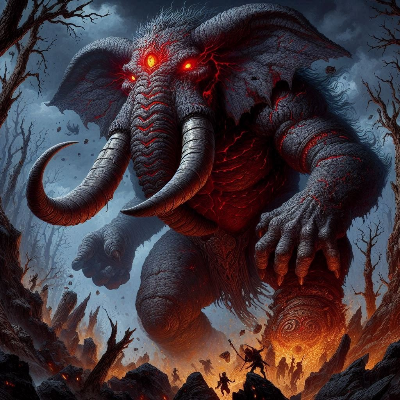
Gajasura is a Danava prince, the son of Mahishasura, the buffalo-demon whose conquest of heaven and destruction at the hands of the goddess Durga is the central narrative of the Devi Mahatmya. Following his father's death, Gajasura undertook severe austerities, obtained boons of near-invincibility, and turned his power against the gods and against the sacred site of Arunachala, the holy mountain in the Tamil country known in the later tradition as Thiruvannamalai. He was ultimately slain by the goddess Durga in her form as the protector of Arunachala, who pierced him with her trident. His death is distinguished from that of his father by his final act of repentance, in which he made requests regarding the disposition of his remains and the commemoration of his death. The primary source for his narrative is the Skanda Purana, specifically the Arunachala Mahatmya, Chapters 7 through 9. This Gajasura is a distinct figure from the elephant-demon of the same name who was slain by Shiva and who is the son of the Asura Andhaka; those two figures share a name and a general category but belong to entirely separate narrative lineages.
✦ The Name
The name Gajasura is a Sanskrit compound of gaja, meaning elephant, and asura, the Puranic term for a powerful non-divine being or demon standing in opposition to the gods. The compound therefore means the elephant-demon. The name reflects his form in battle, as he is associated with the elephant in his martial manifestation, paralleling the way his father Mahishasura was identified with the buffalo. The epithet Gajasura Danava, used to distinguish him within the genealogical tradition, marks his membership in the Danava class of beings descended from the progenitor sage Kashyapa and his wife Danu.
✦ Lineage
- Paternal great-grandfather: Kashyapa — the great progenitor sage, son of Marichi and grandson of Brahma, who fathered the Danava race through his wife Danu; the ultimate patrilineal ancestor of Gajasura's entire line.
- Paternal great-grandmother: Danu — a daughter of the progenitor Daksha and wife of Kashyapa; the mother of the Danava race, from whom the class takes its name.
- Paternal grandfather: Rambha — a Danava chieftain, son of Kashyapa and Danu, who performed intense austerities to obtain a boon of a supremely powerful son; he united with a she-buffalo named Mahishi near the river Indus while in buffalo form and was subsequently killed by a jealous rival bull.
- Paternal grandmother: Mahishi — the she-buffalo consort of Rambha, who immolated herself on his funeral pyre; Mahishasura was born from that fire, making her Gajasura's paternal grandmother through the miraculous birth narrative recorded in the Devi Bhagavata Purana.
- Father: Mahishasura — the buffalo-demon and king of the Danavas, who conquered the three worlds and expelled the gods from heaven; he was slain by the goddess Durga, manifested through the combined divine energies of Brahma, Vishnu, Shiva, and the assembled gods, as recorded in the Devi Mahatmya of the Markandeya Purana; his death was the direct cause of Gajasura's campaign of vengeance.
- Children: None recorded in any primary source.
✦ The Austerities and the Boon
Following the death of his father Mahishasura at the hands of the goddess Durga, Gajasura was consumed by grief and the desire for revenge. In the manner characteristic of powerful Asura and Danava figures in the Puranic tradition, he turned to severe tapas as the means of acquiring the strength necessary to challenge the gods. The Skanda Purana's Arunachala Mahatmya records that he undertook prolonged and intense austerities through which he propitiated a deity and obtained boons that rendered him effectively invincible against conventional divine opposition. Armed with these boons and emboldened by the power they conferred, he assembled his forces and launched a campaign of terror against the Devas, replicating and extending the pattern of his father's earlier conquest of heaven.
✦ The Assault on Arunachala
The distinctive feature of Gajasura's campaign, as presented in the Arunachala Mahatmya, is that his aggression was directed specifically at the sacred mountain of Arunachala, the holy site venerated in the South Indian tradition as a manifestation of Shiva in the form of a column of fire and light. By targeting Arunachala, Gajasura's assault was not merely a political or military act against the gods but an attack upon a site of supreme sanctity. The Skanda Purana frames the goddess's intervention in this episode not as the mobilisation of divine armies in open war, as in the earlier Mahishasura narrative, but as a protective act undertaken specifically to defend the sacred mountain and its holiness from desecration and destruction at the demon's hands. This framing gives Gajasura's episode a markedly kshetra-mahatmya character — a narrative oriented around the glory and protection of a sacred place — rather than a purely cosmological conflict.
✦ The Battle and Death
The goddess Durga, identified in this context as Arunachala-Durga or Mahishasuramardini in her role as the protector of the Arunachala kshetra, confronted Gajasura in battle. The Skanda Purana describes the encounter as culminating in the goddess piercing Gajasura with her trident, the trishula, which is the weapon most closely associated with her divine sovereignty in the Shakta tradition as well as with Shiva. The manner of his death by the trident distinguishes this episode from his father Mahishasura's death, in which the goddess severed his head with her sword after pinning him beneath her foot. Gajasura fell mortally wounded by the thrust of the trident.
✦ The Repentance and Final Requests
The most theologically distinctive element of Gajasura's narrative, and the feature that sets him apart most sharply from his father, is his response to his own death. As he lay dying, Gajasura underwent a transformation of consciousness and repented of his actions. In this state of repentance he addressed the goddess and made two requests. The first was that his skin be put to sacred use — in some versions of the account this means offered to the goddess herself, and in other versions it means offered to Shiva, connecting the episode obliquely to the more widely known Gajasura-Samhara narrative in which Shiva dons the skin of the elephant demon he has slain. The second request was that the day of his death be commemorated as a festival. The Skanda Purana presents these dying requests as evidence of the demon's ultimate recognition of the goddess's sovereignty and his final submission to the divine order, a motif that recurs across Puranic accounts of demons who are granted a form of redemption or honour at the moment of their destruction.
✦ Textual Variants and Inconsistencies
The Skanda Purana's Arunachala Mahatmya is the only major Puranic source that explicitly identifies this Gajasura as the son of Mahishasura and frames his narrative as a continuation of the Mahishasura cycle. The Varaha Purana contains a brief mention of a Gajasura associated with the Mahishasura clan but does not develop the vengeance narrative or the Arunachala setting in any comparable detail. Regional Sthala Puranas from the Tamil country, including traditions connected to Thiruvarur and Chidambaram, sometimes link a Gajasura figure to the Mahishasura lineage, but these accounts show a tendency to blend this Gajasura with the more widely known elephant demon of the same name who was slain by Shiva and whose parentage is given elsewhere as the Asura Andhaka. This conflation is a recognised feature of the regional textual tradition and should not be taken as evidence that the two figures are the same. The Devi Mahatmya itself, the foundational source for the Mahishasura narrative, makes no mention of Gajasura and closes the story of Mahishasura's line with his death alone.
✦ Theological Significance
Within the structure of the Arunachala Mahatmya, Gajasura serves as a narrative closure figure for the Mahishasura cycle. His story brings the arc initiated by his grandfather Rambha's austerities to a conclusion at the sacred site of Arunachala, creating a geographical and spiritual endpoint for the entire lineage. The fact that his death is accompanied by repentance and a request for commemoration introduces a redemptive dimension absent from the deaths of both Rambha and Mahishasura. This redemptive motif is consistent with the Puranic theological principle that even demonic beings who are slain by the supreme deity or the supreme goddess attain liberation or honour through that very act of destruction. Gajasura's insistence that his death day be celebrated transforms his end from a simple defeat into an occasion of sacred significance, and his request regarding his skin participates in the wider Shaiva-Shakta tradition of the goddess and Shiva together subduing and incorporating the power of the demons they destroy.
✦ Connection to the Wider Genealogy
Gajasura stands at the terminal point of a four-generation Danava lineage running from Kashyapa and Danu through Rambha and Mahishi to Mahishasura and finally to himself. No children are recorded for him in any primary source, and the Skanda Purana presents his narrative explicitly as the closing chapter of the Mahishasura cycle rather than as the opening of a new generational story. His death at Arunachala under the protection of the goddess completes the movement of the lineage from its origin in Kashyapa's cosmological progeny through successive cycles of demonic ambition, divine opposition, and destruction, ending at one of the most sacred sites in the South Indian Shaiva tradition.
✦ References
- Primary Sources:
- Skanda Purana, Arunachala Mahatmya, Chapters 7–9: The definitive primary source for this figure; provides the narrative of Gajasura's austerities, his assault on Arunachala, his battle with the goddess, his death by her trident, his repentance, and his dying requests; explicitly identifies him as the son of Mahishasura.
- Varaha Purana: Contains a brief reference to a Gajasura associated with the Mahishasura clan; does not elaborate the vengeance narrative or the Arunachala setting.
- Markandeya Purana, Chapters 81–93 (Devi Mahatmya): The foundational source for the Mahishasura narrative that forms the necessary backdrop to Gajasura's story; does not mention Gajasura directly but establishes the death of Mahishasura that motivates his son's campaign.
- Devi Bhagavata Purana, Book 5, Chapters 2–3: Provides the genealogical origin narrative for the lineage, covering Rambha, Mahishi, and the birth of Mahishasura, establishing the full patrilineal context within which Gajasura belongs.
- Secondary Sources:
- Mani, Vettam. Puranic Encyclopaedia. Motilal Banarsidass, 1975: Provides entries distinguishing the multiple figures named Gajasura across the Puranic tradition, noting the separate identities of the son of Mahishasura and the elephant demon slain by Shiva.