
About
Dhenukasura — Danava Demon in Donkey Form, Slain by Balarama in the Talavana Forest
Dhenukasura · Dhenuka · Gardabhasura · Sahasika
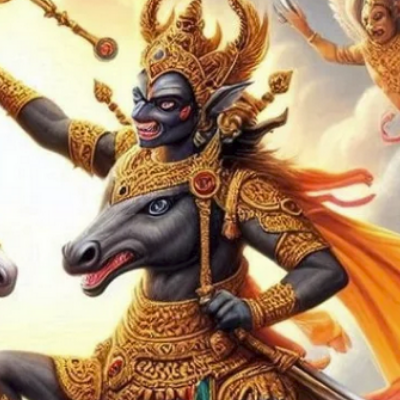
Dhenukasura is a demon who assumed the form of a donkey and resided in the Talavana, a palm forest in the vicinity of Vrindavan. He is known principally for his destruction at the hands of Balarama, the elder brother of Krishna, during the period of their youth among the cowherds of Vrindavan. The episode is recorded in the Bhagavata Purana and the Vishnu Purana as one of the early heroic deeds of Balarama and Krishna. In terms of his genealogical identity, the Vishnu Purana places him within the Danava lineage as a son of the progenitor sage Kashyapa and his wife Danu. The Garga Samhita provides an extended backstory identifying Dhenukasura as the reincarnation of a figure named Sahasika, a son of Bali Maharaja who was cursed to take donkey form by the sage Durvasa. His episode carries theological significance in the Vaishnava tradition as a symbol of the removal of ignorance and spiritual obstruction.
✦ The Name
The name Dhenukasura is a compound of dhenuka, a Sanskrit word meaning donkey or ass, and asura, the Puranic term for a powerful non-divine being. The compound therefore means the donkey-demon, directly reflecting the form he inhabited in his encounter with Balarama and Krishna. The alternate designation Gardabhasura, occasionally applied to him, uses a different Sanskrit word for donkey — gardabha — combined with the same asura suffix, and carries the same meaning. The name Sahasika, given in the Garga Samhita as his identity in a previous life, is a separate proper noun belonging to his pre-curse existence as a son of Bali Maharaja and does not carry the demonic connotation of his later name.
✦ Lineage
- Father: Kashyapa — the great progenitor sage, son of Marichi and grandson of Brahma, who fathered the Danava race through his wife Danu and the Deva race through his wife Aditi; identified in the Vishnu Purana as the father of Dhenukasura within the Danava lineage.
- Mother: Danu — a daughter of the progenitor Daksha and wife of Kashyapa; the mother of the entire Danava race, which takes its collective name from her.
- Siblings: The Vishnu Purana lists Dhenukasura among a large number of Danava brothers. Among the named siblings in this listing are Shumbha and Nishumbha, two powerful Danava brothers who later waged war upon the gods and were destroyed by the goddess Durga in her form as Ambika, as recorded in the Devi Mahatmya; and Rambha, the Danava chieftain who fathered Mahishasura, the buffalo-demon, through his union with the she-buffalo Mahishi.
✦ The Previous Life — Sahasika and the Curse of Durvasa
The Garga Samhita provides an account of Dhenukasura's existence prior to his demonic incarnation. In this account he was formerly a being named Sahasika, identified as a son of Bali Maharaja, the celebrated Danava king who is a significant figure across multiple Puranic narratives. While sporting with a large group of women on Mount Gandhamadana, Sahasika caused loud music to be played, and the noise disturbed the deep meditation of the sage Durvasa, a rishi renowned in the Puranic tradition for the severity of the curses he pronounced upon those who offended him. Enraged at the interruption, Durvasa cursed Sahasika to be reborn as a donkey. When Sahasika repented and sought mitigation of the curse, Durvasa modified it with a promise of liberation: after four hundred thousand years in donkey form, Sahasika would be killed by Balarama and thereby attain release from the curse. This backstory is specific to the Garga Samhita and is not found in the Bhagavata Purana or the Vishnu Purana, which present Dhenukasura without any account of a prior identity.
✦ The Episode in the Talavana Forest
The Bhagavata Purana in its tenth book and the Vishnu Purana both recount the episode of Dhenukasura's destruction in the Talavana, a forest of palm trees near Vrindavan filled with ripe and fragrant fruit. Dhenukasura had taken up residence in this forest and guarded it aggressively, preventing all beings — human, animal, and divine — from entering to enjoy its fruits. The cowherd companions of Krishna and Balarama, aware of the sweet palm fruits but unable to enter the forest because of the demon, appealed to the two brothers to clear the way for them. Krishna and Balarama entered the Talavana together. Balarama approached the palm trees and shook them with great force, causing the ripe fruits to fall to the ground in large numbers. The sound of the falling fruits and the shaking of the trees roused Dhenukasura, who charged at Balarama in his donkey form, attacking him by striking his chest with both hind legs. Balarama seized the demon by his hind legs, swung him in great circles with increasing force, and hurled his body into the upper branches of a palm tree, killing him. The demon's companions, also in donkey form, then attacked in a group; Krishna and Balarama together dispatched them all in the same manner, hurling their bodies into the treetops until the forest was cleared. After the demon and his companions were destroyed, the cowherd boys entered the forest freely and enjoyed its fruits.
✦ Textual Variants and Inconsistencies
The two principal sources for the Talavana episode — the Bhagavata Purana and the Vishnu Purana — are broadly consistent in their account of the battle and Dhenukasura's death, with no significant contradictions between them on the core narrative. The most substantial textual divergence concerns Dhenukasura's identity and origin. The Bhagavata Purana and Vishnu Purana present him as a Danava in donkey form without any backstory. The Garga Samhita introduces the entirely separate tradition of his previous identity as Sahasika, son of Bali Maharaja, and the curse of Durvasa, adding a karmic and devotional dimension to the episode that is absent from the earlier texts. These two layers — the Danava genealogy of the Vishnu Purana and the cursed-prince backstory of the Garga Samhita — represent distinct textual traditions that should not be uncritically harmonised, as they present different accounts of who Dhenukasura fundamentally was before his encounter with Balarama.
✦ Theological Significance
In the Vaishnava interpretive tradition, Dhenukasura's episode carries allegorical weight. Bhaktivinoda Thakura, the nineteenth-century Vaishnava theologian and author of Chaitanya Shiksamrita, interpreted Dhenukasura as representing ignorance and superstition — specifically the gross anarthas, or spiritual impediments, that obstruct a devotee's progress on the path of bhakti. The palm forest he guarded, rich with sweet fruit but rendered inaccessible by his presence, is understood as the spiritual knowledge and bliss that remain unavailable to the conditioned soul so long as ignorance holds sway. Balarama's destruction of the demon and the liberation of the forest for the enjoyment of the cowherds is read as the removal of these impediments through the power of divine grace, restoring access to spiritual nourishment. This allegorical reading is a feature of the Vaishnava commentarial tradition and is not present in the primary narrative texts themselves, which present the episode as a straightforward heroic deed of Balarama and Krishna during their youth.
✦ Connection to the Wider Genealogy
Through his parentage as a son of Kashyapa and Danu, Dhenukasura belongs to the same Danava lineage that produced Rambha, the father of Mahishasura, and Shumbha and Nishumbha, the two Danava brothers destroyed by the goddess Durga. The Vishnu Purana's listing of Dhenukasura alongside these figures places him within the broader Danava family as a collateral member rather than as part of the direct line running through Rambha and Mahishasura. No children are recorded for Dhenukasura in any primary source, and his narrative ends entirely with his destruction in the Talavana forest.
✦ References
- Primary Sources:
- Bhagavata Purana, Book 10, Chapter 15: The principal narrative source for the Talavana episode; recounts Dhenukasura's residence in the palm forest, his attack on Balarama, his destruction, and the dispatch of his companions by Balarama and Krishna.
- Vishnu Purana: Corroborates the Talavana episode and places Dhenukasura within the Danava genealogy as a son of Kashyapa and Danu, listing him alongside Shumbha, Nishumbha, Rambha, and other Danava figures.
- Garga Samhita: The source for the backstory of Dhenukasura's previous identity as Sahasika, son of Bali Maharaja; records the episode on Mount Gandhamadana, the disturbance of Durvasa's meditation, the curse, and the sage's promise of liberation through death at Balarama's hands after four hundred thousand years.
- Secondary Sources:
- Mani, Vettam. Puranic Encyclopaedia. Motilal Banarsidass, 1975: Provides a consolidated summary of Dhenukasura's narrative drawing on the Bhagavata Purana and Vishnu Purana accounts.
- Bhaktivinoda Thakura. Chaitanya Shiksamrita: The source for the Vaishnava allegorical interpretation of Dhenukasura as a symbol of ignorance and spiritual impediment obstructing the devotee's path.