
About
Pralambhasura — Danava General, Agent of Kamsa, Slain by Balarama in the Bhandiravana Forest
Pralambhasura · Pralamba · Vijaya · Danava General of Kamsa
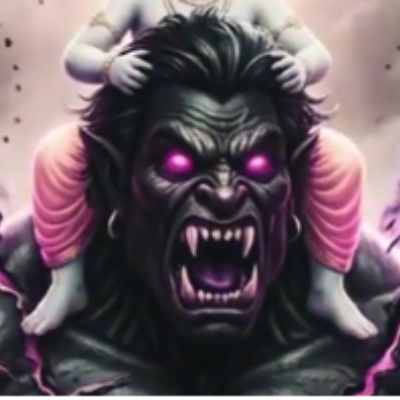
Pralambhasura is a high-ranking Danava who served as a general and agent of Kamsa, the tyrannical Bhoja-Yadava king of Mathura who was the maternal uncle and principal adversary of Krishna during the latter's youth. Belonging to the broader Danava lineage descended from the progenitor sage Kashyapa and his wife Danu, Pralambhasura was dispatched by Kamsa to harm or kill Balarama and Krishna during their time among the cowherds of Vrindavan. He infiltrated the company of the cowherd boys by assuming a disguise, participated in their games in the Bhandiravana forest, and attempted to carry Balarama away to his death. He was destroyed when Balarama struck him a single blow to the crown of his head. The primary narrative sources are the Bhagavata Purana in its tenth canto and the Vishnu Purana, while the Garga Samhita and the Harivamsha provide his Danava classification and his backstory as a cursed Gandharva named Vijaya. His destruction is theologically significant in the Vaishnava tradition as a demonstration of Balarama's identity as Ananta Shesha, the infinite cosmic serpent, whose weight is without limit.
✦ The Name
The name Pralambhasura is a compound of pralamba, a Sanskrit word meaning one who hangs down, extends, or reaches far, and asura, the Puranic designation for a powerful non-divine being. The compound may carry the connotation of a large or extending demon, though the primary texts do not offer a specific etymological gloss on his name. The name Pralamba is used as its shorter form. In the Garga Samhita his previous identity is given as Vijaya, meaning victory, a name belonging to his existence as a Gandharva, the celestial musician class of beings, before his curse transformed him into a demonic incarnation.
✦ Lineage
- Paternal lineage: Kashyapa — the great progenitor sage, son of Marichi and grandson of Brahma, who fathered the Danava race through his wife Danu; the Garga Samhita and the Harivamsha both classify Pralambhasura as a Danava, placing him within the lineage of Kashyapa's one hundred sons through Danu.
- Lineage class: Danu — a daughter of the progenitor Daksha and wife of Kashyapa; the mother of the Danava race; Pralambhasura's specific mother is not individually named in any primary source, though his Danava classification ties him to this lineage.
- Previous identity: Vijaya — a Gandharva, son of Sudesha, who in a former existence was Pralambhasura's identity before the curse that reduced him to demonic birth; recorded in the Garga Samhita.
- Affiliation: Kamsa — the Bhoja-Yadava king of Mathura, maternal uncle and principal adversary of Krishna; Pralambhasura served as a high-ranking general and agent in Kamsa's inner circle and was dispatched by him to destroy Balarama and Krishna.
- Children: None recorded in any primary source.
✦ The Previous Life — Vijaya the Gandharva and the Curse
The Garga Samhita provides an account of Pralambhasura's existence prior to his demonic birth. He was formerly Vijaya, a Gandharva and son of Sudesha, belonging to the class of celestial musicians and semi-divine beings who inhabit the middle regions of the cosmos in the Puranic scheme. Through arrogance he provoked the wrath of a sage — identified in some versions of the account as the sage Parvata and in others as Durvasa, the rishi renowned for the severity of his curses — and was cursed to be reborn as a demon. The curse carried within it a condition of redemption: Vijaya would attain liberation only when he was struck by the hand of Balarama. This structure of a cursed celestial being destined for liberation through destruction at the hands of a divine figure is consistent with the backstory given for Dhenukasura in the same text, where the figure of Sahasika is likewise promised release through Balarama's killing blow, and reflects a recurring theological pattern in the Garga Samhita's treatment of the demons destroyed during Krishna and Balarama's youth.
✦ The Infiltration and the Games of Bhandiravana
The Bhagavata Purana in its tenth canto, Chapter 18, provides the most vivid account of Pralambhasura's final episode. Dispatched by Kamsa to eliminate Balarama and Krishna, Pralambhasura employed a strategy of deception rather than direct assault. He assumed a disguise that allowed him to pass as one of the cowherd boys and joined the company of Krishna, Balarama, and their companions without revealing his true identity. The group made their way to the Bhandiravana forest, a woodland associated with the boyhood pastimes of Krishna and Balarama in the Vrindavan region. There the boys engaged in a game whose rules required the losers of each round to carry the winners on their backs. The game divided the boys into two teams, one led by Krishna and one by Balarama. Pralambhasura, concealed among the players, was assigned to Balarama's team and manoeuvred himself into a position where he would be required to carry Balarama on his shoulders as a consequence of the game's outcome. The Vishnu Purana in its fifth book corroborates this account in a more concise form, confirming the essential structure of the deception and the game.
✦ The Death of Pralambhasura
Having positioned himself to carry Balarama, Pralambhasura revealed his true demonic form and size as he bore Balarama on his shoulders, intending to carry him away from the forest and destroy him. He moved with great speed, abandoning the pretence of being a cowherd boy and rushing away with his burden. The Bhagavata Purana records that as Pralambhasura ran, Balarama became aware of the demon's true nature. The text conveys that the demon found Balarama's weight to be immeasurably and impossibly great — a detail understood in the Vaishnava tradition as a direct expression of Balarama's identity as Ananta Shesha, the infinite cosmic serpent upon whom the universe rests and whose weight is by definition without limit or measure. Crushed and overwhelmed by this unbearable weight, and unable to proceed further, Pralambhasura was brought to a halt. Balarama then struck him a single blow with his fist to the crown of his head. The force of this blow was sufficient to kill the demon outright. Pralambhasura fell dead, his body shattered by the impact. The Bhagavata Purana describes the cowherd boys witnessing his destruction and offering their praise to Balarama. The manner of his death — a single unarmed blow to the head from Balarama — distinguishes this episode from the kills associated with Krishna, which typically involve weapons, choking, or other means, and marks it as characteristic of Balarama's particular form of divine physical power.
✦ Textual Variants and Inconsistencies
The Bhagavata Purana and the Vishnu Purana are in broad agreement on the essential structure of the Pralambhasura episode — the disguise, the game, the carrying of Balarama, and the killing blow — with the Bhagavata providing greater narrative detail and the Vishnu Purana offering a more condensed account. The significant textual divergence concerns Pralambhasura's identity and origin. The Bhagavata Purana and Vishnu Purana present him simply as a demon sent by Kamsa without any elaborated genealogy or backstory. The Garga Samhita introduces the separate tradition of his previous identity as Vijaya the Gandharva, son of Sudesha, and the curse that produced his demonic birth, adding the devotional dimension of liberation through Balarama's blow. The Harivamsha corroborates his classification as a Danava without providing the Gandharva backstory. As with the parallel case of Dhenukasura, these layers represent distinct textual traditions — the Mahapuranic narrative layer and the Garga Samhita's devotional expansion — that should be understood separately rather than harmonised into a single account.
✦ Theological Significance
The episode of Pralambhasura's destruction carries specific theological significance within the Vaishnava tradition on two levels. The first concerns Balarama's identity as Ananta Shesha, the primordial infinite serpent who upholds the cosmos and serves as the divine bed of Vishnu. The demon's inability to bear Balarama's weight, which proved limitless and crushing, is understood as a direct manifestation of this cosmic identity, with the game providing the narrative occasion for its revelation. The second level concerns the theme of liberation through destruction that the Garga Samhita introduces through the backstory of Vijaya's curse. In this reading, Pralambhasura's death was not merely a defeat but a redemptive event long promised and anticipated, in which the divine blow of Balarama released the cursed Gandharva from his demonic existence and restored him to his true nature. This theme of grace operating through what appears outwardly as violence is consistent with the broader Vaishnava theological principle that contact with the divine — even in the form of destruction — confers liberation upon those who are fated to receive it.
✦ Connection to the Wider Genealogy
Through his classification as a Danava in the Garga Samhita and the Harivamsha, Pralambhasura belongs to the same broad lineage of Kashyapa and Danu that includes Dhenukasura, Rambha, Shumbha, Nishumbha, and the other Danava figures of the Puranic tradition. He stands as a collateral member of this lineage rather than as part of any direct generational line, and his narrative ends entirely with his destruction in the Bhandiravana forest. No children or further descendants are recorded. His story, taken alongside that of Dhenukasura, forms part of a cluster of episodes in the Bhagavata Purana's tenth canto in which Balarama and Krishna systematically destroy a series of demons dispatched by Kamsa, each episode serving to reveal a particular aspect of the two brothers' divine nature and power.
✦ References
- Primary Sources:
- Bhagavata Purana, Canto 10, Chapter 18: The principal and most detailed narrative source for the Pralambhasura episode; provides the vivid account of the disguise, the game in the Bhandiravana forest, the carrying of Balarama, the revelation of his demonic form, the unbearable weight, and the killing blow to the crown of the head.
- Vishnu Purana, Book 5, Chapter 9: Corroborates the core narrative of the Pralambhasura episode in a more concise structural account; confirms the broad Puranic consensus on the episode's essential details.
- Garga Samhita, Canto 1, Chapter 11: The source for Pralambhasura's classification as a Danava, his previous identity as Vijaya the Gandharva and son of Sudesha, the curse that produced his demonic birth, and the promise of liberation through Balarama's killing blow.
- Harivamsha, Vishnu Parva, Chapter 14: Corroborates Pralambhasura's classification as a Danava within the broader Kashyapa-Danu lineage.
- Secondary Sources:
- Mani, Vettam. Puranic Encyclopaedia. Motilal Banarsidass, 1975: Provides a consolidated summary of the Pralambhasura episode drawing on the Bhagavata Purana and Vishnu Purana accounts and noting his role within the broader pattern of Kamsa's demonic agents.