
About
Arishtasura — Danava Demon in Bull Form, Agent of Kamsa, Slain by Krishna at Vrindavan
Arishtasura · Arishta · Anahlad · The Bull Demon of Vrindavan
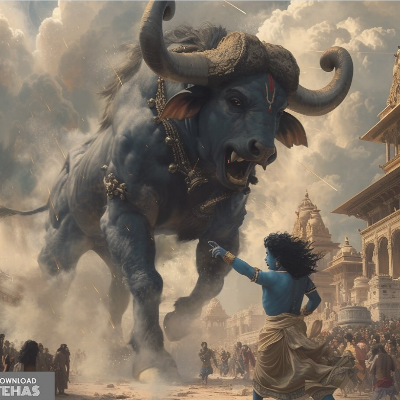
Arishtasura is a Danava who assumed the form of a massive and terrifying bull and was dispatched by Kamsa, the tyrannical Bhoja-Yadava king of Mathura and maternal uncle of Krishna, to attack and kill Krishna in Vrindavan. He belongs to the Danava lineage descended from the progenitor sage Kashyapa and his wife Danu and stands among the outer circle of generals in Kamsa's service, alongside other Danava agents such as Dhenukasura and Pralambhasura. His assault on Vrindavan, his confrontation with Krishna, and his destruction are recorded in the Bhagavata Purana and the Vishnu Purana. The Garga Samhita and the Padma Purana provide a backstory identifying him as a former disciple of Brihaspati, the preceptor of the gods, named Anahlad, who was cursed to take bull form for a failure of respect toward his teacher. After his death at Krishna's hands, the site of the encounter became associated with the creation of the sacred water body known as Arishta-kunda, later celebrated as Shyamakunda. In the Gaudiya Vaishnava interpretive tradition he is understood as a symbol of false religiosity and hypocritical righteousness.
✦ The Name
The name Arishtasura combines arishta, a Sanskrit word carrying meanings of calamity, ill omen, or that which is harmful, with asura, the Puranic term for a powerful non-divine being. The compound therefore means the demon of ill omen or the calamitous demon, a fitting designation for a figure whose arrival in Vrindavan brought terror and physical destruction to the inhabitants and their cattle. The name Arishta is used as its shorter form. In the Garga Samhita his previous identity is recorded as Anahlad, a proper name belonging to his existence as a disciple of Brihaspati before the curse that produced his demonic bull incarnation.
✦ Lineage
- Father: Kashyapa — the great progenitor sage, son of Marichi and grandson of Brahma, who fathered the Danava race through his wife Danu and the Deva race through his wife Aditi; the patrilineal ancestor of Arishtasura's line.
- Mother: Danu — a daughter of the progenitor Daksha and wife of Kashyapa; the mother of the Danava race, from whom the class takes its name; Arishtasura's classification as a Danava places him among her hundred sons through Kashyapa.
- Affiliation: Kamsa — the Bhoja-Yadava king of Mathura, maternal uncle and principal adversary of Krishna; Arishtasura served as one of the outer circle of demonic generals in Kamsa's service and was specifically dispatched by him to destroy Krishna in Vrindavan.
- Previous identity: Anahlad — a disciple of Brihaspati, the preceptor of the gods, who in a former existence was Arishtasura's identity before the curse that compelled his demonic bull birth; recorded in the Garga Samhita and echoed in the Padma Purana.
- Children: None recorded in any primary source.
✦ The Previous Life — Anahlad and the Curse of Brihaspati
The Garga Samhita, echoed in the Padma Purana, provides the backstory of Arishtasura's existence before his demonic incarnation. He was formerly Anahlad, a student and disciple of Brihaspati, who holds the office of Guru of the Gods and is the preceptor and spiritual guide of the Deva class of beings. Anahlad committed a serious breach of the respect owed to his teacher — in some versions of the account by entering his teacher's presence without offering the proper salutation, and in others by interrupting a sacred sacrifice being conducted by Brihaspati. The sage, offended by this failure of reverence, pronounced a curse upon him directing him to be reborn in the form of a bull, a beast of burden. When Anahlad repented and sought mitigation, Brihaspati modified the terms of the curse with a promise of redemption: he would be liberated from his animal existence when Krishna touched his horns in battle. This structure — a cursed being destined for liberation through a specific act of divine contact — follows the same theological pattern found in the backstories of Dhenukasura, who was promised release through Balarama's killing blow, and Pralambhasura, who was similarly told he would attain moksha through Balarama's hand.
✦ The Assault on Vrindavan
The Bhagavata Purana in its tenth canto, Chapter 36, provides the most detailed account of Arishtasura's arrival in Vrindavan. He appeared in the form of a bull of enormous proportions, with massive horns, a heavily humped back, and a terrifying roar. The Bhagavata Purana describes the effect of his arrival on the inhabitants of Vrindavan as one of immediate and overwhelming terror. His roar was so violent and powerful that it caused miscarriages among the cows of the settlement, disturbed the earth, and sent the residents and the animals fleeing in all directions. The pastoral community of Vrindavan, dependent on its cattle and deeply connected to the natural world of the forest and the river, was thrown into complete disorder by the demon's approach. The residents sought the protection of Krishna, calling out to him as he stood among them.
✦ The Battle and the Death of Arishtasura
Krishna stood his ground as Arishtasura charged toward him and responded to the demon's aggression with deliberate playfulness, clapping his hands loudly to provoke and draw the bull's charge directly upon himself. When Arishtasura rushed at him with full force, Krishna caught him by the horns and physically overpowered him, throwing him back eighteen steps through sheer strength. The two grappled with great force, the demon exerting his full power against Krishna and Krishna holding and controlling the bull's massive body. Krishna then wrenched one of Arishtasura's own horns from his head and used it as a weapon, beating the demon with it until he died. The Vishnu Purana in its fifth book confirms this account in a more concise form, corroborating the core details of the confrontation and its outcome. The manner of Krishna's kill — unarmed combat, a physical grip on the demon's horns, and the use of the demon's own severed horn as the instrument of death — is distinctive within the pattern of Krishna's encounters with Kamsa's agents and reflects a particular kind of intimate physical dominance over the demonic form.
✦ The Creation of Arishta-kunda
Following Arishtasura's death, the Gopis of Vrindavan raised a playful objection with Krishna, pointing out that by killing a bull he had incurred the sin of go-vadh, the slaying of a bovine, which carries serious ritual and moral consequences in the dharmic tradition regardless of the bull's demonic nature. In response to their teasing, Krishna struck the ground with his heel, causing a spring of water to burst forth from the earth. This water body, formed at the site of the encounter, came to be known as Arishta-kunda, taking its name from the demon whose death had occasioned its creation. In the later tradition of Vrindavan's sacred geography, Arishta-kunda became identified with Shyamakunda, one of the most celebrated sacred ponds of the Vrindavan-Mathura region, which sits adjacent to Radhakunda and is venerated as a place of great sanctity in the Vaishnava pilgrimage tradition.
✦ Textual Variants and Inconsistencies
The Bhagavata Purana and the Vishnu Purana are in broad agreement on the essential structure of the battle episode, with the Bhagavata offering the more expansive and vivid account and the Vishnu Purana providing a condensed corroboration. The significant textual divergence, as in the parallel cases of Dhenukasura and Pralambhasura, concerns the demon's prior identity and the origin of his animal form. The Bhagavata Purana and Vishnu Purana present Arishtasura as a demon in bull form without any backstory of a previous existence or curse. The Garga Samhita and the Padma Purana introduce the tradition of his former identity as Anahlad, the disciple of Brihaspati, and the curse that produced his bull incarnation, adding the devotional dimension of liberation through Krishna's touch. These two layers — the Mahapuranic narrative account and the later devotional expansion of the Garga Samhita — represent distinct textual traditions and should be understood separately.
✦ Theological Significance
In the Gaudiya Vaishnava interpretive tradition, as articulated in Bhaktivinoda Thakura's Chaitanya Shiksamrita, Arishtasura carries a specific allegorical significance rooted in his bull form. The bull is a symbol of dharma in the Hindu tradition, most prominently as Nandi, the divine bull and vehicle of Shiva who embodies righteousness. Arishtasura's demonic bull form is therefore interpreted as representing false religion or hypocritical righteousness — the outward performance of religious ceremony and ritual observance without genuine devotion or inner transformation. His attack on Vrindavan, the paradigmatic space of simple and pure devotional love in the Vaishnava tradition, is read as the threat that formal and ego-driven religiosity poses to authentic bhakti. Krishna's destruction of the demon is understood as the removal of this obstruction, protecting the natural and sincere faith of the Vrajavasis from being overwhelmed by the corrupted form of dharma that Arishtasura represents. The subsequent creation of Shyamakunda at the site of his death transforms the place of the demon's destruction into a permanent locus of sanctity, emblematic of the Vaishnava principle that Krishna's redemptive presence purifies and consecrates every place it touches.
✦ Connection to the Wider Genealogy
Through his Danava classification, Arishtasura belongs to the same broad lineage of Kashyapa and Danu that includes Dhenukasura, Pralambhasura, Rambha, Shumbha, Nishumbha, and the other Danava figures of the Puranic tradition. He stands as a collateral member of this lineage, serving Kamsa as one of several Danava agents dispatched during Krishna's youth in Vrindavan. His narrative ends entirely with his destruction and the creation of Arishta-kunda, and no children or further descendants are recorded in any primary source. His story forms part of a distinct cluster of episodes in the Bhagavata Purana's tenth canto in which successive demonic agents of Kamsa are destroyed by Krishna and Balarama, each episode manifesting a particular quality of the divine brothers' power — in Arishtasura's case, Krishna's sovereign physical dominance over even the most terrifying forms of demonic aggression.
✦ References
- Primary Sources:
- Bhagavata Purana, Canto 10, Chapter 36: The principal and most detailed narrative source for the Arishtasura episode; provides the full account of his arrival in bull form, the terror he caused among the inhabitants and cattle of Vrindavan, his confrontation with Krishna, the physical battle, and his death by his own severed horn.
- Vishnu Purana, Book 5, Chapter 14: Corroborates the core narrative of the episode in a concise account, confirming Arishtasura's role as a key demonic agent dispatched by Kamsa and the essential details of his destruction by Krishna.
- Garga Samhita: The primary source for Arishtasura's previous identity as Anahlad, disciple of Brihaspati, his curse to bull form for a failure of respect toward his teacher, and the promise of liberation through Krishna's touch of his horns in battle.
- Padma Purana: Echoes the Garga Samhita's account of Anahlad's curse and the backstory of Arishtasura's demonic birth, providing a secondary corroboration of this tradition.
- Secondary Sources:
- Mani, Vettam. Puranic Encyclopaedia. Motilal Banarsidass, 1975: Provides a consolidated summary of the Arishtasura episode drawing on the Bhagavata Purana and Vishnu Purana accounts and noting his place within the pattern of Kamsa's demonic agents destroyed during Krishna's youth.
- Bhaktivinoda Thakura. Chaitanya Shiksamrita: The source for the Gaudiya Vaishnava allegorical interpretation of Arishtasura as a symbol of false religiosity and hypocritical dharma threatening the pure devotional faith of the Vrajavasis.