
About
Kesi — Danava Demon in Horse Form, Commander of Kamsa, Slain by Krishna at Vrindavan
Kesi · Keshi · Keshin · Kumuda · The Horse Demon of Vrindavan
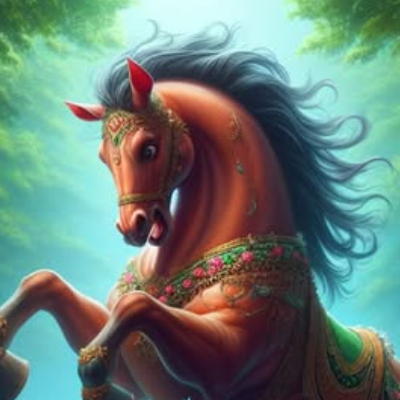
Kesi is a Danava of high rank who assumed the form of a monstrous horse and was dispatched by Kamsa, the tyrannical Bhoja-Yadava king of Mathura and maternal uncle of Krishna, to attack and destroy Krishna in Vrindavan. He belongs to the Danava lineage descended from the progenitor sage Kashyapa and his wife Danu and is counted among the hundred sons of Danu recorded in the Mahabharata and the Harivamsha, where he served as a minister and military commander in Kamsa's service. His assault on Vrindavan and his destruction at Krishna's hands are recorded in the Bhagavata Purana and the Vishnu Purana. The Garga Samhita provides a backstory identifying his previous identity as Kumuda, a celestial servant of Indra who stole the sacrificial horse during an Ashvamedha Yajna and was cursed to take horse form as punishment. Krishna's destruction of Kesi gave rise to one of his most celebrated epithets, Keshava, meaning the slayer of Keshi. The site of the battle on the banks of the Yamuna is commemorated as Keshi Ghat in Vrindavan, a place of active pilgrimage. In Vaishnava theology he is understood as a symbol of pride, vanity, and the destructive power of uncontrolled speech.
✦ The Name
The name Kesi or Keshi derives from the Sanskrit root kesha, meaning hair or mane, and may refer to the demon's form as a horse with a flowing and formidable mane, or may simply function as a proper noun within the tradition. The extended form Keshin carries the same root with an adjectival suffix, meaning one possessing a mane or the maned one. The epithet Keshava, applied to Krishna following this episode, is derived directly from the demon's name and means the slayer of Keshi, making it one of the few major Krishnaite epithets whose origin is explicitly tied to a demonic adversary. The name Kumuda, given in the Garga Samhita as his previous celestial identity, is a separate Sanskrit word meaning the white water lily, a name characteristic of Indra's celestial attendants in the Puranic tradition.
✦ Lineage
- Father: Kashyapa — the great progenitor sage, son of Marichi and grandson of Brahma, who fathered the Danava race through his wife Danu and the Deva race through his wife Aditi; the patrilineal ancestor of Kesi's line.
- Mother: Danu — a daughter of the progenitor Daksha and wife of Kashyapa; the mother of the entire Danava race, which takes its collective name from her; Kesi is counted among her hundred sons through Kashyapa as listed in the Mahabharata and the Harivamsha.
- Affiliation: Kamsa — the Bhoja-Yadava king of Mathura, maternal uncle and principal adversary of Krishna; Kesi served as a minister and military commander in Kamsa's inner circle and was specifically dispatched by him to destroy Krishna in Vrindavan.
- Previous identity: Kumuda — a celestial servant of Indra, the king of the gods, who in a former existence was Kesi's identity before the curse that condemned him to demonic horse form; recorded in the Garga Samhita, Canto 5, Chapter 2.
✦ The Previous Life — Kumuda and the Curse of Indra
The Garga Samhita in its fifth canto records the backstory of Kesi's existence before his demonic incarnation. He was formerly Kumuda, a celestial attendant in the service of Indra, the king of the gods. Indra was performing an Ashvamedha Yajna, the horse sacrifice that constitutes one of the most elaborate and powerful Vedic rituals, undertaken in this instance as an act of atonement for the killing of Vritrasura, a Brahmin by nature, whose destruction at Indra's hands had incurred a severe taint of guilt upon the god. During the preparation or conduct of this sacrifice, Kumuda stole the sacrificial horse — an act that struck at the very heart of the ritual's efficacy and constituted a grave offence against both his lord and the sacred rite. Indra, enraged at this theft and betrayal by his own servant, pronounced a curse upon Kumuda directing him to be reborn upon the earth in the form of a monstrous horse. When Kumuda repented, Indra modified the terms of the curse with a promise of redemption: he would be liberated from his demonic horse existence when the Supreme Lord Krishna personally touched him during battle. This condition of liberation through divine contact in combat follows the same theological structure found in the backstories of Dhenukasura, Pralambhasura, and Arishtasura in the same tradition, each of whom was promised release through a specific act of physical contact by Krishna or Balarama.
✦ The Assault on Vrindavan
The Bhagavata Purana in its tenth canto, Chapter 37, provides the most detailed account of Kesi's arrival in Vrindavan. He came in the form of a horse of tremendous and unnatural size, his physical presence alone sufficient to cause widespread disruption and terror. The Bhagavata Purana describes his tail as scattering clouds as he moved and his hooves as striking the earth with such force that they caused tremors. His neighing filled the atmosphere with an overwhelming sound that sent the inhabitants and animals of Vrindavan fleeing. The scale of the terror he inspired placed him among the most dramatically described of Kamsa's agents, and the physical imagery of his arrival — the disturbed sky, the shaking earth, the overwhelming noise — conveyed the full scope of the demonic disruption he brought to the pastoral world of Vrindavan.
✦ The Battle and the Death of Kesi
Krishna confronted Kesi directly and, as in the episode of Arishtasura, met the demon's charge with a characteristic playfulness rather than alarm or defensive retreat. When Kesi opened his enormous mouth to bite at Krishna, Krishna thrust his left arm deep into the demon's throat. The Bhagavata Purana records that once inside the demon's mouth and throat, Krishna's arm expanded, growing in size, heat, and weight until it became as burning and immovable as a great iron rod lodged within the demon's body. Kesi was unable to expel the arm, unable to close his mouth, and unable to breathe. The expansion of the arm within the throat suffocated and crushed the demon from the inside, and Kesi died in this manner, his body convulsing and his legs thrashing before he finally collapsed and expired. The Vishnu Purana corroborates this account in a more condensed form. The manner of this kill — the thrusting of the arm into the demon's open mouth and the lethal expansion within — is unique among Krishna's encounters with Kamsa's agents and stands as one of the most distinctive episodes of his Vrindavan career.
✦ The Epithet Keshava
Following Kesi's destruction, the sage Narada, the divine wandering rishi who moves freely between the worlds in the Puranic tradition and who appears as a witness and commentator at several significant moments in Krishna's life, came to Krishna and praised him for his victory. The Bhagavata Purana records that in this context Narada addressed Krishna by the name Keshava, acknowledging the epithet that had arisen from his slaying of Keshi. Keshava, meaning the slayer of Keshi, subsequently became one of the most widely used and celebrated of Krishna's thousand names, appearing in the Vishnu Sahasranama and in devotional literature across the Vaishnava tradition. It is among the relatively small number of major Krishnaite epithets whose origin is directly and explicitly tied to the destruction of a named demonic adversary, giving the episode of Kesi's death a lasting linguistic and theological legacy within the tradition.
✦ The Sacred Site — Keshi Ghat
The site on the banks of the Yamuna River in Vrindavan where the battle between Krishna and Kesi took place is known as Keshi Ghat, taking its name directly from the demon whose destruction occurred there. Keshi Ghat is among the most prominent of Vrindavan's sacred bathing ghats and remains an active place of pilgrimage in the Vaishnava tradition. Evening aartis are performed there in commemoration of the liberation of the horse-demon and the manifestation of Krishna's divine power at that spot. The naming of the ghat after the demon follows the same pattern seen in the creation of Arishta-kunda following Arishtasura's destruction, in which the site of a demon's death at Krishna's hands becomes permanently consecrated and named in memory of that encounter, transforming what was a moment of demonic aggression into a lasting landmark of sacred geography.
✦ Textual Variants and Inconsistencies
The Bhagavata Purana and the Vishnu Purana are in broad agreement on the core narrative of the battle and Kesi's death, with the Bhagavata providing the more expansive and vivid account and the Vishnu Purana offering a condensed corroboration. As with the parallel cases of Dhenukasura, Pralambhasura, and Arishtasura, the significant textual divergence concerns the demon's prior identity. The Mahapuranic sources present Kesi as a demon in horse form dispatched by Kamsa without any backstory of a previous celestial existence. The Garga Samhita introduces the tradition of his former identity as Kumuda, Indra's celestial servant, and the Ashvamedha horse-theft and its consequences, adding the devotional dimension of liberation through Krishna's touch. These two layers — the Mahapuranic narrative and the Garga Samhita's devotional expansion — represent distinct textual traditions and should be understood separately rather than harmonised.
✦ Theological Significance
In the Vaishnava interpretive tradition, Kesi carries a specific allegorical significance. His horse form, his enormous mouth, and his overwhelming neighing are understood as symbols of pride, vanity, and the destructive tendency to criticise and overwhelm others with the noise of the ego. The horse's neigh — loud, penetrating, and filling the atmosphere — is compared in this reading to the empty boasting and proud proclamations of a mind given over to self-aggrandisement. Krishna's act of thrusting his arm into the demon's throat and expanding it there until the demon is silenced and destroyed is interpreted as the divine purification of speech and the removal of false pride at its very source, the throat being the organ of utterance. This allegorical reading places the Kesi episode alongside those of Dhenukasura, who represented ignorance, and Arishtasura, who represented false religiosity, as part of a sustained interpretive framework in which each demon destroyed by Krishna and Balarama during the Vrindavan period embodies a specific spiritual obstruction that the divine presence systematically removes.
✦ Connection to the Wider Genealogy
Through his parentage as a son of Kashyapa and Danu, Kesi belongs to the same broad Danava lineage that includes Dhenukasura, Pralambhasura, Arishtasura, Rambha, Shumbha, Nishumbha, and the other Danava figures of the Puranic tradition. He stands as a collateral member of this lineage in his role as a minister and commander of Kamsa rather than as part of any direct generational line. His narrative ends entirely with his destruction at Keshi Ghat, and no children or further descendants are recorded in any primary source. His episode forms part of the same cluster of Bhagavata Purana narratives in which successive demonic agents of Kamsa are destroyed by Krishna and Balarama during their years in Vrindavan, each encounter serving to reveal a particular quality of divine power and to consecrate a specific site within the sacred geography of the Vrindavan-Mathura region.
✦ References
- Primary Sources:
- Bhagavata Purana, Canto 10, Chapter 37: The principal and most detailed narrative source for the Kesi episode; provides the full account of his arrival in horse form, the terror he caused in Vrindavan, his confrontation with Krishna, the thrusting of Krishna's arm into his throat, the expansion of the arm, and his death by suffocation; also records Narada's subsequent address to Krishna as Keshava.
- Vishnu Purana, Book 5: Corroborates the core narrative of the episode in a more concise account, confirming Kesi's role as a key demonic agent of Kamsa and the essential details of his destruction by Krishna.
- Garga Samhita, Canto 5, Chapter 2: The primary source for Kesi's previous identity as Kumuda, the celestial servant of Indra; records the theft of the Ashvamedha sacrificial horse, Indra's curse to horse form, and the promise of liberation through Krishna's touch in battle.
- Mahabharata and Harivamsha: List Kesi among the hundred sons of Danu and Kashyapa, corroborating his classification within the Danava lineage and his standing as a member of the primordial Asura clans.
- Secondary Sources:
- Mani, Vettam. Puranic Encyclopaedia. Motilal Banarsidass, 1975: Provides a consolidated summary of the Kesi episode drawing on the Bhagavata Purana and Vishnu Purana accounts, noting the origin of the epithet Keshava and Kesi's place within the pattern of Kamsa's demonic agents.