
About
Kapali — First of the Eleven Rudras, the Skull-Bearer
Kapali · Kapalin · Ekadasha Rudra No. 1 · Son of Kashyapa and Surabhi
Kapali is the first and foremost of the eleven Rudras, the Ekadasha Rudras, who are collectively described in the Shata-Rudra Samhita of the Shiva Purana as incarnations of the supreme deity Shiva, born through Surabhi, the divine wish-fulfilling cow and wife of the sage Kashyapa Prajapati. Kapali is named as the leader among the eleven in several textual enumerations and is defined entirely by his defining emblem — the kapala, the skull-cup held in his hand. His consort, paired with him among the eleven Rudranis, is Dhi, a feminine power representing divine intellect and discernment, as named in the Vishnu Purana (1.7). Kapali appears across the Shiva Purana, the Mahabharata, the Skanda Purana, and the Bhagavata Purana, though the name-lists and contexts in which he appears vary by text.
✦ The Name
The name Kapali derives from the Sanskrit word kapala, meaning skull or skull-cup. The suffix -in or -i forms a possessive epithet, so Kapali means literally "the one who bears or holds the skull." The variant form Kapalin carries the same meaning and is used interchangeably across texts. In the Skanda Purana, the name is connected to a specific mythological episode in which Shiva severed one of the heads of Brahma and carried it; the one who holds the skull is therefore Kapali. The name is also a recognized epithet of Shiva in his broader tradition, attesting to the close identification between this Rudra form and the supreme deity himself. The kapala in iconographic tradition is not merely a weapon or ornament but a vessel representing the skull of ego and mortality, held to signify complete dominion over death and liberation from the cycle of birth and rebirth.
✦ Lineage
- Father: Kashyapa Prajapati — the great progenitor sage, one of the mind-born sons of Brahma, and the progenitor of both the Devas and many other orders of beings. He is described in the Shiva Purana as performing austerities at Kashi to obtain the boon of Shiva's incarnation through his wife.
- Mother: Surabhi — the divine wish-fulfilling cow, daughter of Daksha Prajapati, and wife of Kashyapa. She is celebrated in Puranic tradition as the mother of all cows and the source of abundance. The Harivamsha (Harivamsa Parva 1.3.49–50) affirms that it was through Surabhi, hallowed by her own ascesis and the grace of Mahadeva, that the eleven Rudras were brought forth.
- Brothers: The ten remaining Ekadasha Rudras — Pingala, Bhima, Virupaksha, Vilohita, Shastra, Ajapada, Ahirbudhnya, Shambhu, Chand, and Bhava — all born simultaneously from Surabhi as incarnations of Shiva.
- Consort: Dhi — named in the Vishnu Purana (1.7) as the first of the eleven Rudranis, the feminine powers born to be consorts of the eleven Rudras. Dhi represents divine intellect, discernment, and wisdom.
✦ The Origin Narrative
The Shata-Rudra Samhita of the Shiva Purana, in its seventeenth section, narrates the circumstances of Kapali's birth as part of the collective origin of all eleven Rudras. The account begins with the defeat of Indra and the Devas at the hands of the Rakshasas, who expelled the gods from their celestial city of Amaravati. The dispossessed Devas sought the counsel of Kashyapa Prajapati, the great progenitor sage, who is also described in this tradition as the father of Indra. Moved by the suffering of the gods, Kashyapa undertook severe austerities at Kashi, the sacred city associated with Shiva. Shiva, pleased by the depth of Kashyapa's penance, appeared before him and offered a boon. Kashyapa requested that Shiva himself incarnate as his sons through his wife Surabhi and assist the Devas in regaining their celestial abode. Shiva consented. Through Surabhi's womb, sanctified by both her own ascetic power and the grace of Mahadeva, eleven sons were born — the Ekadasha Rudras, with Kapali at their head. Together with their vast host of attendant Rudra-warriors, they went to battle against the demons, vanquished the Rakshasa forces, and restored Indra to his rightful lordship over Amaravati.
✦ Role as Foremost of the Rudras
Kapali's position as the first-named among the eleven Rudras in the Shiva Purana list is significant. In the Mahabharata's enumeration of the Rudras in the Anushasana Parva, it is Kapalin who is described as the foremost among the Rudras assembled, a statement that equates his pre-eminence in the group with the supreme status of Shiva himself, since Kapalin is simultaneously one of Shiva's own most recognised epithets. The Bhagavata Purana also records that the eleven Rudras, headed by Kapali, together slew the elephant demon Gajasura, further affirming his role as the commander of the divine Rudra host. Their shared iconography in this context includes lion-skin garments, matted hair, serpents coiled around the neck, yellow-hued throats, tridents, skulls, and the crescent moon adorning the forehead.
✦ Textual Variants and Inconsistencies
The name Kapali does not appear in every Puranic enumeration of the eleven Rudras, and the position of leader or foremost shifts across texts. The Bhagavata Purana (3.12) gives a completely different set of eleven names — Manyu, Manu, Mahinasa, Mahan, Shiva, Ritadhvaja, Ugrareta, Bhava, Kala, Vamadeva, and Dhritavrata — in which Kapali does not appear at all. In the Bhagavata Purana (6.6), the eleven Rudras are said to be the sons of Sarupa and Bhuta rather than Kashyapa and Surabhi, again with a different name-list. The Vamana Purana assigns Kashyapa–Aditi rather than Kashyapa–Surabhi as the parentage of the Rudras. The Mahabharata contains at least two different lists of eleven Rudras across its various books, and Kapali appears in one of them. In the Vishnu Purana, the Rudras are said to emerge from Rudra-Shiva's own body in Ardhanari form rather than from any mortal womb, producing yet another distinct name-list. The only consistent point across these variant traditions is the number eleven and the broad character of the Rudras as fierce, protective manifestations of Rudra-Shiva.
✦ Theological and Philosophical Significance
Kapali embodies the Shaiva theological principle that death is not an end to be feared but a threshold to be transcended. The skull held in his hand signifies the defeat of ego, the impermanence of the physical body, and the liberation that follows genuine renunciation of attachment to life. His association with cremation grounds, which in the Shaiva tradition are regarded not as places of pollution but as sites of the highest spiritual intensity, reflects a broader Shaiva and Tantric understanding that the boundary between life and death is the most potent ground for spiritual realisation. As a form of Shiva, Kapali also participates in the cosmic role of dissolution — he is that aspect of Shiva which presides over the ending of each cycle, clearing the way for renewal. The eleven Rudras collectively are understood in the Vayu Purana as corresponding to the eleven vital breaths and functions within the living being, with each Rudra governing one of the ten pranas and the mind. In this interior cosmology, Kapali corresponds to the first and most fundamental vital principle.
✦ Iconography
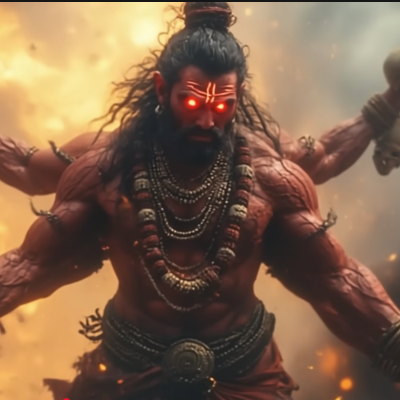
Classical texts of sacred iconography, including the Rupamandana and the Vishvakarmashilpa, provide descriptions of the Ekadasha Rudras' physical forms. Kapali is depicted with a white or ash-grey complexion, reflecting the ascetic who has smeared himself with the ash of the cremation ground — a mark of Shiva's lordship over death. He holds a kapala, the skull-cup, in one hand and a sword in the other. He wears garlands strung with skulls. His hair is matted and bound in the style of a forest ascetic. Serpents coil about him as ornaments. He bears a trident and has the crescent moon upon his forehead. The yellow throat that characterises the Rudra group collectively is also present, a visual echo of Shiva Neelakantha, the blue-throated deity who held the cosmic poison within himself to protect creation.
✦ Connection to the Wider Genealogy
Kapali belongs to the lineage of Kashyapa Prajapati, one of the seven great sages and a son of Brahma, the creator. Kashyapa is the father of the Devas through his wife Aditi, of the Asuras through Diti, of serpents through Kadru, and of many other orders of beings through his various wives. Surabhi, Kapali's mother, is the daughter of Daksha Prajapati, who is himself a Prajapati and a son of Brahma. This makes Kapali and his ten brothers both the grandsons of Brahma through Kashyapa on their father's side, and the grandsons of Daksha through Surabhi on their mother's side. As incarnations of Shiva, the Rudras also stand in a theological relationship to the supreme Rudra who transcends them, forming a dual identity as both divine children born of a sage's wife and as direct manifestations of the godhead who sanctioned their own birth.
✦ References
Primary Sources
- Shiva Purana, Shata-Rudra Samhita, Chapter 3, Section 17: Primary narrative source for the birth of the eleven Rudras from Kashyapa and Surabhi; names Kapali as the first of the eleven and describes the context of Kashyapa's penance at Kashi.
- Harivamsha, Harivamsa Parva 1.3.49–50 and 3.36.50–51: Earliest clear Puranic attestation of Surabhi and Kashyapa as parents of the eleven Rudras; affirms that Surabhi produced the Rudras through the grace of Mahadeva.
- Vishnu Purana 1.7: Names the eleven Rudranis including Dhi as the consort of the first Rudra; also gives an alternate account of the Rudras' origin from Rudra's own Ardhanari form with a different name-list.
- Mahabharata, Anushasana Parva: Contains an enumeration of the eleven Rudras in which Kapalin is described as the foremost; also contains a separate list in which the Rudras are sons of Tvashtr.
- Bhagavata Purana 6.6.17–18: Names Kapali as leading the group of Rudras who collectively slay the elephant demon Gajasura; assigns a different parentage of Sarupa and Bhuta.
- Bhagavata Purana 3.12: Gives a completely different list of eleven Rudras born from Brahma's anger, in which Kapali does not appear, establishing a major textual variant.
- Skanda Purana: Connects the epithet Kapali to the episode of Shiva severing one of Brahma's heads and carrying the skull.
- Vayu Purana 2.5.68–70: Names eleven Rudras as sons of Surabhi and Kashyapa with a different name-list; also gives the correspondence of the eleven Rudras with the eleven vital breaths.
- Rupamandana and Vishvakarmashilpa (texts of sacred iconography): Describe the physical appearance and attributes of the Ekadasha Rudras, including the skull-cup, sword, serpent ornaments, matted hair, and ash-grey complexion.
Modern Reference Works
- Wikipedia, "Rudras": Surveys the various Puranic lists of the eleven Rudras and their textual sources; notes the Harivamsha as the primary authority for the Kashyapa–Surabhi parentage.
- Wisdomlib, "Number of Rudra" (Rudra-Shiva Concept Study): Provides Sanskrit verse references from the Vayu Purana, Brahma Purana, Bhagavata Purana, and Linga Purana for the different Rudra lists, with transliteration.
- Exotic India Art, "11 Rudra Avatars of Lord Shiva": Describes the iconographic and symbolic significance of Kapali within the Shiva Purana's Shata-Rudra Samhita framework.