
About
Dhi — One of the Eleven Rudranis, Consort of the Rudra Kapali
Dhi · Dhih · Rudrani of Manyu · Shakti of Kapali
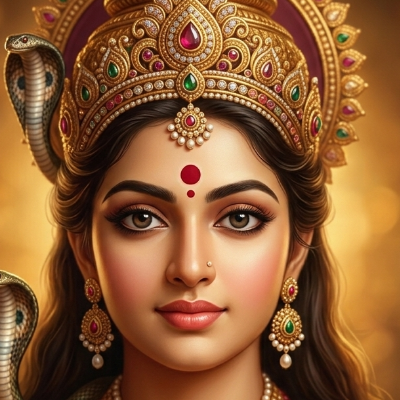
Dhi is a divine feminine figure identified in the Vishnu Purana and the Bhagavata Purana as one of the eleven Rudranis — the female counterparts and consorts of the eleven Rudras, a group of fierce divine beings who are forms or close attendants of the great Vedic deity Rudra, identified in later tradition with Shiva. In the cosmogonic account preserved in the Vishnu Purana (Book I, Chapter VIII), the eleven Rudranis are described as having been born from a primordial female half when Rudra divided his androgynous form, and they were assigned as wives to the eleven male Rudras. Dhi stands first in the canonical list of Rudranis given in that text. In the specific pairing recorded in the Vishnu Purana tradition, she is the consort of the Rudra named Manyu. In a parallel and widely circulated tradition drawing on the Shiva Purana, the Matsya Purana, and popular Puranic usage, the first of the eleven Rudras is identified as Kapali rather than Manyu, and Dhi is accordingly associated with him as his Shakti and consort. Both Manyu and Kapali are understood within their respective enumerations as among the foremost or first-named of the Rudra group.
✦ The Name
The Sanskrit word Dhi (written in Devanagari as धी) is a feminine noun derived from a verbal root meaning to perceive, to reflect, or to hold in the mind. Its primary meanings encompass intellect, understanding, wisdom, intelligence, meditation, and the active operation of the mind upon a particular thought. It differs from the more generalised Sanskrit term mati, which denotes thought as a mental process; Dhi conveys the intellect's directed engagement with an idea — closer in nuance to discernment or insight than to thought in the broad sense. The word is ancient and appears in the Rigveda, where it is used to denote religious reflection and the sacred mental faculty through which the seer perceives divine truth. As a divine name, Dhi thus signifies the personification of intellect and discernment as a cosmic feminine power. The Monier-Williams Sanskrit dictionary explicitly notes that Dhi is personified as the wife of Rudra-Manyu in the Bhagavata Purana (3.12.13). The epithet Rudrani, which may also be applied to her, is a Sanskrit feminine formation meaning the female counterpart or Shakti of a Rudra, formed by adding the feminine suffix -ani to the masculine theonym Rudra.
✦ Lineage
- Origin: According to the Vishnu Purana (Book I, Chapter VIII), the eleven Rudranis came into being from the female half of Rudra after he divided his original androgynous form. They are not described as children of mortal or divine parents in the genealogical sense but as manifestations of that primordial feminine half, collectively assigned as wives to the eleven male Rudras.
- Spouse (Vishnu Purana tradition): Manyu — the first-named of the eleven Rudras in the Vishnu Purana enumeration. Manyu, whose name means wrath or ardour, is a Rudra presiding over the heart according to the cosmological allocation of stations described in the same chapter.
- Spouse (Shiva Purana / Matsya Purana / popular tradition): Kapali — the first-named of the eleven Rudras in the Shiva Purana (Shat-Rudra Samhita, Chapter 18) and Matsya Purana enumerations. Kapali is the skull-bearing Rudra, whose name derives from kapala (skull), and who is associated with cremation grounds, asceticism, fearlessness before death, and the impermanence of existence. In the Mahabharata (Adi Parva), Kapalin is described as the foremost among the Rudras.
- Co-Rudranis (fellow Rudranis in the Vishnu Purana list): Vrtti, Usana, Urna, Niyuta, Sarpis, Ila, Ambika, Iravati, Sudha, and Diksa — the ten other Rudranis named alongside Dhi in the same passage, each assigned as wife to one of the remaining Rudras.
- Co-Rudranis (Bhagavata Purana 3.12.13 list): Dhrti, Rasala, Uma, Niyut, Sarpi, Ila, Ambika, Iravati, Svadha, and Diksa — the ten other Rudranis named alongside Dhi in this slightly variant list from the Bhagavata Purana.
✦ The Cosmogonic Narrative of Origin
The primary narrative in which Dhi appears is the Puranic account of Rudra's self-division and the simultaneous generation of the eleven Rudras and their consorts. The Vishnu Purana narrates that at the beginning of the present world-cycle, as Brahma the creator sought to bring forth a son resembling himself, the being Rudra — identified here with Shiva — manifested in an androgynous form, half male and half female. Rudra then divided himself: from the male half emerged eleven distinct forms, the Rudras, who vary in nature from gentle and luminous to dark and fierce; from the female half emerged eleven Rudranis, who became their respective wives. Brahma then allocated to each Rudra a specific station corresponding to aspects of both the cosmos and the human body — the heart, the five sense organs, the five organs of action, and the mind. Dhi, as the first of the Rudranis, is correspondingly associated with the station and domain of the first-named Rudra in this scheme.
The Bhagavata Purana (3.12.13) presents a closely related but not identical account. Here, Brahma addresses Rudra directly and names the eleven Rudranis as already belonging to him, presenting the assignment as a bestowal rather than a consequence of prior division. The list given in this passage names Dhi first, followed by ten other Rudranis. The Bhagavata Purana's enumeration of the Rudras themselves in Canto 3 differs from the Vishnu Purana's list, which creates the textual difficulty of determining precisely which Rudra is paired with Dhi in this account.
✦ Textual Variants and Inconsistencies
The Puranic sources present several significant inconsistencies that bear directly on Dhi's identity and her specific pairing with a named Rudra.
First, the names of the eleven Rudras themselves vary substantially across texts. The Vishnu Purana (Book I, Chapter VIII) names them as Manyu, Manu, Mahmasa, Mahan, Siva, Rtudhvaja, Ugraretas, Bhava, Kama, Vamadeva, and Dhrtavrata. The Shiva Purana (Chapter 18 of the Shat-Rudra Samhita) names them as Kapali, Pingala, Bhima, Virupaksha, Vilohita, Shasta, Ajapada, Ahirbudhnya, Shambhu, Chanda, and Bhava. The Matsya Purana gives yet another list, including Kapali, Pingala, Kapardi, and others. The Mahabharata provides two further distinct enumerations in different passages, in one of which Kapalin is named foremost. The Bhagavata Purana (Canto 6, Chapter 6) provides yet another set of names. No two major texts agree on a single consistent enumeration.
Second, the list of Rudranis also shows variation. The Vishnu Purana names Dhi, Vrtti, Usana, Urna, Niyuta, Sarpis, Ila, Ambika, Iravati, Sudha, and Diksa. The Bhagavata Purana (3.12.13) names Dhi, Dhrti, Rasala, Uma, Niyut, Sarpi, Ila, Ambika, Iravati, Svadha, and Diksa. The H. H. Wilson commentary on the Vishnu Purana also notes, citing the Bhagavata Purana, a list in which the Rudranis are Dhi, Dhriti, Rasaloma, Niyut, Sarpi, Ila, Ambika, Iravati, Svadha, Diksa, and Rudrani. These lists share several names but differ in others.
Third, the specific one-to-one pairing of each Rudrani with a named Rudra is made explicit only in certain accounts and is not consistently specified across all texts. The identification of Dhi as consort of Kapali specifically arises from aligning the first name in the Rudrani list with the first name in the Shiva Purana or Matsya Purana Rudra list, where Kapali heads the enumeration. The identification of Dhi as consort of Manyu arises from the Vishnu Purana tradition, where Manyu leads the Rudra list. Both identifications are textually grounded, but they derive from different primary sources and cannot be simultaneously correct.
✦ Theological and Philosophical Significance
The name Dhi carries considerable theological weight within the broader Hindu philosophical tradition, even when considered apart from her specific role as a Rudrani. In the Rigveda, dhi denotes the faculty through which the rishi perceives sacred truth — it is the inward light of the mind that grasps what lies beyond mere sensory perception. The Gayatri Mantra of the Rigveda, one of the most venerated Vedic verses, invokes the deity Savitri to stimulate or inspire the worshipper's dhi, making the concept central to Vedic spirituality. As a personified being and consort of a Rudra, Dhi embodies this power in its divine and cosmic dimension: she is the Shakti of discernment, the active feminine intelligence that accompanies and empowers her fierce consort.
In the broader framework of the Rudrani theology developed most fully in the Shakta Puranas, each Rudrani represents the Shakti — the activating power — of her corresponding Rudra, without whom he cannot perform his cosmic functions. The Rudranis collectively are understood as manifestations of the supreme Goddess in her role as the dynamic complement to the eleven forms of Rudra-Shiva. Dhi's position as the first-named Rudrani, placed at the head of the list, may reflect a traditional priority given to the faculty of intellect in the hierarchy of inner powers.
✦ Connection to the Wider Genealogy
Dhi belongs to the group of eleven Rudranis who are, collectively, among the divine consorts generated in the same primordial act of creation that produced the eleven Rudras. The Rudras themselves are traced to varying ultimate parentages across different texts: the Ramayana and Vamana Purana make them children of the sage Kashyapa and his wife Aditi; the Matsya Purana and Harivamsa name Surabhi the divine cow as their mother, either as wife of Brahma or of Kashyapa; the Vishnu Purana derives them from Rudra's own self-division at Brahma's instigation; the Bhagavata Purana (Canto 6) makes them sons of Sarupa, a daughter of Daksha, and Bhuta. Dhi's own origin is tied to whichever of these cosmogonic frameworks is adopted, since she is consistently derived from the same generative event that produced her consort. The eleven Rudras and their consorts collectively occupy a distinct tier in the Puranic divine hierarchy — neither the supreme triad of Brahma, Vishnu, and Shiva, nor minor subordinate beings, but fierce and powerful divine attendants who govern specific domains of creation, cosmic time, and the human constitution.
✦ References
- Vishnu Purana, Book I, Chapter VIII — Primary source for the cosmogonic account of Rudra's self-division, the generation of the eleven Rudras and eleven Rudranis, and the first named list of Rudranis including Dhi. English translation by H. H. Wilson consulted; Wilson's footnotes note the variant list from the Bhagavata Purana.
- Bhagavata Purana, Canto 3, Chapter 12, Verse 13 — Names the eleven Rudranis assigned to Rudra, with Dhi listed first, in a variant list that differs in some names from the Vishnu Purana. This passage is the source noted by Monier-Williams for the personification of Dhi as wife of Rudra-Manyu.
- Bhagavata Purana, Canto 6, Chapter 6, Verses 17–18 — Provides a further enumeration of the eleven Rudras as children of Sarupa and Bhuta, with names differing from the Vishnu Purana list; relevant to establishing the variant genealogy of the Rudras and by extension of Dhi's consort.
- Shiva Purana, Shat-Rudra Samhita, Chapter 18 — Names the eleven Rudra incarnations as Kapali, Pingala, Bhima, Virupaksha, Vilohita, Shasta, Ajapada, Ahirbudhnya, Shambhu, Chanda, and Bhava, placing Kapali first and thus establishing the basis for identifying Dhi as consort of Kapali when the Rudrani list is aligned with this enumeration.
- Matsya Purana, relevant chapters on the Rudras — Names the eleven Rudras in a list that includes Kapali as first or prominent, and is one of the sources for the tradition that pairs Dhi with Kapali.
- Mahabharata, Adi Parva, Chapter 66 — Names Kapali as one of the eleven Rudras and identifies him as a son of Sthanu, who is himself a son of Brahma; in one passage of the epic, Kapalin is described as the foremost among the Rudras.
- Rigveda, various hymns — Primary source for the Vedic usage of the word dhi as the faculty of sacred insight and perception, underlying the theological significance of Dhi as a personified power.
- Monier-Williams Sanskrit–English Dictionary (M. Monier-Williams, 1899) — Entry for Dhi (page 516) records the meanings of the word and explicitly notes its personification as the wife of Rudra-Manyu in the Bhagavata Purana 3.12.13.
- Puranic Encyclopaedia (Vettam Mani, 1975) — Reference work providing concise entries on the Rudras and Rudranis, useful for cross-referencing variant lists across the Puranas.
- Wikipedia, "Rudras" article — Secondary source compiling variant Rudra lists from primary texts; used to verify the cross-textual inconsistencies in naming and enumeration.
- Wisdomlib.org, "Dhi: 31 definitions" — Secondary aggregator of Sanskrit lexicographical sources; confirmed the German-language Cologne Digital Sanskrit Dictionary's note that Dhi is personified as the wife of Rudra-Manyu in the Bhagavata Purana.
- Sacred-texts.com, Vishnu Purana Book I Chapter VIII (Wilson translation) — English translation and footnotes consulted directly for the passage naming the eleven Rudras, their wives, and their cosmic stations.