
About
Vritti — One of the Eleven Rudranis, Consort of the Rudra Pingala
Vritti · Vrtti · Vrriti · Rudrani of Manu · Shakti of Pingala
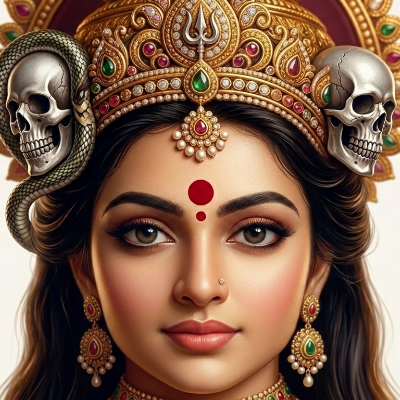
Vritti is a divine feminine figure named in the Vishnu Purana as the second of the eleven Rudranis — the female counterparts and consorts collectively assigned to the eleven Rudras, the group of fierce divine beings who are forms or close attendants of the Vedic deity Rudra, identified in later tradition with Shiva. In the cosmogonic account of the Vishnu Purana (Book I, Chapter VIII), the Rudranis are described as having arisen from the female half of Rudra when he divided his primordial androgynous form at the instigation of Brahma, and were then assigned as wives to the eleven male Rudras. Vritti is named second in the Vishnu Purana list of Rudranis, and in the pairing given in that tradition she is the consort of the Rudra named Manu. In a parallel and widely current tradition drawing on the Shiva Purana and Matsya Purana — where the eleven Rudras are named Kapali, Pingala, Bhima, Virupaksha, Vilohita, Shasta, Ajapada, Ahirbudhnya, Shambhu, Chanda, and Bhava — the second Rudra is Pingala, and Vritti is accordingly identified as his Shakti and consort. The figure of Pingala is a fierce, tawny or reddish-hued Rudra associated with solar energy, fire, and the vital force.
✦ The Name
The Sanskrit word Vritti (written in Devanagari as वृत्ति) is a feminine noun derived from the verbal root vrt, meaning to turn, to revolve, to move, to exist, or to abide. Its range of meanings in classical Sanskrit is broad and context-dependent. In ordinary usage it can mean mode of life, conduct, behaviour, profession, or means of subsistence. In philosophical and psychological contexts — particularly in the tradition of Yoga philosophy codified by Patanjali — vritti denotes a mental modification or fluctuation of the mind-stuff (chitta): any wave of thought, perception, or mental activity that arises in consciousness. The aim of Yoga is defined in the Yoga Sutras as the cessation of these vrittis. In a more general cosmological sense, vritti can mean activity, function, or the operating mode of any faculty or principle. As a divine name, Vritti therefore personifies the power of active functioning, mental operation, or the very movement of being — the dynamic principle by which any faculty turns and works. The name stands in natural complement to that of Dhi, the first Rudrani, who personifies the intellect as a receptive and discerning capacity: where Dhi is the understanding, Vritti is its active turning or functioning.
✦ Lineage
- Origin: According to the Vishnu Purana (Book I, Chapter VIII), Vritti arose from the female half of Rudra's androgynous primordial form when he divided himself into male and female. The eleven Rudranis produced from this female half are not born of parental lineage in the conventional genealogical sense but are simultaneous manifestations of a single divine feminine source, each individualised to become the consort of one of the eleven male Rudras.
- Spouse (Vishnu Purana tradition): Manu — the second-named Rudra in the Vishnu Purana enumeration, whose name means the thinking being or the one who reflects, and who is associated in the same cosmological scheme with one of the eleven stations allocated to the Rudras by Brahma.
- Spouse (Shiva Purana / Matsya Purana tradition): Pingala — the second-named Rudra in the Shiva Purana (Shat-Rudra Samhita, Chapter 18) and Matsya Purana lists. The name Pingala means tawny, reddish-brown, or golden-hued, and this Rudra is associated with the radiance and energy of the sun, with fire, and in later Tantric physiology with the Pingala Nadi, the right-side energy channel of the human subtle body that is linked with solar force and vital heat.
- Fellow Rudranis (Vishnu Purana list): Dhi, Usana, Urna, Niyuta, Sarpis, Ila, Ambika, Iravati, Sudha, and Diksa — the ten other Rudranis named in the same passage, each the consort of one of the remaining Rudras.
- Fellow Rudranis (Bhagavata Purana 3.12.13 list): Dhi, Dhrti, Rasala, Uma, Niyut, Sarpi, Ila, Ambika, Iravati, Svadha, and Diksa — the variant list from the Bhagavata Purana, in which the name Vritti does not appear; see the section on textual variants below.
✦ The Cosmogonic Narrative of Origin
The narrative in which Vritti appears is the same cosmogonic account that generates all eleven Rudranis. The Vishnu Purana (Book I, Chapter VIII) narrates that at the beginning of the present world-cycle, Brahma desired to bring forth a son like himself, and from that creative intention arose Rudra in an androgynous form — half male, half female. Rudra then divided this form: from the male half arose eleven distinct Rudras, differing among themselves in complexion and temperament, some white and gentle, others dark and fierce; from the female half arose eleven Rudranis who were assigned as wives to those eleven Rudras. Brahma then allocated cosmic and bodily stations to the Rudras: the heart, the five organs of sense, the five organs of action, and the mind — eleven stations in all. Vritti, as the second Rudrani in this scheme, is associated with the station and domain of her consort, the second-named Rudra of the same enumeration.
✦ Textual Variants and Inconsistencies
The name Vritti appears in the list of Rudranis given in the Vishnu Purana (Book I, Chapter VIII) as the second name, following Dhi. It is notably absent from the list of eleven Rudranis given in the Bhagavata Purana (3.12.13), which names Dhi, Dhrti, Rasala, Uma, Niyut, Sarpi, Ila, Ambika, Iravati, Svadha, and Diksa. Several names in the Bhagavata list differ from those in the Vishnu Purana list, and the two lists cannot be fully reconciled. Vritti's absence from the Bhagavata Purana list means that the textual basis for her as a Rudrani rests primarily on the Vishnu Purana.
The identification of Vritti specifically as the consort of Pingala arises from aligning the second position in the Vishnu Purana Rudrani list with the second position in the Shiva Purana and Matsya Purana Rudra lists, where Pingala is named second after Kapali. In the Vishnu Purana's own Rudra list, the second-named Rudra is Manu, not Pingala. The pairing of Vritti with Pingala therefore involves cross-referencing two different textual traditions — the Vishnu Purana for the Rudrani list and the Shiva Purana or Matsya Purana for the Rudra list — a combination that is not explicitly made in any single primary text but reflects the way these traditions have been harmonised in later Puranic reception and in secondary scholarly and popular usage.
The names of the eleven Rudras themselves vary considerably across the major Puranas. The Vishnu Purana names them as Manyu, Manu, Mahmasa, Mahan, Siva, Rtudhvaja, Ugraretas, Bhava, Kama, Vamadeva, and Dhrtavrata. The Shiva Purana names them as Kapali, Pingala, Bhima, Virupaksha, Vilohita, Shasta, Ajapada, Ahirbudhnya, Shambhu, Chanda, and Bhava. The Matsya Purana, the Mahabharata in its various passages, and the Bhagavata Purana each supply further differing enumerations. No single consistent list of the eleven Rudras is shared across all major texts.
✦ Theological and Philosophical Significance
As a personification of vritti — the active modification, movement, or functioning of the mind and of any operative power — Vritti as a divine figure represents the dynamic, outward-moving aspect of consciousness and existence. In the context of the Rudra theology, where each Rudrani is understood as the Shakti or activating energy of her consort Rudra, Vritti's significance lies in her embodiment of function and operation as cosmic feminine principles. She is, in a sense, the power that makes a faculty move and act, as distinct from the faculty's inherent nature. The pairing of Vritti with Pingala is theologically coherent in a symbolic register: Pingala, the tawny and fiery Rudra associated with solar force, vital heat, and outward-directed energy, finds in Vritti the very principle of active operation and dynamic turning — the Shakti that makes his solar force move and manifest.
In the broader Shakta Puranic framework, the Rudranis collectively are understood as partial manifestations of the supreme Goddess, each expressing one facet of the divine feminine power that sustains and activates the Rudra group. Vritti's position as second in the traditional list places her immediately after Dhi, a juxtaposition that may reflect a conceptual sequence: Dhi as the receptive, discerning intellect, Vritti as the active operation or turning of that intellect — understanding followed by functioning.
✦ Connection to the Wider Genealogy
Vritti belongs to the collective of eleven Rudranis whose origin is inseparable from the cosmogonic act that produced the eleven Rudras. The Rudras themselves are traced to different ultimate sources across the Puranas: the Ramayana and Vamana Purana make them children of the sage Kashyapa, one of the seven great primordial sages and a grandson of Brahma, by his wife Aditi, the mother of the gods; the Matsya Purana and Harivamsa name Surabhi, the divine wish-granting cow, as their mother; the Vishnu Purana derives them from Rudra's own self-division; the Bhagavata Purana (Canto 6, Chapter 6) makes them the sons of Sarupa, a daughter of Daksha the progenitor, and her husband Bhuta. Vritti's own origin is tied to whichever of these genealogical frameworks is adopted, as she is derived from the same generative act that produced her consort. The eleven Rudras and eleven Rudranis together constitute a distinct collective within the Puranic divine order, presiding over specific aspects of cosmic function, bodily constitution, and the stages of sacrificial and human life.
✦ References
- Vishnu Purana, Book I, Chapter VIII — Primary source for the cosmogonic account of Rudra's self-division and the generation of the eleven Rudranis, naming Vritti second in the list. English translation by H. H. Wilson consulted, including his footnotes on variant lists from the Bhagavata Purana.
- Bhagavata Purana, Canto 3, Chapter 12, Verse 13 — Names the eleven Rudranis assigned to Rudra; Vritti is absent from this list, which names Dhrti as the second Rudrani. The divergence from the Vishnu Purana list is directly relevant to establishing the limited textual basis for Vritti.
- Bhagavata Purana, Canto 6, Chapter 6, Verses 17–18 — Names the eleven Rudras as sons of Sarupa and Bhuta, with a list differing from those of the Vishnu Purana and Shiva Purana; relevant to the genealogical variants of the Rudras who are Vritti's consort-group.
- Shiva Purana, Shat-Rudra Samhita, Chapter 18 — Names the eleven Rudra incarnations with Pingala second, providing the basis for identifying Vritti as consort of Pingala when the Rudrani list of the Vishnu Purana is aligned with this enumeration.
- Matsya Purana, chapters on the Rudras — Provides a further enumeration of the Rudras placing Pingala as a prominent figure, contributing to the tradition that pairs Vritti with Pingala.
- Mahabharata, Adi Parva — Provides two distinct enumerations of the eleven Rudras in different passages, neither of which names Pingala in the second position; relevant for establishing the extent of variation across the epic and Puranic traditions.
- Yoga Sutras of Patanjali, Book I — The defining classical source for the philosophical usage of the term vritti as a mental modification or fluctuation of consciousness; relevant to understanding the theological significance of Vritti as a personified power.
- Monier-Williams Sanskrit–English Dictionary (M. Monier-Williams, 1899) — Entry for Vrtti records the full semantic range of the word, from mode of life and conduct to mental modification and active functioning, underlining the significance of the name.
- Puranic Encyclopaedia (Vettam Mani, 1975) — Reference work consulted for cross-referencing the variant lists of Rudras and Rudranis across the Puranas.
- Wikipedia, "Rudras" article — Secondary source compiling variant Rudra and Rudrani lists from primary texts; used to verify the cross-textual inconsistencies in naming and enumeration.
- Sacred-texts.com, Vishnu Purana Book I Chapter VIII (Wilson translation) — English translation and footnotes consulted directly for the passage naming the eleven Rudranis including Vritti.