
About
Bhima — Third of the Eleven Rudras, the Terrible and Mighty Warrior
Bhima · Bheem · Bhima Rudra · Ekadasha Rudra No. 3 · Son of Kashyapa and Surabhi
Bhima is the third of the eleven Rudras, the Ekadasha Rudras, named in the Shata-Rudra Samhita of the Shiva Purana as incarnations of Shiva born through Surabhi, the divine wish-fulfilling cow and wife of the sage Kashyapa Prajapati. The name Bhima means terrible, enormous, and mighty, and this Rudra embodies Shiva's aspect as the supreme warrior — the most physically formidable and fearsome of the eleven — representing unstoppable strength, the removal of obstacles, and the destruction of hostile forces. His consort among the eleven Rudranis is Usana, named third in the Vishnu Purana's (1.7) list of the feminine powers paired with the Rudras. Bhima appears in the Shiva Purana and Jyotisha tradition as the third Rudra, and his name also carries resonances with the Vedic tradition's conception of Rudra as the terrifying storm force that sweeps away obstruction. A Puranic narrative, recorded in secondary sources drawing on the Shiva Purana, associates a Bhima Rudra avatar with the slaying of a demon, though the details of this episode vary across tellings.
✦ The Name
The Sanskrit word bhima derives from the root bhi, meaning fear, and carries the senses of terrible, formidable, enormous, and awe-inspiring. It is a word applied across the Sanskrit tradition to beings or phenomena of overwhelming power — it is an epithet of the storming winds in the Rigveda, a name of the second Pandava hero in the Mahabharata who is celebrated for prodigious physical strength, and here a name of Shiva in his most uncompromisingly powerful warrior manifestation. As a Rudra, Bhima concentrates within himself the most extreme expression of Shiva's destructive-protective capacity: not the subtle dissolution of Kapali, nor the solar vitality of Pingala, but sheer overwhelming force directed against cosmic evil. The name has also been read in the broader Shaiva tradition as signifying the awe that righteously attends the divine when it intervenes in the world to defend dharma — the fear experienced by demons in the presence of supreme divine power.
✦ Lineage
- Father: Kashyapa Prajapati — the great progenitor sage, a mind-born son of Brahma, and father of the Devas through Aditi. In the Shiva Purana, Kashyapa performed austerities at Kashi and received from Shiva the boon of the god's incarnation through his wife Surabhi.
- Mother: Surabhi — the divine wish-fulfilling cow, daughter of Daksha Prajapati and wife of Kashyapa. The Harivamsha (Harivamsa Parva 1.3.49–50) affirms that the eleven Rudras were produced through Surabhi by the grace of Mahadeva and the power of her own austerities.
- Brothers: The ten remaining Ekadasha Rudras — Kapali, Pingala, Virupaksha, Vilohita, Shastra, Ajapada, Ahirbudhnya, Shambhu, Chand, and Bhava — all born simultaneously from Surabhi as incarnations of Shiva.
- Consort: Usana — named third among the eleven Rudranis in the Vishnu Purana (1.7). The name Usana is related to the Sanskrit word for ardour, desire, and the burning force of will; it is also an ancient name associated with the planet Venus and with Shukracharya, the preceptor of the Asuras, though in this context it denotes the feminine power paired with Bhima Rudra. The pairing of formidable physical power with the burning energy of will is consonant with Bhima's martial character.
✦ The Origin Narrative
Bhima shares the collective birth narrative of the eleven Rudras as narrated in the Shata-Rudra Samhita of the Shiva Purana. When the Devas, led by Indra, were driven from Amaravati by the Rakshasas, Kashyapa Prajapati journeyed to Kashi and undertook severe penance to invoke Shiva. Pleased by Kashyapa's devotion, Shiva granted him the boon of incarnating through Surabhi as eleven powerful sons. Bhima was the third of these sons, manifesting specifically as the most formidable warrior aspect of Shiva's power. Together with his ten brothers and their vast host of attendant Rudra-warriors, Bhima fought in the great battle against the demons, his might being decisive in the destruction of the Rakshasa forces and the restoration of Indra to his rightful place in Amaravati.
✦ The Bhima Rudra Homa
Among the eleven Rudras, Bhima is the one most specifically associated in the Vedic ritual tradition with the acquisition of physical strength, courage, and fearlessness. A sacrificial ritual known as the Bhima Rudra Homa is performed in accordance with this tradition, invoking Bhima Rudra as the source of divine martial power. This ritual is described as granting physical prowess, inner confidence, and protection against enemies and harmful forces. The association of Bhima with physical strength and the removal of obstacles also places him within the tradition of Ekadasha Rudra mantra worship, where his specific mantra is invoked for the fulfilment of desires and the overcoming of material and spiritual obstructions.
✦ Theological and Philosophical Significance
Within the framework of the eleven Rudras as a collective expression of Shiva's cosmic functions, Bhima occupies the register of physical might and martial protection. The Brihadaranyaka Upanishad describes the eleven Rudras as corresponding to the ten vital energies in the living body and the Atman as the eleventh; Bhima, as the third Rudra, corresponds to one of these vital energies — the force that powers muscular action and the capacity for outward engagement with the world. The Vayu Purana similarly maps the Rudras onto the pranic system, reinforcing this physiological dimension. In the broader Shaiva theological picture, Bhima represents the aspect of Shiva that cannot be approached or persuaded — the overwhelming divine force that descends in full cosmic authority to destroy what cannot be reformed, healed, or absorbed. This is Shiva not as the ascetic, the teacher, or the householder, but as the primordial storm: unstoppable, terrifying to the impure, and the supreme protector of those under divine shelter.
✦ Iconography
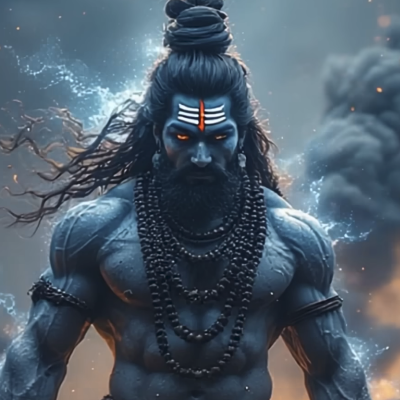
The iconographic manuals describe Bhima in distinctly terrifying terms. He is depicted with a deep red or dark complexion, reflecting the colour of destruction and burning power. His face is shown as jackal-like with fearsome fangs, an image combining the ferocity of the wild animal with divine authority. He wears a garland of skulls and carries the khatvanga — the skull-staff, a weapon formed from a staff surmounted by a skull — which is a characteristic weapon of the most extreme ascetic and destructive forms of Shiva. His expression is one of fierce anger. These features distinguish Bhima iconographically from his brothers: where Pingala is golden and luminous, and Kapali is ash-white and death-accepting, Bhima is red-dark and ferocious, the unambiguous image of divine force on the battlefield. The general attributes shared by all eleven Rudras — matted hair, serpents, trident, crescent moon, lion-skin garments, and yellow-hued throat — also apply to Bhima.
✦ Textual Variants and Inconsistencies
The name Bhima does not appear in the Matsya Purana's list of eleven Kashyapa–Surabhi Rudras, which replaces it with other names entirely. It is absent from the Bhagavata Purana's two lists, the Vayu Purana's Kashyapa–Surabhi list, and the Vishnu Purana's eleven names from the Ardhanari division. Bhima as the third Rudra is thus a feature specific to the Shiva Purana's Shata-Rudra Samhita enumeration and its counterpart in the Jyotisha tradition's Rudramsha system, where the same list of eleven governs the eleven-division astrological chart. One secondary source draws on the Shiva Purana to associate a Bhima Rudra avatar narrative with the slaying of a demon sometimes identified as Bakasura, but this association requires caution: Bakasura in the Mahabharata is killed by the Pandava Bhima, not by any Rudra, and the Puranic narrative conflating the two Bhimas is found in later retellings rather than in the primary Shiva Purana text itself. These variant and conflated readings are noted here but should not be treated as canonical primary-source accounts.
✦ Connection to the Wider Genealogy
Bhima belongs to the same dual lineage as all eleven Ekadasha Rudras. Through his father Kashyapa Prajapati, a son of Brahma, Bhima is a grandson of the creator on the paternal side. Through his mother Surabhi, daughter of Daksha Prajapati — himself a son of Brahma — Bhima is also a maternal grandson of Daksha. As an incarnation of Shiva, Bhima stands in identity with the supreme Rudra, whose most formidable warrior-destroyer aspect he most fully embodies among the eleven. His consort Usana, as a Rudrani, is theologically understood as a manifestation of Shakti in the mode of burning will and ardour, the feminine counterpart that activates Bhima's martial power into directed cosmic action.
✦ References
Primary Sources
- Shiva Purana, Shata-Rudra Samhita, Chapter 3, Section 17: Names Bhima as the third of the eleven Rudras born from Kashyapa and Surabhi; sets the collective origin narrative and martial mission of the Ekadasha Rudras.
- Harivamsha, Harivamsa Parva 1.3.49–50 and 3.36.50–51: Primary authority for the Kashyapa–Surabhi parentage of all eleven Rudras, affirming Surabhi's role as mother through Mahadeva's grace and her own austerities.
- Vishnu Purana 1.7: Names Usana as the third of the eleven Rudranis, paired as consort with the third Rudra.
- Brihadaranyaka Upanishad: Identifies the eleven Rudras with the ten vital energies in the body and the Atman as the eleventh, providing the philosophical basis for the pranic correspondence of each Rudra.
- Vayu Purana 1.25.67: Maps the eleven Rudras to the eleven vital breaths and functions of the living body, supporting the physiological significance of each Rudra including Bhima.
- Rupamandana and Vishvakarmashilpa (texts of sacred iconography): Prescribe Bhima's specific iconographic features including his deep red or dark complexion, jackal face, terrible fangs, skull garland, and khatvanga staff.
- Jyotisha Shastra (Rudramsha system): Preserves the same eleven-Rudra list as the Shiva Purana, placing Bhima third, and assigns each Rudra governance over one division of the eleven-part astrological chart.
Modern Reference Works
- Sreenivasarao's Blogs, "The Rudras Eleven": Provides iconographic details of Bhima Rudra from multiple classical texts including the khatvanga, skull garland, jackal face, and deep red complexion; surveys the inconsistency of iconographic prescriptions across traditions.
- Exotic India Art, "11 Rudra Avatars of Lord Shiva": Describes Bhima Rudra's martial significance, dark blue-black warrior appearance, and the Bhima Rudra Homa ritual within the Shiva Purana framework.
- Wisdomlib, "Number of Rudra" (Rudra-Shiva Concept Study): Provides comparative Puranic references establishing the different eleven-Rudra lists and contextualising Bhima's absence from traditions other than the Shiva Purana list.