
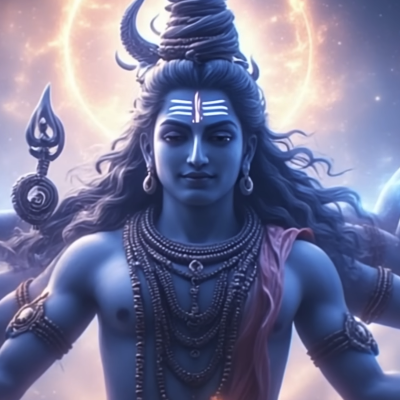
About
Virupaksha — Fourth of the Eleven Rudras, the Diversely-Eyed All-Seeing Form
Virupaksha · Virupaksa · Virūpākṣa · Ekadasha Rudra No. 4 · Son of Kashyapa and Surabhi
Virupaksha is the fourth of the eleven Rudras, the Ekadasha Rudras, named in the Shata-Rudra Samhita of the Shiva Purana as incarnations of Shiva born through Surabhi, the divine wish-fulfilling cow and wife of the sage Kashyapa Prajapati. The name Virupaksha means one whose eyes are deformed, irregular, or diversely constituted — a reference to Shiva's three eyes, the sun, moon, and fire, which are not two ordinary human eyes but a set of perceptual organs spanning the visible, the nocturnal, and the transcendent. This Rudra embodies Shiva's cosmic omniscience, his capacity to perceive simultaneously across all planes of existence, all times, and all directions. His consort among the eleven Rudranis is Uma, named fourth in the Vishnu Purana's (1.7) list of the feminine powers paired with the Rudras — a pairing of extraordinary significance, since Uma is one of the most celebrated names of Parvati, the supreme consort of Shiva himself. Virupaksha is attested as an epithet of Shiva in the Vayu Purana, appears as a name in the Mahabharata, and is the presiding deity of the celebrated Virupaksha temple at Hampi in Karnataka.
✦ The Name
The Sanskrit compound Virūpākṣa is formed from virūpa, meaning deformed, irregular, unlike the usual, or diversely constituted, and akṣa, meaning eye or eyes. The compound thus yields the sense of one having deformed, irregular, or manifold eyes. In the Shaiva tradition, this is consistently interpreted as a reference to Shiva's possession of three eyes — two ordinary eyes and the third, vertical eye on the forehead which is the eye of fire and higher perception, the eye that burned Kama to ash when opened. The Vayu Purana names Virupaksha as another name for Shiva, explicating this as Shiva having the sun, moon, and fire as his three eyes. An alternate interpretation found in Buddhist tradition renders virūpa as meaning various or manifold, yielding the sense of many-eyed or all-seeing — a reading that aligns with the Hindu theological understanding of Virupaksha as the form of Shiva who perceives all things without obstruction. The Mahabharata uses Virupaksha both as an epithet of Rudra and as the name of a Gana-chief who participated in Virabhadra's campaign against Daksha's sacrifice.
✦ Lineage
- Father: Kashyapa Prajapati — the great progenitor sage, a mind-born son of Brahma, and father of the Devas through Aditi. In the Shiva Purana, Kashyapa performed austerities at Kashi and received from Shiva the boon of the god's incarnation through his wife Surabhi as the eleven Rudras.
- Mother: Surabhi — the divine wish-fulfilling cow, daughter of Daksha Prajapati and wife of Kashyapa. The Harivamsha (Harivamsa Parva 1.3.49–50) records that the eleven Rudras were produced through Surabhi by the grace of Mahadeva and the power of her own austerities.
- Brothers: The ten remaining Ekadasha Rudras — Kapali, Pingala, Bhima, Vilohita, Shastra, Ajapada, Ahirbudhnya, Shambhu, Chand, and Bhava — all born simultaneously from Surabhi as incarnations of Shiva.
- Consort: Uma — named fourth among the eleven Rudranis in the Vishnu Purana (1.7). Uma is among the most prominent names of the goddess Parvati, the supreme consort of Shiva, and daughter of Himavat, the king of the Himalayas. Her pairing specifically with Virupaksha among the eleven Rudranis — and not with any of the others — is noteworthy given her supreme status in the tradition, and reflects the identification of this Rudra form with Shiva's own cosmic-perceptive aspect.
✦ The Origin Narrative
Virupaksha shares the collective birth narrative of the eleven Rudras as narrated in the Shata-Rudra Samhita of the Shiva Purana. The Devas, driven from Amaravati by the Rakshasas, sought the help of Kashyapa, who undertook intensive austerities at Kashi. Shiva, pleased with Kashyapa's devotion, consented to be born as eleven sons through Surabhi. Virupaksha was born as the fourth of these sons, embodying the aspect of Shiva as the cosmic perceiver — the form whose omnidirectional vision ensures that no demon, no deceit, and no violation of dharma can remain hidden or escape divine reckoning. Together with his brothers and their vast host of attendant Rudras, Virupaksha fought against the demon forces, his all-encompassing perception giving the Rudra host a decisive advantage in detecting and tracking the movements of their enemies.
✦ Virupaksha as a Presiding Deity and Linga
The Shaiva Agamas record Virupaksha as a presiding deity of one of the sixty-eight svayambhuva lingas — the self-manifested lingas held to be among the most sacred in the tradition. According to the Jirnoddharadashaka commentary by Nigamajnanadeva, Virupaksha presides over the linga at Hemakuta. The Virupaksha temple at Hampi in Karnataka is the most celebrated site of Virupaksha worship and has been a continuously active place of worship from at least the Chalukya period onwards. The temple was the tutelary shrine of the first dynasty of the Vijayanagara Empire, whose kings claimed the patronage of Virupaksha as their royal protector. The Shiva Purana also names Virupaksha as the lord of Ganas who led sixty-four crore Gana warriors in Virabhadra's great campaign against the sacrifice of Daksha — though this figure is identified as a Gana-chief in that context rather than as the Ekadasha Rudra directly.
✦ Theological and Philosophical Significance
Virupaksha embodies Shiva's omniscient aspect — the capacity of divine consciousness to perceive simultaneously without the limitations that constrain ordinary sight. Where the two ordinary eyes perceive the visible world in the present moment, the third eye of Shiva ranges across time, across hidden dimensions, and into the interior of beings. The Vayu Purana's identification of Virupaksha's three eyes as the sun, moon, and fire encodes a cosmological vision: the sun governs the daytime world of manifest activity, the moon governs the night world of the subtle and the emotional, and fire governs the transformative, the sacrificial, and the destructive-purificatory. The deity who possesses all three simultaneously sees everything that exists, has existed, and will exist across all registers of cosmic life. In the Brihadaranyaka Upanishad's scheme of the Rudras as the ten vital energies and the Atman, Virupaksha corresponds to one of the perceptual vital functions — appropriately, the one governing awareness and the faculty of vision in the widest sense.
✦ Iconography
The Vishvakarmasilpa, a classical text of sacred iconographic prescription, provides the most detailed description of Virupaksha among the iconographic manuals. It describes him as a sixteen-armed divine form bearing a formidable array of weapons and ritual objects. In his eight right hands he holds the khadga (sword), shula (trident), damaru (hand drum), ankusha (goad), sarpa (serpent), chakra (discus), gada (mace), and akshamala (rosary of beads). In his eight left hands he holds the khetaka (shield), khatvanga (skull-staff), shakti (lance), parashu (axe), tarjani (the gesture of warning or admonishment), ghata (pot), ghanta (bell), and kapala (skull-cup). This elaborate sixteen-armed form places Virupaksha among the most iconographically complex of the eleven Rudras, his many weapons encoding the full spectrum of Shiva's capacities — from the contemplative rosary and ritual drum to the most martial sword and axe. Notably, the Rupamandana places Virupaksha tenth rather than fourth in its own enumeration of the twelve Rudra forms, reflecting a different ordering tradition within the iconographic corpus.
✦ Textual Variants and Inconsistencies
Virupaksha appears as the fourth Rudra in the Shiva Purana's Shata-Rudra Samhita list and in the Jyotisha Rudramsha system, but does not appear in the Matsya Purana's Kashyapa–Surabhi list, the Bhagavata Purana's two lists, or the Vishnu Purana's eleven names. The Vayu Purana and Linga Purana both include Virupaksha in their own eleven-Rudra lists — but in those texts the position is third, not fourth, and the parentage differs. The Rupamandana, a later iconographic manual, enumerates twelve rather than eleven Rudra forms and places Virupaksha tenth among those twelve — indicating that different schools of iconographic practice did not all follow the Shiva Purana's ordering. The Mahabharata uses Virupaksha as a name in multiple different contexts: as an epithet of Rudra-Shiva, as the name of a Gana-chief, and as the name of a Rakshasa who fought in Ravana's army against Rama — these are distinct figures sharing the same name, a common feature of the Puranic naming tradition, and should not be conflated.
✦ Connection to the Wider Genealogy
Virupaksha belongs to the same dual lineage as all eleven Ekadasha Rudras. Through his father Kashyapa Prajapati, a son of Brahma, he is a paternal grandson of Brahma the creator. Through his mother Surabhi, daughter of Daksha Prajapati — himself a son of Brahma — Virupaksha is also a maternal grandson of Daksha. The pairing of Virupaksha with Uma as his Rudrani is theologically the most charged among all eleven Rudra-Rudrani pairings, since Uma is the name of Parvati herself in one of her most celebrated forms — the daughter of Himavat and the supreme Shakti. This places Virupaksha in a unique position among the eleven: his consort is not merely a derivative feminine energy but the very goddess who is Shiva's own eternal companion at the cosmic level, here paired specifically with the omniscient-perceiving Rudra form.
✦ References
Primary Sources
- Shiva Purana, Shata-Rudra Samhita, Chapter 3, Section 17: Names Virupaksha as the fourth of the eleven Rudras born from Kashyapa and Surabhi; also names him as a Gana-chief in the Daksha sacrifice episode.
- Harivamsha, Harivamsa Parva 1.3.49–50: Primary authority for the Kashyapa–Surabhi parentage of all eleven Rudras.
- Vishnu Purana 1.7: Names Uma as the fourth Rudrani, consort of the fourth Rudra.
- Vayu Purana 68.11: Gives Virupaksha as an epithet of Shiva, explicating it as referring to Shiva's three eyes — the sun, moon, and fire.
- Linga Purana: Includes Virupaksha in its own enumeration of the eleven Rudras, placing him third in its ordering.
- Mahabharata (I.59.25, I.65, I.61.22): Uses Virupaksha as an epithet of Rudra and as a name in Puranic genealogical contexts.
- Vishvakarmasilpa (Vishvakarma Shilpa): Provides the most detailed iconographic prescription for Virupaksha as the fourth Ekadasha Rudra, describing his sixteen-armed form with its full complement of weapons and ritual objects.
- Rupamandana: Lists Virupaksha as the tenth of twelve Rudra forms in its alternate iconographic enumeration, establishing a variant ordering.
- Jirnoddharadashaka commentary by Nigamajnanadeva: Records Virupaksha as the presiding deity of the svayambhuva linga at Hemakuta.
- Brihadaranyaka Upanishad: Identifies the eleven Rudras with the ten vital energies in the body and the Atman, providing the philosophical framework for Virupaksha's correspondence with perceptual faculty.
Modern Reference Works
- Wisdomlib, "Virupaksha: 36 definitions": Comprehensive survey of the name's usage across Shaivism, Shilpashastra, Purana, Dharmashastra, Mahabharata, and Buddhist contexts; provides the Vishvakarmasilpa iconographic prescription in detail.
- Wikipedia, "Virupaksha": Gives the etymology of the Sanskrit compound virūpa and akṣa and notes the Buddhist interpretation of virūpa as various, yielding the all-seeing sense.
- Exotic India Art, "11 Rudra Avatars of Lord Shiva": Describes Virupaksha's cosmic vision, iconographic weapons list, and his role as the all-perceiving form within the Shiva Purana framework.