
About
Vilohita — Fifth of the Eleven Rudras, the Deep Fiery-Red Form
Vilohita · Vilohit · Nilalohita · Ekadasha Rudra No. 5 · Son of Kashyapa and Surabhi
Vilohita is the fifth of the eleven Rudras, the Ekadasha Rudras, named in the Shata-Rudra Samhita of the Shiva Purana as incarnations of Shiva born through Surabhi, the divine wish-fulfilling cow and wife of the sage Kashyapa Prajapati. The name Vilohita denotes a deep fiery red — specifically the intense crimson of burning fire — and this Rudra embodies Shiva's aspect as the purifying, destroying, and regenerating power of fire. Vilohita is the Rudra of active combustion: the divine force that burns away impurity, destroys hostile forces, and through destruction makes renewal possible. His consort among the eleven Rudranis is Niyuta, named fifth in the Vishnu Purana's (1.7) list of the feminine powers paired with the Rudras. The name Vilohita has an ancient Vedic pedigree — the Yajurveda Samhitas use the related form Nilalohita as an epithet of Rudra himself, signifying the deity's dual blue-and-red chromatic nature, of which Vilohita represents the intensely red, fiery pole.
✦ The Name
The Sanskrit word vilohita is formed from the prefix vi-, conveying intensity or completeness, and lohita, meaning red, blood-red, or the colour of fire. The compound thus means deeply or intensely red — the vivid crimson of flame at its most concentrated. In the tradition of Vedic colour symbolism applied to Rudra, the red or lohita hue specifically represents the fiery, inflicting, and destroying aspect of the deity — the face of divine power directed outward in action against that which must be purged or consumed. The Atharva Veda and the Yajurveda Samhitas both use the compound name Nilalohita — blue-and-red — as a name for Rudra, in which nila, the blue-black of storm and of the held poison in Shiva's throat, represents his overwhelming of evil, while lohita, the red, represents his infliction of consequence upon those who oppose the divine order. The Yajurveda Samhitas further shorten this to Vilohita — the purely red form — as a standalone epithet. The same Sanskrit root lohita gives the name of one of the seven tongues of Agni, the fire god, attesting to the deep identification of this colour with divine fire across the Vedic tradition. Vilohita Rudra is therefore not merely a warrior with a red complexion but the embodiment of Shiva's fiery principle — the purifying, transformative heat that is at the core of the Vedic sacrificial order.
✦ Lineage
- Father: Kashyapa Prajapati — the great progenitor sage, a mind-born son of Brahma, and father of the Devas through Aditi. In the Shiva Purana, Kashyapa performed austerities at Kashi and received from Shiva the boon of the god's incarnation through Surabhi as the eleven Rudras.
- Mother: Surabhi — the divine wish-fulfilling cow, daughter of Daksha Prajapati and wife of Kashyapa. The Harivamsha (Harivamsa Parva 1.3.49–50) affirms that the eleven Rudras were produced through Surabhi by the grace of Mahadeva and the power of her own austerities.
- Brothers: The ten remaining Ekadasha Rudras — Kapali, Pingala, Bhima, Virupaksha, Shastra, Ajapada, Ahirbudhnya, Shambhu, Chand, and Bhava — all born simultaneously from Surabhi as incarnations of Shiva.
- Consort: Niyuta — named fifth among the eleven Rudranis in the Vishnu Purana (1.7). The word niyuta in Sanskrit carries the meaning of appointed, fixed, bound, or multiplied — a feminine power of directed, purposeful energy that appropriately pairs with Vilohita's blazing, concentrated destructive-purifying force.
✦ The Origin Narrative
Vilohita shares the collective birth narrative of the eleven Rudras as narrated in the Shata-Rudra Samhita of the Shiva Purana. When the Devas, led by Indra, were expelled from Amaravati by the Rakshasas, Kashyapa Prajapati undertook severe austerities at Kashi to invoke Shiva. Pleased with Kashyapa's devotion, Shiva consented to be born as eleven sons through Surabhi. Vilohita was born as the fifth of these sons, manifesting the aspect of Shiva as the consuming, purifying fire that destroys what is corrupt and clears the cosmic ground for renewal. Together with his ten brothers and their host of attendant Rudras, Vilohita fought the demon forces, his fiery power cutting through darkness and evil with the concentrated heat of divine flame.
✦ The Vilohita Narrative and the Demon Andhaka
A secondary Puranic narrative, preserved in later sources drawing on the Shiva Purana tradition, associates Vilohita with the destruction of the demon Andhaka. Andhaka — a figure of complex origin, described in Puranic texts as a blind demon who acquired tremendous power through penance — began tormenting the gods and disrupting the cosmic order. In response to the gods' prayers, Shiva manifested in the fierce form of Vilohita, described as having been produced from the blazing energy of Shiva's third eye. In this fiery manifestation, Vilohita confronted Andhaka in an intense battle and ultimately defeated him. This account requires some caution: in the primary Puranic texts, the destruction of Andhaka is most consistently attributed to Shiva himself or to Virabhadra, not specifically to Vilohita as a separate Rudra figure. The attribution to Vilohita appears in secondary retellings that conflate the fire-born Rudra with other fire-born manifestations of Shiva's third eye. The detail is noted here as a later narrative association rather than a primary-source statement.
✦ Vedic Antecedents: Nilalohita and the Colour of Rudra
The name Vilohita connects the fifth Rudra directly to an ancient stratum of Vedic theology concerning the colours of the deity Rudra. Both the Atharva Veda and the Yajurveda Samhitas — both the Shukla and Krishna recensions — address Rudra by the compound epithet Nilalohita, meaning blue-and-red. Commentators and scholars have interpreted this compound in multiple ways: as the colour of smoke-covered fire, where the dark blue represents the smoke and the red represents the flame; as the colour of the sky at sunset; and as a cosmological statement that Rudra encompasses both the dark, withdrawing aspect of consciousness and the burning, inflicting aspect. The Atharva Veda provides a specific theological gloss: the blue signifies how Rudra overwhelms evil, while the red signifies how he inflicts consequence on those who oppose him. The Krishna and Shukla Yajurveda each employ Vilohita as a standalone name derived from this compound, isolating the red-fiery dimension as an independent epithet. This gives Vilohita a textual depth exceeding most of his Rudra brothers, whose names are largely Puranic rather than Vedic.
✦ Theological and Philosophical Significance
Within the framework of the eleven Rudras, Vilohita occupies the register of fire and active purification. Where Kapali governs death-acceptance, Pingala governs solar vitality, Bhima governs martial power, and Virupaksha governs omniscient perception, Vilohita governs the specifically transformative function of fire — the irreversible process of burning that destroys form to release what is essential. In the Vedic sacrificial tradition, fire is the medium of all offering: the oblation cast into fire is not destroyed but transformed, reaching the divine realm in a changed state. Vilohita as the red Rudra represents this same principle at the cosmic scale — the divine force that consumes what is impure, releases what is true, and makes possible the renewal of the cycle. In the Brihadaranyaka Upanishad's correspondence of the eleven Rudras with the eleven vital functions, Vilohita corresponds to one of the vital energies governing the body's internal heat and metabolic fire. The Vayu Purana's mapping of the Rudras to the pranic system similarly positions this Rudra within the thermal and digestive functions of the subtle body.
✦ Iconography
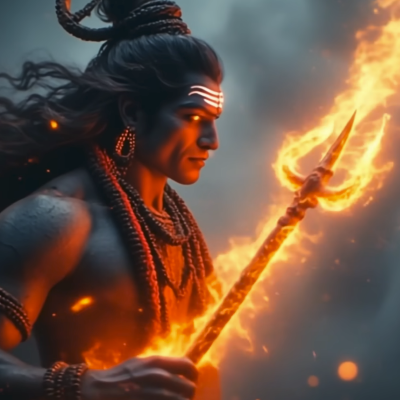
Vilohita is depicted with a vivid blood-red or burning-red complexion — the colour of active fire rather than the deep dark red of Bhima or the golden-yellow of Pingala. His form is described as terrifying in aspect, embodying the heat and light of a blazing conflagration. He shares the general iconographic features of all eleven Rudras: matted hair, serpents as ornaments, trident, crescent moon on the forehead, lion-skin garments, and yellow-hued throat. His specific attributes within the iconographic tradition emphasise fire-associated weapons and the instruments of purificatory destruction. The Rigveda's description of Rudra as a multihued deity — pururupa, of many colours — has been understood by later commentators as a foundation for the distinct chromatic identities of the eleven Rudras, of which Vilohita's deep red is the most elementally fire-associated.
✦ Textual Variants and Inconsistencies
Vilohita appears as the fifth Rudra in the Shiva Purana's Shata-Rudra Samhita list and is preserved in the Jyotisha Rudramsha enumeration. The name does not appear in the Matsya Purana's Kashyapa–Surabhi list, the Bhagavata Purana's two lists, the Vayu Purana's Kashyapa–Surabhi list, or the Vishnu Purana's own eleven names born from the Ardhanari division. The closely related form Nilalohita — encompassing both the blue and the red aspect — appears across several Puranas as a standalone Shiva epithet and occasionally as a distinct entry in alternate Rudra lists, creating an overlap between the name Vilohita as a specific Ekadasha Rudra and Nilalohita as a broader Shiva epithet. These two should be understood as closely related but textually distinguishable: Nilalohita emphasises the dual chromatic nature, while Vilohita isolates and intensifies the red-fire pole alone.
✦ Connection to the Wider Genealogy
Vilohita belongs to the same dual lineage as all eleven Ekadasha Rudras. Through his father Kashyapa Prajapati, a son of Brahma, he is a paternal grandson of Brahma. Through his mother Surabhi, daughter of Daksha Prajapati — himself a son of Brahma — he is also a maternal grandson of Daksha. As an incarnation of Shiva, Vilohita stands in identity with the supreme Rudra's fiery, purifying aspect, carrying into the Puranic framework a name whose roots reach directly into the Vedic Samhita tradition. His consort Niyuta, as the fifth Rudrani, represents the directed, purposive dimension of Shakti — the feminine power of fixed and unwavering focus that activates and channels Vilohita's consuming fire toward its cosmic purpose.
✦ References
Primary Sources
- Shiva Purana, Shata-Rudra Samhita, Chapter 3, Section 17: Names Vilohita as the fifth of the eleven Rudras born from Kashyapa and Surabhi; describes the collective origin, mission, and battle of the Ekadasha Rudras.
- Harivamsha, Harivamsa Parva 1.3.49–50 and 3.36.50–51: Primary authority for the Kashyapa–Surabhi parentage of all eleven Rudras.
- Vishnu Purana 1.7: Names Niyuta as the fifth Rudrani, consort of the fifth Rudra.
- Krishna Yajurveda (Taittiriya Samhita) and Shukla Yajurveda (Vajasaneyi Samhita): Both Samhitas use Vilohita as an epithet of Rudra, derived from the compound Nilalohita — the blue-and-red form — and isolating the intensely red dimension as a standalone Vedic name.
- Atharva Veda 15.1.8: Gives the theological interpretation of Rudra's dual colours, blue and red, specifying that the red represents his infliction of consequence on those who oppose him — the theological foundation for the Vilohita epithet.
- Rigveda 2.33.9: Describes Rudra as pururupa, of many colours, providing the Vedic basis for the distinct chromatic identities of the individual Rudras including Vilohita.
- Brihadaranyaka Upanishad: Identifies the eleven Rudras with the ten vital energies in the body and the Atman, providing the philosophical framework for Vilohita's correspondence with bodily heat and metabolic fire.
- Vayu Purana 1.25.67: Maps the eleven Rudras to the eleven vital breaths and functions of the living body.
Modern Reference Works
- Sanatana Dhara, "Shiva-Rudra across Vedas to Itihasa": Provides detailed analysis of the Vedic colour-names of Rudra including Nilalohita and Vilohita, with citations from the Atharva Veda and both Yajurveda Samhitas; notes the theological interpretation of the red hue as Rudra's role of inflicting consequence.
- Wisdomlib, "Rudra as Nilalohita": Surveys the Puranic and Vedic usage of Nilalohita as a name of Rudra, with citation of the Vajasaneyi Samhita commentary by Mahidhara.
- Exotic India Art, "11 Rudra Avatars of Lord Shiva": Describes Vilohita's fire symbolism, blood-red appearance, and role as the destroyer of evil and darkness within the Shiva Purana framework.