
About
Ahirbudhnya — Eighth of the Eleven Rudras, the Serpent of the Depths
Ahirbudhnya · Ahirbradhna · Ahirabradhya · Ahi Budhnya · Ekadasha Rudra No. 8 · Son of Kashyapa and Surabhi
Ahirbudhnya is the eighth of the eleven Rudras, the Ekadasha Rudras, named in the Shata-Rudra Samhita of the Shiva Purana as incarnations of Shiva born through Surabhi, the divine wish-fulfilling cow and wife of the sage Kashyapa Prajapati. The name means the serpent of the deep, or the serpent of the foundation, and this Rudra embodies Shiva as the hidden, foundational cosmic force that lies beneath the surface of manifest creation — the subterranean serpent energy that sustains the worlds from below, precisely as Ajapada supports them from above. Ahirbudhnya is one of the most ancient figures in this series: like Ajapada, he appears in the Rigveda itself and in nearly every subsequent Puranic enumeration of the Rudras, paired almost invariably with Ajapada as his complementary counterpart. His consort among the eleven Rudranis is Iravati, named eighth in the Vishnu Purana's (1.7) list. Ahirbudhnya is also the presiding deity of the nakshatra Uttarabhadrapada, and a Pancharatra text — the Ahirbudhnya Samhita — bears his name.
✦ The Name
The Sanskrit compound Ahirbudhnya is formed from ahir, a Vedic and classical form meaning serpent, and budhnya, meaning of the deep, of the foundation, or of the bottom — derived from budhna, the base, the deep, the fundament. The compound thus means the serpent of the deep, or the serpent at the foundation of things. In the Rigveda, budhna is used of the deepest part of the atmospheric ocean as well as the base or root of the cosmic structure; Ahirbudhnya is therefore the serpent coiled at the very base of the cosmos. The name appears in variant forms across texts — Ahirbradhna in the Vayu Purana list, Ahirabradhya in the Matsya Purana list, and Ahi Budhnya in the Rigveda — reflecting the same underlying compound with phonological variations across manuscript traditions. The serpent imagery is theologically precise: the serpent coiled at the foundation, not striking outward, represents dormant and latent power, the unawakened creative potential of the cosmos, the subterranean ocean of consciousness that underlies all manifest activity without itself becoming visible or active in ordinary experience.
✦ Lineage
- Father: Kashyapa Prajapati — the great progenitor sage, a mind-born son of Brahma, and father of the Devas through Aditi. In the Shiva Purana, Kashyapa performed austerities at Kashi and obtained from Shiva the boon of incarnation through Surabhi as the eleven Rudras.
- Mother: Surabhi — the divine wish-fulfilling cow, daughter of Daksha Prajapati and wife of Kashyapa. The Harivamsha (Harivamsa Parva 1.3.49–50) affirms that the eleven Rudras were produced through Surabhi by the grace of Mahadeva and her own austerities.
- Brothers: The ten remaining Ekadasha Rudras — Kapali, Pingala, Bhima, Virupaksha, Vilohita, Shastra, Ajapada, Shambhu, Chand, and Bhava — all born simultaneously from Surabhi as incarnations of Shiva. Ajapada, the seventh Rudra, is Ahirbudhnya's most closely paired sibling, reflecting the ancient Vedic pairing of Aja Ekapada and Ahi Budhnya as complementary cosmic principles.
- Consort: Iravati — named eighth among the eleven Rudranis in the Vishnu Purana (1.7). The name Iravati is associated with the great river Ravi in the Punjab, and carries meanings of refreshing, nourishing, and the life-giving power of flowing water. The pairing of the serpent-of-the-deep with the goddess of flowing water is cosmologically coherent: the subterranean serpent energy governs the deep, static waters of the cosmic foundation, while Iravati represents the dynamic, nourishing waters flowing through the manifest world that those depths ultimately feed.
- Alternative parentage: The Vishnu Purana gives a different genealogy for Ahirbudhnya in a non-Rudra context, describing him as a son of Vishvakarma, the divine architect. This is a separate textual tradition and refers to a different figure sharing the name, not the Ekadasha Rudra of the Shiva Purana.
✦ Vedic Antecedents: Ahi Budhnya in the Rigveda
Ahi Budhnya appears in the Rigveda, most notably in RV 6.49.14, as a figure invoked for protection alongside other cosmic deities. In the Vedic hymns, he appears almost exclusively in the company of Aja Ekapada — the two are consistently paired in five or more Rigvedic hymns as a complementary divine dyad. The scholar V. S. Agrawala interpreted them as twin aspects of the same underlying deity: Aja Ekapada being the upward-reaching pillar of fire or light that connects earth to heaven, and Ahi Budhnya being the downward-coiling serpent that penetrates the cosmic depths. This above-below pairing encodes a complete cosmological model — the axis mundi in its two directions, the vertical fire ascending and the serpent-root descending, together forming the total axis of cosmic existence. The Paraskara Grihya Sutra records both as recipients of ritual libations in domestic ceremony, attesting to their continued cultic recognition beyond the Samhita period.
✦ The Origin Narrative
Ahirbudhnya shares the collective birth narrative of the eleven Rudras as narrated in the Shata-Rudra Samhita of the Shiva Purana. When the Devas were expelled from Amaravati, Kashyapa undertook austerities at Kashi and obtained from Shiva the boon of incarnation as eleven sons through Surabhi. Ahirbudhnya was born as the eighth, embodying the aspect of Shiva as the hidden, foundational, subterranean power — the force that does not manifest openly but sustains all manifest activity from its concealed position in the cosmic depths. In the battle against the Rakshasas, Ahirbudhnya's role was the unshakeable stabilising force: the deep-water foundation that remained constant beneath the turbulence of the battle above, supporting the entire effort of the eleven Rudras with his inexhaustible hidden power.
✦ Ahirbudhnya and the Nakshatra Uttarabhadrapada
In the Jyotisha tradition, Ahirbudhnya is the presiding deity of the nakshatra Uttarabhadrapada — the twenty-sixth of the twenty-seven lunar mansions, spanning the middle and latter portions of Pisces. The shakti associated with this nakshatra is varshodhyamana — the power to bring rain and to grow plants from below upward, the power of the subterranean waters to nourish the surface world. Uttarabhadrapada is paired with Purvabhadrapada, whose deity is Aja Ekapada, preserving the ancient Vedic pairing of the two deities in the astrological framework just as it is preserved in the Puranic one. The nakshatra is characterised by depth, hidden power, spiritual maturation, and the endurance that sustains long processes from their foundation. The two adjacent nakshatras together — Purvabhadrapada with Ajapada and Uttarabhadrapada with Ahirbudhnya — form a complementary pair encoding the full axis of cosmic support: the above and the below, fire and water, the ascendant pillar and the descending serpent-root.
✦ The Ahirbudhnya Samhita
The Ahirbudhnya Samhita is a text within the Pancharatra tradition — a body of Vaishnava Agamic literature — that bears Ahirbudhnya's name as its presiding authority. The text deals with rituals, mantras, and the worship of the Sudarshana Chakra, Vishnu's divine discus, as well as esoteric teachings on Kundalini energy and inner transformation. Its association with Ahirbudhnya reflects the deity's ancient connection with hidden subterranean power and the coiled energy of the cosmic serpent — characteristics that translate naturally into the Tantric and Pancharatra framework of Kundalini and cosmic force. The existence of this text, despite its Vaishnava context, attests to the breadth of Ahirbudhnya's presence across the tradition as a figure whose serpentine, foundational character transcends any single sectarian affiliation.
✦ Theological and Philosophical Significance
Among the eleven Rudras, Ahirbudhnya is the most subterranean in character — the only one whose primary identity is explicitly rooted below the surface of the manifest world. Where the other Rudras govern manifest qualities — death, solar vitality, force, perception, fire, command, the pillar above — Ahirbudhnya governs what lies beneath and within. The serpent coiled at the cosmic base is the oldest image in Indian religious iconography of latent, stored, foundational power — the force that has not yet risen, the potential that has not yet become actual, the wisdom that lies in the depth before it surfaces. In the yogic and Tantric tradition this is precisely the imagery of Kundalini — the serpent power coiled at the base of the spine that, when awakened, rises through the Sushumna nadi toward liberation. Ahirbudhnya is thus the deity whose cosmic form corresponds to Kundalini in its dormant state at the muladhara, just as Ajapada's cosmic form corresponds to the Sushumna nadi itself. Together they represent the complete journey of consciousness from its coiled, latent foundation to its upward awakening. The Brihadaranyaka Upanishad's eleven Rudras as the ten vital energies and the Atman provides the philosophical grounding: Ahirbudhnya corresponds to the deepest, most instinctual of the body's vital functions — the foundational prana that sustains life without ever rising to the surface of awareness.
✦ Iconography
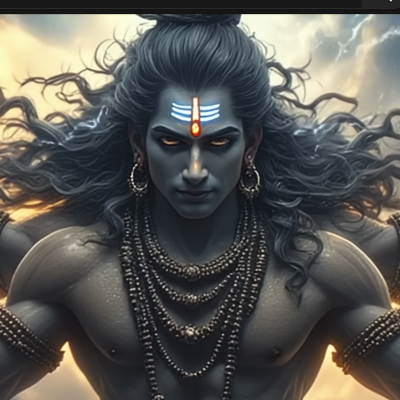
The Vishvakarmasilpa describes Ahirbudhnya as a sixteen-armed deity. In his right hands he holds the gada, chakra, khadga, damaru, mudgara, shula, ankusha, and akshamala; in his left hands he holds the tomara, pattisa, dhala, kapala, tarjani, ghata, shakti, and parashu. He is depicted with serpents coiling about him — around his neck, arms, and body — reflecting his deep identification with the serpentine principle. He is associated with the waters and with the cosmic depths, and his complexion in some traditions is described as dark or blue-grey, befitting the colour of deep water and the underworld. He shares the general iconographic features of all eleven Rudras: matted hair, trident, crescent moon, lion-skin garments, and yellow-hued throat. The serpent symbolism that characterises Shiva across all his forms is most fully concentrated in Ahirbudhnya among the eleven, making him the Rudra in whom Shiva's identification with the naga reaches its most explicit expression.
✦ Textual Variants and Inconsistencies
Ahirbudhnya, in its various phonological forms — Ahirbradhna, Ahirabradhya, Ahirbudhnya — appears in more Puranic Rudra lists than almost any other name in this series, spanning the Rigveda, Mahabharata, Vayu Purana, Brahma Purana, Matsya Purana, Linga Purana, Agni Purana, and Shiva Purana. Its position varies across lists — first or second in many Puranic enumerations (where it is paired with Ajaikapad at the head of the list), and eighth in the Shiva Purana's Shata-Rudra Samhita. The Vishnu Purana in a separate passage names Ahirbudhnya as a son of Vishvakarma — an identification that belongs to a different genealogical layer of the Puranic tradition and should not be conflated with his parentage as an Ekadasha Rudra through Kashyapa and Surabhi. Some Puranas list Aja, Ekapada, and Ahirbudhnya as three distinct Rudras rather than maintaining the pairing of Aja-Ekapada as a single compound name, but the pairing with Ahirbudhnya is consistently maintained regardless of how the Aja Ekapada question is resolved.
✦ Connection to the Wider Genealogy
Ahirbudhnya belongs to the same dual lineage as all eleven Ekadasha Rudras. Through his father Kashyapa Prajapati, a son of Brahma, he is a paternal grandson of the creator. Through his mother Surabhi, daughter of Daksha Prajapati, he is also a maternal grandson of Daksha. As an incarnation of Shiva, Ahirbudhnya stands in identity with the supreme Rudra's aspect as the hidden, foundational, serpentine power that underlies all manifest existence. His consort Iravati, as the eighth Rudrani, represents the flowing, life-giving waters of the manifest world that the deep serpent's foundation nourishes and sustains — the dynamic surface expression of the power whose source lies coiled in the depths below.
✦ References
Primary Sources
- Shiva Purana, Shata-Rudra Samhita, Chapter 3, Section 17: Names Ahirbudhnya as the eighth of the eleven Rudras born from Kashyapa and Surabhi; describes the collective origin, mission, and battle of the Ekadasha Rudras.
- Rigveda (RV 6.49.14 and others): The earliest textual attestation of Ahi Budhnya, appearing in divine enumerations consistently alongside Aja Ekapada.
- Paraskara Grihya Sutra 2.15.2: Records Ahi Budhnya alongside Aja Ekapada as recipients of ritual libations in domestic ceremony.
- Harivamsha, Harivamsa Parva 1.3.49–50 and 3.36.50–51: Primary authority for the Kashyapa–Surabhi parentage of all eleven Rudras.
- Vishnu Purana 1.7: Names Iravati as the eighth Rudrani, consort of the eighth Rudra.
- Mahabharata (Adi Parva): Lists Ahirbudhnya among the eleven Rudras and also among the Maruts; notes the pairing with Ajaikapad.
- Vayu Purana 2.5.68–70: Includes Ahirbradhna in its own Kashyapa–Surabhi list of eleven Rudras.
- Matsya Purana: Includes Ahirabradhya in its own Kashyapa–Surabhi list of eleven Rudras.
- Ahirbudhnya Samhita (Pancharatra tradition): A Vaishnava Agamic text bearing his name as its presiding authority, dealing with Sudarshana Chakra worship and Kundalini teachings.
- Vishvakarmasilpa: Provides the full sixteen-armed iconographic prescription for Ahirbudhnya, detailing his weapons in both right and left hands.
- Brihadaranyaka Upanishad 3.9.4: Identifies the eleven Rudras with the ten vital energies and the Atman, providing the philosophical framework within which Ahirbudhnya corresponds to the deepest foundational vital function.
Modern Reference Works
- Vedicmarga.com, "Ahirbudhnya — Serpent Deity of Uttara Bhadrapada": Surveys his Vedic and Puranic attestations, Kundalini association, Uttarabhadrapada nakshatra rulership, and the Ahirbudhnya Samhita.
- Hindu Blog, "Ahi Budhnya in Vedas": Notes his Rigvedic attestation, the atmospheric ocean serpent reading, and his Mahabharata role as a Rudra and Marut.
- Wikipedia, "Rudras": Documents the various Puranic lists in which Ahirbudhnya appears and the textual inconsistencies around parentage across traditions.
- Nathas.org, "Aja Ekapada": Analyses the inseparable Vedic pairing of Aja Ekapada and Ahi Budhnya as twin aspects of the same cosmic reality, providing the theoretical foundation for understanding Ahirbudhnya as Ajapada's complement.