
About
Chand — Tenth of the Eleven Rudras, the Ferocious Destroyer of Evil and Arrogance
Chand · Chanda · Chandan · Ekadasha Rudra No. 10 · Son of Kashyapa and Surabhi
Chand is the tenth of the eleven Rudras, the Ekadasha Rudras, named in the Shata-Rudra Samhita of the Shiva Purana as incarnations of Shiva born through Surabhi, the divine wish-fulfilling cow and wife of the sage Kashyapa Prajapati. The name Chand means ferocious, violent, fierce, or wrathful — a word that reaches toward the most extreme edge of Shiva's destructive capacity, beyond even the physical force of Bhima, into the register of uncontrolled divine rage directed at moral evil. Chand is Shiva as the destroyer of arrogance, injustice, and ignorance, the protector who strikes with terrible and irresistible force against whatever violates cosmic order, the guardian invoked in times of crisis when all subtler remedies have failed. His consort among the eleven Rudranis is Diksha, named tenth in the Vishnu Purana's (1.7) list. The pairing of the most ferocious Rudra with Diksha — the goddess of sacred initiation — is theologically striking, encoding the principle that the most extreme destructive power of the divine is always inseparably linked to the transformative discipline that makes liberation possible. This Rudra is known also in Tantric and Shakta traditions through the compound form Chanda-Rupa or in relation to the demon Chanda whom the goddess Chandika slays in the Devi Mahatmya — though the Ekadasha Rudra Chand and the demon Chanda of that text are distinct figures sharing a common name-root.
✦ The Name
The Sanskrit word chanda or chand derives from the root chand, carrying the senses of fierce, violent, passionate, burning with intensity, and wrathful. It is a word applied to the most extreme manifestations of inner fire when turned outward in action — the blazing, consuming wrath of one who has no tolerance for injustice or the profanation of sacred order. In the tradition of the divine epithets, chanda appears as a component of several important Shaiva and Shakta names: Mahachanda (the great ferocious one), Chandeshvara (lord of the fierce, a name of Shiva), and Chandika (the ferocious goddess, another name of Durga). The same root also gives rise to Chandala — one who burns — a word with complex social and ritual meanings across the tradition. In the context of Chand Rudra, the name encodes the principle that Shiva's most uncompromising, blazing destructive force — beyond the structured martial power of Bhima, beyond the solar energy of Pingala, beyond even the consuming fire of Vilohita — is ultimately a protective and righteous force directed against whatever opposes the divine order. Chand is not random violence but concentrated divine fury with a moral target.
✦ Lineage
- Father: Kashyapa Prajapati — the great progenitor sage, a mind-born son of Brahma, and father of the Devas through Aditi. In the Shiva Purana, Kashyapa performed austerities at Kashi and obtained from Shiva the boon of incarnation through Surabhi as the eleven Rudras.
- Mother: Surabhi — the divine wish-fulfilling cow, daughter of Daksha Prajapati and wife of Kashyapa. The Harivamsha (Harivamsa Parva 1.3.49–50) affirms that the eleven Rudras were produced through Surabhi by the grace of Mahadeva and her own austerities.
- Brothers: The ten remaining Ekadasha Rudras — Kapali, Pingala, Bhima, Virupaksha, Vilohita, Shastra, Ajapada, Ahirbudhnya, Shambhu, and Bhava — all born simultaneously from Surabhi as incarnations of Shiva.
- Consort: Diksha — named tenth among the eleven Rudranis in the Vishnu Purana (1.7). Diksha is the feminine personification of sacred initiation — the formal transmission of spiritual authority, teaching, and empowerment from a qualified teacher to a prepared student. It is the threshold ritual of every Shaiva, Shakta, and Tantric lineage, the act that transforms the aspirant into a legitimate participant in the sacred tradition. The pairing of Chand — the most ferocious Rudra — with Diksha — the goddess of initiation — carries profound meaning: the most intense destructive force of the divine is the same force that, when received through proper transmission, becomes the initiatory fire that burns away the student's ignorance and establishes them in the tradition.
✦ The Origin Narrative
Chand shares the collective birth narrative of the eleven Rudras as narrated in the Shata-Rudra Samhita of the Shiva Purana. When the Devas were expelled from Amaravati by the Rakshasas, Kashyapa undertook austerities at Kashi and obtained from Shiva the boon of incarnation as eleven sons through Surabhi. Chand was born as the tenth, embodying the most extreme and uncompromising aspect of Shiva's wrathful-protective power — the divine fury that admits no negotiation with evil and strikes with total force. In the battle against the demons that followed, Chand's role was the most direct and frontal: the irresistible divine wrath that swept through the Rakshasa forces without hesitation or restraint, clearing the battlefield in advance of the cosmic restoration that Shambhu's creative power would then establish. Some secondary sources drawing on Shaiva Tantric texts describe Chand as the lead Rudra in the great battle — consistent with his position as the second-to-last and most battle-seasoned among the eleven before the final, encompassing Bhava.
✦ Chand and the Shakta Tradition
The name Chand carries a significant resonance in the Shakta tradition as well. In the Devi Mahatmya, the central text of Shakta theology, the demon pair Chanda and Munda are among the generals of the Asura king Shumbha; the goddess Kali, arising from Durga's forehead, destroys them and thereby earns the epithets Chamunda (slayer of Chanda and Munda). The demon Chanda and the Ekadasha Rudra Chand share the same name-root but are entirely distinct figures: one is a cosmic demon representing arrogant destructive power turned against the divine order, while the other is a divine form of Shiva representing Shiva's own ferocious protective power directed against precisely such demonic arrogance. The linguistic irony — that the Rudra of divine ferocity and the demon of corrupted ferocity share the same name-root — is theologically deliberate, encoding the principle that the same fundamental force of burning intensity, depending on its direction and governance, can be either the greatest threat to cosmic order or its most potent defender. Chand Rudra worship is also specifically associated with Shakta sadhana and Tantric practices in which Shiva's fierce form is invoked alongside Mahakali for protection and victory over hostile forces.
✦ Theological and Philosophical Significance
Within the framework of the eleven Rudras, Chand occupies the penultimate position — the last of the specifically named fierce forms before the encompassing Bhava. His placement at the tenth position, immediately before Bhava who means existence itself, encodes a theological sequence: the most extreme and uncompromising destruction of what opposes cosmic order immediately precedes and enables the manifestation of pure being. Chand removes the final obstacles; Bhava restores the ground of existence. The Brihadaranyaka Upanishad's mapping of the eleven Rudras to the ten vital energies and the Atman finds in Chand the vital energy most directly associated with the forceful, expulsive, and purging functions of the body — the force that actively removes what does not belong, whether physical impurity or cosmic obstruction. The Ekadasha Rudra mantra tradition invokes Chand specifically for victory over rivals and powerful opponents, for the fierce energy needed to overcome strong opposing forces — positioning him as the Rudra of concentrated, directed wrath in service of righteousness.
✦ Iconography
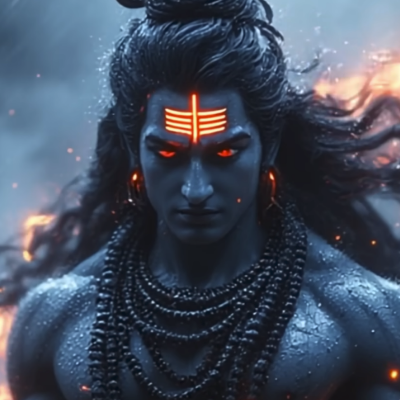
Chand is depicted with a fearsome expression, multiple arms, and a terrifying form — among the most intensely martial of the eleven Rudras in appearance. He holds a khatvanga — the skull-topped staff that appears across the fiercest Shaiva and Tantric forms — and a noose, which is the weapon of binding and inescapable restraint. His complexion is dark or fierce in hue, appropriate for a deity of uncompromising wrath. He is described as blazing with energy and radiating a fearsome power that strikes terror into the forces of evil. He shares the general iconographic features of all eleven Rudras — matted hair, serpents, trident, crescent moon, lion-skin garments, and yellow-hued throat — but his countenance is the most intensely wrathful of the group, surpassing even Bhima in ferocity of expression if not in sheer physical mass.
✦ Textual Variants and Inconsistencies
Chand as the tenth Ekadasha Rudra is specific to the Shiva Purana's Shata-Rudra Samhita list and the Jyotisha Rudramsha enumeration. The name does not appear in the Matsya Purana's Kashyapa–Surabhi list, the Bhagavata Purana's two lists, the Vayu Purana's Kashyapa–Surabhi list, or the Vishnu Purana's Ardhanari-derived list. A secondary source, the Templepurohit account drawing on a Puranic story associated with Brahma's request to Shiva to create beings, gives the tenth Rudra's name as Chanda and the eleventh as Dhruva — a variant of the Shiva Purana's list in which the eleventh is Bhava rather than Dhruva. This variant is noted but not found confirmed in the primary Shiva Purana text itself. The Tantric tradition's Chanda Rudra and the mainstream Puranic Chand Rudra are the same figure accessed through different textual and ritual frameworks, not distinct deities.
✦ Connection to the Wider Genealogy
Chand belongs to the same dual lineage as all eleven Ekadasha Rudras. Through his father Kashyapa Prajapati, a son of Brahma, he is a paternal grandson of the creator. Through his mother Surabhi, daughter of Daksha Prajapati, he is also a maternal grandson of Daksha. As an incarnation of Shiva, Chand stands in identity with the supreme Rudra's most ferocious and uncompromising aspect — the divine wrath that tolerates no corruption, no arrogance, and no usurpation of sacred order. His consort Diksha, as the tenth Rudrani, is the feminine power of sacred initiation — the transformative discipline that receives the initiatory fire of Chand's ferocity and channels it into the structured transmission of spiritual power, the burning that destroys the old self and establishes the initiated one in the living tradition of Shiva.
✦ References
Primary Sources
- Shiva Purana, Shata-Rudra Samhita, Chapter 3, Section 17: Names Chand as the tenth of the eleven Rudras born from Kashyapa and Surabhi; describes the collective origin, mission, and battle of the Ekadasha Rudras.
- Harivamsha, Harivamsa Parva 1.3.49–50 and 3.36.50–51: Primary authority for the Kashyapa–Surabhi parentage of all eleven Rudras.
- Vishnu Purana 1.7: Names Diksha as the tenth Rudrani, consort of the tenth Rudra.
- Devi Mahatmya (Markandeya Purana): Records the demon Chanda and Munda as generals of the Asura Shumbha; the goddess's slaying of Chanda yields the epithet Chamunda. Establishes the distinction between the demonic Chanda and the Rudra Chand through their opposing cosmic roles.
- Brihadaranyaka Upanishad 3.9.4: Identifies the eleven Rudras with the ten vital energies and the Atman, providing the philosophical framework for Chand's correspondence with the forceful, purging vital function.
- Vayu Purana 1.25.67: Maps the eleven Rudras to the eleven vital functions of the living body.
- Rupamandana and Vishvakarmashilpa (texts of sacred iconography): Describe the shared iconographic features of all eleven Rudras and the fierce, multi-armed, khatvanga-holding specific attributes of Chand.
Modern Reference Works
- Exotic India Art, "11 Rudra Avatars of Lord Shiva": Describes Chand Rudra's ferocious character, his role as guardian against evil, his khatvanga and noose as weapons, his dark fierce appearance, and the specific benefit of invocation for victory over rivals.
- Shiva1008.com, "Chanda Avatar": Provides the Tantric and Shakta dimensions of Chand Rudra worship, his association with Shakti sadhana, and the origin narrative involving Surabhi and Kashyapa from the Shiva Purana.
- Wisdomlib, "Rudra: Number of Rudra": Contextualises Chand within the multiple Puranic lists and notes the variant Puranic parsings of the tenth and eleventh positions.