
About
Usana — One of the Eleven Rudranis, Consort of the Rudra Bhima
Usana · Usana Rudrani · Ushana · Rasala · Shakti of Bhima · Rudrani of Mahmasa
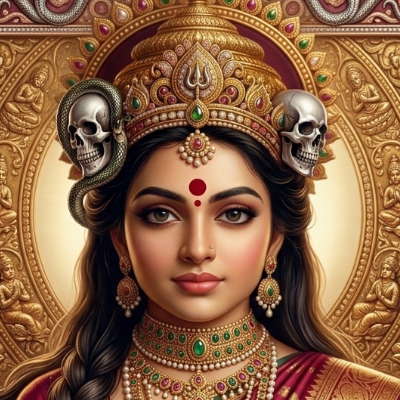
Usana is a divine feminine figure named in the Vishnu Purana as the third of the eleven Rudranis — the female counterparts and consorts assigned to the eleven Rudras, the group of fierce divine beings who are forms or close attendants of the Vedic deity Rudra, identified in later tradition with Shiva. In the cosmogonic account of the Vishnu Purana (Book I, Chapter VIII), the Rudranis are described as having arisen from the female half of Rudra's primordial androgynous form when he divided himself at the instigation of Brahma, and were assigned as wives to the eleven male Rudras. Usana is named third in the Vishnu Purana list of Rudranis. In that text's own Rudra enumeration, where the third-named Rudra is Mahmasa, she is correspondingly the consort of Mahmasa. In the parallel and widely current tradition drawn from the Shiva Purana and Matsya Purana — where the eleven Rudras are named Kapali, Pingala, Bhima, Virupaksha, Vilohita, Shasta, Ajapada, Ahirbudhnya, Shambhu, Chanda, and Bhava — the third Rudra is Bhima, and Usana is accordingly identified as his Shakti and consort. The figure of Bhima among the Rudras is a mighty, formidable form associated with unmatched strength, ferocity in battle, and the destruction of demonic forces.
✦ The Name
The Sanskrit word Usana (written in Devanagari as उशना or उषण) presents a degree of interpretive complexity. In its most direct nominal sense, Usana is related to the verbal root ush or vas, conveying the ideas of desire, longing, eagerness, or burning ardour. A cognate form, Usanas, is a well-known masculine name in the Puranic and epic tradition — it is one of the names of the great preceptor of the Asuras, Shukra, who is also called Kavya Usanas, renowned for his mastery of the Mritasanjivani lore and his role as the teacher of the demon clans. In its feminine form, Usana as a Rudrani name may carry the sense of she who burns with ardour or she who is possessed of eager longing — a quality consonant with the fierce, energetic nature of the Rudra tradition she belongs to. The name thus personifies a kind of intense, burning desire or passionate impetus as a divine feminine power.
It must be noted that the Bhagavata Purana (3.12.13), in its variant list of Rudranis, replaces the name Usana with Rasala in the third position. The name Rasala (from rasa, meaning essence, juice, flavour, or sap) carries an entirely different semantic field, evoking the nourishing vital essence of things rather than burning ardour. These two names are not obviously related etymologically, and their divergence is among the more striking differences between the two principal Puranic lists of Rudranis.
✦ Lineage
- Origin: According to the Vishnu Purana (Book I, Chapter VIII), Usana arose from the female half of Rudra's primordial androgynous form when he divided himself into male and female at Brahma's creative instigation. The eleven Rudranis produced from this female half are not born of a maternal or paternal lineage in the conventional sense but are simultaneous individualisations of a single divine feminine source, each assigned as consort to one of the eleven male Rudras.
- Spouse (Vishnu Purana tradition): Mahmasa — the third-named Rudra in the Vishnu Purana's own enumeration of the eleven Rudras. The name Mahmasa is sometimes rendered Mahinasa or Mahimasa and carries the sense of the great-bodied or the greatly honoured one. Beyond his position in the Vishnu Purana list, Mahmasa receives no extended narrative treatment in the primary sources.
- Spouse (Shiva Purana / Matsya Purana tradition): Bhima — the third-named Rudra in the Shiva Purana (Shat-Rudra Samhita, Chapter 18) and Matsya Purana enumerations. The name Bhima means the formidable, the terrible, or the mighty one, and this Rudra is characterised in these texts as an unparalleled warrior among the Rudra group, embodying immense destructive strength directed against demonic adversaries. He is to be distinguished from the Pandava hero Bhima of the Mahabharata, who is a son of the wind-god Vayu and the queen Kunti, and who bears the same name by virtue of his own prodigious strength.
- Fellow Rudranis (Vishnu Purana list): Dhi, Vritti, Urna, Niyuta, Sarpis, Ila, Ambika, Iravati, Sudha, and Diksa — the ten other Rudranis named in the same passage of the Vishnu Purana, each assigned as consort to one of the remaining Rudras.
- Fellow Rudranis (Bhagavata Purana 3.12.13 list): Dhi, Dhrti, Rasala, Uma, Niyut, Sarpi, Ila, Ambika, Iravati, Svadha, and Diksa — the variant list from the Bhagavata Purana, in which Rasala occupies the position corresponding to Usana in the Vishnu Purana list.
✦ The Cosmogonic Narrative of Origin
The narrative in which Usana appears is the same cosmogonic account that generates all eleven Rudranis simultaneously. The Vishnu Purana (Book I, Chapter VIII) narrates that at the beginning of the present world-cycle, Brahma desired to bring forth a son like himself, and from that creative intention Rudra manifested in an androgynous form — half male, half female. Rudra then divided this form: from the male half arose eleven distinct Rudras, some luminous and gentle, others dark and fierce; from the female half arose eleven Rudranis who were assigned as wives to those eleven Rudras. Brahma then allocated to each Rudra one of eleven cosmic and bodily stations — the heart, the five sense organs, the five organs of action, and the mind. Usana, as the third Rudrani in this scheme, is associated with the station and domain corresponding to the third-named Rudra of the same enumeration.
The Bhagavata Purana (3.12.13) presents the same essential event from a different narrative angle. Here, Brahma addresses Rudra directly and pronounces the names of eleven Rudranis as already belonging to him — presenting the assignment as a formal bestowal rather than a consequence of prior self-division. In this account, the name Rasala appears in the third position where Usana stands in the Vishnu Purana, suggesting either a different tradition regarding the identity of the third Rudrani or a variant name for the same figure.
✦ Textual Variants and Inconsistencies
Usana's name appears in the Vishnu Purana list of Rudranis as the third entry. It does not appear in the Bhagavata Purana (3.12.13) list, where the third name is Rasala. As noted above, these two names carry distinct meanings and are not obvious variants of one another. The H. H. Wilson commentary on the Vishnu Purana explicitly records this divergence when noting the Bhagavata's alternative list in its footnotes. The textual basis for Usana as a Rudrani therefore rests primarily and perhaps solely on the Vishnu Purana, with the Bhagavata Purana representing a divergent tradition that does not include her name.
The identification of Usana as consort of Bhima follows from aligning the third position in the Vishnu Purana Rudrani list with the third position in the Shiva Purana and Matsya Purana Rudra lists, where Bhima stands third after Kapali and Pingala. The Vishnu Purana's own third-named Rudra is Mahmasa, not Bhima. This means the pairing of Usana with Bhima involves cross-referencing two different textual traditions and is not stated explicitly in any single primary source. The pairing of Usana with Mahmasa, by contrast, is internally consistent within the Vishnu Purana framework, though Mahmasa is a far less widely discussed figure in the Puranic tradition than Bhima.
A further complication arises from the fact that the name Usanas in its masculine form is already occupied in the Puranic tradition by the preceptor of the Asuras, Shukracharya, whose full name is often given as Kavya Usanas or simply Usanas. This creates a potential for confusion when reading passages that refer to Usana or Usanas without sufficient contextual clarification, though the feminine form Usana as applied to the Rudrani is grammatically distinct from the masculine Usanas applied to the Asura preceptor.
✦ Theological and Philosophical Significance
As a personification of burning ardour, passionate impetus, or eager desire, Usana as a divine feminine power embodies the energising impulse that drives action and creation outward into manifestation. In the framework of the Rudra theology, where each Rudrani is the Shakti — the activating energy — of her corresponding Rudra, Usana's significance as the consort of the mighty Bhima carries a particular resonance. Bhima among the Rudras is characterised by immense physical and cosmic power; the Shakti that accompanies and enables such power is fittingly understood as an ardent, burning energy — the passionate intensity that underlies great strength.
In the broader Shakta understanding of the Rudranis as partial manifestations of the supreme Goddess, Usana represents one specific modality of the divine feminine — the fierce, eager, burning aspect — that complements and empowers the destructive might of her consort. Read in sequence with Dhi and Vritti — the first two Rudranis, personifying the discerning intellect and active mental functioning respectively — Usana may be understood as a third principle in a progression: from understanding, through operation, to the burning desire or impetus that drives that operation forward.
✦ Connection to the Wider Genealogy
Usana belongs to the collective of eleven Rudranis whose origin is inseparable from the cosmogonic act that simultaneously produced the eleven Rudras. The Rudras themselves are traced to different ultimate parentages across the major Puranas: the Ramayana and Vamana Purana make them children of the sage Kashyapa — one of the seven great primordial sages, a grandson of Brahma, and the father of a vast range of divine and semi-divine beings — by his wife Aditi, the mother of the gods and sister of Diti; the Matsya Purana and Harivamsa name Surabhi, the divine wish-granting cow, as their mother, either as wife of Brahma or of Kashyapa; the Vishnu Purana derives them directly from Rudra's own self-division at Brahma's instigation; the Bhagavata Purana (Canto 6, Chapter 6) names them as the sons of Sarupa, a daughter of Daksha the progenitor and lord of created beings, by her husband Bhuta. Usana's own origin is tied to whichever of these genealogical frameworks governs the account of her consort's generation, as she arises from the same creative act. The eleven Rudras and their eleven Rudrani consorts collectively occupy a specific tier within the Puranic divine order, governing domains of cosmic function, bodily physiology, and the stages of sacrificial and human life.
✦ References
- Vishnu Purana, Book I, Chapter VIII — Primary source naming Usana as the third of the eleven Rudranis, in the context of the cosmogonic account of Rudra's self-division. English translation by H. H. Wilson consulted, including footnotes recording the Bhagavata Purana's variant list.
- Bhagavata Purana, Canto 3, Chapter 12, Verse 13 — Names the eleven Rudranis with Rasala in the third position rather than Usana; the divergence from the Vishnu Purana is directly relevant to establishing the limited and source-specific textual basis for Usana's name.
- Bhagavata Purana, Canto 6, Chapter 6, Verses 17–18 — Names the eleven Rudras as sons of Sarupa and Bhuta with a list differing from those of the Vishnu Purana and Shiva Purana; relevant to the genealogical variants of the Rudras who form Usana's consort-group.
- Shiva Purana, Shat-Rudra Samhita, Chapter 18 — Names the eleven Rudra incarnations with Bhima third, providing the basis for identifying Usana as consort of Bhima when the Vishnu Purana Rudrani list is aligned positionally with this enumeration.
- Matsya Purana, chapters on the Rudras — Provides a further enumeration of the Rudras listing Bhima among the prominent figures, contributing to the tradition that positions Bhima as the third Rudra and by extension Usana as his consort.
- Mahabharata, Adi Parva — Provides distinct enumerations of the eleven Rudras in multiple passages; relevant for establishing the range of variation in Rudra nomenclature across the epic and Puranic traditions.
- Monier-Williams Sanskrit–English Dictionary (M. Monier-Williams, 1899) — Entry for Usana and related forms records the semantic range of the root and the distinction between the feminine Rudrani name and the masculine name Usanas applied to the Asura preceptor Shukra.
- Puranic Encyclopaedia (Vettam Mani, 1975) — Reference work consulted for cross-referencing variant lists of Rudras and Rudranis across the Puranas, and for the entry on Mahmasa as a Rudra.
- Wikipedia, "Rudras" article — Secondary source compiling variant Rudra and Rudrani lists from primary texts; used to verify the cross-textual inconsistencies in naming and enumeration.
- Sacred-texts.com, Vishnu Purana Book I Chapter VIII (Wilson translation) — English translation and footnotes consulted directly for the passage naming the eleven Rudranis including Usana in the third position.