
About
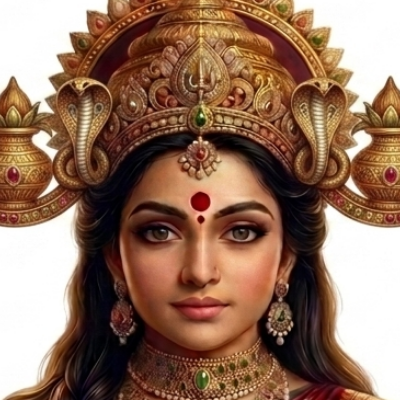
Uma — One of the Eleven Rudranis, Consort of the Rudra Virupaksha
Uma · Urna · Uma Rudrani · Shakti of Virupaksha · Rudrani of Mahan · Haimavati · Parvati · Ambika
Uma is a divine feminine figure who appears in two distinct but deeply interrelated capacities in the Hindu scriptural tradition. In the first and theologically far more extensive capacity, Uma is one of the principal names of the supreme goddess Parvati, the daughter of Himavat the mountain-king and his wife Mena, and the primary consort of the great god Shiva. In the second and more specialised capacity that is the subject of this profile, Uma appears as one of the eleven Rudranis in the list of Rudrani consorts preserved in the Bhagavata Purana (Canto 3, Chapter 12, Verse 13), where she is named as the fourth of the eleven wives assigned to the eleven Rudras. In the positional alignment of that Bhagavata Purana Rudrani list with the Shiva Purana and Matsya Purana enumeration of the eleven Rudras — where the Rudras are named Kapali, Pingala, Bhima, Virupaksha, Vilohita, Shasta, Ajapada, Ahirbudhnya, Shambhu, Chanda, and Bhava — the fourth Rudra is Virupaksha, and Uma in her Rudrani capacity is accordingly his Shakti and consort. The Vishnu Purana (Book I, Chapter VIII), which provides the other major list of Rudranis, gives Urna rather than Uma in the fourth position; this discrepancy is among the more significant of the variant readings between the two principal Puranic enumerations of the Rudranis and is addressed fully in the section on textual variants below.
✦ The Name
The name Uma (written in Devanagari as उमा) is among the most ancient and widely attested feminine divine names in the Sanskrit tradition. Its etymology has been interpreted in more than one way. One traditional derivation, preserved in several Puranic and exegetical sources, connects the name to an exclamation — the syllables u and ma, meaning O, do not — which the goddess's mother Mena is said to have addressed to her daughter when the young Parvati declared her intention to undertake severe austerities to win Shiva as her husband. On this account, Uma means she who was told do not, and the name encodes the narrative of the goddess's determination to pursue her austerities despite maternal discouragement. A second derivation, preferred by some Sanskrit lexicographers, connects Uma to the root av or ava, meaning to protect or to favour, or alternatively to a root meaning brilliance or splendour, yielding the sense the luminous one or the gracious one. A third interpretation links the name etymologically to words for flax or a related plant, though this reading is less commonly invoked in theological contexts.
The name Urna, which appears in the corresponding fourth position in the Vishnu Purana Rudrani list, is a distinct Sanskrit word meaning wool or what is woven, derived from the root urnv or a related stem. It is semantically unrelated to Uma, which further underlines the significance of the divergence between the two lists at this position. Whether Urna and Uma in these two lists refer to the same divine figure under different names, or to genuinely distinct figures occupying the same structural position in two separate traditions, cannot be determined from the primary sources themselves.
Among Uma's other principal names and epithets in the broader tradition are Parvati — daughter of the mountain, from parvata meaning mountain, referring to her father Himavat; Haimavati — the daughter of Himavat, which appears notably in the Kena Upanishad; Gauri — the fair or golden one; Girija — mountain-born; Ambika — the little mother or dear mother, a name she shares with one of the other Rudranis in the same lists; Durga; Kali; and Bhavani, among many others. The Vayu Purana explicitly harmonises the Rudrani identity with the supreme goddess identity, stating that Rudrani was the best among them and excelling the others in her attributes, and immediately thereafter identifying this same figure as Uma in the context of her love for Sankara.
✦ Lineage
- Origin as Rudrani: According to the Vishnu Purana (Book I, Chapter VIII), the eleven Rudranis arose from the female half of Rudra's primordial androgynous form when he divided himself at Brahma's instigation. The Bhagavata Purana (3.12.13) presents the same event as Brahma formally bestowing the eleven named Rudranis upon Rudra. In either account, the Rudranis are not born of a specific parental lineage but are individualisations of a primordial feminine principle.
- Origin as Parvati-Uma: In the far more extensively narrated tradition of the goddess as supreme deity, Uma-Parvati is the daughter of Himavat, the personified king of the Himalaya mountains, and his wife Mena, herself described in various texts as a daughter of the ancestral pitrs or as a daughter of mount Meru. Uma's birth in this form is said to be a reincarnation of Sati, the daughter of Daksha the progenitor, who was Shiva's first wife and who abandoned her body at Daksha's sacrifice in protest at her father's dishonour of her husband.
- Father (as Parvati-Uma): Himavat — the personified king of the Himalaya range, one of the great mountain-lords of the world, who appears in the Mahabharata, the Ramayana, and numerous Puranas as the father of Uma-Parvati.
- Mother (as Parvati-Uma): Mena — the wife of Himavat, described in various texts as a daughter of the ancestral fathers (pitrs) or as belonging to a mountain lineage.
- Siblings (as Parvati-Uma): The Mahabharata and Puranas name Ganga, the divine river-goddess, as a sister of Uma in some accounts; and Mainaka, the mountain who escaped the ocean when Indra clipped the wings of mountains, is named as her brother in certain texts.
- Spouse (Bhagavata Purana Rudrani tradition): Virupaksha — the fourth-named Rudra in the Shiva Purana and Matsya Purana enumerations. The name Virupaksha means he of the irregular or diverse eyes, or he whose eyes are of a different kind, from virupa meaning deformed, diverse, or of various forms, and aksha meaning eye. This Rudra is associated with the capacity to perceive all realms of existence simultaneously and with the all-seeing, omnipresent aspect of the Rudra group.
- Spouse (Vishnu Purana tradition, fourth position): Mahan — the fourth-named Rudra in the Vishnu Purana's own enumeration, whose name means the great one. The consort assigned to Mahan in the Vishnu Purana scheme is Urna, not Uma.
- Spouse (as Parvati-Uma in the supreme deity tradition): Shiva — the great god, lord of the universe, destroyer in the divine triad of Brahma, Vishnu, and Shiva, identified with the Vedic Rudra. This spousal relationship is by far the most extensively narrated in the entire Puranic and epic tradition and forms the central subject of texts including the Shiva Purana, the Devi Bhagavata Purana, the Kumara Sambhava of the poet Kalidasa, and numerous episodes within the Mahabharata and Ramayana.
- Children (as Parvati-Uma): Skanda — also known as Karttikeya, Murugan, Kumara, and Subrahmanya, the god of war, born to lead the divine armies against the demon Taraka; and Ganesha — the elephant-headed lord of beginnings and remover of obstacles, who is described in various Puranic accounts as born from Uma's body or created by her directly.
- Fellow Rudranis (Bhagavata Purana 3.12.13 list): Dhi, Dhrti, Rasala, Niyut, Sarpi, Ila, Ambika, Iravati, Svadha, and Diksa — the ten other Rudranis named alongside Uma in the Bhagavata Purana passage.
- Fellow Rudranis (Vishnu Purana list): Dhi, Vritti, Usana, Urna, Niyuta, Sarpis, Ila, Ambika, Iravati, Sudha, and Diksa — the list from the Vishnu Purana, in which Urna rather than Uma occupies the fourth position.
✦ The Cosmogonic Narrative of Origin as Rudrani
The narrative in which Uma appears as a Rudrani is the same cosmogonic account that generates all eleven Rudranis simultaneously. The Vishnu Purana (Book I, Chapter VIII) narrates that at the beginning of the present world-cycle, Brahma desired to create a son in his own likeness, and from that creative intention Rudra arose in an androgynous form — half male, half female. Rudra then divided this form: from the male half arose eleven distinct Rudras varying in nature and complexion; from the female half arose eleven Rudranis who were then assigned as wives to those eleven Rudras. Brahma allocated to each Rudra a specific cosmic and bodily station among the heart, the five sense organs, the five organs of action, and the mind. The Bhagavata Purana (3.12.13) presents the same essential moment as a direct pronouncement by Brahma to Rudra, naming the eleven Rudranis in a list in which Uma appears fourth.
✦ Uma as the Supreme Goddess: Principal Narrative Episodes
The identification of the Rudrani Uma with the supreme goddess Parvati-Uma draws together two distinct streams of tradition. In the first stream, Uma-Parvati is Sati reborn: Sati, the devoted wife of Shiva and daughter of Daksha, immolated herself when her father excluded Shiva from his great sacrifice and heaped dishonour upon him. Shiva, in his grief and fury, wandered the worlds carrying Sati's body until Vishnu dismembered it with his discus, and the parts fell to earth as the Shakti Pithas — sacred sites of goddess worship. Sati was subsequently reborn as Uma, daughter of Himavat, with the purpose of again becoming Shiva's wife.
In the second stream, Uma-Parvati undertakes severe austerities on a Himalayan peak to win Shiva's attention and his acceptance of her as his wife, since Shiva had retreated into deep meditation after Sati's death. The story of these austerities — their nature, duration, and the tests placed before her by Shiva in disguise — is narrated at length in the Shiva Purana, the Skanda Purana's Kasi Khanda, and the Kumara Sambhava of Kalidasa. Uma's perseverance through these trials and her ultimate reunion with Shiva form one of the central narrative cycles in the entire Puranic tradition.
The Kena Upanishad contains a celebrated episode in which Uma Haimavati — Uma the daughter of Himavat — appears to the gods after their defeat of a great demon to instruct Indra and the other devas in the true nature of Brahman. This Upanishadic episode presents Uma in the role of divine teacher and revealer of ultimate truth, and is among the earliest textual appearances of the name Uma in a clearly theological context outside the purely narrative Puranic accounts.
✦ Textual Variants and Inconsistencies
The most significant textual issue specific to this profile concerns the divergence between the Bhagavata Purana and the Vishnu Purana at the fourth position in the Rudrani list. The Bhagavata Purana (3.12.13) names Uma in the fourth position; the Vishnu Purana (Book I, Chapter VIII) names Urna. These are not variant spellings of the same name but genuinely distinct Sanskrit words with different meanings. Whether they refer to the same divine figure under two different names, or to distinct figures occupying the same structural slot in two separate textual traditions, is not resolvable from the primary sources. The H. H. Wilson commentary on the Vishnu Purana records the Bhagavata's variant list in its footnotes without harmonising the difference.
A second and broader textual complication concerns the relationship between Uma as a Rudrani and Uma as the supreme goddess Parvati. The Vayu Purana, as noted in secondary sources, explicitly equates the supreme Rudrani with Uma and identifies her love for Sankara — an epithet of Shiva — as the hallmark of this identification. The Vishnu Purana similarly, in a cosmological allegory in the same chapter (Book I, Chapter VIII), equates Sri-Lakshmi with Gauri, the consort of Shiva, as part of a broader identification of the consorts of the major gods. These harmonising moves in the Puranic texts suggest that the Rudrani Uma and the supreme goddess Uma were understood by at least some Puranic authors as the same figure, though the genealogical and narrative details of the two identities — Rudrani as born from Rudra's own female half, versus Parvati as daughter of Himavat and Mena — are formally incompatible if taken literally.
The identification of Virupaksha as the specific Rudra consort of Uma also rests on the positional cross-referencing of the Bhagavata Purana Rudrani list with the Shiva Purana and Matsya Purana Rudra lists, and is not stated explicitly in a single primary text. In the Bhagavata Purana's own Rudra enumeration in Canto 3, the names differ again from the Shiva Purana list, which creates further uncertainty about precisely which Rudra is Bhagavata Uma's counterpart within that text's internal logic.
✦ Theological and Philosophical Significance
Uma occupies a position of singular theological importance in the Hindu tradition that far exceeds her role as one Rudrani among eleven. As the primary consort of Shiva and the supreme Goddess in the Shakta tradition, Uma embodies the principle of Shakti — the active, creative, and sustaining power of the cosmos — in its most comprehensive and exalted form. The Devi Bhagavata Purana, a foundational Shakta text, identifies Rudrani as the supreme reality itself, the non-dual Shakti who is also Brahman, and names her as the presiding deity of Rudraloka.
The commentary tradition on the Shiva Purana identifies Rudrani specifically as Kriya Shakti — the Power of Action — one of the three fundamental Shaktis alongside Jnana Shakti (the Power of Knowledge) and Iccha Shakti (the Power of Will). In the Kena Upanishad, Uma Haimavati serves as the mediating presence through whom Brahman reveals itself to the gods, casting her in the role of the divine teacher and the accessible face of the absolute. This Upanishadic role of Uma as revealer of Brahman has made her one of the most philosophically significant goddess figures in the non-dual Vedantic tradition.
Within the Shaiva theological framework, Uma-Parvati and Shiva together represent the union of Shakti and Shiva, the inseparable complementarity of energy and consciousness, of the dynamic and the static principles of existence. This union is iconographically expressed in the Ardhanarishvara form — the deity who is half Shiva and half Parvati — which is explicitly linked in several texts to the same Puranic cosmogonic account of Rudra's self-division into male and female that generates the Rudras and Rudranis.
✦ Iconography and Worship
As the supreme goddess Parvati-Uma, her iconography is described across many texts. She is typically depicted with a golden or fair complexion, hence the epithet Gauri. She may be shown seated beside Shiva on Mount Kailasa, or seated on a lion as Durga, or in the fierce form of Kali with dark complexion. She holds various weapons and emblems depending on the form depicted. In her benign form as Uma she is typically shown with two or four arms, holding a lotus, adorned with ornaments, and seated beside her lord. The Vishnu Purana describes the Rudrani figure — equated with Uma — as holding a lotus and a whisk, seated on a tiger skin atop a lotus, with iconographic forms made of gold, silver, bronze, wood, or stone. Tantric traditions associated with the Rudrani prescribe worship including esoteric rituals, and some sources note that the Rudrani was historically propitiated with animal offerings in certain regional traditions.
Uma-Parvati is also venerated as one of the Saptamatrikas — the seven divine mothers — in her form as Rudrani or Mahesvari, the Shakti of Maheshvara-Shiva. This matrika form is described in texts including the Devi Mahatmya and the Devi Bhagavata Purana as having arisen from the body of the goddess during her cosmic battle against the demons Shumbha and Nishumbha, embodying the fierce maternal power that destroys evil forces.
✦ Connection to the Wider Genealogy
In her capacity as Rudrani, Uma belongs to the collective of eleven Rudranis whose origin is inseparable from the cosmogonic act that simultaneously produced the eleven Rudras. The Rudras are traced to differing ultimate parentages across the major Puranas — to Kashyapa and Aditi in the Ramayana and Vamana Purana, to Surabhi in the Matsya Purana and Harivamsa, to Rudra's self-division in the Vishnu Purana, and to Sarupa and Bhuta in the Bhagavata Purana — with each framework carrying different implications for the genealogy of the Rudranis who arise alongside them.
In her far more extensively narrated capacity as the supreme goddess, Uma-Parvati stands at the apex of the divine feminine genealogy. She is the daughter of Himavat and Mena, the wife of Shiva, and the mother of Skanda and Ganesha. Through her previous birth as Sati she is connected to the lineage of Daksha, one of the great progenitors and a son of Brahma, making her genealogically a granddaughter of Brahma in that earlier form. The Shakta Puranas, however, reverse this genealogical hierarchy entirely, presenting Uma-Parvati not as a created being descended from Brahma but as the primordial Shakti from whom Brahma, Vishnu, and Shiva themselves derive their powers — placing her prior to and encompassing the entire divine order rather than located within it.
✦ References
- Bhagavata Purana, Canto 3, Chapter 12, Verse 13 — Primary source naming Uma as the fourth of the eleven Rudranis in the list bestowed by Brahma upon Rudra; the principal textual basis for Uma's specific identity as a Rudrani.
- Vishnu Purana, Book I, Chapter VIII — Names Urna rather than Uma in the fourth position of the Rudrani list; the divergence from the Bhagavata Purana is directly relevant to the textual discussion. H. H. Wilson's English translation and footnotes consulted.
- Shiva Purana, Shat-Rudra Samhita, Chapter 18 — Names the eleven Rudra incarnations with Virupaksha fourth, providing the basis for identifying Uma as consort of Virupaksha through positional alignment with the Bhagavata Purana Rudrani list.
- Shiva Purana, Rudra Samhita and Koti Rudra Samhita — Extensive source for the narrative of Uma-Parvati's birth, austerities, marriage to Shiva, and her theological identification as Kriya Shakti and as the supreme Rudrani.
- Devi Bhagavata Purana — Foundational Shakta text identifying Rudrani-Uma as the supreme reality presiding over Rudraloka, and presenting her as the Prakriti and Shakti from whom the male gods derive their powers.
- Kena Upanishad, Section III–IV — Primary source for the episode of Uma Haimavati appearing to the gods as teacher and revealer of Brahman; among the earliest textual appearances of the name Uma in a clearly philosophical and theological role.
- Vayu Purana, relevant chapters on the Rudranis — Explicitly identifies the supreme Rudrani with Uma and establishes her ideal love for Sankara, harmonising the Rudrani identity with the supreme goddess identity.
- Mahabharata, Adi Parva and Anushasana Parva — Multiple passages narrating Uma-Parvati's identity, her relationship with Shiva, and the birth of Skanda; also relevant for the enumerations of the Rudras.
- Ramayana, Bala Kanda — Briefly narrates the story of Uma's birth and marriage to Shiva, contributing to the primary narrative tradition of the goddess.
- Kumara Sambhava of Kalidasa — Classical Sanskrit mahakavya narrating at length the austerities of Uma and their culmination in her union with Shiva; an important literary source for the Uma-Parvati tradition though a secondary rather than primary scriptural source.
- Matsya Purana, chapters on the Rudras — Names the eleven Rudras including Virupaksha in the fourth position, contributing to the tradition that establishes Virupaksha as Uma's Rudra consort.
- Monier-Williams Sanskrit–English Dictionary (M. Monier-Williams, 1899) — Entries for Uma and Urna record the distinct etymologies and semantic ranges of the two names, clarifying that they are not variant spellings of the same word.
- Puranic Encyclopaedia (Vettam Mani, 1975) — Reference work consulted for cross-referencing variant Rudra and Rudrani lists, and for entries on Uma, Virupaksha, and related figures.
- Wikipedia, "Rudrani" and "Rudras" articles — Secondary sources compiling and summarising primary textual material on the Rudranis and their identification with the supreme goddess; used to verify cross-textual patterns.
- Sacred-texts.com, Vishnu Purana Book I Chapter VIII (Wilson translation) — English translation and footnotes consulted directly for the passage naming Urna in the fourth Rudrani position and recording the Bhagavata's variant.